This guide explains what the phrase “Upanishad Sri Sri Ravi Shankar” refers to: the commentaries on Upanishads given by Gurudev Sri Sri Ravi Shankar, which are published and taught through the Art of Living and related Wisdom pages. It covers which Upanishads he has commented on, how his commentaries present the stories in those texts, and where the evidence stops. Short answer: Gurudev has commented on four Upanishads, namely Ishavasya, Katha, Kena and Yogasara, according to the Art of Living’s Upanishad commentary page. These commentaries are his interpretations, and they should be read alongside the original texts and traditional commentaries.
Quick answer

Sri Sri Ravi Shankar’s Upanishad work is a set of spoken and written commentaries. The Art of Living describes the Upanishads as dialogues between master and student, and presents Gurudev’s commentary on four texts: the Ishavasya Upanishad, the Katha Upanishad, the Kena Upanishad and the Yogasara Upanishad. The same source notes that there are nearly 100 Upanishads known today, and that eleven are usually considered the most important. The commentaries are therefore one modern teacher’s reading of a small part of a much larger literature.
What “Upanishad” means
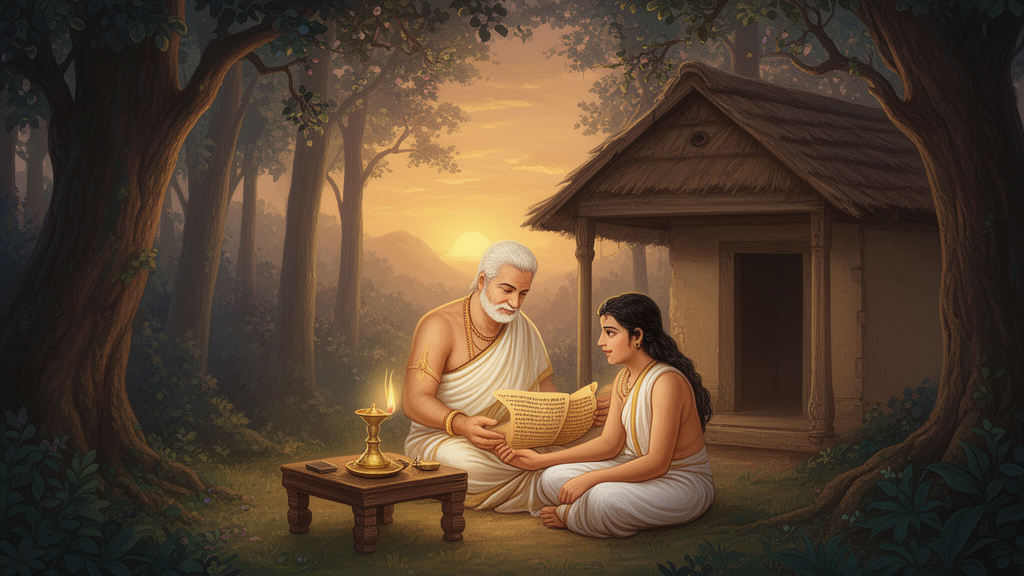
The Art of Living’s commentary page explains that, in Sanskrit, upanishad is commonly understood as “sitting close” to the master. The page adds that this closeness is not only physical but also mental. It describes the term as signifying the finite moving closer to the infinite, and the known reaching toward the unknown.
That explanation is a teaching offered in Gurudev’s framing. It is useful for readers because it turns a word many people know only as a title into a description of a relationship: a student seeking wisdom from a teacher who embodies it. Readers who want the word’s wider history, including how scholars trace its meanings in older Sanskrit usage, should consult academic introductions to the Upanishads rather than relying on a single commentary.
The same page describes the Upanishads as dialogues between a master and a student from “ages ago.” Read this as the commentary’s description of the literary form. It does not establish a specific date or author for each text.
Which Upanishads Sri Sri Ravi Shankar has commented on
According to the Art of Living’s page, Gurudev has spoken on four Upanishads to date. Each is listed below with what the source says about it. Readers can compare these descriptions with the commentary editions linked at the end of this article.
Ishavasya Upanishad
The Art of Living describes the Ishavasya Upanishad as the most regarded of all Upanishads. It also states that the other Upanishads are said to be commentaries on verses mentioned briefly in the Ishavasya. That is a traditional claim reported by the commentary page. Scholars do not necessarily accept it in that form, so it should be read as a devotional and traditional framing rather than as a settled historical fact.
The same page says the Ishavasya contains many hints that show insight into who we really are, and that it offers a mystical description of the Self and of both the seen and unseen world. A commentary edition titled Ishavasya Upanishad: A Commentary by Gurudev Sri Sri Ravi Shankar is listed on Amazon as a Kindle edition, which indicates that the commentary is available in print or digital form.
Readers who want a different commentary tradition on the same text can compare this with the separate Ishavasya Upanishad page on HindusGod.com, Ishavasya Upanishad Sri M, which is a draft and not yet confirmed as public. For the older Isha Upanishad and a different commentary by Sri Aurobindo, see Isha Upanishad Sri Aurobindo, also a draft.
Katha Upanishad
The Art of Living describes the Katha Upanishad as the story of young Nachiketa, who goes to face the lord of death and enters an extraordinary dialogue with him. The page says Gurudev takes listeners through this story and connects its meaning with real-life situations. That is a description of how the commentary is presented, and readers should expect a teacher’s application of the story rather than a neutral translation.
For a fuller treatment of the Katha story and its themes, see the HindusGod.com draft Katha Upanishad Sri Sri Ravi Shankar. The draft is not yet public, so treat that link as a planned destination until the owner publishes it.
Kena Upanishad
The Kena Upanishad is the text behind the story that Gurudev retells on the Wisdom site: the Devas, the Yaksha, Agni, Vayu and Indra. This story is discussed in detail below. The Art of Living page presents the Kena as a text in which the finite approaches the infinite, a theme it links to the word “upanishad” itself. The commentary edition’s description and the Wisdom retelling both emphasise practical lessons, including humility and openness to experience.
The HindusGod.com draft Kena Upanishad Sri Sri Ravi Shankar covers this text separately and is not yet public.
Yogasara Upanishad
The Art of Living describes Yogasara as a series of commentaries by Gurudev on yoga, which the page says were drawn from four talks on the subject. The page presents these as commentaries on the essence of yoga. A related Amazon listing, Upanishads Vol 1: Ishavasya, Kena, Katha, Yogasara, indicates that the four commentaries have been published together in one volume, with ISBN 9789387578951.
A separate HindusGod.com draft on this text is The Yogasara Upanishad Sri Sri Ravi Shankar. It is not yet public, so the owner should confirm its status before linking to it from other published pages.
The Kena Upanishad story of the Devas and the Yaksha
The Wisdom site includes a retelling by Gurudev titled “The Story of Devas and a Yaksha from Kena Upanishad.” Because this is a retelling, the account below paraphrases it and does not quote it at length. The Devas, the gods, began to feel that the whole world belonged to them. A Yaksha, a supernatural being, came to challenge them.
The Devas sent Agni, the fire principle, first. Agni boasted that he could burn or transform anything. The Yaksha placed a blade of grass before him and challenged him to burn it. Agni could not. In Gurudev’s telling, Agni then insisted on his own identity, and the retelling says that this self-definition limited his power. He had not recognised himself as part of Brahman, the cosmic whole, but had treated himself as one particular energy.
The Devas then sent Vayu, the wind or atmosphere. Vayu could not lift the blade of grass. Finally Indra, described in the retelling as the lord of the mind and of the Devas, approached the Yaksha. The Yaksha could not be seen by the eyes or felt by touch. In the story, the Yaksha transforms into a beautiful divine mother, and Indra surrenders to her. She reminds him that the victory of Brahman is the victory of everything. Only then does Indra understand who the Yaksha is and what truth is.
Practical lessons in Gurudev’s reading
The retelling draws three lessons. First, do not underestimate anyone or any challenge, even one that seems to come from below you. Second, a sense of separate self-importance can reduce one’s capacity. Third, the experience of the Devas, which the retelling describes as flashes of higher consciousness, is not the final goal. The spiritual world, in this telling, is a step further, where the mind dissolves.
These lessons are Gurudev’s application of the story. They are not the only reading of the Kena Upanishad. Readers who want to compare the text with earlier commentaries, including those of Adi Shankaracharya, should consult editions with a known translator and commentator.
Devotional and textual layers
The story is best understood on two levels, as Gurudev himself suggests in other teachings. On the narrative level, it is a story of gods and a challenge. On the teaching level, it is a description of how ego and self-definition obstruct recognition of the whole. Keep these levels distinct. The story’s narrative details, such as the Yaksha transforming into a divine mother, belong to the text as retold in this commentary. The lesson about ego is an interpretation offered by the teacher.
Katha Upanishad: Nachiketa and the lord of death
The Art of Living page summarises the Katha Upanishad as the story of Nachiketa, who goes to face Yama, the lord of death. The page states that the whole world runs away from death because death takes everything, but the person who accepts it and faces it willingly receives something from death itself. The page concludes that knowledge of death gives the gift of life.
This is a sharp theme, and it is one of the reasons the Katha is widely read in devotional and philosophical circles. The commentary presents it as a question about how a seeker should face mortality. Readers should note that this is Gurudev’s framing. The story itself, in the traditional text, centres on Nachiketa’s request for knowledge about what happens after death. Readers who want the text itself should consult a complete translation with its translator named.
For a broader HindusGod.com introduction to the Katha, read the draft Katha Upanishad Sri Sri Ravi Shankar. Those who want the wider context of Upanishadic teaching may also start with Meaning of Upanishad, another draft page.
Satyakama and the cows: a story read on two levels
A second Wisdom story, from the tag archive, concerns Satyakama. The archive describes it as a story from the Upanishads in which Satyakama attains enlightenment while taking cows to the forest. The archive page states that the Upanishads have a surface level, which is a story, and a deeper level of meaning. It notes that in Sanskrit gau does not only mean cow.
This is a useful example of a reading method that Gurudev applies across his commentaries. The archive excerpt does not give the full Sanskrit meaning of gau, and the reader should check that point in a dictionary and a scholarly translation before relying on it. The excerpt’s claim is only that the word carries meanings beyond “cow” in the teaching. The full story, including its source chapter, is not confirmed in the material reviewed for this article, so it is not reproduced here.
How to read these commentaries: text, tradition, and interpretation
Readers of any Upanishad commentary should separate three things. The first is the text: the Sanskrit verses and their translation. The second is the tradition: the commentaries of earlier teachers and the practices that grew around the texts. The third is the modern interpretation: the teacher’s explanation for contemporary listeners. Gurudev’s commentaries belong mainly to the third category, although they draw on the traditional text and the philosophy of the Upanishads.
This matters for three reasons. First, a commentary can be meaningful to a devotee while still being one interpretation among several. Second, a story retold in a teacher’s own words can differ in emphasis from the older text. Third, claims about dates, authorship, and textual history need evidence beyond a commentary. The Art of Living page makes the traditional claim that the other Upanishads comment on the Ishavasya. That is a tradition-based statement, and readers should weigh it as such.
Useful questions when reading
- Which Upanishad is being discussed, and which edition or translation is used?
- Is the statement a quotation of the text, a traditional teaching, or the commentator’s interpretation?
- Does the commentary note variant readings or the views of earlier commentators?
- Is a claim about history supported by evidence beyond the commentary?
Variant spellings and editions
Readers will encounter several spellings. The Art of Living page uses “Ishavasya,” and the Amazon listing uses the same form for the commentary. Other sources use “Isha Upanishad,” which is also common. “Katha” and “Kena” appear consistently in the sources reviewed, as does “Yogasara.” Readers searching for a specific text should try both spellings and check the translator or commentator.
Two different Ishavasya or Isha Upanishad pages exist as drafts on HindusGod.com, one by Sri Sri Ravi Shankar’s commentary context and another attributed to Sri M, and one by Sri Aurobindo. These are different commentaries. Do not treat them as the same text with different titles.
What the available sources do not establish
The sources reviewed for this article do not provide the full Sanskrit text of the four commentaries, page-level citations for every claim in them, or independent historical dating of the Upanishads. The Amazon pages reviewed show product and edition details, but their visible text is largely site navigation and does not reproduce the commentary. For that reason, this article does not quote the commentaries directly, does not cite verse numbers, and does not state scholarly dates for the texts.
A full scholarly guide to the Upanishads would require academic sources such as a critical edition or an introduction by a recognised Indologist. Such a source should be added before this article is treated as complete. Until then, the article is best read as a guide to Gurudev’s commentaries and their stated content.
Who may find this useful
- Readers who want to know which Upanishads Gurudev has commented on, and what each commentary is said to emphasise.
- Students who want to compare a modern commentary with older or scholarly translations.
- Devotees who use Upanishadic stories in reflection or teaching, and who want to separate the story from the teacher’s application.
FAQs
Has Sri Sri Ravi Shankar commented on all the Upanishads?
No. The Art of Living page states that he has spoken on four Upanishads to date: Ishavasya, Katha, Kena and Yogasara. The same page says that there are nearly 100 Upanishads and that eleven are considered most important.
What is the Ishavasya Upanishad known for in this commentary?
The Art of Living page describes it as the most regarded Upanishad and says it contains a mystical description of the Self and of both the seen and unseen world. The page also states that other Upanishads are said to comment on its verses, which is a traditional claim.
Is the Kena Upanishad story a direct translation?
No. The Wisdom page presents it as a story retold by Gurudev. The account in this article paraphrases that retelling. Readers who want the Sanskrit text should consult a translated edition with a named translator.
Where should a beginner start?
A beginner can start with the Katha Upanishad, which the Art of Living page summarises clearly, and then read a complete translation. Pair the commentary with the text rather than relying on a summary alone.
Closing takeaway
Sri Sri Ravi Shankar’s Upanishad commentaries focus on four texts: Ishavasya, Katha, Kena and Yogasara. They present the Upanishads as a dialogue that brings the seeker closer to wisdom, and they offer practical lessons drawn from stories such as the Devas and the Yaksha and Nachiketa’s meeting with the lord of death. Read them as one teacher’s interpretation. Pair them with a complete translation and, where possible, a scholarly introduction, so that the text, the tradition and the commentary remain distinct.
Sources and further reading
- Wisdom Commentary Upanishads, The Art of Living: describes the four commentaries, the meaning of “upanishad” as presented by Gurudev, and the Katha and Ishavasya summaries.
- The Story of Devas and a Yaksha from Kena Upanishad, Wisdom by Gurudev Sri Sri Ravi Shankar: Gurudev’s retelling of the Kena story discussed above.
- Upanishads tag archive, Wisdom by Gurudev Sri Sri Ravi Shankar: lists the Satyakama story and other Upanishad-related items.
- Ishavasya Upanishad: A Commentary by Gurudev Sri Sri Ravi Shankar, Kindle edition: edition listing for the Ishavasya commentary.
- Upanishads Vol 1: Ishavasya, Kena, Katha, Yogasara, Amazon: edition listing showing the four commentaries in one volume.