The Ullambana Sutra, also called the Yulanpen Sutra, is a Mahayana Buddhist scripture about filial piety. It tells how the disciple Maudgalyayana uses spiritual powers to search for his deceased mother, finds her reborn as a hungry ghost (preta), and seeks the Buddha’s help to relieve her suffering. The text is the basis for the Ullambana or Yulan Bowl festival, which East Asian Buddhists observe as a time of gratitude for parents and ancestors. This guide explains what the sutra says, how it has been transmitted, and how different communities understand and observe it.
Because this is a Buddhist scripture rather than a Hindu text, readers should note that it is part of the Buddhist tradition. Many Hindu families are unfamiliar with it, and the account below describes Buddhist teaching and practice without presenting them as Hindu belief.
Direct answer: what is the Ullambana Sutra?
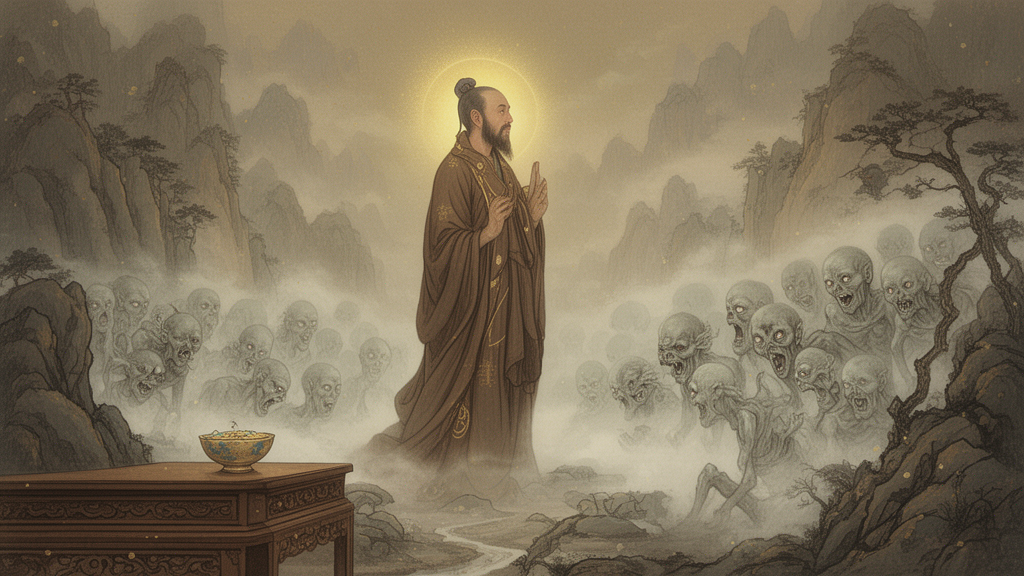
The Ullambana Sutra is a short Mahayana sutra on filial piety. Its central narrative concerns Maudgalyayana, a senior disciple of the Buddha who is described as foremost in spiritual powers. After attaining the six spiritual powers (abhijna), he looks for his dead parents and finds his mother in the preta realm. The Buddha instructs him to make offerings to the monastic community (Sangha) at the close of the monsoon retreat, so that the merit can benefit his mother and relatives. The sutra is traditionally linked with the fifteenth day of the seventh lunar month and with the Ghost Festival observed in parts of China and wider East Asia.
Names and variant spellings
Readers will encounter several forms of the title. The Chinese title is written as Yulanpen jing (盂蘭盆經 in traditional characters). Its literal meaning is commonly given as “Sutra of the Yulan Bowl.” The English form “Ullambana” is an alternate transliteration, and “Yulanpen” follows the Chinese pinyin system. Japanese readers use the name urabon-kyo, Korean sources use uranbungyeong, and Vietnamese sources use Kinh Vu Lan Bon. These variants refer to the same text tradition, though local pronunciation and festival names differ.
The Chinese text is usually cited by its Taisho Tripitaka numbers. According to the Wikipedia article on the Yulanpen Sutra, the text appears as Taisho 685 and Taisho 686 in Volume 16 of the Collected Sutra Section. Scholars and practitioners therefore often refer to the two versions by these numbers rather than by a single title.
Two Chinese versions and their translation history
The sutra survives in two Chinese versions that are important for understanding its transmission. Taisho 685 is traditionally attributed to Dharmaraksa, who is said to have translated it under the Jin dynasty at some point between 265 and 311 CE. It is titled in English as “The Buddha Speaks the Yulanpen Sutra.” Taisho 686 has an unknown or lost translator from the Eastern Jin period and carries the title “The Buddha Speaks the Sutra of Offering Bowls to Repay Kindness.”
These dates should be treated as traditional attributions. The Wikipedia article states that the Yulanpen Sutra “has traditionally been regarded” as translated from Sanskrit into Chinese by Dharmaraksa, and it notes that the subject matter is broadly similar to accounts in other sutras. Modern scholarship has examined the relationship between the two Chinese versions. According to Karashima, as summarized by Wikipedia, Taisho 686 is basically a more idiomatic adaptation of Taisho 685. This is a scholarly reading, not a statement made in the sutra itself, so it should be understood as an interpretation of textual relationships.
Readers who want the actual wording should consult a full scripture edition or a reliable translation. The present article does not quote the Chinese text, because the sources consulted here did not provide a verified full translation to quote from.
The story of Maudgalyayana and his mother
The narrative is the emotional center of the sutra. Maudgalyayana, one of the Buddha’s leading disciples, gains spiritual powers and uses them to search for his parents after their deaths. The Pure Land Buddhism website, which reflects a Pure Land teaching perspective, describes how he discovers that his mother has been reborn in the hungry ghost realm. She is emaciated, and he tries to help her by offering a bowl of rice. Because of her karma as a preta, the rice turns into burning coal before she can eat it.
This detail explains why the story is so often remembered in the context of offerings. In the narrative, the problem is not a lack of love but the condition of rebirth in the preta realm, which prevents the mother from receiving ordinary food. The sutra’s answer comes from the Buddha, not from Maudgalyayana’s own power alone.
The Buddha’s instruction
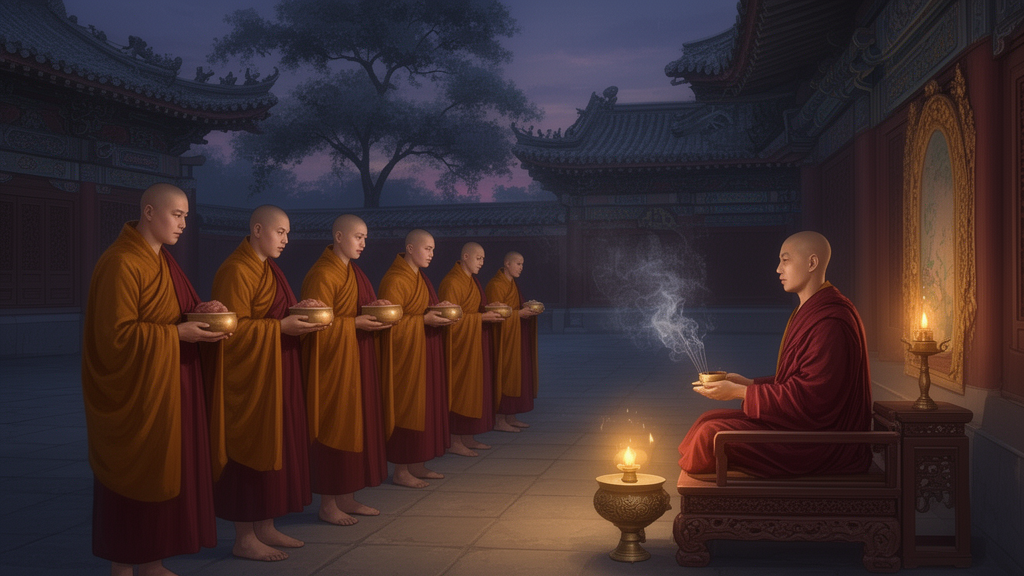
When Maudgalyayana asks for help, the Buddha explains how offerings can benefit living and deceased parents. The Pure Land Buddhism account describes the instruction as offering food and other goods to the Sangha during Pravarana, the ceremony held at the end of the monastic rains retreat (varsa). The same account says that by the end of the retreat many monks have advanced in spiritual practice, and that on Pravarana, the fifteenth day of the seventh month, the Sangha dedicates the merit of its practice to deceased parents and ancestors.
The Sanskrit term Pravarana is explained in that source as broadly meaning “invitation,” “request,” or “inviting criticism,” and it is also called the Monastic Self-Repentance Day. These meanings point to a monastic practice of self-examination. The festival’s offerings are therefore connected to the Buddhist monastic calendar as well as to family devotion.
What the story teaches in Buddhist terms
The Khenpo Sodargye Rinpoche teaching page describes the sutra as a Mahayana text concerning filial piety. It presents the story as an account in which Maudgalyayana finds his mother in the preta realm and saves her with the help of the Buddha and the blessing of the Sangha. The same page links filial piety to bodhicitta, the aspiration to attain enlightenment for the benefit of all beings. In this reading, gratitude to parents is not only a cultural duty but part of a path of compassion.
This is one Tibetan Buddhist teacher’s interpretation, presented as a teaching. It is not the only way the sutra is read. Other communities emphasize the festival’s ritual and ancestral dimensions, while some scholars focus on the text’s literary history.
Filial piety as the sutra’s central theme
Filial piety is the most consistent theme across the sources consulted. The Wikipedia article calls the sutra a Mahayana sutra “concerning filial piety.” Khenpo Sodargye’s teaching notes that cultivating a virtuous personality is emphasized throughout the Buddhist Tripitaka, and that filial piety is one of the qualities that forms such a personality.
For readers new to Buddhism, filial piety here means respect, gratitude, and care for parents and ancestors. The sutra connects this respect to offerings made in a monastic setting, rather than presenting it as a purely private sentiment. Readers should therefore distinguish three things: the text’s teaching on gratitude, the Buddhist explanation of how merit may be dedicated, and later folk customs that developed around the festival.
The Ghost Festival and the Yulan Bowl
The Ullambana festival is observed on the fifteenth day of the seventh lunar month in many Chinese Buddhist communities. The Pure Land Buddhism source states that Chinese Buddhists usually celebrate it on that date, that it is also known as Buddha’s Delight Day and Pravarana Day, and that the festival is celebrated widely in China. The same source notes that the festival is called the Zhongyuan Festival in Taoism and the Ghost Festival in Chinese folk culture.
The Wikipedia article states that the East Asian Ghost Festival is based on this sutra. This is a broad statement about the sutra’s influence. The festival’s forms vary among families, temples, and regions. Some observances are primarily monastic, with offerings to the Sangha. Others are household rituals, and some folk customs are not described in the sources reviewed here, so this article does not attempt to list them.
Calendar and date caution
The festival date follows the lunar calendar, so its date on the Gregorian calendar changes from year to year. Readers planning observances should check a current temple, monastery, or cultural calendar for the relevant year and location. This article does not provide a specific date for any year, because the sources reviewed here do not establish a verified date for a particular calendar year.
Regional and tradition-specific observance
The sutra has been transmitted across Chinese, Japanese, Korean, and Vietnamese Buddhist contexts, as reflected in the variant names listed in the Wikipedia article. Each community has its own emphases and practices. Describing a single “standard” observance would therefore misrepresent the tradition.
- Textual tradition: Chinese Buddhist texts preserve the Taisho versions, and modern editions and commentaries explain the story and its teachings.
- Monastic tradition: Pravarana-linked offerings to the Sangha are central to the sutra’s explanation of merit dedication, according to the Pure Land Buddhism account.
- Household and folk tradition: In Chinese folk culture the period is known as the Ghost Festival, a name that differs from the scriptural emphasis on parents and the Sangha.
- Lineage teaching: Tibetan Buddhist teachers such as Khenpo Sodargye present the sutra through filial piety and bodhicitta, which is one of several ways the text is taught.
Readers should avoid assuming that these emphases are interchangeable. A monastery may frame the festival as a day for Sangha offerings and merit dedication, while a family may treat it as a time to remember ancestors. Both can be authentic expressions of the tradition, but they are different kinds of practice.
Text, belief, tradition, and scholarship
Understanding the Ullambana Sutra requires separating four kinds of statements. Scripture makes claims within the text, such as the story of Maudgalyayana and the Buddha’s instruction. Traditional belief holds that offerings and dedications benefit the dead, and that the story is an accurate account of events. Community practice describes how people observe the festival today. Scholarship examines translation dates, textual relationships, and historical development.
For example, the statement that Dharmaraksa translated Taisho 685 between 265 and 311 CE is a traditional attribution repeated in reference sources. The statement that Taisho 686 is a more idiomatic adaptation of Taisho 685 is a scholarly interpretation associated with Karashima. Neither statement should be presented as if it were a verse or teaching from the sutra itself.
Earlier stories and the Petavatthu connection
The Wikipedia article notes that the subject matter of the Yulanpen Sutra is broadly similar to several accounts in other sutras. It identifies one of the oldest of these as Petavatthu No. 14, which concerns the disciple Sariputta and his mother, who had become a preta. The same article gives the impression that the theme of rescuing a relative from the preta realm has a wider history in Buddhist literature.
This comparison helps readers see that the Ullambana story is part of a larger family of narratives about the dead, rebirth, and merit. It does not prove that any one account was the direct source of another. Scholars treat such relationships carefully, and this article follows that caution.
Practices people commonly associate with the sutra
Practices vary, and the sources reviewed here do not provide a complete ritual manual. Still, several common themes appear in the material. The following points describe what the sources connect to the sutra, not universal requirements.
- Study the text or a reliable translation. Readers can begin with a full scripture edition or a translation from a recognized Buddhist publisher, then compare it with commentary from a teacher within their own tradition.
- Offer food or support to the Sangha. The Pure Land Buddhism account links the Buddha’s instruction to offerings made to the monastic community during Pravarana.
- Dedicate merit to parents and ancestors. Buddhist teaching describes merit dedication as an act of compassion and gratitude, not as a mechanical transfer that guarantees a result.
- Practice gratitude and filial respect. Khenpo Sodargye’s teaching frames filial piety as part of cultivating a virtuous character and a bodhicitta-based motivation.
- Follow local monastic or community guidance. Because the ritual details differ, a temple or teacher is the best source for step-by-step instructions.
Each of these practices is tradition-specific in its details. Whether a family or temple performs a particular offering depends on local custom and the instructions of the teaching lineage.
What the sutra does not promise
The sutra presents offerings and merit dedication as meaningful acts within Buddhist teaching. It should not be read as a guarantee of a particular outcome for any individual or ancestor. Traditional belief in the benefits of merit is a matter of faith and interpretation, and reputable teachers typically frame it in those terms. Readers should be cautious about any claim that a specific act will produce a guaranteed material, emotional, or supernatural result.
How to read the sutra responsibly
Readers who want to go deeper should begin with a clear reading path. First, read the basic account of Maudgalyayana’s search and the Buddha’s instruction. Second, compare the Chinese title variants and the two Taisho numbers so you know which edition a translation follows. Third, read commentary from a teacher or scholar within the tradition you are studying. Fourth, look for scholarly discussions of translation history if you want historical context.
Readers who are not Buddhist can still find the text useful as a window into East Asian ideas about gratitude, ancestors, and compassion. Respectful study means recognizing that the sutra is a sacred text for Buddhist communities, and that its meaning is explained differently across lineages.
Frequently asked questions
Is the Ullambana Sutra a Hindu text?
No. The sources reviewed describe it as a Mahayana Buddhist sutra. It is part of the Buddhist scriptural tradition, and readers should study it within that context.
Who is Maudgalyayana in the sutra?
He is described as a senior disciple of the Buddha, considered foremost in spiritual powers. In the narrative he uses his abhijna powers to search for his deceased parents.
Why is the festival connected to the seventh lunar month?
The Pure Land Buddhism source states that Chinese Buddhists usually celebrate Ullambana on the fifteenth day of the seventh lunar month, which it links with Pravarana. Dates on other calendars vary, so check a current calendar for the relevant year.
Summary and next step
The Ullambana Sutra is a Mahayana Buddhist text on filial piety. Its story of Maudgalyayana and his mother has shaped the Yulan Bowl and Ghost Festival traditions across East Asia. The text survives in two Chinese versions traditionally associated with different translators and periods, and scholars read their relationship in different ways. Readers who want to explore further should start with a verified scripture edition, then compare teaching and practice within a specific lineage.
Related HindusGod.com reading
The following HindusGod.com pages are currently WordPress drafts, so these links may not be publicly accessible until the owner publishes the target posts. They are included as related reading on Buddhist sutras and devotional texts.
- Amida Sutra Meaning, for a related Pure Land scripture.
- Amida Sutra, for the Pure Land sutra and its general teachings.
- Avalokiteshvara Sutra, for a bodhisattva-centered sutra.
- Akasagarbha Sutra, for another Mahayana scripture on compassion and merit.
- Dharani Sutra, for the Mahayana dharani literature.
- Dhyana Sutra, for meditation texts.
- Brahmajala Sutra, for Buddhist precepts and ethical training.
- Diamond Sutra Meaning, for a central Mahayana wisdom text.
- Avatamsaka Sutra, for a major Mahayana scripture.
Sources and further reading
- Wikipedia, “Yulanpen Sutra” (https://en.wikipedia.org/wiki/Yulanpen_Sutra). Used for the title variants, Taisho numbers, translation attributions, the Maudgalyayana summary, the Petavatthu comparison, and the Ghost Festival connection.
- Pure Land Buddhism, “The Ullambana (Yulanpen) Sutra” (https://www.pure-land-buddhism.com/other-sutras/ullambana-sutra). Used for the Pravarana context, the account of the Buddha’s instruction, and Chinese festival names and dates.
- Khenpo Sodargye Rinpoche, “The Ullambana Sutra” (https://khenposodargye.org/teachings/khenpos-short-teachings/the-ullambana-sutra/). Used for the filial-piety framing and the link to bodhicitta, presented as one teacher’s Tibetan Buddhist interpretation.