The Upanishads: Katha, Prashna, Mundaka is a modern English-language book by Sri M that brings together three Upanishads in one volume. It is a reader’s edition, not the ancient texts themselves. To understand the three Upanishads, read them as part of the Vedic corpus, compare translations, and keep the translator’s or commentator’s voice separate from what the original text says. This guide explains each text, what the edition offers, and how to read it responsibly.
What this book is and what it is not
The title names three Upanishads: the Katha, the Prashna, and the Mundaka. Catalogue listings on Amazon identify the author as “M, Sri” and show a 2020 digital edition on the Internet Archive under the identifier the-upanishads-katha-prashna-sri-m_202006. The Amazon India listing also shows “Singh, Uma” and “Ali, Roshan” in its contributor line, so readers should check the title page of the copy they hold to see who translated, edited, or introduced the text.
The distinction matters. The Upanishads are Sanskrit texts that developed over centuries and are part of the wider Vedic literature. A modern book can present a translation, an introduction, or a commentary on them. Those three things are different, and a reader should not treat an introduction’s opinion as a line of the scripture.
An Internet Archive scan of this work includes a passage about the Upanishads’ later reception. It says that in modern times Sri Aurobindo, Sri Krishnaprem, Dr Radhakrishnan, Swami Ranganathananda, Eknath Ishwaran and others have produced commentaries and interpretations on various Upanishads. That statement describes the commentary tradition around the texts. It does not establish what the Katha, Prashna, or Mundaka themselves teach on any particular point.
The three Upanishads at a glance
Each Upanishad has its own setting, style, and central theme. The table below gives a short orientation. Details about school affiliation and Veda association come from standard reference works and should be checked against a scholarly edition before you cite them in your own work.
| Upanishad | Main narrative or structure | Central theme in brief |
|---|---|---|
| Katha | A dialogue between a boy named Nachiketa and Yama, the lord of death | Death, the nature of the self, and the difference between the pleasant and the good |
| Prashna | Six seekers ask questions to a teacher named Pippalada | Origins of creation, the vital breath, the self, and meditation on the syllable Om |
| Mundaka | A teaching arranged in sections that distinguishes two kinds of knowledge | Higher and lower knowledge, the nature of Brahman, and the disciplined search for truth |
The table is a summary, not a substitute for the text. Many translations render key terms differently, and a single word such as atman or brahman can carry different philosophical weight in different commentaries.
The Katha Upanishad: Nachiketa and the question of death
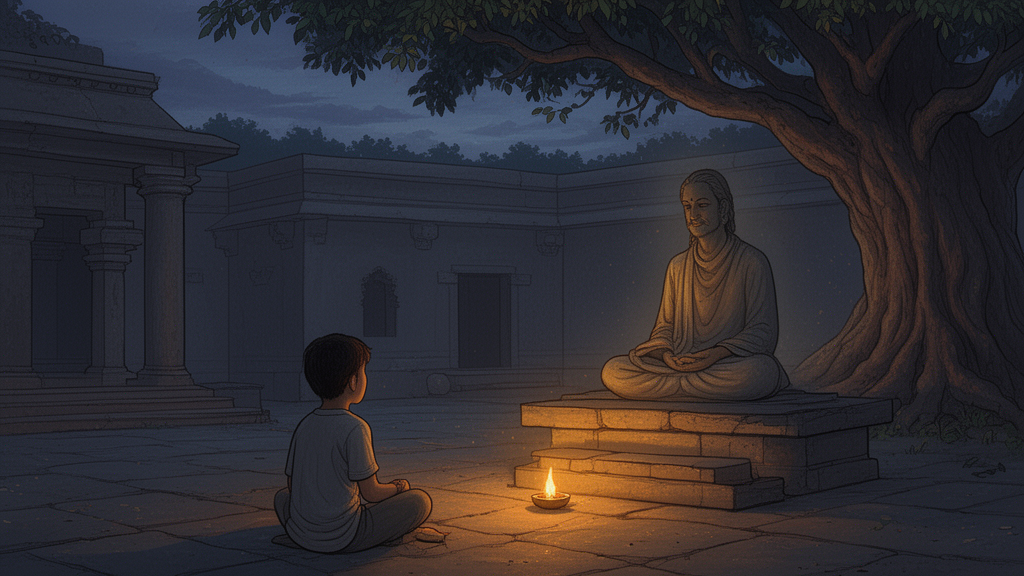
The Katha Upanishad is the best known of the three in popular Hindu teaching. In its traditional narrative, a young boy named Nachiketa is sent to Yama, the lord of death, after a dispute with his father. Yama offers him boons. Nachiketa asks for a teaching about what happens after death, and the rest of the dialogue turns on that question. The story is widely told in the Hindu tradition, and it is a good entry point for readers new to the Upanishads because it moves from a concrete scene to abstract ideas.
The teaching of the chariot and the senses
Among the Katha’s best-known images is the comparison of the body to a chariot. In that image, the self is the rider, the body is the chariot, the intellect is the driver, the mind is the reins, and the senses are the horses. The image is taught as a way of understanding discipline. It explains why a person who lets the senses run unchecked is said to be pulled in many directions, while one who has steady control reaches the goal the teaching describes. Readers should note that the image is a teaching device within the text. It is not a physical description of the body or a ritual instruction.
The difference between the pleasant and the good
Another central idea is the distinction between what is pleasant and what is good. Yama is said to set these before Nachiketa as two paths, and the Katha presents the choice as a test of wisdom rather than a simple moral lesson. Commentators across traditions have used this distinction to talk about spiritual discipline, although they disagree about how far it should be read as a call to renunciation. A devotional reader may take it as a call to inner steadiness. A philosophical reader may take it as an argument about the nature of knowledge. Both readings are interpretations, and the text itself does not settle which emphasis a reader should adopt.
What the Katha does not promise
The Katha is sometimes read as offering a method for overcoming death or securing a particular outcome. The narrative addresses the question of death through teaching about the self, not through a guaranteed result for the reader. Readers who come to the text seeking comfort may find it meaningful, but the reflection it offers is philosophical and spiritual, not a promise of a material or supernatural benefit.
The Prashna Upanishad: six questions
The Prashna Upanishad is organised around questions. Six students approach a teacher named Pippalada, each with a question about the origin of beings, the sources of life, and the nature of the self and meditation. The format is a teaching dialogue, and it gives the reader a sequence of topics rather than a single argument.
Creation and the vital breath
Several of the questions concern how beings come into existence and what sustains life. The Prashna’s answers give a central place to prana, usually translated as breath or vital energy. Translators often render the term in different ways, and some commentators read it as a cosmic principle while others read it more practically as the life-force within a person. Readers should look at how their chosen translation handles the term and consider whether the translator has added explanatory glosses.
Meditation on Om
The Prashna also includes teaching on the syllable Om as a support for meditation. This is one of the parts of the Upanishad most often quoted in devotional and yoga settings. When you read it, keep in mind that the text presents Om as a subject of contemplation within a philosophical framework. Practices built on it vary widely across communities, and many traditions teach it with specific instructions from a teacher. This guide does not give a meditation method, and readers should look to their own lineage or a qualified teacher for practice.
Why the question form matters
The question-and-answer structure is useful for readers because each question leads to a new level of explanation. The format also reflects the guru-shishya tradition in which knowledge is passed through patient questioning. A reader working alone can use the same method by noting each question and checking whether the answer fully addresses it.
The Mundaka Upanishad: two kinds of knowledge
The Mundaka Upanishad is often remembered for its distinction between a lower and a higher knowledge. In the traditional presentation, the lower knowledge includes the Vedas and their ritual sciences, while the higher knowledge is the knowledge by which the imperishable is known. Translators and commentators differ on how strongly to read this as a rejection of ritual. Many traditions treat the lower knowledge as valid within its scope and the higher knowledge as the aim toward which it points.
Imagery of the fire and the sparks
The Mundaka also uses images of fire and sparks to describe the relation between the individual and the source of being. Such images are poetic and should be read as teaching devices. They are not literal descriptions of cosmology, and commentators have used them in different ways.
Disciplined seeking
The Mundaka stresses the seriousness of the search for truth, including the role of a teacher and the need for steady inner preparation. Readers who approach it as a study text often find it helpful to read a section at a time and to compare the translation with a second edition or a scholarly commentary.
Sri M’s edition: how to read the framing material
An edition like this one usually contains an introduction, translation, and sometimes notes. The introduction tells you what the editor thinks the texts mean, which is valuable but separate from the texts. When reading, mark the translator’s choices, especially where a single Sanskrit word has several possible English renderings. Ask whether a note is explaining the Sanskrit or offering a philosophical reading.
Catalogue data also shows variation in how the book is listed. The Amazon US listing identifies the work as a paperback with ISBN 9788195608942 and an author listed as “Sri M.” A Kindle edition is listed separately with the author as “M, Sri.” Google Books lists the title under “Upanishads: Katha – Prashna – Mundaka – Sri M.” These differences are normal in publishing data, but they mean readers searching for the book may encounter more than one name form. When you buy or cite the book, use the bibliographic details on the title page.
Other Upanishads and related reading on HindusGod.com
Readers who want a wider introduction to the Upanishads may find it useful to look at related guides. Note that the pages below are verified target drafts on the HindusGod.com WordPress site and may not yet be public; confirm live status before following them.
- An overview of the Upanishads as a body of literature is available in Upanishads.
- A guide to the Upanishads written in English is in About Upanishads in English.
- For a summary of major teachings across the corpus, see Essence of the Upanishads.
- The Sri M edition of the Upanishads is discussed in Sri M Upanishads.
- The Ishavasya Upanishad, another text in Sri M’s translation work, is covered in Ishavasya Upanishad Sri M.
- Readers interested in the Katha through a different commentary may compare it with Katha Upanishad Sri Sri Ravi Shankar.
- Commentary by Sri Aurobindo on Upanishadic texts is covered in Aurobindo Upanishads.
- For a note on how counts of the Upanishads differ across lists, see 112 Upanishads.
- A separate overview of the twelve principal Upanishads appears in 12 Upanishads.
Tradition, text, and scholarship
Hindu traditions read the Upanishads in several ways. Some schools of Vedanta treat them as the basis for philosophical systems about the self and Brahman, and they differ among themselves in important ways. Other readers approach the texts devotionally, as scripture to be recited or contemplated in daily life. Academic scholars often approach them historically, studying language, manuscript traditions, and how the texts developed over time.
These approaches do not cancel each other out. A devotional reader can learn from a scholarly edition, and a scholar can respect the devotional life of a text. The mistake to avoid is treating one approach as the only valid reading or presenting a commentator’s view as the words of the text.
Practical reading plan
- Read the translator’s introduction and note what the editor says about the texts and their setting.
- Read one Upanishad at a time, marking terms that recur, such as breath, self, knowledge, and death.
- Compare a key passage with a second translation or a scholarly commentary.
- Write down questions you cannot resolve from the text alone, and consult a teacher or academic source.
- Keep a note that separates what the text says from what commentators or the editor add.
Frequently asked questions
Is this book the original Upanishad text?
No. It is an English-language edition that presents three Upanishads in translation and, depending on the edition, with introductory or explanatory material. Check the title page to see the translator, editor, and any commentary included.
Which Upanishads are included?
The title lists the Katha, the Prashna, and the Mundaka. Readers should confirm the contents of their specific edition, since introductions and appendices can differ between printings and formats.
Can I quote this edition in my own writing?
Short quotations with proper attribution are generally appropriate for study and commentary, but copyright rules apply to the translation and any introductory text. Check the copyright notice and the publisher’s terms, and avoid long quotations from copyrighted translations.
Sources and further reading
- The Upanishads: Katha – Prashna – Mundaka by Sri M, Internet Archive catalogue record. Supports the title, the “M, Sri” author listing, and the digital availability of the work.
- Internet Archive PDF of The Upanishads: Katha – Prashna – Sri M. Cited only for the statement about modern commentaries by Sri Aurobindo and others; this page was listed but its full text was not inspected in this draft.
- Amazon US paperback listing, ISBN 9788195608942. Supports the title and author listing for the print edition.
- Amazon US Kindle listing. Supports the existence of a Kindle edition with author listed as “M, Sri.”
- Amazon India listing. Supports the contributor line including “M, Sri, Singh, Uma, Ali, Roshan” and the existence of multiple formats.
- Google Books bibliographic page. Supports the title variant “Upanishads: Katha – Prashna – Mundaka – Sri M” only; full page content was not inspected.
Takeaway
The Upanishads: Katha, Prashna, Mundaka gives English readers access to three important texts in one volume. Read it as an edition, check the translator and introduction, and separate the text from commentary. Let the Katha’s questions about death and the self, the Prashna’s sequence of questions, and the Mundaka’s distinction between kinds of knowledge guide your study, and use a teacher or a scholarly edition when you need more depth.