The story of Holy Week is the Christian account of the final days of Jesus’s life, from his entry into Jerusalem on Palm Sunday through his crucifixion, burial, and resurrection on Easter Sunday. Holy Week is the last week of Lent and is the most sacred week in the Christian calendar. This article explains the events in order, shows how different churches observe the week, and notes where the dates and customs vary. It is written for HindusGod.com readers who want an accurate overview of a Christian observance. Holy Week is not a Hindu festival, and this article does not describe it as one.
Short answer: what the story of Holy Week is

Holy Week is the period that Christians remember as the last days of Jesus’s earthly life. It begins with Palm Sunday, when Jesus enters Jerusalem, and it ends with Easter Sunday, which Christians celebrate as the resurrection. Along the way, the week includes a temple confrontation, a final meal with the disciples, the arrest and crucifixion, and a day of waiting before the empty tomb is discovered. According to the Wikipedia overview of Holy Week, the week is the last week of Lent and runs from Palm Sunday to the dusk of Maundy Thursday in the Western framework, with the rest of the observances continuing through Easter.
In short, the story of Holy Week has three parts: the events leading to the crucifixion, the crucifixion and burial, and the resurrection that Christians celebrate at Easter.
A note on tradition and scope
Holy Week belongs to Christianity. Its core story comes from the four Gospels of the New Testament, and its liturgical structure developed within Christian communities over many centuries. The week is observed by Catholic, Orthodox, Anglican, Lutheran, and many Protestant churches, but each tradition arranges and emphasizes the days differently. Readers should therefore treat any single day-by-day timeline as one tradition’s presentation, not as the only possible one.
This article separates three kinds of information. The first is what the Gospel texts narrate. The second is the liturgical practice of churches that observe Holy Week. The third is the historical and scholarly discussion of how the events and observances developed. These are related, but they are not the same thing.
Where the story comes from
The narrative of Holy Week is drawn primarily from the Gospels of Matthew, Mark, Luke, and John. These four accounts were written independently and emphasize different details. A secondary study guide, Bible Inspire, notes that the four Gospels give a disproportionately large share of their text to the final week of Jesus’s life, and that combining them into one timeline requires some careful reading. Scholars and readers often compare the accounts side by side for this reason.
Because the Gospels differ in emphasis, the order of some details can vary between traditions and between commentaries. When this article describes a day, it follows the common sequence used in general Christian teaching. Readers who want the original wording should consult a scripture edition directly.
Palm Sunday: the entry into Jerusalem
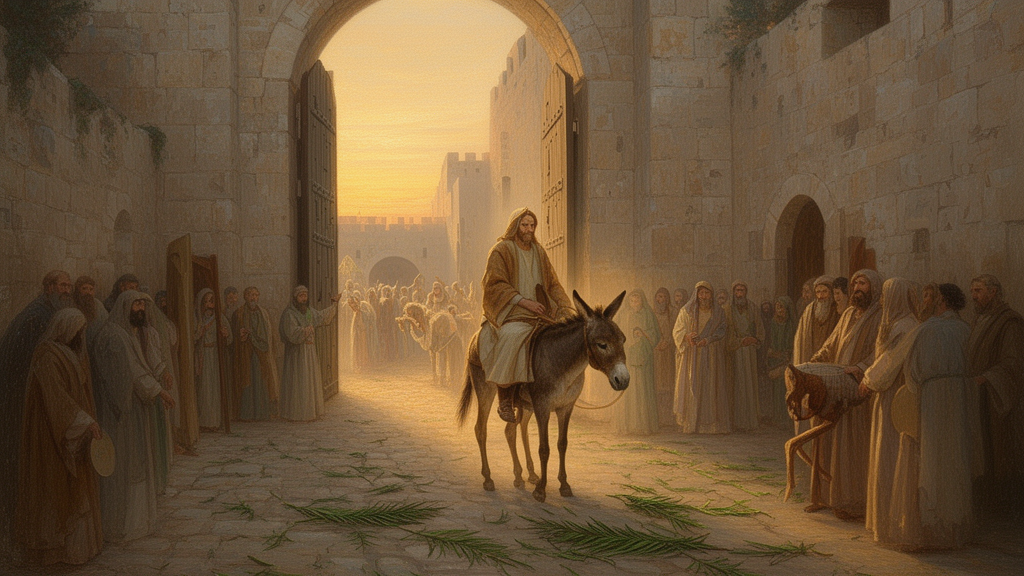
Palm Sunday marks the beginning of Holy Week. In the Gospel accounts, Jesus enters Jerusalem as crowds gather, some laying cloaks and branches on the road. The Gospel of Matthew describes Jesus riding on a donkey and its colt, and the study guide Bible Inspire cites Matthew 21:1-11 for this scene. Christian readers commonly connect the event with a prophecy in the book of Zechariah about a king arriving on a donkey, though the exact interpretation is a matter of Christian commentary.
Many churches begin Palm Sunday services with a procession carrying palm or other branches. In the Eastern Orthodox Church, Palm Sunday is linked with the Saturday of Lazarus, which the Wikipedia overview describes as marking the start of Holy Week in that tradition. The procession is a liturgical act, and its details vary widely between parishes.
Monday and Tuesday: teaching and the temple
The Gospels describe Jesus’s activity in Jerusalem during the following days, including his teaching and a confrontation in the temple courts. Bible Inspire cites Mark 11:12-19 for an account in which Jesus clears traders from the temple area. Many Christian commentators read this episode as a critique of commercial activity in a sacred space, while others emphasize its connection to Jewish prophetic tradition. Both readings are interpretations of the text, not separate historical records.
Tuesday is commonly associated in Western Christian practice with further teaching, including discourses that the Gospels place in the final days. Churches vary in how they mark these days. Some hold special services or readings, and others focus on prayer and quiet reflection. In the Western framework, the days are sometimes named Holy Monday and Holy Tuesday, and the Wikipedia article gives a separate section to each.
Wednesday: betrayal and preparation
Holy Wednesday is often called Spy Wednesday in Western tradition. The name refers to the Gospel account of a disciple’s agreement to betray Jesus, which the Gospels place in this period. The name Spy Wednesday is a traditional label; the Gospels themselves do not use it. Many churches observe the day with quieter services, and some traditions use the readings to prepare for the events of the following days.
Maundy Thursday: the last supper and the washing of feet
Maundy Thursday commemorates the final meal Jesus shares with his disciples, which Christians call the Last Supper. The Gospel of John describes Jesus washing the disciples’ feet at this meal, and it records a command to love one another. The word Maundy is generally traced to the Latin word for command, mandatum, which is associated with that instruction. Many churches celebrate the Eucharist or Lord’s Supper on this day, and some hold a foot-washing ceremony, although practice differs among denominations.
In many traditions, the Maundy Thursday service ends with the removal of decorations or with the stripping of the altar, which signals the solemnity of the coming days. Some churches keep vigil through the night. These customs are church-specific, and readers should look to their own tradition’s guidance.
Good Friday: the crucifixion
Good Friday commemorates the crucifixion of Jesus. The Gospels describe his trial, his death on a cross, and his burial. Christian observance on Good Friday is typically sober and reflective. Many churches hold services of the Passion, with readings from the Gospel accounts of the crucifixion, and some observe silence or fasting. The Wikipedia overview describes Good Friday as one of the central days of Holy Week in Western Christianity.
Christian belief holds that the crucifixion has theological significance, especially in relation to sin and redemption. These are doctrinal interpretations found in Christian theology. They are not historical findings in themselves, and different Christian traditions explain atonement in different ways.
Holy Saturday: the day of waiting
Holy Saturday, also called Black Saturday in some Western usage, falls between Good Friday and Easter Sunday. According to the Gospel accounts, Jesus is in the tomb on this day. Many churches observe it with a quiet tone, and the Easter Vigil, held after nightfall on Saturday in several traditions, is a major liturgy that marks the transition to Easter. Practice varies, and some churches hold the vigil in the early hours of Sunday.
The Eastern Orthodox Church uses the term Great and Holy Saturday for the corresponding day, and the Wikipedia overview gives a distinct description of its liturgical practices. Readers who observe the week in a different tradition should consult their own church calendar.
Easter Sunday: the resurrection
Easter Sunday is the culmination of Holy Week. Christians celebrate the resurrection of Jesus on this day, which they regard as the central event of their faith. The Light and Gospel guide describes Holy Week as ending on Easter Sunday and emphasizes that the resurrection represents the victory of life over death in Christian belief. This is a devotional interpretation. Historians and scholars study the resurrection narratives in various ways, and their conclusions differ.
Easter services often include joyful music and the proclamation of the resurrection. Many churches decorate with flowers and light, and families may share festive meals. These customs vary greatly across cultures.
Eastern and Western differences
Holy Week is observed in both Western and Eastern Christianity, and the two traditions differ in naming, sequence, and calendar. The Wikipedia article devotes separate sections to Holy Week in Western Christianity and in Eastern Christianity, and it notes distinct practices in the Coptic Orthodox Church and in Eastern Catholic and Eastern Lutheran churches.
Western Christianity
In Western churches, Holy Week is usually organized around the named days from Palm Sunday through Holy Saturday. Western observances also include many regional customs. The Wikipedia overview lists distinct Holy Week observances in several countries, including Brazil, Guatemala, Honduras, Italy, Malta, Mexico, the Philippines, and Spain, each with local practices. Processions, religious plays, and street events are examples of such customs, and they belong to particular communities rather than to the whole church.
Eastern Orthodoxy and the Coptic Church
In Eastern Orthodoxy, the services for Great and Holy Monday through Wednesday, Great and Holy Thursday, Great and Holy Friday, and Great and Holy Saturday are structured differently from Western practice. Eastern churches often use extended services with hymns and readings. The Coptic Orthodox Church observes its own calendar and traditions, as described in the Wikipedia overview. Because these churches calculate Easter differently, their Holy Week dates may not match Western dates in a given year.
Why the dates change
The date of Easter, and therefore of Holy Week, is not fixed to the solar calendar. Light and Gospel explains that the exact dates change each year because they follow a lunar-based calculation. The Western calendar and the Eastern calendars use different methods for setting the date, so Easter may fall on different days in the two traditions. Readers should check the calendar of their own church for the current year rather than relying on a general rule.
Observances and devotional practice
Holy Week is observed through worship, prayer, fasting, and reflection. Common practices include attending services, reading the Passion narratives, praying the Stations of the Cross, and abstaining from certain foods on Good Friday in some traditions. These practices are often described as spiritual disciplines. They are meant to deepen faith and reflection, and churches do not present them as guarantees of any outcome.
Families sometimes use devotional guides to read the story day by day with children or relatives. HindusGod.com has a related draft guide, Holy Week Devotional, and a version aimed at households, Holy Week Devotional for Families (URL to confirm as public; both are currently drafts). A longer reading companion is also available as Holy Week Book (URL to confirm as public).
Practical steps for reading the week
- Read the Palm Sunday account in one of the Gospels, then review the summary in a reputable reference.
- Follow each day in turn, noting which Gospel passages your church or guide uses for each reading.
- Compare your church’s Holy Week calendar with the Western and Eastern dates when relevant.
- Attend a service or read the liturgy for a day, if your tradition offers one.
How Holy Week relates to Hindu scripture and practice
Holy Week is a Christian observance, and its scriptural basis is the New Testament. Hinduism has its own texts, festivals, and calendars. Comparing the two can help readers see how different traditions structure sacred time, but comparisons should avoid suggesting that the stories or practices are equivalent. Readers interested in how Hindus approach their own sacred books can read about Holy Scriptures and what the term holy book means across traditions, with the understanding that these pages are drafts and may not yet be public.
For Hindus, the Bhagavad Gita is one of the best-known scriptures, and readers who want an introduction can explore Holy Gita (URL to confirm as public). Where a Christian and a Hindu author both use the word holy, the meaning depends on the tradition, so readers should not assume equivalence between them.
Frequently asked questions
Is Holy Week a Hindu festival?
No. Holy Week is a Christian observance that commemorates the final days of Jesus’s life. Hindu festivals follow different texts, calendars, and traditions.
Why does Holy Week begin on Palm Sunday?
Palm Sunday commemorates Jesus’s entry into Jerusalem, as described in the Gospels. Christian churches treat it as the start of the final week before Easter.
Why do the dates of Holy Week change each year?
Easter, and so Holy Week, follows a lunar-based calculation rather than a fixed solar date, as explained in the Light and Gospel guide. Eastern and Western churches may calculate the date differently.
Do all Christians observe Holy Week the same way?
No. Churches differ in liturgy, naming of days, and customs. Some communities also have regional traditions that are not shared across the whole church.
Summary
The story of Holy Week tells the Christian account of Jesus’s final days, from Palm Sunday through Good Friday, Holy Saturday, and Easter Sunday. The Gospels provide the narrative, and churches have built liturgical practices and local customs around it over time. Holy Week is observed differently in Western and Eastern churches, and its dates depend on the calendar used. Readers who want to explore further should consult primary scripture editions and their own church’s calendar.
Sources and further reading
- Holy Week, Wikipedia: used for the structure of Holy Week, the Western and Eastern observance sections, and the regional observance list.
- Holy Week Explained, Light and Gospel: a devotional explainer used for the description of Holy Week as a Christian observance and for the lunar-calendar explanation of changing dates.
- The Holy Week Timeline, Bible Inspire: a secondary study guide used for its citations of Matthew 21:1-11 and Mark 11:12-19 and for its description of the Gospel emphasis on the final week.
For primary reading, consult a scripture edition of the four Gospels from a reputable publisher or institution.