“The Return of Holy Russia” is the title of a 2020 nonfiction book by Gary Lachman, subtitled Apocalyptic History, Mystical Awakening, and the Struggle for the Soul of the World. It traces the spiritual, esoteric and messianic currents in Russian history and asks what they mean for Russia’s place in the world. This post explains what the phrase refers to, what the book covers, and how readers can approach it with care. It is not a Hindu scripture or a Hindu devotional text, and HindusGod.com does not present it as one.

What the phrase “Holy Russia” refers to
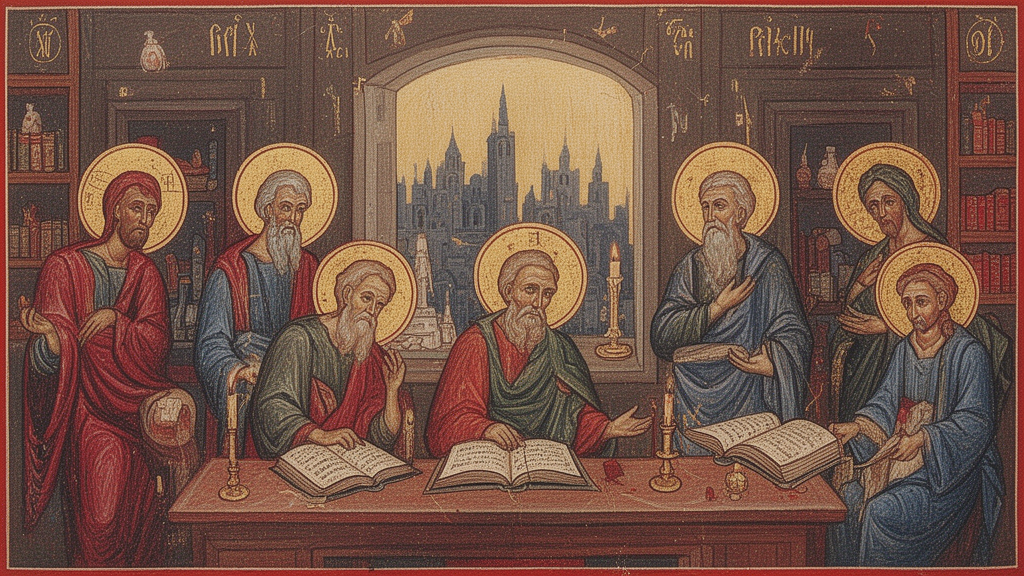
In the book’s publisher description on Goodreads, “Holy Russia” is tied to the “God-Seekers” of Russia’s Silver Age, a period the description places at the turn of the twentieth century. The description says these thinkers pursued “the salvation of the world through art and ideas,” and that their visions of Holy Russia are “returning to prominence” in the present day (Goodreads book description).
The phrase, then, is best understood as a term within a particular intellectual and religious history rather than a single doctrine. It points to a cluster of ideas about Russia as a spiritually chosen or uniquely positioned nation. The book’s description presents these ideas as shaped by Eastern Orthodox Christianity, older Slavic paganism, and the occult and esoteric movements that flourished alongside them.
What the book covers
According to the Goodreads description, Lachman’s book covers a wide range of subjects. The listed topics include:
- Russia’s original Slavic paganism and its adoption of mystical and apocalyptic Eastern Orthodox Christianity
- The Silver Age and its “occult revival,” including Rasputin’s prophecies, Blavatsky’s Theosophy, Roerich’s “Red Shambhala,” and the philosophies of Berdyaev and Solovyov
- Russian Rosicrucianism, the Illuminati Scare, Russian Freemasonry, and other secret societies
- The idea of the Russian character as “holy fool,” as seen in nineteenth-century literature, especially Dostoyevsky
- Psychic research carried out by the Russian government during the twentieth century
- The influence of Julius Evola and the esoteric right on Russian spiritual and political circles
The range is broad. It mixes religious history, literary criticism, political thought and the history of the occult. Readers should keep these categories distinct, because the book’s subjects do not all belong to the same kind of evidence. A novel by Dostoyevsky, a Rasputin prophecy reported by others, and a modern political reading of a philosopher’s work each require different kinds of support.
The Silver Age and the “God-Seekers”
The Silver Age is central to the book’s framing. The Goodreads description describes it as a period of “a powerful spiritual and cultural rebirth,” with “a vital resurgence of interest in the occult” and “a creative intensity not seen in the West since the Renaissance” (Goodreads book description). That is the publisher’s characterization. A historian of Russian culture might weigh the same period differently, and readers who want that wider context should consult academic histories of the Russian Silver Age.
The “God-Seekers” are the figures the book returns to most often. Their concern, as summarized in the description, was the salvation of the world through art and ideas. This gives the phrase “Holy Russia” a forward-looking sense: it refers not only to a past religious identity but to a claimed future mission.
Holy fool, holy Russia, and literature
One of the more concrete threads in the book is the idea of the “holy fool.” The Google Books description says Lachman explores the Russian character as that of the “holy fool,” as seen in the great Russian literature of the nineteenth century, especially Dostoyevsky (Google Books description). This is a literary and cultural image. It should not be confused with a formal religious office or a verified historical category. Its significance lies in how writers and readers have used it to describe a certain moral and spiritual type.
Contested readings and political claims
The book’s publisher description makes a strong connection between these older ideas and present-day politics. It says the Silver Age visionaries “greatly influence Putin today” and that Russian president Vladimir Putin, “inspired by their ideas, envisions a new ‘Eurasian’ civilization with Russia as its leader” (Goodreads book description). These are claims made in the marketing description of the book, and they are interpretations. Readers should treat them as the author’s argument to be evaluated, not as established fact.
Reader responses also show that interpretation is contested. A review excerpt on the Simon & Schuster page calls the book “a riveting account of Russia’s spiritual history” and adds that “some of my interpretations differ from Gary’s” (Simon & Schuster book page). The reviewer’s disagreement is a useful reminder that the book’s political and historical conclusions are open to debate.
A second endorsement excerpt, shown in an archived PDF, describes the book as giving “perspectives on Russia’s spiritual history” that help readers understand Russian thinking about exceptionalism and American moral leadership (archived PDF excerpt). This is an endorsement, not an independent analysis, and it should be read as such.
Why this topic appears on a Hindu-focused site
HindusGod.com focuses on Hinduism, its deities, scriptures, festivals and devotional practice. The Russian topic sits outside that core. The book’s own description still gives a few points of contact with the wider history of East–West religious encounter. It names Blavatsky’s Theosophy, a movement that engaged with Asian religious thought, and it frames Russia as lying “between East and West” in its spiritual identity (Goodreads book description).
Those connections are thematic. The sources reviewed here do not establish any direct role for Hindu traditions in the book’s central argument about “Holy Russia,” and this post does not claim one. Readers looking for Hindu teachings on sacred texts, divine names or devotion should begin with the scripture and deity guides linked below.
How to read a book like this
A careful reader can separate the material into four layers:
- Religious belief and tradition: what Orthodox, pagan, theosophical or esoteric communities claimed about their own spiritual meaning.
- Textual evidence: what specific novels, letters, essays or prophecies actually say, checked against a reliable edition or translation.
- Historical record: dates, institutions, and events, which should be confirmed from academic histories rather than popular summaries.
- Interpretation: the author’s argument about what these elements mean for Russia and the world today.
The book’s appeal is partly that it moves across all four layers. That is also why readers should check which layer a given claim belongs to.
Questions to ask while reading
- Is this a claim about what a source says, or about what it means?
- Does the author cite a primary text, or a secondary account of it?
- Are the political conclusions drawn from the historical material, or added to it?
- Do other historians of Russian religion or culture agree with the reading?
Frequently asked questions
Is “The Return of Holy Russia” a religious text?
No. It is a nonfiction history and interpretive work by Gary Lachman. It discusses religious traditions, esoteric movements and literature, but it is not a scripture or devotional text for any religion.
Does this book relate to Hinduism?
Not directly, according to the publisher descriptions reviewed here. The book’s subject is Russian spiritual and political history. It mentions East–West encounters through figures such as Blavatsky, but this post has not found evidence that Hindu traditions are central to its argument.
Should I treat the book’s political claims as settled?
No. The political connections in the publisher description are the author’s interpretation, and at least one reviewer disagrees with parts of the reading. Check the claims against independent historical and academic sources.
Summary
“The Return of Holy Russia” is Gary Lachman’s 2020 book on Russia’s mystical, apocalyptic and Silver Age spiritual history. The phrase refers to a set of ideas about Russia’s spiritual identity and mission, tied to the “God-Seekers” of the Silver Age and to later political readings. The book’s strength is its breadth; its limits are that its interpretations are contested and its sources need to be separated carefully. Readers interested in the subject should read the book alongside academic histories of Russian religion and culture.
Related reading on HindusGod.com
These pages cover related terms from the site’s own collection. Their status is noted because they are WordPress drafts and may not be public yet.
- Holy Book Meaning (URL status: draft, may not be public yet)
- Holy Scriptures (URL status: draft, may not be public yet)
- Holy Gita (URL status: draft, may not be public yet)
- Holy Text (URL status: draft, may not be public yet)
- Holy Madness (URL status: draft, may not be public yet)
Sources and Further Reading
- Goodreads: The Return of Holy Russia, publisher description: summary of topics, the Silver Age, and political claims (interpretive, from the description).
- Amazon Kindle listing, The Return of Holy Russia: bibliographic listing identifying Gary Lachman as author and the title’s subtitle.
- Google Books: The Return of Holy Russia: description of the holy fool theme and the book’s coverage of secret societies (page not separately inspected).
- Simon & Schuster: The Return of Holy Russia: reviewer excerpt noting differing interpretations (page not separately inspected).
- Archive.org PDF excerpt, The Return of Holy Russia (2020): endorsement excerpt; the full PDF was not inspected and is not verified as a licensed copy.
For academic background on Russian religious history and the Silver Age, readers should consult university press histories of Russian religion and culture. Those titles were not verified in this research pass and are not cited here.