The Holy Spirit in Luke refers to the way the third Gospel, which Luke also continues in the Acts of the Apostles, presents the Spirit as the active presence and power of God. In Luke’s Gospel, the Spirit comes upon key figures at the turning points of the story: the births of John the Baptist and Jesus, Jesus’s baptism, his temptation in the wilderness, and the start of his public ministry. Luke also points forward to a promised gift of the Spirit that is fulfilled in Acts. This article explains the main passages, the differing Christian interpretations, and the translation issues readers should know about.
This is a guide to Christian scripture and Christian doctrine. The Holy Spirit is not a Hindu deity, and this article does not equate the Holy Spirit with any Hindu concept. Readers who want to compare traditions will find it helpful to keep each tradition’s texts and categories separate.
The short answer: what Luke says about the Spirit

Luke writes more about the Holy Spirit than any other New Testament author, according to Graham H. Twelftree’s essay for Bible Odyssey, a publication of the Society of Biblical Literature. Twelftree notes that Luke portrays the Spirit as the activity and presence of God (Luke 4:18), but also at times as something closer to an impersonal force or power (Luke 5:17; Luke 8:46). Luke also describes Jesus as a man ‘primarily of the Spirit’ and refers to ‘the Spirit of Jesus’ in Acts 16:7 (Bible Odyssey, The Holy Spirit in Luke-Acts).
In practical terms, Luke’s Gospel presents the Spirit in four ways:
- Divine action: the Spirit comes upon people to bring about God’s purposes, as with the conception of Jesus (Luke 1:35).
- Empowerment: the Spirit gives Jesus and his followers power for speaking and healing.
- Revelation and guidance: the Spirit reveals God’s plans and directs people’s movements, as with Simeon (Luke 2:25-27).
- Promise: the Spirit is a gift the Father promises, which Luke says will come after Jesus’s departure (Luke 24:49).
Why the Spirit matters in Luke’s storytelling
Luke tells his story in two volumes. The Gospel traces Jesus’s life and ministry, while Acts follows the early movement that continues his work. Bible Odyssey observes that the key turning points in this two-volume story are initiated by the Spirit, especially Jesus’s birth (Luke 1:35), baptism (Luke 3:21-22), temptation (Luke 4:1-2), and the start of his ministry of speaking and healing (Luke 4:18). The same article notes that the start of Acts (Acts 2:4) and the beginning of the mission to the Gentiles (Acts 10:44-48) are also marked by experience of the Spirit (Bible Odyssey).
This pattern helps explain why the Spirit appears so often in Luke’s Gospel. The Spirit is not a background detail. It marks the moments when God acts in a new way.
The Spirit in the birth narratives (Luke 1-2)
John the Baptist and his parents
Luke’s opening chapter names several people who are filled with the Spirit. A translation of Luke 1:15, quoted in a 19th-century-style Christian article from The Holy Spirit in Luke’s Gospel on STEM Publishing’s An Outline of Sound Words, records the promise that John ‘shall be filled with the Holy Ghost, even from his mother’s womb.’ That article uses the King James wording ‘Holy Ghost,’ which is an older English rendering of the same Greek word now usually translated ‘Holy Spirit’ (STEM Publishing, The Holy Spirit in Luke’s Gospel).
Luke also says Elizabeth was filled with the Spirit and spoke a blessing over Mary (Luke 1:41-45). Her husband Zechariah, whose name is often spelled Zacharias in older English Bibles, is described as filled with the Spirit when he prophesies about John’s mission (Luke 1:67-80). Here the Spirit is linked both to speech and to God’s saving plan.
Mary and the Spirit’s coming
The angel’s message to Mary is the central birth passage. In Luke 1:35, the angel says that the Holy Spirit will come upon Mary and the power of the Most High will overshadow her. The Gospel of Luke presents this as the reason the child will be called holy and the Son of God. Believers across traditions generally read this verse as a statement about the conception of Jesus, but they differ on how much to say about the mechanics beyond the text itself. Many readers do not attempt to explain the mechanism at all.
Biblical scholars often compare Luke’s language of ‘power’ with the Greek word dunamis. A study-oriented article by Rodney W. Francis notes that the Greek dunamis is commonly rendered ‘power’ and describes ‘power capable of anything’ (The Gospel Faith Messenger, The Holy Spirit in the Gospels of Luke and John). That article is a devotional and teaching resource, so its word studies should be checked against a lexicon or a critical commentary before being used in academic work.
Simeon and the Spirit’s guidance
Simeon, described as ‘just and devout,’ waits for the consolation of Israel. Luke 2:25-27 says the Holy Spirit was upon him, had revealed that he would not die before seeing the Lord’s Christ, and guided him into the temple when Jesus’s parents brought the child there. The STEM Publishing article reads this scene as part of a ‘godly remnant’ of Israel and emphasizes that the Spirit was active among God’s people before Pentecost (STEM Publishing). The article’s further claim that the Spirit did not yet indwell believers in the Old Testament reflects one Christian theological position. Other traditions read Old Testament and Gospel texts about the Spirit differently, so that claim should be presented as an interpretation.
The Spirit at Jesus’s baptism and wilderness testing (Luke 3-4)
The promise of baptism with the Spirit
In Luke 3:16, John the Baptist says that one who is coming will baptize people with the Holy Spirit and with fire. Luke places this statement within John’s preaching about repentance. Interpreters often connect it with the later coming of the Spirit in Acts 2, where the Spirit comes on the gathered disciples with visible signs, but they debate whether ‘fire’ refers to judgment, purification, or both.
The Spirit descends at the baptism
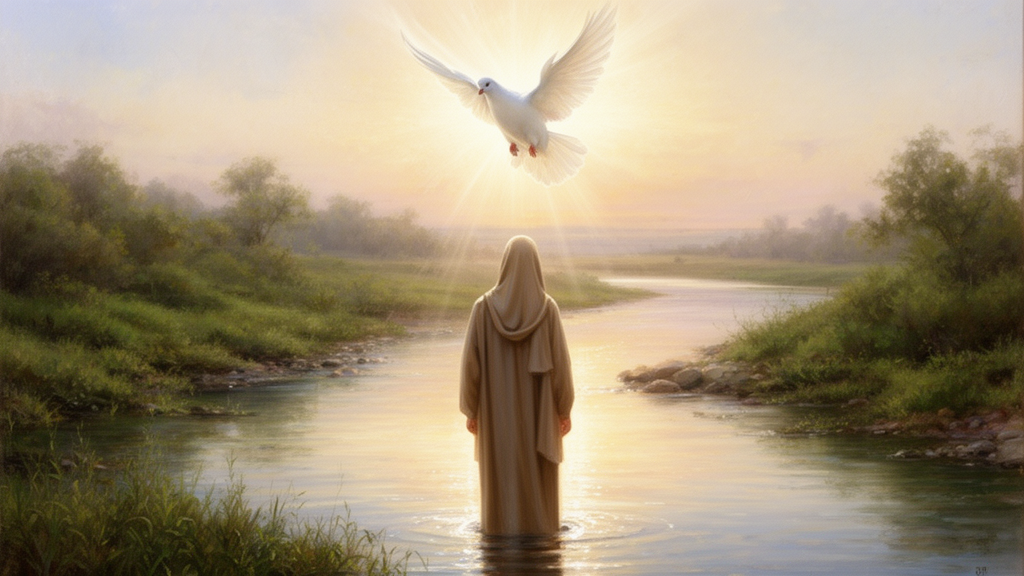
Luke 3:21-22 describes Jesus praying after his baptism when the Holy Spirit descends in bodily form like a dove. Luke says the Spirit descends in a ‘bodily shape,’ a phrase that the Rodney Francis article repeats while noting the dove imagery (The Gospel Faith Messenger). Many commentators see the dove as a visible sign of the Spirit’s presence rather than a claim about the Spirit’s nature. Christian art has often depicted this scene, and readers can find many historical images, but artistic symbols should not be confused with the text itself.
Led into the wilderness
Luke 4:1-2 says that Jesus, full of the Holy Spirit, was led by the Spirit into the wilderness, where he was tempted for forty days. Bible Odyssey lists this temptation among the Spirit-marked turning points in Luke’s account (Bible Odyssey). Note the difference in translation: some English versions say ‘full of the Holy Ghost’ while others say ‘full of the Holy Spirit.’ The Bible Gateway KJV and NKJV passage for Luke 4:1 uses the phrase ‘full of the Holy Ghost’ (Bible Gateway, Luke 4:1, 4:18, 24:27 KJV;NKJV).
Return in power and the Nazareth reading
Luke 4:14 says Jesus returned to Galilee ‘in the power of the Spirit,’ and Luke 4:18 records him reading from Isaiah 61 in the synagogue at Nazareth. The Spirit is named in the reading as anointing the speaker to preach good news to the poor, to proclaim release to the captives, and to proclaim the Lord’s favor. Bible Odyssey identifies Luke 4:18 as the moment the Spirit is linked to the start of Jesus’s ministry of speaking and healing. Readers should note that the passage is Luke’s narrative use of an Isaiah text, and commentators differ on how far Luke intends the Isaiah reading to define Jesus’s whole ministry.
For a readable overview of Luke 4 in several English translations, the ASV text on Bible Gateway shows the phrase ‘And Jesus, full of the Holy Spirit’ in its title, although the page itself includes a long list of translations and advertising (Bible Gateway, Luke 4 ASV). Readers should use a fuller study Bible or commentary to examine the Greek and context.
The Spirit as presence and as power
Personal presence or impersonal power?
One of the more debated questions in Luke’s Gospel is whether the Spirit is best described as a personal presence of God or as a force that God uses. Twelftree’s Bible Odyssey essay says Luke portrays the Spirit both as the activity and presence of God and as an impersonal force or power, citing Luke 5:17 and Luke 8:46 for the second category (Bible Odyssey). Christian theologians later developed the doctrine of the Trinity, which affirms the Spirit as a divine person. The Gospel text itself does not always use the categories that later creeds use, so readers should distinguish what Luke says from what later doctrine says about the Spirit.
Joy, speech, and inspired action
Luke connects the Spirit with several observable outcomes. The Spirit is linked to proclamation, as with Jesus’s teaching in Luke 4:14-15 and inspired speech in Acts 2:14. Luke 10:21 describes Jesus rejoicing in the Spirit. Acts 2:17 and Acts 7:55-56 include visions. Twelftree notes that Luke’s stories of the Spirit’s coming often involve some tangible expression, sometimes including glossolalia, or speaking in tongues. That observation is important for Pentecostal readers, but it is a description of Luke-Acts narratives rather than a universal rule that every Spirit-filled person will speak in tongues.
How Luke’s Gospel leads into Acts
Promise in Luke 24
Luke’s Gospel ends with the promise of what the Father has promised. Luke 24:49 is widely read as a bridge to Acts, and Bible Odyssey describes Pentecost as the fulfillment of that promise for Jesus’s followers. Readers who study the link between the two volumes can use Acts 1:4-8 as the next step, because it connects the promise to the disciples’ mission.
Pentecost and the gift for all
Acts 2:1-4 says the Spirit came on all the disciples gathered in Jerusalem. Twelftree points out that Luke presents this story as a model for later Christians (Acts 2:38), and that the Pentecost narrative signals God’s final salvation has arrived (Acts 1:4-8; Acts 2:16-36). Bible Odyssey also notes that Luke sees the Spirit as important for the new age in a way that parallels how the Law of Moses was important in the older covenant, with the Jewish philosopher Philo’s writing on the Law offering a point of comparison (Bible Odyssey).
Twelftree also observes that Luke sees the birth of the church not at Pentecost but when Jesus called his first disciples (Luke 6:13). Readers should note that this is a scholarly reading of Luke’s narrative structure, not a claim every church tradition shares.
Where Christian traditions differ
Christian readers do not agree on every question about the Spirit in Luke. The sources reviewed for this article show at least three distinct emphases.
- Pentecostal readings emphasize the Spirit’s power and subsequent experience. Bible Odyssey notes that contemporary Pentecostals describe the coming of the Spirit as a donum superadditum, Latin for ‘an additional gift,’ but Twelftree argues that Luke generally presents the coming of the Spirit as part of the conversion-initiation experience rather than a later, separate event, with exceptions such as Acts 2:38 and Acts 10:43-48.
- Reformed and evangelical readings often stress God’s sovereign work and the Spirit’s role in conversion, although the sources reviewed here do not provide a full statement of that position.
- Devotional and Brethren-type readings such as the STEM Publishing article stress the Spirit’s ministry to believers and the church, and argue that the Spirit’s indwelling of believers was connected with the completion of the work of the cross. This is an interpretive claim, and it is not the only way Christians read Old Testament and Gospel texts.
The fair way to present these differences is to name the tradition, quote the text accurately, and separate scripture from interpretation. Readers who want to explore the debate should consult the Greek text, major commentaries, and sources from each tradition.
Translation notes for readers
The phrase ‘Holy Spirit’ appears in modern English translations such as the New Revised Standard Version and many newer translations. The King James Version and some older devotional works use ‘Holy Ghost.’ Both render the same Greek concept, but the older term can sound unfamiliar to modern readers. The Greek words most often discussed in Luke include pneuma, meaning ‘spirit’ or ‘breath,’ and dunamis, meaning ‘power.’ Translators sometimes render pneuma with ‘Spirit’ capitalized when it refers to the Holy Spirit and in lowercase when it refers to human spirit or another spirit.
When you read Luke’s Gospel in several versions, compare the following:
- Whether the translation says ‘Holy Spirit’ or ‘Holy Ghost’ at Luke 1:35 and Luke 4:1.
- Whether ‘power’ or ‘strength’ is used for dunamis at Luke 4:14.
- Whether the translation capitalizes ‘Spirit’ consistently.
A practical study method
Readers who want to study the Holy Spirit in Luke can follow these steps:
- Read the passages in order. Start with Luke 1:15, 1:35, 2:25-27, 3:16, 3:22, 4:1, 4:14, and 4:18, then read Luke 24:49 and Acts 2:1-4.
- Mark each reference to the Spirit. Note who receives the Spirit, what the Spirit does, and what results from it.
- Compare translations. Use at least two English versions and note any differences in wording.
- Separate text from interpretation. Ask whether a statement is what Luke says or what a commentary or tradition says about it.
- Check at least two traditions. Read a Pentecostal, Reformed, or other tradition’s account and see how it reads the same passage.
Frequently asked questions
Does Luke’s Gospel mention the Holy Spirit more than other Gospels?
Luke’s Gospel and Acts together contain a large amount of material about the Spirit, and Bible Odyssey states that Luke has more to say about the Spirit than any other biblical writer. Readers should compare the specific counts in a concordance rather than relying on a general statement.
Is the Spirit given only at Pentecost?
Luke’s Gospel presents people being filled with the Spirit before Pentecost, including John’s parents, Simeon, and Jesus himself. Acts presents Pentecost as a major moment in which the Spirit comes on the gathered disciples. Christian traditions differ on how the earlier and later experiences relate.
Is the Holy Spirit a Hindu concept?
No. The Holy Spirit is a Christian concept rooted in Christian scripture. Readers who want to learn about Hindu scriptures, deities, or spiritual terms should explore those topics separately, since the categories and sources are different.
Summary
In Luke’s Gospel, the Holy Spirit is the presence and power of God at the key turning points of Jesus’s story, from the births of John and Jesus to the start of his ministry. Luke also presents the Spirit as a promise that is fulfilled in Acts. Christian traditions read these texts differently, especially on whether the Spirit’s coming is separate from conversion and how the Spirit relates to the Old Testament. A careful reader can keep the text, the tradition, and the scholarly reading distinct.
Sources and further reading
- Graham H. Twelftree, ‘The Holy Spirit in Luke-Acts,’ Bible Odyssey. Academic overview of Luke’s portrayal of the Spirit and the Pentecost narrative.
- ‘The Holy Spirit in Luke’s Gospel,’ STEM Publishing, An Outline of Sound Words. Devotional Christian article with a particular theological reading of Old Testament and Gospel texts.
- Rodney W. Francis, ‘The Holy Spirit in the Gospels of Luke and John,’ The Gospel Faith Messenger. Teaching article listing Spirit references in Luke 1-4 and Luke 11.
- Bible Gateway, Luke 4:1, 4:18, 24:27 in KJV and NKJV. Scripture text for comparing translations of Spirit-related verses.
- Bible Gateway, Luke 4 in the American Standard Version. Scripture text for Luke 4, with translation options.