The Holy Souls is a Catholic term for the faithful departed who are believed to be in purgatory, a state of purification before entering heaven. Catholics pray for them, offer Masses on their behalf, and take part in devotions such as the Rosary for the Holy Souls in the belief that prayer can help them. This article explains what the term means, what the Church teaches about purgatory, and which practices are commonly used. The Holy Souls is a Christian devotion, not a Hindu one, so this article describes Catholic belief and practice and does not present them as a Hindu teaching.
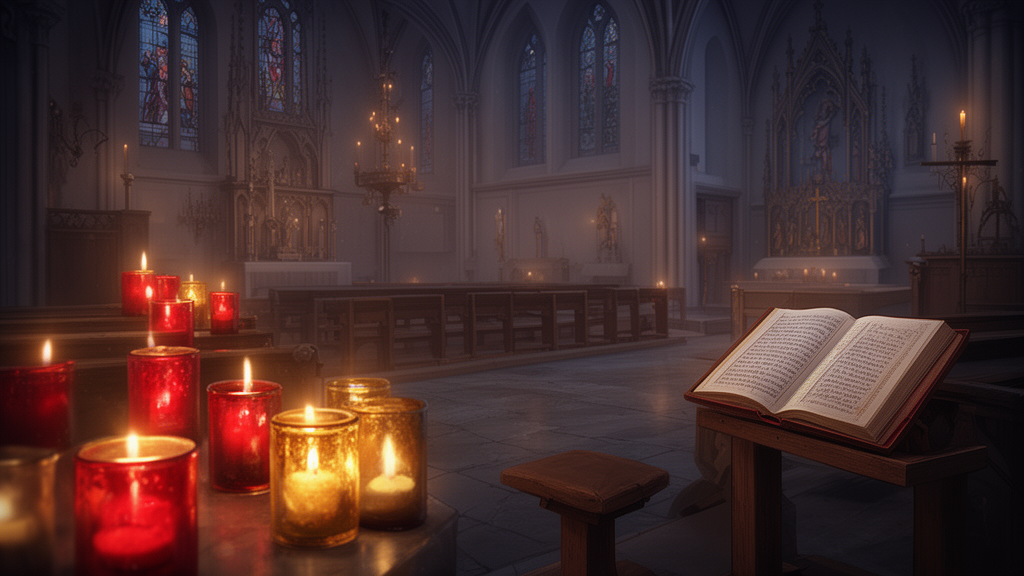
The Holy Souls: a direct answer
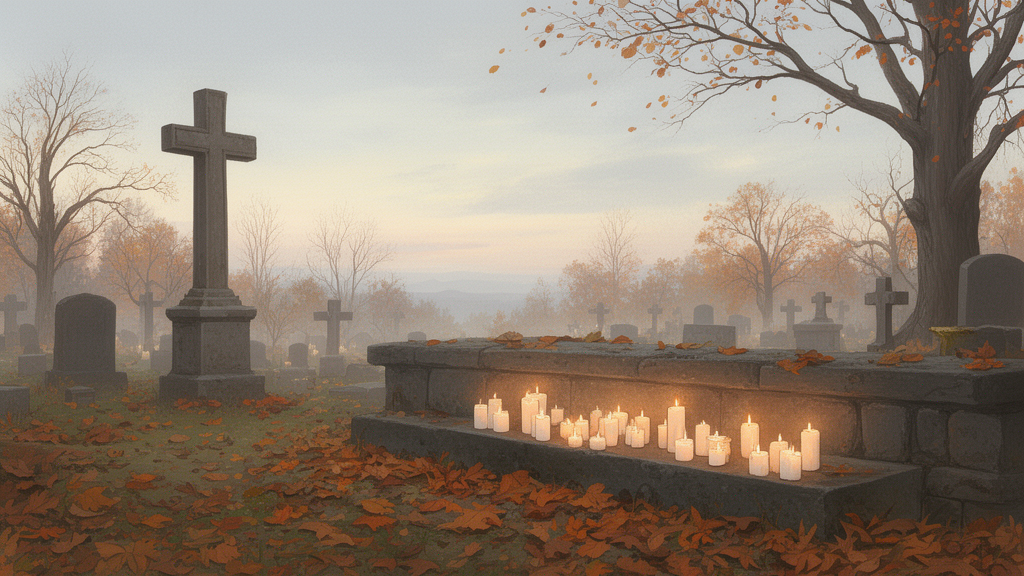
In Catholic usage, the Holy Souls are the souls of people who have died in God’s friendship but who are not yet ready for heaven. They are believed to be undergoing purification in purgatory. Catholics do not regard the Holy Souls as saints. They are seen as beloved members of the Church who still need prayer, and whose eventual entry into heaven is hoped for and prayed for by the living.
The phrase appears throughout Catholic devotional writing. A 2014 essay on the Mystics of the Church website calls it an older expression that many younger Catholics may not recognize, though it remains common in prayer books, parish life, and the liturgical calendar.[6] The term describes a group of people rather than a single doctrine. Understanding it requires knowing what Catholics mean by purgatory, the Communion of Saints, and intercessory prayer.
Purgatory and the Communion of Saints
Purgatory is the Catholic teaching that some who die in God’s grace still need a final purification before they see God fully. The idea is rooted in the belief that sin leaves a debt that must be cleansed, and that the process is not the same as damnation. Catholic writers often describe purgatory as a state of hope, because those who are there are certain of eventually reaching heaven.
The Catholic practice of praying for the dead depends on the Communion of Saints. In traditional terms, the Communion of Saints includes three groups: the Church Militant (the faithful on earth), the Church Triumphant (the souls in heaven), and the Church Suffering (the souls in purgatory).[4] Catholic teaching holds that members of these groups remain connected through prayer and charity.
Why the living pray for those in purgatory
Susan Tassone, a Catholic author who writes extensively on purgatory, presents the logic in simple terms. Those still on earth need the prayers of others, and Catholics are called to pray for the living. The same charity extends to the dead, who are believed to be unable to help themselves in the same way.[4] This is a devotional argument. It explains why prayer is offered, but it is not a historical or scientific proof.
Heaven, purgatory, and what is not known
Catholic teaching names specific individuals as saints only through formal canonization. Apart from the saints, the Church does not declare who is in heaven or purgatory. Tassone notes that the Church does not identify particular souls unless they have been canonized, and that Catholics may ask heaven-dwelling loved ones for help while still praying for the departed in general.[4] This distinction matters. Catholics may pray that a particular person is in heaven, but they do not claim certain knowledge of that person’s final state.
Why Catholics pray for the dead
Prayer for the dead is an ancient and widespread part of Catholic life. The 2014 Mystics of the Church essay quotes two recent popes on this subject. It cites Pope John Paul II, who encouraged the faithful to pray for souls in purgatory, and it refers to Pope Benedict XVI’s Sacramentum Caritatis (32) and Spe Salvi (44–48), both published in 2007, which the essay presents as reminders of the value of prayer for the dead and of offering Mass for them.[6] Readers who want to check these passages should consult the encyclicals directly, since the essay is a devotional summary rather than the primary text.
The same essay describes the Church’s practice of remembering the dead in the Eucharistic liturgy, and of offering individual Masses for particular people. It also lists praying for the living and the dead among the Seven Spiritual Works of Mercy.[6] These works are traditional Catholic teachings, and their basis lies in Catholic catechesis rather than in a single verse that all Christian traditions accept in the same way.
Belief, liturgy, and scholarship
It helps to separate three things. The first is belief: Catholics hold that the souls in purgatory can be helped by prayer and sacrifice. The second is liturgy and devotion: Masses, prayers, and rosaries are offered in their name. The third is theological explanation, which includes debates about how indulgences, intercession, and the Communion of Saints work. Devotional writers often speak with confidence about what prayer achieves. A careful reader can recognize that the affirmation of belief is the Church’s, while the details of how God applies grace are explained in theology and are not fully described in Scripture.
Ways to pray for the Holy Souls
Catholic devotion offers many ways to pray for the souls in purgatory. Some are part of the official liturgy, and others are popular devotions that vary by parish, religious order, and personal practice. None is required in a single form for every Catholic, and the list below describes common practices rather than a fixed rule.
All Souls’ Day and the month of November
The Church sets aside specific days for remembering the dead. All Saints’ Day falls on November 1, when the Church honors the saints in heaven. All Souls’ Day falls on November 2, when the Church remembers all the faithful departed. The entire month of November is traditionally dedicated to the Holy Souls.[4] Many Catholics visit cemeteries, attend Mass, or pray for deceased relatives during this period.
The timing is determined by the Catholic liturgical calendar. Parishes may publish their own schedules for All Souls’ Day Masses and related services, so readers should check their local church for dates and times.
Mass and Gregorian Masses
The Mass is central to Catholic prayer for the dead. Many Catholics ask for Masses to be offered for a deceased person, and the Holy Souls Sodality, a Catholic organization with a spiritual director, offers services that include requests for individual Masses, Gregorian Masses, and daily Masses for the Holy Souls.[3] A Gregorian Mass is a series of thirty consecutive Masses offered for one soul, a practice that Catholic writers associate with a long tradition of devotion.[6] Mystics of the Church discusses the thirty Gregorian Masses as part of its guide to the Holy Souls.[6]
Gregorian Masses are a Catholic devotional practice, and they are not required for every believer. Some parishes and organizations offer them, and fees or donations may be involved. Readers should check the policies of the organization they use before making a request.
The Rosary for the Holy Souls
The Rosary is a Marian prayer of the Catholic Church, and devotional Rosaries for the Holy Souls adapt its structure to focus on the dead. Susan Tassone’s book The Rosary for the Holy Souls in Purgatory, according to a Grokipedia summary, is a pocket-sized guide published in 2002 that includes Scripture passages and meditations on purgatory.[1] Readers should verify the publisher and publication details with the publisher or a library, since Grokipedia is an encyclopedia-style summary rather than a primary source.
The Holy Souls Sodality also promotes a Holy Souls Rosary, and its spiritual director has spoken about it in a video on the organization’s website.[3] Tassone describes the book as a way to combine Rosary prayer with intercession for those in purgatory.[2] A devotional Rosary is an optional practice. Catholics who do not use this form can still pray the standard Rosary for the dead.
Prayer to Jesus Christ for the Holy Souls
A widely shared devotion is a prayer attributed to St. Alphonsus Liguori, which the EWTN website presents as a prayer to Jesus Christ for the Holy Souls. The prayer repeats a series of invocations that ask Jesus to have mercy on the souls, referring to his sufferings in the Garden of Gethsemane, his scourging, his crowning with thorns, his carrying of the cross, his crucifixion, his agony on the cross, and his death.[5] Each invocation is followed by the response, ‘Have mercy on them, O Lord.’ The EWTN page notes that it may be prayed in common or individually, at any time, or as a novena, especially for All Souls’ Day.[5]
The prayer is an example of a devotional text, not a Scripture passage. Readers should recognize that its authorship and wording come from the published tradition associated with St. Alphonsus, and that different Catholic prayer books may print slightly different versions. The prayer ends with a petition for the departed and an invitation to name personal intentions.[5]
Organizations and resources for the Holy Souls
Several Catholic organizations work on prayer for the dead. The Holy Souls Sodality, associated with the Marian Fathers of the Immaculate Conception, offers prayers, Masses, a purgatory board for intentions, conferences, articles, and resources.[3] The Purgatory Project’s website describes a service in which people may register living and deceased persons for perpetual Masses, and says that the site has been running since 2001 under a newer format launched in 2017.[2] Inclusion in such a service is a personal choice, and readers should review its terms, fees, and privacy statements before using it.
Catholic parishes, religious orders, and diocesan offices also often arrange All Souls’ Day services, memorial Masses, and prayer groups. Local parishes are the best place to find current schedules and services.
How this differs from Hindu practices for the departed
Readers who arrive at HindusGod.com from a Hindu background may want to know how the Holy Souls relate to Hindu rites for ancestors. Hinduism has its own practices for the departed, including rites commonly called shraddha and offerings made in memory of ancestors. These rites belong to a different theological framework and vary widely by region, family, and text. They are not the same as Catholic purgatory or the Communion of Saints, and this article does not attempt a detailed comparison. A sourced comparison would require separate research into Hindu scriptures, commentaries, and community practices.
The main difference to keep in mind is that the Holy Souls concept is part of Catholic doctrine, with its own sources of authority, including Scripture, the Church’s liturgy, papal teaching, and theological development. Hindu rites for the ancestors come from different texts and traditions. Each should be understood on its own terms.
Common misunderstandings
Are the Holy Souls saints?
Catholics usually distinguish the Holy Souls from the saints. The saints are believed to be in heaven, and the Church names some of them through canonization. The Holy Souls are believed to be in purgatory and in need of prayer. The distinction is important because Catholics ask the saints for their intercession, while they pray for the Holy Souls.[4]
Does prayer guarantee a result?
Catholic devotional writers often express strong confidence in the value of prayer for the dead. However, Catholic teaching also acknowledges that God is free and merciful in how he acts. Prayer is understood as an act of charity and hope, not as a mechanical way to secure a particular outcome. Readers should avoid treating any devotion as a guaranteed material result.
Is this a teaching shared by all Christians?
No. Purgatory and prayer for the dead are central to Catholic and Eastern Orthodox teaching in different ways, while many Protestant churches do not accept purgatory as a doctrine. Catholics also differ among themselves about certain details, and some popular devotions are regional or specific to a religious order. This article describes the Catholic Church’s teaching and common practice.
Practical ways to pray for the Holy Souls
For readers who want to begin, the simplest practice is a short prayer offered on a regular schedule. A person might pray for a deceased relative each evening, attend Mass on All Souls’ Day, or pray one decade of the Rosary for the dead. Some Catholics keep a list of names for prayer during November. Others request Masses for the deceased through a parish or an organization.
- Pray for named individuals, using their names during personal prayer.
- Attend Mass on All Souls’ Day or request a Mass for a particular person.
- Pray a devotional Rosary for the Holy Souls, following a published form.
- Use a published prayer such as the one attributed to St. Alphonsus Liguori.
- Offer works of charity or sacrifice with the intention of helping the dead.
The prayers themselves should be chosen according to the reader’s own tradition and parish guidance. A priest, catechist, or parish office can explain local customs and answer questions about indulgences and Mass offerings.
Related HindusGod.com articles
Readers interested in Christian devotion to the dead may also want to see the drafts below, which are related topics on this website. These links are target drafts and may not yet be public: Devotion to the Holy Souls in Purgatory, Helpers of the Holy Souls, and Holy Souls in Purgatory Rosary. Only three of the verified target drafts closely match this topic, so no other internal links are included.
Frequently asked questions
What is the difference between the Holy Souls and the saints?
The Holy Souls are believed to be in purgatory and in need of prayer. The saints are believed to be in heaven, and Catholics ask for their intercession. Only saints named through formal canonization are publicly recognized by the Church.[4]
When are the Holy Souls remembered?
Catholics remember them especially on All Souls’ Day, November 2, and throughout the month of November.[4] Parishes may also hold memorial services at other times.
Do Catholics have to pray a particular prayer for the Holy Souls?
No single prayer is required for every Catholic. Common options include the Mass, the Rosary for the Holy Souls, and the prayer attributed to St. Alphonsus Liguori. Parish guidance and personal devotion determine which practices a person uses.[5]
Summary
The Holy Souls is a Catholic term for the faithful departed who are believed to be in purgatory. Catholics pray for them because they believe the Communion of Saints links the living, the saints, and the souls being purified. Common practices include All Souls’ Day, the month of November, Masses, Gregorian Masses, the Rosary for the Holy Souls, and published prayers. Each practice reflects Catholic belief and tradition, and each should be understood in its own context. Readers who want to learn more can consult their parish, a Catholic catechism, and the primary texts of the Church.
Sources and further reading
- The Rosary for the Holy Souls in Purgatory (book) summary: used only for the book’s description, author, and publication details. This is an encyclopedia-style summary, so verify details with the publisher.
- Purgatory Project home page: used to describe the service that registers persons for perpetual Masses.
- Holy Souls Sodality: used for its description of Masses, prayers, resources, and Holy Souls Rosary material.
- How to pray for the holy souls in purgatory, Catholic Digest: used for the Communion of Saints, the Church Militant, Triumphant, and Suffering, and the calendar of November remembrance.
- Prayer to Jesus Christ for the Holy Souls, EWTN: used for the prayer’s attribution, invocations, and suggested use.
- The Holy Souls of Purgatory, Mystics of the Church: used for the Alphonsus quotation, papal references as summarized by the author, Gregorian Masses, and the Seven Spiritual Works of Mercy.