The Holy Roman Empire was a large, decentralized political order in Central and Western Europe that lasted for roughly a thousand years, usually dated from the early Middle Ages until its dissolution in 1806. It was headed by an emperor, but he was not a ruler in the modern sense. Power was shared among princes, bishops, imperial cities, and other territories, and the emperor’s authority depended heavily on negotiation, tradition, and personal loyalty. The name is also misleading. The empire was not entirely Roman, not always ruled by a single dynasty, and not a centralized empire in the way the word is often understood. This short history explains what the empire was, how it developed, what held it together, and why historians still debate its nature.
The direct answer: what was the Holy Roman Empire?
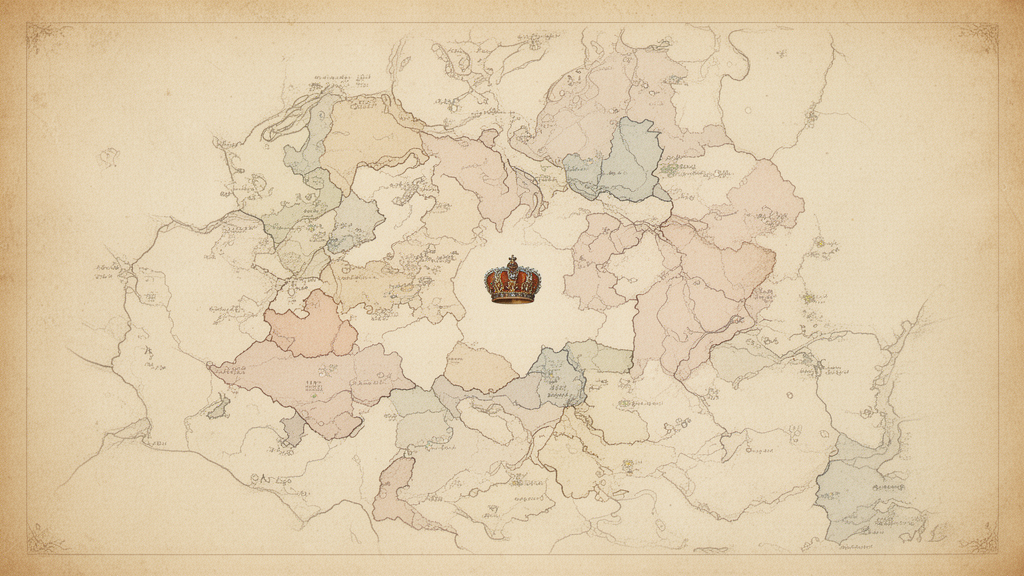
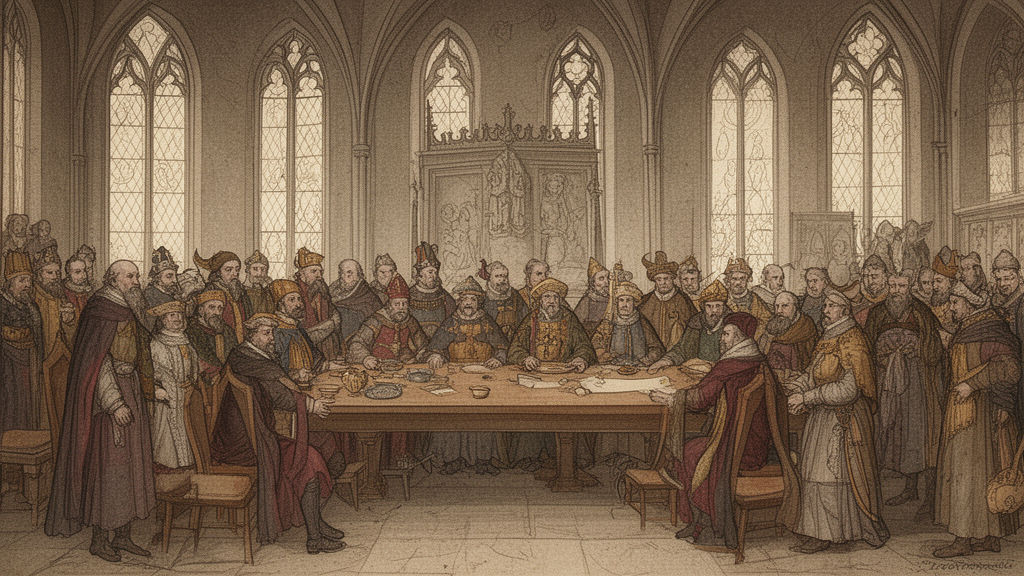
The Holy Roman Empire was a loose association of territories in Central Europe, and at various times parts of Western Europe, governed under an elected emperor. Historians Barbara Stollberg-Rilinger and Yair Mintzker describe it as a political body that emerged in the Middle Ages as a loosely integrated union of German states and city-states under the supreme rule of an emperor. Around 1500 it took on a more formal structure, with institutions such as the Reichstag and the Imperial Chamber Court, which endured more or less intact until Napoleon brought the empire to an end in 1806 (Princeton University Press publication record).
The empire is sometimes described with several names. Wikipedia notes that it was also known as the Holy Roman Empire of the German Nation after 1512, and that it controlled much of Central and Western Europe under a decentralized structure (Wikipedia: Holy Roman Empire). That longer name reflects a change in emphasis: the German-speaking lands became the core identity of the empire even though its boundaries were never fixed.
Why the name is misleading
Many readers assume the title means a Roman state ruled from a holy center. History.com makes a blunt point about this: the thousand-year-old empire ruled Europe without ever being truly holy, Roman, or an empire in the sense people usually expect (HISTORY: What Was the Holy Roman Empire?). The word “holy” reflected the empire’s close association with Christian rulership and the Church. The word “Roman” reflected a claim of continuity with the ancient Roman world and its imperial tradition. Neither term describes the empire’s everyday political reality.
The word “Reich” also carries special weight for German readers. Princeton University Press notes that the German word for “empire” immediately invokes the Third Reich, the Nazi dictatorship of 1933 to 1945, and that this association has shaped how the earlier German empires have been discussed. The Holy Roman Empire, the Second Empire (Imperial Germany), and the Nazi state are different historical entities, and treating them as one continuous story can distort the past (Princeton University Press: Introduction to The Holy Roman Empire).
Origins in the Early Middle Ages
Scholars do not agree on a single starting date. Wikipedia states that the empire developed in the Early Middle Ages, with its beginning given as either 800 or 962 depending on how the imperial title and its continuity are interpreted (Wikipedia: Holy Roman Empire). The year 800 is commonly linked to the coronation of Charlemagne as emperor, while 962 is linked to Otto I. Both dates appear in historical discussion, and the choice between them depends on what a historian considers the essential feature of the empire: the revival of an imperial title, or the continuous line of rulers who held it.
The early history of the empire is closely tied to the Carolingian world and the division of the Frankish realm that followed. Wikipedia’s structure of the article places the Carolingian Empire and the post-Carolingian Eastern Frankish Kingdom before the formation of the Holy Roman Empire, which indicates that historians see the empire as emerging from earlier Frankish political arrangements rather than appearing suddenly (Wikipedia: Holy Roman Empire). A reader who wants the detailed events of these centuries should consult the specialist works listed at the end of this article.
The High and Late Middle Ages
The empire did not remain static. The Wikipedia outline of the article identifies major phases including the Investiture Controversy, the Hohenstaufen dynasty, the Interregnum, and the rise of territories after the Hohenstaufens. These developments show a recurring pattern in the empire’s history: the emperor’s power could be strong under a capable dynasty, but it often weakened when rival princes, cities, or churchmen gained independent authority. The later medieval period is therefore best understood as a balance between imperial claims and the growing autonomy of regional powers.
Another important theme is imperial reform in the late Middle Ages. Historians use this term for a series of efforts to create lasting institutions that could manage disputes, collect funds, and keep the peace across a large and divided territory. Princeton’s summary of the book explains that the empire’s formal structure emerged around 1500 and included institutions designed to endure. These reforms did not turn the empire into a modern state, but they gave it a more regular structure than it had in earlier centuries (Princeton University Press publication record).
Institutions that shaped daily political life
The empire’s institutions are central to understanding its longevity. According to Princeton University Press, the Reichstag and the Imperial Chamber Court were among the powerful institutions established around 1500 that would endure more or less intact until 1806 (Princeton University Press publication record). The Reichstag was an assembly where imperial estates met to discuss common matters, and the Imperial Chamber Court handled legal disputes that could not be settled locally. These bodies gave the empire a shared framework without requiring a centralized bureaucracy.
The Wikipedia article lists other institutional categories, including imperial estates, the King of the Romans, the Imperial Diet, imperial courts, imperial circles, and an army. The presence of these headings shows how the empire was organized into layers of authority. The emperor was elected, the “King of the Romans” was a title associated with the successor-designate, and imperial circles grouped territories for regional administration and defense (Wikipedia: Holy Roman Empire). Readers who want the finer legal distinctions should check the full article and the specialist sources cited there.
A political body without a standing army or general taxation
Stollberg-Rilinger and Mintzker argue that comparing the empire to modern states can be misleading. The empire had no standing army, no clear boundaries, no general taxation, and no bureaucracy in the modern sense. Instead, it was a heterogeneous association based on tradition and shared purpose, held together by personal loyalty and reciprocity, and renewed through solemn rituals (Princeton University Press publication record).
This point helps explain why the empire could survive for so long. Its authority depended on relationships among rulers and on rules that were widely accepted, rather than on a single military or fiscal machine. When a prince, city, or church leader accepted imperial law, obligations, and ceremonies, the system continued. When these shared expectations broke down, the empire struggled to act decisively.
Princeton’s summary also notes that the book compares the empire not to the European Union or modern states, but to a political body unlike any other. This comparison is useful for readers who want to avoid assuming that the empire was an early version of a nation-state. It was a different kind of political order, and historians continue to debate how best to describe it.
Religion, Christianity, and the Reformation
The empire’s Christian identity shaped many of its conflicts. The Reformation of the sixteenth century, which divided Western Christianity, placed strain on an empire whose authority was connected to religious institutions and to the balance among princes. Princeton’s summary identifies the crisis of the Reformation as one of the major turning points in the period from the reform era at the dawn of the sixteenth century onward (Princeton University Press publication record). Wikipedia’s outline likewise lists Reformation and Renaissance as a distinct section in the empire’s history (Wikipedia: Holy Roman Empire).
For readers of this blog, it is worth noting that religious history in Europe cannot be reduced to one belief system or one institution. The empire included Catholic, Lutheran, and other Christian territories and communities, and the legal settlements that addressed these divisions shaped its later politics. Historians distinguish between religious doctrine, political practice, and the social experience of ordinary people, and this distinction is important when reading accounts of the period.
The Peace of Augsburg
Princeton’s summary refers to the consolidation of the Peace of Augsburg as part of the period the book covers (Princeton University Press publication record). The settlement was an attempt to manage confessional conflict within the empire through legal arrangements rather than general agreement. Its significance lies in showing how the empire responded to religious division by using institutions and negotiated rules, even when those arrangements did not solve every dispute.
War and rivalry in the early modern period
The early modern empire faced major conflicts. Princeton lists the destructive fury of the Thirty Years’ War as part of the book’s narrative, and it also points to the conflict between Austria and Prussia in the later period (Princeton University Press publication record). Wikipedia’s outline includes Baroque period and Modern period sections, with subsections on Prussia and Austria and on the French Revolutionary Wars and final dissolution (Wikipedia: Holy Roman Empire).
These conflicts reveal a central tension. The empire had institutions for negotiation and legal judgment, but it lacked a unified army or tax system that could compel obedience across all territories. Major territorial powers could use their own resources to pursue goals that the empire as a whole could not easily control. As a result, the rivalry between Austria and Prussia became a major theme of the later empire.
The end of the empire
The empire ended in the age of the French Revolution and the wars that followed. Princeton University Press states that the empire’s downfall came through Napoleon’s dissolution of the empire in 1806 (Princeton University Press publication record). History.com likewise gives the period of the empire as roughly A.D. 800 to 1806 (HISTORY: What Was the Holy Roman Empire?).
The dissolution did not mean that German-speaking lands disappeared. Many territories that had belonged to the empire continued as separate states, and the political map of Central Europe changed in complex ways. Readers should understand 1806 as the formal end of the imperial structure, not as the end of every political, cultural, or legal connection among the territories that had shared it.
How historians read the empire
Historians have long debated whether the Holy Roman Empire was a failed state. Princeton University Press describes the book by Stollberg-Rilinger and Mintzker as presenting an entirely new interpretation of the empire’s political culture and remarkably durable institutions. This framing shows a major shift in scholarship: rather than measuring the empire only by how far it fell short of later nation-states, historians have looked at the rules, rituals, and loyalties that allowed it to function for centuries.
There is also a broader historiographical issue. Older accounts sometimes portrayed the empire as weak, confused, or simply an ancestor of Germany. Recent scholarship tends to treat it on its own terms. Historians still disagree about how much unity the empire possessed, how much its institutions achieved, and how its legacy should be described. These are scholarly questions, and readers should distinguish them from traditional stories or popular summaries.
Examples that show the empire’s structure
A few examples make the empire’s structure easier to understand. First, the emperor was elected rather than born into a fixed succession, as History.com notes when describing a ruler chosen under an electoral system (HISTORY: What Was the Holy Roman Empire?). Second, the empire included kingdoms, duchies, and city-states, so a legal decision might involve a prince, a bishop, and an imperial city at once. Third, the Imperial Chamber Court gave disputants a way to seek judgment without immediately resorting to violence, which shows how institutional procedures could shape political behavior.
These examples show that the empire was not simply a map with one ruler at the top. It was a set of relationships, many of them formalized through law, ceremony, and shared obligations. The concept of reciprocity, highlighted in Princeton’s summary, helps explain why these relationships mattered (Princeton University Press publication record).
Further reading on the empire
For readers who want to explore the empire further, HindusGod.com has related draft articles on books about the Holy Roman Empire and on the empire’s 1495 to 1806 period. These links will become public only if the owner publishes those posts. Readers may also find the discussion of borders and freedom of movement useful for understanding how the empire’s territories were governed in practice.
- Books About the Holy Roman Empire (URL to confirm before publication, target draft)
- The Holy Roman Empire 1495 1806 (URL to confirm before publication, target draft)
- Heart of Europe a History of the Holy Roman Empire (URL to confirm before publication, target draft)
- Borders and Freedom of Movement in the Holy Roman Empire (URL to confirm before publication, target draft)
Frequently asked questions
Was the Holy Roman Empire really an empire?
It was called an empire and had an emperor, but its structure differed from modern empires and modern states. Its authority was shared among many territories and institutions, and historians describe it as a decentralized political body rather than a centralized state.
Why was it called holy and Roman?
The “holy” element connects the empire to its Christian identity, while “Roman” reflects a claim of continuity with the ancient Roman imperial tradition. History.com notes that the name does not describe the empire’s everyday reality with precision.
When did the Holy Roman Empire end?
It ended in 1806, when Napoleon brought the empire to an end. Earlier dates appear in discussions of its beginning, and historians debate whether 800 or 962 is the better starting point.
Summary and takeaway
The Holy Roman Empire was a long-lived and decentralized political order in Central and Western Europe. It combined an elected emperor, powerful institutions, shared legal traditions, and many semi-independent territories. It had no standing army, no general taxation, and no bureaucracy in the modern sense, yet it endured for centuries because its members accepted common rules and rituals. Its name is misleading, its beginning is debated, and its legacy is interpreted differently by historians. For readers, the most useful approach is to read the empire on its own terms, separating the names and myths from the documented institutions and events.
Sources and further reading
- Holy Roman Empire, Wikipedia: used for the general definition, the 800 or 962 starting dates, the Holy Roman Empire of the German Nation name after 1512, and the article’s outline of historical periods and institutions. Encyclopedic summary; check cited works listed on that page.
- The Holy Roman Empire: A Short History, Princeton University Press (Barbara Stollberg-Rilinger and Yair Mintzker, 2018): used for the book’s abstract on the empire’s institutions, the 1806 dissolution, the Peace of Augsburg, the Thirty Years’ War, and the interpretation of the empire’s political culture.
- Introduction, The Holy Roman Empire: A Short History, Princeton University Press: used for the note on the Nazi appropriation of imperial terminology and the Third Reich association.
- What Was the Holy Roman Empire?, HISTORY: used for the general territorial description, the roughly 800 to 1806 date range, and the remark on the empire’s name.
- The Holy Roman Empire: A Short History, JSTOR: listed as a possible further access point; the page did not load during inspection, so no claims are drawn from it.