The Taittiriya Upanishad is a principal Upanishad of the Krishna Yajurveda, and several Kannada editions of it are available for reading, listening, and study. This guide explains what the text is, how it is organized into three vallis, what its main teachings are, and what to check when you choose a Kannada edition. It separates what the text says from how later commentators and devotional communities interpret it.

In short: the Taittiriya Upanishad teaches that Brahman is reality, consciousness, and infinity, and it presents an ordered path of education, ethical discipline, and contemplation that leads toward that knowledge. Kannada readers can find the Sanskrit text in Kannada script, transliteration, and Kannada translation on several websites, but those editions differ in their layout and wording, so it helps to know which one you are reading. For the broader context of other Kannada Upanishad texts, see our Kannada Upanishad overview.
What the Taittiriya Upanishad is
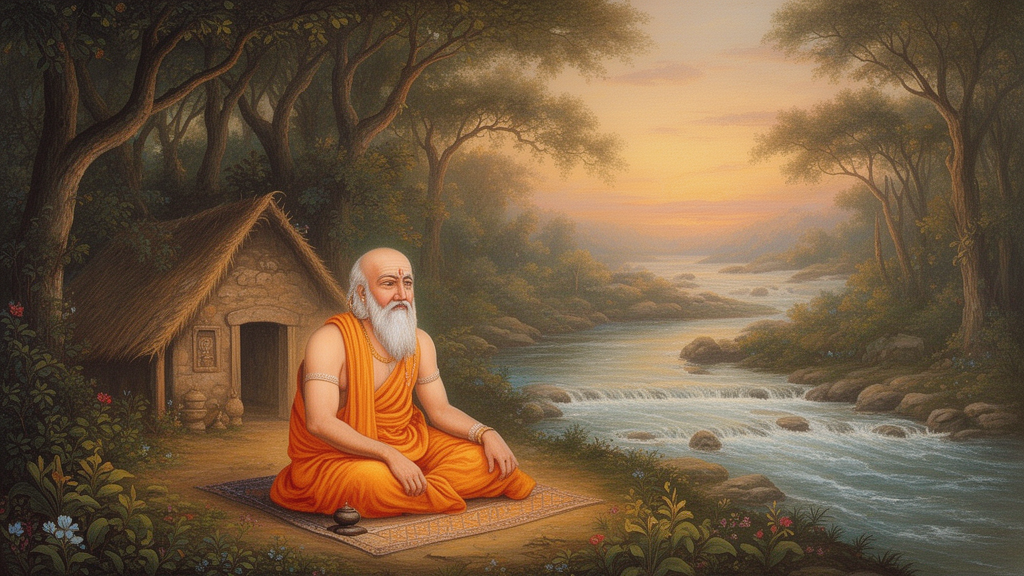
The Taittiriya Upanishad belongs to the Krishna Yajurveda, the Vedic collection associated with the Taittiriya school. According to the Vedapath Kannada page, it is one of the principal Upanishads of that Veda and is arranged in valli and anuvaka sections rather than as one continuous narrative.[5] The Stotra Nidhi Kannada edition labels its first section as Shikshavalli and cites it as part of the Taittiriya Aranyaka in its reference line, which is a useful reminder that Upanishadic texts are often discussed in relation to larger Vedic collections.[4]
It is worth separating three kinds of material that readers often encounter together:
- The Upanishadic text itself, in Sanskrit, which is the scripture.
- Kannada transliteration and translation, which are renderings made by editors or translators. They can be helpful, but they are not the scripture itself.
- Commentary and traditional interpretation, such as explanations associated with Advaita Vedanta and other schools, which add an interpretive layer.
When this guide describes teachings, it refers to what the text states in the editions consulted, and it marks interpretive claims as such.
The Taittiriya school and the Krishna Yajurveda
The Krishna Yajurveda is distinguished from the White (Shukla) Yajurveda in part by how its mantras and prose passages are combined. The Taittiriya school is one of its major branches. Readers should treat the textual history as a subject for specialist study. Publicly available sources describe the Taittiriya Upanishad as principal within this Veda, but the finer details of manuscript history, dating, and school transmission require scholarly works rather than devotional websites.
The three vallis at a glance
The Vedapath Kannada page divides the Upanishad into three vallis and gives a short description and verse count for each. Its counts add up to 83 verses in total, which matches its listing of the whole text.[5] The division below follows that source. Verse counts vary across editions, so use them as a guide to that page rather than as a universal standard.
- Shiksha Valli, the first valli, which the Vedapath page lists at 36 verses.[5]
- Brahmananda Valli, the second valli, listed at 32 verses and titled in the Kannada page as the valli describing Brahman as reality, consciousness, and infinity.[5]
- Bhrigu Valli, the third valli, listed at 15 verses, which presents a dialogue between Bhrigu and his father Varuna.[5]
Shiksha Valli: sound, discipline, and study
Shiksha Valli opens with the Shanti mantra and then turns to shiksha, the science of pronunciation. The Dharmsutra Kannada edition, which gives Sanskrit in Kannada script and a Kannada rendering, shows the opening lines that announce the subject: varna (sound units), svara (accent or tone), matra (measure or duration), bala (effort), sama (harmonic connection), and santana (continuity).[6] The Vedapath summary describes this valli as teaching pure pronunciation, self-study (svadhyaya), reverence for the teacher, and ethical discipline as preparation for knowledge of the self.[5]
This section is one of the reasons the Taittiriya Upanishad is often described as methodical. It does not begin with metaphysics. It begins with the physical act of reciting correctly, then moves to instruction on conduct. Readers who are new to Vedic recitation should note that traditional recitation is taught orally, from a teacher, and written transliteration cannot fully replace that training.
Brahmananda Valli: Brahman and the layered self
The second valli is widely discussed for its definition of Brahman. The Vedapath page summarizes it through the phrase satyam jnanam anantam brahma, meaning Brahman as reality, consciousness or knowledge, and infinity.[5] The same page describes a teaching on the five sheaths (panchakosha) and an analysis of bliss (ananda) that leads toward the highest.[5]
The panchakosha teaching is one of the best-known parts of the Upanishad. The Vedapath summary names the five sheaths as annamaya (food-sheath), pranamaya (vital-breath sheath), manomaya (mental sheath), vijnanamaya (discriminative or intellectual sheath), and anandamaya (bliss sheath).[5] The Upanishad uses these layers as a way of moving from the gross body toward the inner self. Teachers in different traditions have read this model in different ways, so it is best presented here as a structure described by the text and expanded by commentators.
Bhrigu Valli: inquiry and realization
The third valli narrates a dialogue in which the sage Bhrigu approaches his father Varuna to learn about Brahman. According to the Vedapath summary, Varuna tells him to seek truth through austerity and meditation, and Bhrigu gradually identifies food, breath, mind, knowledge, and bliss as Brahman.[5] The valli ends with the conclusion that bliss is the supreme truth. The Vedapath page frames this as a movement from the gross to the subtle, with the teaching that experiential verification follows repeated inquiry.[5]
Bhrigu Valli is often read as a pedagogical model: a student questions, reflects, and tests what he has learned. This reading is a common interpretation, and the text presents the sequence as a dialogue rather than as a set of formal rules.
Taittiriya Upanishad in Kannada: what to check in an edition
Kannada readers may find several editions online, including those on Vedapath, Stotra Nidhi, Dharmsutra, and Vaidika Vignanam. The editions differ in several ways, and each is worth checking before you rely on it for study or recitation.
Script, transliteration, and the presentation of the text
Some editions present the Sanskrit in Kannada script, while others show Devanagari, IAST transliteration, or a bilingual layout. The Stotra Nidhi page, for example, offers reading options in several scripts and labels its section as Shikshavalli.[4] The Dharmsutra page shows Sanskrit in Kannada script with Kannada translation and includes accent-like marks in its displayed text.[6] These presentational differences matter. A Kannada script edition can make pronunciation harder to follow for a reader who expects IAST, and the reverse is also true.
When you compare editions, check three things: whether the Sanskrit is complete, whether the anuvaka and valli numbering is shown, and whether the translation is labeled and attributed.
Translation notes
A Kannada translation is a rendering, and translations of Upanishadic text involve interpretive choices. Words such as Brahman, atman, and ananda have technical meanings in different philosophical traditions. A translation may choose a Kannada word that works in one context but is less precise in another. The Vedapath page gives Kannada translations alongside the Sanskrit and transliteration, which is useful for comparison, but readers should look for the translator or publisher and, where possible, compare with a scholarly English or Sanskrit reference.
Recitation and audio
Recitation is a traditional practice, and many people learn the text by listening to a teacher. Audio resources can help with rhythm and pronunciation, but they vary in quality and in the style of recitation. If you are learning to chant, a qualified teacher from your own lineage or community is the most reliable guide, because chanting customs differ between families and schools.
Key teachings explained in context
The Taittiriya Upanishad covers several themes. The list below describes what the text says and marks where interpretation begins.
- Shanti mantra: the opening peace prayer, invoking Mitra, Varuna, Aryaman, Indra, Brihaspati, and Vishnu for well-being.
- Brahman as satyam, jnanam, anantam: the defining formula of Brahmananda Valli.
- Panchakosha: the five-sheath model used to move inward from the physical body.
- Ananda mimamsa: a graded analysis of bliss leading to its highest form.
- Ethical discipline: instruction on truthfulness, righteousness, self-control, and study.
The Shanti mantra
The Upanishad begins with a peace invocation. The Dharmsutra and Stotra Nidhi editions both show the opening prayer, which asks that Mitra, Varuna, Aryaman, Indra, Brihaspati, and Vishnu be auspicious for the reciter.[4][6] The Vedapath summary describes this opening as establishing inner and outer peace as a prerequisite for the knowledge of Brahman.[5] That description is a helpful summary of the editorial framing, and readers may treat the emphasis on peace as one reading of the text among others.
The mantra also contains a short passage addressing Vayu as pratyaksha Brahman, meaning Brahman that is directly perceptible, and a commitment to speak rita and satya, the right and the true.[5][6] Commentators have discussed these lines in several ways. The Vedapath page links them to disciplines of speech, which is one reasonable reading.
The five sheaths and the inward path
The panchakosha teaching presents the self as covered by successive layers. Starting with annamaya, the physical body formed from food, the text moves through the vital breath, mind, intellect, and bliss.[5] For devotees and students, this framework often becomes a practical guide to self-observation. The text itself describes the layers; it does not offer a fixed meditation technique, and different teachers present different methods.
Ananda mimamsa and the highest bliss
The Brahmananda Valli includes a graded description of bliss, sometimes described in translations as a series of measures of joy. The Vedapath summary calls this an analysis of bliss culminating in Brahman.[5] Readers encountering this section for the first time should read the original passage and a reliable translation together, since the wording is precise and technical.
Ethical instruction: satyam vada, dharmam chara
The phrase satyam vada, dharmam chara, meaning speak the truth and practice righteousness, is one of the best-known lines associated with the Taittiriya Upanishad. The Vedapath page describes it as a well-known teaching in the context of the samavartana, the instruction given as a student completes studies and prepares to return to household life.[5] The text places ethics alongside study and reverence for the teacher, which is why the Vedapath summary presents Shiksha Valli as ethical as well as phonetic.[5]
This is an area where readers should be careful about overgeneralizing. The phrase is part of a traditional educational setting, and its meaning in daily life is an application that families and communities develop in different ways.
How to read a passage step by step
For readers who want to study a section rather than read it all at once, the following method can help. It is a study approach, not a traditional ritual instruction.
- Choose one valli and one anuvaka. Begin with a short section such as the opening of Shiksha Valli, which is the first anuvaka and contains the Shanti mantra.
- Read the Sanskrit in your preferred script. If you are unfamiliar with Kannada script for Sanskrit, compare the same passage in transliteration.
- Read a translation and note who produced it. Record the editor or translator, the edition, and the date if given.
- Identify key terms. Words such as Brahman, atman, ananda, and sadhana appear repeatedly. Keep a short glossary and note how each translation renders them.
- Separate text from commentary. When you read an explanation, mark whether it is the Upanishad speaking or a later teacher interpreting it.
- Check a second source. If two editions differ on a word or line, consult a scholarly reference or a teacher.
Scholarly and devotional perspectives
The Taittiriya Upanishad is studied in several ways. Devotional communities often recite it as part of their regular practice, and many families regard it as a text to be learned orally with a teacher. Philosophers have read it as a source for Vedanta, and commentators in different schools have developed their own interpretations of Brahman, the five sheaths, and the ethical instruction. Academic scholars study its language, structure, and place within the Krishna Yajurveda.
These perspectives overlap, but they are not the same. A devotional reading may treat a passage as a living spiritual instruction. A scholarly reading may focus on how the text is organized or how its vocabulary developed. Neither approach makes the other unnecessary. Readers can benefit from both, provided they know which one they are using at any moment.
Regional and community practices also differ. Kannada-speaking families may learn the Upanishad through local teachers, printed editions, or recordings, and their chanting styles and study customs may vary. Where a practice is specific to a family, school, or region, it is best described as tradition-specific rather than universal.
Taittiriya Upanishad and other Kannada Upanishad guides on HindusGod.com
If you are comparing this Upanishad with others, the following pages may help. Each page addresses a different text or question.
- For a general introduction to the Taittiriya Upanishad, see Taittiriya Upanishad.
- For an explanation of the meaning of the text, see Taittiriya Upanishad Meaning.
- For the English-language version, see Taittiriya Upanishad English.
- For the Sanskrit-focused guide, see Taittiriya Upanishad Sanskrit.
- For online reading options, see Taittiriya Upanishad Online.
- For comparable Kannada texts, see Aitareya Upanishad in Kannada, Brihadaranyaka Upanishad in Kannada, Isha Upanishad in Kannada, and Katha Upanishad in Kannada.
- For readers who want translations in other languages, see Taittiriya Upanishad in Hindi, Taittiriya Upanishad in Bengali, and Taittiriya Upanishad in Telugu.
Frequently asked questions
Is the Taittiriya Upanishad available in Kannada?
Yes. Several websites publish Kannada editions, including pages that show Sanskrit in Kannada script with Kannada translation. Quality, completeness, and attribution vary, so compare more than one edition before relying on a particular text.
How many vallis does the Taittiriya Upanishad have?
The text is commonly divided into three vallis: Shiksha Valli, Brahmananda Valli, and Bhrigu Valli. The Vedapath Kannada page describes this three-part division and lists verse counts that total 83.[5]
What is the main teaching of the Taittiriya Upanishad?
The best-known teaching is the description of Brahman as satyam, jnanam, and anantam, meaning reality, consciousness or knowledge, and infinity.[5] The Upanishad also teaches the panchakosha model of the self and ethical discipline as preparation for knowledge.
Should I learn the chanting from a book or audio?
Books and recordings can help you study the text, but chanting is traditionally learned from a qualified teacher. Customs differ by family, school, and region, so a teacher from your own tradition is the most reliable guide for pronunciation and recitation.
Sources and further reading
- Taittiriya Upanishad in Kannada, Vedapath: used for the valli structure, verse counts, key teaching summaries, and the Kannada overview.
- Taittiriya Upanishad Shikshavalli, Stotra Nidhi: used for the Shikshavalli Kannada edition and the Shanti mantra text as presented on the page.
- Taittiriya Upanishad in Kannada, Dharmsutra: used for the opening Shiksha Valli lines and the Mahasamhita passage as presented on the page.
- Taittiriya Upanishad Shiksha Valli, Vaidika Vignanam: listed as a further edition; its contents were not inspected for this draft.
- ತೈತ್ತಿರೀಯೋಪನಿಷತ್, Kannada Wikipedia: listed for general orientation; its contents were not inspected for this draft.
Key takeaway
The Taittiriya Upanishad combines careful instruction in sound and conduct with a philosophical account of Brahman and the self. A Kannada edition can make the text accessible, but the most useful reading comes from comparing editions, separating scripture from translation and commentary, and learning recitation from a qualified teacher. Start with Shiksha Valli, keep notes on key terms, and move to the later valli once the structure is clear.