The Svetasvatara Upanishad is a short Sanskrit scripture of six chapters, or adhyayas, that asks what the ultimate cause of the universe is and answers that it is a single divine principle, the Lord (Ishvara), who is also the inner Self of all beings. Reading it online is useful because many versions are available, but they differ in language, commentary, and tradition. This guide explains the text’s structure and main ideas, shows how to check translations and verse numbers, and separates what the scripture says from later commentary and devotional interpretation.
Quick answer: what the Svetasvatara Upanishad teaches

The Svetasvatara Upanishad opens with a question: what is Brahman, the ultimate reality, and what is its relationship to the world, to life, and to suffering? It rejects time, nature, chance, the elements, and the individual soul, taken singly or together, as sufficient causes. It then presents a personal God, Ishvara, as the power behind all causes and as the hidden witness within every being. Liberation is described as the recognition of this presence through meditation, devotion, and clear knowledge.
The source material supports this summary. The Hinduwebsite.com translation page describes the text as a Shaiva Upanishad that investigates the cause of the universe, rejects time, chance, and nature as ultimate explanations, and introduces Ishvara as the ruler of both the perishable and the imperishable (Hinduwebsite.com, Svetasvatara Upanishad translation).
What the Svetasvatara Upanishad is
Its place in the Upanishadic literature
The Upanishads are part of the Vedic corpus and are usually called Vedanta, meaning the end or culmination of the Veda, because they are often read as the philosophical conclusion of Vedic thought. The Svetasvatara Upanishad belongs to this group. The Darshya.online summary places it in the Krishna Yajur Veda, associating it with the Taittiriya school and appending it to its Aranyaka (Darshya.online, Svetasvatara Upanishad summary). Other traditions and editions may classify the text differently, so readers who need precise textual classification should check a scholarly edition.
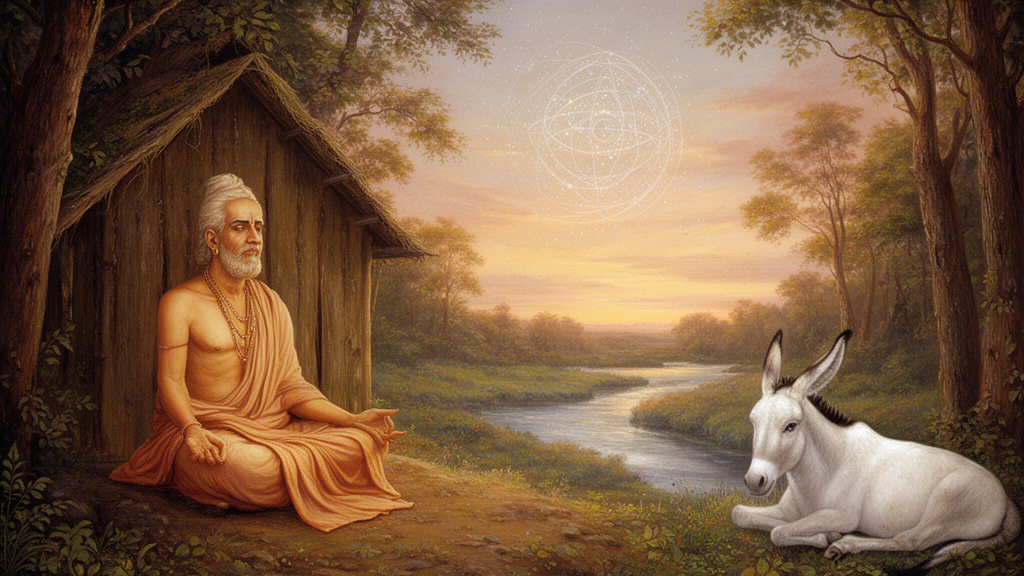
The name is traditionally linked to the sage Svetasvatara, whose name the summary translates as “of the white mule.” Readers should treat that as the name given in the tradition and in the modern summaries, not as a historical biography of a known person.
The six adhyayas
The text is divided into six chapters. The Hinduwebsite.com page presents Max Muller’s English translation of all six adhyayas and lists them as separate sections, from the First to the Sixth Adhyaya (Hinduwebsite.com). The chapters move from the opening question about causes, through cosmological images and meditative practice, to a fuller account of the Lord as the inner witness and the source of liberation.
The commonly cited total of 113 mantras appears in the Darshya.online summary (Darshya.online). Verse counts can vary between editions because of how numbering, prose passages, and repeated lines are handled. When you compare online versions, check whether the numbering system matches before assuming a verse is missing or different.
Reading the text online: translations, editions, and transliteration
Choosing a translation
Online readers usually meet three kinds of presentation: an English translation with little or no commentary, a Sanskrit text with transliteration and English, and a commentary or lecture-based presentation. Each serves a different purpose. A plain translation helps with first reading. A Sanskrit edition is useful for checking chapter and verse numbers and for comparing wording. A commentary shows how a later teacher or school read the text, which may not be the same as the verse’s original sense.
- Translation pages such as the Hinduwebsite.com version present a named translator, in this case Max Muller, which helps you identify the source of the English wording.
- Sanskrit and transliteration pages, such as the Shastram.org page, show the Devanagari text, a romanized transliteration, and an English rendering for each verse. This format is useful for checking word-level meaning against the original.
- Digitized print editions, such as the 1916 edition by S. Varma Shastri listed on the Internet Archive, let you compare wording with an earlier published text. The archive page is a catalogue record and does not by itself prove the accuracy of its contents, so use it as a reference for checking edition details (Internet Archive, The Svetasvatara Upanisad 1916).
Transliteration and spelling
You will see several spellings of the title. “Svetasvatara”, “Shvetashvatara”, and “Svetasvatara Upanisad” all refer to the same scripture. The Sanskrit Documents collection uses the form “Shvetashvatara Upanishad” in its English title, and its transliteration follows a different system from the Shastram.org page. Diacritics, such as the macron in ā and the dot under ṣ, change the romanized form but not the word. If you search across sites, try several spellings. For reading, choose one spelling and keep it consistent in notes.
Here is an example from the opening verse as it appears on the Shastram.org page. The Sanskrit line “kiṃ kāraṇaṃ brahma kutaḥ sma jātā” (“What is the cause, Brahman? From where were we born?”) is a question posed by the expounders of Brahman. The Devanagari and transliteration are shown together on that page, which makes checking the wording straightforward.
The main themes of the Svetasvatara Upanishad
The question of the cause (1.1–1.2)
The first chapter begins with the question of Brahman as the cause of the universe. The Shastram.org translation renders the opening lines as questions about where life comes from, what sustains it, where it rests, and under whose direction we live in happiness and misery (Shastram.org, Svetasvatara Upanishad 1.1).
Verse 1.2 then considers candidate causes: time, one’s own nature, law or necessity, chance, the elements, and the soul or person. The verse states that none of these can be the cause alone, nor can their combination, and that the soul is also not the cause because it is subject to pleasure and pain. This is a philosophical argument within the text. It prepares the ground for the claim that the cause must be something beyond these limited factors (Shastram.org).
This section matters because it shows the text’s method. It asks questions, rules out possibilities, and then searches for a deeper source through meditation. Readers who expect a direct statement of doctrine in the first lines will find a process of reasoning instead.
Yoga, meditation, and the hidden power
Verse 1.3 describes sages who, using meditation and concentration, perceive a hidden power of the self-luminous Lord. The Shastram.org translation says this power is covered by its own attributes and governs all causes, including time and the individual soul (Shastram.org). The reference to dhyana yoga, meaning disciplined meditation, is one of several places where the text links knowledge of the divine with practice.
Readers sometimes connect this language with later systematic yoga. Darshya.online describes the Upanishad as containing an early seed of astanga-yoga, including posture, breath, and withdrawal of the senses, in its later chapters (Darshya.online). That is a modern summary and a comparative claim. Scholars may describe the relationship between this text and later yoga traditions in different ways, so present such connections as interpretation rather than as a settled historical fact.
The cosmic wheel and the river of life
The Hinduwebsite.com introduction notes that the text uses symbolic imagery, including the cosmic wheel, the river of life, and the hidden fire, to illustrate the relationship between the Self and the divine (Hinduwebsite.com). These images are central to understanding the text’s style.
Verse 1.4 describes a wheel with many parts and bonds, a complex image of cosmic structure. Verse 1.5 describes a river with five currents, five whirlpools, and waves made of the five breaths, a symbol of the flow of life and suffering (Shastram.org). These are not literal diagrams. They are teaching images, and different commentaries have explained the numbers and categories in different ways. A practical approach is to read the images first as symbols of the changing world and then consult a commentary if you need the traditional details.
Verse 1.6 uses the image of a swan, or hamsa, wandering within a wheel of Brahman. The Shastram.org rendering gives the sense that, by recognizing the Lord as distinct from the self and as the one who inspires, a person becomes free and attains immortality, the final phrase of the verse in Sanskrit (Shastram.org). The page’s English rendering of the last lines is incomplete in the portion reviewed, so check the full verse on the page before quoting it.
The Lord as inner witness
A central teaching of the Upanishad is that the Lord is hidden within all beings and is their inner Self. Hinduwebsite.com states that the text emphasizes meditation, devotion, and the recognition of the Lord as the inner Self, and that liberation arises when one perceives this divine presence in all beings and transcends ignorance (Hinduwebsite.com).
The Darshya.online summary highlights a famous verse, 6.11, which it renders in Sanskrit and English as one God hidden in all beings, all-pervading, the inner Self of all, overseer of action, dwelling in all beings, the witness, the knower, alone and beyond the gunas. The page gives the mahavakya “eko devaḥ sarva-bhūteṣu gūḍhaḥ” (“one God hidden in all beings”). Because this verse is widely quoted, check it against a Sanskrit edition with a verse number before you cite it in your own writing (Darshya.online).
In practice, this is where the text moves from cosmic questions to personal relationship. A reader who begins with the question of the cause may end with the question of how the Lord is known within the self. That shift is why the Upanishad is often used in discussions of devotion and meditation.
Shaiva and Rudra-Shiva: how the text is read in tradition
The Svetasvatara Upanishad is often described as Shaiva because of its emphasis on Rudra-Shiva as the Supreme. The Hinduwebsite.com introduction calls it decidedly a Shaiva Upanishad (Hinduwebsite.com). The Darshya.online summary says the Upanishad worships Rudra-Shiva as the Supreme Brahman and identifies Rudra as both Brahman and Ishvara (Darshya.online).
These are descriptions from two online sources, and they reflect a particular reading. Other readers, including many Vaishnava and Smarta interpreters, may read the text’s language about the Lord in different ways, emphasizing its general theism or its teaching on Brahman. The Hindu tradition is not uniform on which deity this text best expresses. For devotional readers, the name Shiva may be central. For philosophical readers, the emphasis may be on Ishvara, the personal God, without a sectarian identification. Respectful reading includes noting this difference rather than presenting one sectarian reading as universal.
Belief, text, tradition, and scholarship
Readers benefit from keeping four categories separate when they study this Upanishad:
- The text: what the verses say in Sanskrit and in a specified translation.
- Tradition: how particular schools, lineages, and communities have recited, interpreted, and used the text in worship and study.
- Devotional belief: what a reader or community holds about the Lord, the Self, and liberation.
- Scholarship: historical, linguistic, and comparative analysis of when and how the text developed.
For example, the statement that the text “introduces Ishvara” is a reading of the text’s content. The claim that it is the earliest Upanishad to worship a personal deity is a comparative historical claim that appears in the Darshya.online summary. The Hinduwebsite.com and Shastram.org pages do not establish that claim, and academic dating of Upanishads is complex. Presenting it as settled would overstate the evidence. Treat it as a claim to examine in scholarly literature before repeating it.
Similarly, the statement that Krishna Yajur Veda is the textual family is based on the Darshya.online summary. Readers who need school-level detail, the exact Aranyaka connection, or the history of manuscript transmission should consult specialist editions and academic introductions.
Practical guide: how to study the Svetasvatara Upanishad online
A simple reading method helps readers move from a first look to a more careful study.
- Start with a clear translation. Read one chapter in English, noting the translator and the source page.
- Check the Sanskrit for key terms. Compare words such as Brahman, Ishvara, Rudra, gunas, and Self (atman) across the translation and a transliterated edition.
- Mark the verse numbers. Use a consistent numbering system, such as chapter.verse, so you can return to the same passage in another edition.
- Note the images. Keep a list of wheel, river, swan, and fire imagery and where each appears.
- Consult commentary separately. Record commentary in its own notes, labeled with the teacher or tradition.
- Check later claims. When an online summary states a date, ranking, or comparison, look for a scholarly source before repeating it.
For readers who prefer a Hindi, Tamil, or Sanskrit approach, HindusGod.com has related pages that may help. The Svetasvatara Upanishad in Hindi page, the Svetasvatara Upanishad in Tamil page, and the Svetasvatara Upanishad Sanskrit page are separate destinations, so choose the one that matches your reading language. Note that these pages are drafts in the current WordPress system and may not be public until the owner publishes them.
How the Svetasvatara Upanishad fits within the wider Upanishad collection
Readers who explore the Svetasvatara Upanishad often want to compare it with other Upanishads. Its focus on a personal Lord and its use of yoga and meditation distinguish it from some of the earlier prose Upanishads, but it shares the broader inquiry into Brahman, Self, and liberation. A useful comparison is to read it alongside the Brihadaranyaka Upanishad Online and the Chandogya Upanishad Online, both of which also discuss Brahman and Self in different literary styles. For a short comparison of the Upanishad tradition as a whole, the Meaning of Upanishad page provides context for the term itself.
Another useful comparison is the Mandukya Upanishad Online, which is one of the shorter texts associated with meditation on the syllable Om. Many readers approach the Mandukya first because of its brevity, then move to the Svetasvatara for its wider cosmic and devotional imagery.
For a broader hub, the Online Upanishad page gives an overview of the collection, and the 10 Upanishad and Aitareya Upanishad pages show how different texts are grouped and named in common usage. The Advaita Upanishad page may be useful for readers who want to study the non-dual interpretations associated with the wider tradition. Each of these is a draft destination; check its publication status before linking to it from a public page.
The Online Upanishad in Hindi and Taittiriya Upanishad Online pages are also relevant for readers studying the Krishna Yajur Veda family, since the Taittiriya school is connected in the Darshya.online summary with the Svetasvatara’s appended Aranyaka context. Verify that connection in an academic source before relying on it in an essay.
Frequently asked questions
Is the Svetasvatara Upanishad a Shaiva text?
Several online sources describe it as Shaiva because it presents Rudra-Shiva as the Supreme Brahman and gives a central place to Ishvara. The Hinduwebsite.com page calls it decidedly Shaiva. Other Hindu readers may emphasize its teaching on the one God without identifying that God with a single sectarian name, so present the text as having Shaiva themes that are read differently across traditions.
How many chapters and verses does it have?
The text has six adhyayas. The Darshya.online summary gives 113 mantras, and the Hinduwebsite.com page lists six chapters. Verse numbering can vary across editions, so verify the numbering system before citing a verse.
Which verse is most often quoted?
Verse 6.11, the “one God hidden in all beings” verse, is widely cited and is highlighted in the Darshya.online summary. For a formal citation, confirm the wording against a Sanskrit edition and a named translation.
Should I read it in Sanskrit or in translation?
Both have value. Translation makes the argument accessible, while Sanskrit lets you check terms and structure. Many readers use a translation first and then compare key verses with transliterated Sanskrit.
Does reading the text guarantee a spiritual result?
The text describes liberation as the recognition of the Lord within all beings, a teaching that belongs to Upanishadic philosophy and to the traditions that interpret it. Study and meditation are presented in the text as means of knowledge. No online article can promise a specific personal outcome, and readers should approach the text as a scriptural and devotional source rather than as a guarantee of results.
Closing takeaway
The Svetasvatara Upanishad is best read in steps. Begin with the opening question about the cause of the universe, follow the argument that rules out time, nature, chance, and the individual soul as sufficient causes, and then notice the turn toward the Lord as the hidden witness within all beings. Use online translations and Sanskrit editions together, check verse numbers, and keep commentary separate from the text. When you explore related HindusGod.com pages, choose the language and depth that suit your study.
Sources and further reading
- Hinduwebsite.com, Svetasvatara Upanishad: Complete Translation and Analysis. Supports the six-chapter structure, the translator attribution to Max Muller, the description of the text as Shaiva, the introduction of Ishvara, and the imagery of the wheel, river, and hidden fire.
- Shastram.org, Svetasvatara Upanishad Translation, Commentary, and Lectures. Supports the Sanskrit text with transliteration and English for verses 1.1 to 1.6, including the question of the cause, the rejection of time, nature, and chance, the meditative perception of the hidden power, and the river and wheel imagery.
- Darshya.online, Svetasvatara Upanishad Summary and Key Verses. Supports the Krishna Yajur Veda association, the 113-mantra count, the Rudra-Shiva emphasis, and the rendering of verse 6.11. Its comparative and historical claims should be checked against scholarly sources.
- Internet Archive, The Svetasvatara Upanisad 1916 by S. Varma Shastri. Supports the existence of a digitized 1916 edition for reference. Verify the scanned text before quoting it.