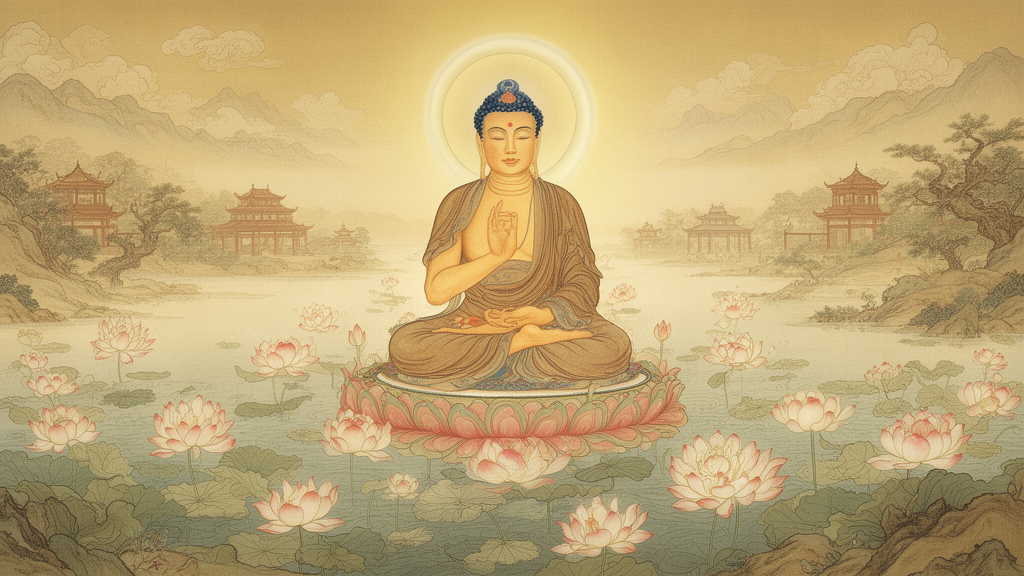
The Sukhavati Vyuha Sutra is a Mahayana Buddhist scripture that describes the Pure Land of Sukhavati, the “land of bliss” presided over by the Buddha Amitabha. Its best-known form, the Larger Sukhavati Vyuha, tells the past-life story of a monk named Dharmakara, who makes a set of Original Vows that lead to the creation of that Pure Land. The sutra is one of the central scriptures of East Asian Pure Land Buddhism and is still chanted widely across Asia. It is a Buddhist text, not a Hindu scripture, but it is studied by many readers interested in Indian religious literature, and it sits close to several Buddhist works discussed on this site.
This article explains the title and its terms, outlines the story and teaching as presented in the text, describes the main editions and translations that readers can consult, and separates what the sutra itself says from later tradition and scholarly interpretation.
Direct answer: what the Sukhavati Vyuha Sutra is
The sutra is a Mahayana Buddhist discourse. Its Sanskrit title is usually rendered in English as the “Array of Sukhavati” or the “Description of Sukhavati, the Land of Bliss.” Another common English name is the Amitayus Sutra, or the “Sutra of Immeasurable Life,” which refers to Amitabha’s alternative name, Amitayus, meaning “Measureless Life.” According to the Wikipedia entry on the text, it is one of two Indian Mahayana sutras that survive in Sanskrit and describe the Pure Land of Amitabha; the other is the shorter Amitabha Sutra.
In short, the sutra answers two questions for its readers: who Amitabha is in the Buddhist cosmos, and how a being can be reborn into the Pure Land where that Buddha teaches. Its story of Dharmakara is the core of that answer.
What the title means
The title has three parts that readers often encounter in different forms, so it helps to be clear about them.
- Sukhavati is usually translated as “land of bliss” or “blissful land.” It names the Pure Land described in the text.
- Vyuha is commonly translated as “array,” “arrangement,” or “description.” The Wikipedia article on the Amitabha-related texts gives “Array of Amitabha” as an alternative title, and the Huntington Archive’s English translation of the Larger text uses the title “Description of Sukhavati, the Land of Bliss.”
- Sutra means a discourse attributed to the Buddha.
Because several English forms exist, readers may see “Sukhavativyuha,” “Sukhāvatīvyūha,” “Sukhavati-vyuha,” or “Sukhavati Vyuha” in catalogues and web pages. These variants refer to the same tradition. The site’s own spelling for this post is “Sukhavati Vyuha Sutra,” with diacritics kept in the sources cited below.
The two Sukhavati sutras
Readers should know that there are two closely related texts. The Wikipedia entry on the Sukhavati Vyuha Sutra describes the larger work as also known as the Amitayus Sutra and the Amitabhavyuha. The Amitabha Sutra is the shorter companion text. Both describe the Pure Land of Amitabha, but they differ in length and in how much narrative they include.
When someone says “Sukhavati Sutra,” they may mean either one. This is one reason scholars and practitioners often name the work specifically, such as the Larger Sukhavati Vyuha or the Amitayus Sutra. For a related keyword discussion, see the site’s draft pages on the Sukhavati Sutra and the Amida Sutra, which deal with overlapping names for Amitabha-centred texts. (URL status: these are WordPress drafts and may not yet be public.)
Why the distinction matters
A reader who searches for a summary of the Amitabha Sutra and finds a summary of the Larger text may encounter different details, such as the length of the narrative and the presence of the Dharmakara story. Naming the specific text avoids confusion and makes it easier to check the claims against an edition.
The story of Dharmakara and the Original Vows
The central narrative of the Larger text concerns Dharmakara, a bodhisattva, which in Mahayana usage is a being on the path toward Buddhahood who vows to help other beings. According to the Wikipedia article on the Amitayus Sutra, this text contains the past-life tale of Dharmakara, who later becomes the Buddha Amitabha. The same article states that the sutra explains how Dharmakara gave rise to the Original Vows, and that these vows led to the creation of the Pure Land of Sukhavati.
The Wisdom Library summary of the Larger Sukhavativyuha Sutra describes the text as a discourse by Shakyamuni Buddha that reveals Amida Buddha as a savior of all beings through the power of his great vows. This summary is a secondary description on a reference website, not a translation of the text itself, but it supports the general framing that the vows are central to the work.
How to read the vows
The vows are best understood as statements of intent by a future Buddha. In the story as summarised by these sources, they describe the kind of Pure Land Dharmakara wishes to establish and the conditions under which beings may be reborn there. Readers who want the exact wording of each vow should consult a full translation, because paraphrases in articles like this one can easily drop nuances that matter to the tradition.
This article does not quote the vows. Where a specific formulation is needed, readers should use a translation and check its attribution, since translations differ in their renderings of key terms.
What the Pure Land of Sukhavati is described as
The sutra presents Sukhavati as a land of bliss created through Dharmakara’s vows and the accumulated merit of his practice. The title of the Huntington Archive’s English translation of the Larger text uses the phrase “Description of Sukhavati, the Land of Bliss,” which reflects the text’s focus on describing the land itself. The Wisdom Library summary frames the work as revealing Amida Buddha’s saving power, so the text is as much about the Buddha’s role as about the physical or spiritual features of the land.
Readers should treat any detailed description of the land’s ornaments, lotuses, birds, or light as a matter of what a specific edition says. These details vary in translation and commentary, and this article does not present them as settled features unless verified in a full text.
Devotional reading and textual description
In Pure Land practice, the description of Sukhavati often serves a devotional purpose. It gives practitioners a vivid image of the goal of their practice and a reason to trust the Buddha’s promise. Scholars, however, read the same passages as literary and doctrinal texts. Both readings are valid, but they answer different questions: one asks what the text inspires, the other asks what the text says and how it was composed.
Why the sutra matters in East Asian Pure Land Buddhism
The Wikipedia article on the Larger text states that the sutra is one of the three central scriptures of East Asian Pure Land Buddhism. It is also described as widely revered and chanted by Pure Land Buddhists throughout Asia. These are useful statements about the tradition’s use of the text, and they are attributed to the Wikipedia summary, which in turn refers to the wider tradition. Readers who want the historical development of the three-scripture arrangement should consult specialist studies of Pure Land history.
Chanting is an important part of this practice. Within the tradition, chanting the name of Amitabha or reciting the text is a devotional act. Practices differ between schools and regions, and many communities combine textual study, recitation, and meditation in different proportions. This article does not describe a single required ritual form.
Practice in context
- Study: Readers approach the text through translation and commentary to understand the vows and the description of the land.
- Recitation: Many communities chant the sutra or its key names as an act of devotion.
- Devotion: The Buddha Amitabha is the object of faith and aspiration in these practices.
These are general categories, not a prescribed sequence. Local teachers and temples may emphasise different aspects, and a reader should follow guidance from a teacher within a tradition when adopting a practice.
Texts, editions, and translations
Several resources are useful for readers who want to check the text directly. Each serves a different purpose, and none should be treated as the only version.
The Sanskrit tradition
The Wikipedia entry states that both Sukhavati texts survive in Sanskrit, which makes the Sanskrit tradition important for scholars comparing readings. Students who want to work with the Sanskrit should consult a critical edition and an academic commentary rather than relying on secondary summaries.
English translations and archive copies
The Huntington Archive hosts a PDF of an English translation of the Larger Sukhavati-vyuha, titled “Description of Sukhavati, the Land of Bliss.” It begins with the traditional homage to the Three Treasures. This is a useful entry point for readers who want to see an English rendering, though the editorial status and translator’s notes should be checked on the source itself.
The Internet Archive also holds a record titled “The Sukhavativyuha Sutra” by Hoshu Y. Matsubayashi, which can be consulted for a scholarly English text when available. The catalogue page was inspected for this article, but its content was limited to the archive’s interface, so readers should verify the specific edition and its terms of use on the record page.
Full text online
The Wisdom Library states that the full text of “The Larger Sukhavativyuha Sutra” in English is available online, and it lists the work’s length as 17,317 words. It also notes that the site is a reference resource and recommends buying a print edition for the latest scholarly version. Readers should treat the online text as one available edition and compare it with other translations when precision matters.
Checking quotations
Any quotation from the sutra should be checked against the translation named in the citation. Paraphrases should not be presented as direct quotations. If a reader finds two translations that differ on a key term, the difference is worth noting rather than resolving by choosing the more convenient version.
How Hindu readers can approach the Sukhavati Vyuha Sutra
HindusGod.com focuses on Hinduism, but readers often explore neighbouring Indian religious texts. The Sukhavati Vyuha Sutra is a Buddhist scripture composed within the Mahayana tradition, and it should be presented as such. It is not part of the Vedic, Puranic, or Agamic canon used in most Hindu practice, and this article does not claim otherwise.
Its Indian origin is relevant, however. The Wikipedia entry describes the two Sukhavati sutras as Indian Mahayana texts surviving in Sanskrit. A reader interested in the Sanskrit language, Indian religious literature, or the history of Buddhism in India may find the sutra a useful study. Readers interested in mantra and dharani traditions may also find the site’s material on related texts helpful. For example, see the draft on the Sukhavati Vyuha Dharani and the draft on the Dharani Sutra, which deal with a different category of text. (URL status: WordPress drafts, not confirmed public.)
Respecting the tradition
Pure Land Buddhism is a living tradition with its own teachers, temples, and communities. Readers should avoid describing it as a Hindu practice or as a version of a Hindu deity’s worship. The Buddha Amitabha is a figure within Buddhist cosmology, and the text is best understood on its own terms.
Separating text, tradition, belief, and scholarship
Readers often encounter these four categories blended together. It helps to separate them.
- Text: What the Larger Sukhavati Vyuha says in a particular translation, such as the description of the land or the account of the vows.
- Tradition: How Pure Land communities use the text, including chanting, reverence for Amitabha, and the place of the sutra among the three central scriptures.
- Belief: The devotional convictions of practitioners about rebirth in the Pure Land and the Buddha’s saving power.
- Scholarship: Historical, linguistic, and textual studies of the Sanskrit sources, the translations, and the development of Pure Land thought.
A summary article can report each category, but it should not allow one to stand in for another. For example, the statement that Pure Land Buddhists chant the sutra is a claim about tradition. The statement that the text describes a particular feature of the land is a claim about the text. The statement that a certain devotional outcome follows is a claim about belief, and this article does not present such outcomes as guaranteed.
Common points of confusion
Is the Sukhavati Vyuha Sutra the same as the Amitabha Sutra?
No. The two are closely related texts about the Pure Land of Amitabha, but they are distinct works. The Larger Sukhavati Vyuha contains the Dharmakara narrative and the Original Vows, while the Amitabha Sutra is the shorter companion. Readers should check which text a source is describing.
Is it the same as the Amida Sutra?
“Amida” is a Japanese form of the name Amitabha, so Amida-related titles often refer to Amitabha-centred texts. The terms are not always used with the same precision, which is why it helps to identify the edition. The site’s Amida Sutra Meaning draft and the Amida Sutra draft can help readers compare these names. (URL status: WordPress drafts, not confirmed public.)
Why is it sometimes called the Immeasurable Life Sutra?
The title Amitayus Sutra, often translated as the Sutra of Immeasurable Life, refers to Amitabha’s alternative name Amitayus, “Measureless Life.” The Wikipedia article on the text notes that the title is often translated in English as the Sutra on the Buddha of Immeasurable Life, or simply the Immeasurable Life Sutra.
Related Buddhist sutra topics on HindusGod.com
Readers who want to explore neighbouring Buddhist texts can use the following draft topics. Each is listed as a WordPress draft, so none should be treated as a public link until the owner publishes it.
- Avatamsaka Sutra, a major Mahayana scripture with its own cosmological vision.
- Avalokiteshvara Sutra, on a bodhisattva associated with compassion.
- Dasabhumika Sutra, on the stages of a bodhisattva’s path.
- Akasagarbha Sutra, another Mahayana text in the site’s Buddhist coverage.
Frequently asked questions
Who is Amitabha in the Sukhavati Vyuha Sutra?
Amitabha is the Buddha who presides over the Pure Land of Sukhavati. The Wikipedia entry on the Amitayus Sutra describes Amitabha as the Buddha who was once the bodhisattva Dharmakara. Amitabha is also known by the name Amitayus in the title of the sutra.
What are the Original Vows?
The Original Vows are the vows made by Dharmakara, according to the Larger text, which led to the creation of the Pure Land of Sukhavati. The exact wording of the vows differs among translations, so readers should consult a specific edition for the vows themselves.
Is the sutra used only by Pure Land Buddhists?
Pure Land Buddhism is the tradition most closely associated with the text, and the Wikipedia article describes it as one of the three central scriptures of East Asian Pure Land Buddhism. Scholars also study the Sanskrit sources as part of Indian Mahayana literature.
Do I need to chant the sutra to understand it?
No. Reading and studying the text is a separate activity from chanting. Some practitioners recite the text as an act of devotion, while others study it for doctrinal or historical reasons. Practice varies by school and community, and a teacher within a tradition can explain which practice fits a particular context.
Summary and next step
The Sukhavati Vyuha Sutra is a central Mahayana scripture that describes the Pure Land of Amitabha and tells the story of Dharmakara and his Original Vows. It survives in Sanskrit and has an important place in East Asian Pure Land Buddhism. For Hindu readers, the text is best approached as a Buddhist scripture within the broader study of Indian religious literature.
A useful next step is to choose one full translation and read the story of Dharmakara alongside a scholarly introduction. Readers should note the translator, the edition, and the source of any quotation they use.
Sources and further reading
- Sukhāvatīvyūhasūtra, Wikipedia: general description of the Larger text, its Sanskrit survival, and its alternative titles.
- The Amitāyus Sutra, Wikipedia: summary of the Dharmakara narrative, the Original Vows, and the Pure Land of Sukhavati.
- The Larger Sukhavativyuha Sutra, Wisdom Library: online reference page with a summary, a note on an English full text, and a stated word count.
- The Larger Sukhavati-vyuha, Huntington Archive PDF: English translation titled “Description of Sukhavati, the Land of Bliss.”
- The Sukhavativyuha Sutra by Hoshu Y. Matsubayashi, Internet Archive: catalogue record for a scholarly English text; check the record for edition details and access terms.
Readers should consult a full translation and an academic introduction before relying on any detailed claim about the text.