The phrase Sixty Upanishads of the Veda usually refers to a collection of sixty Upanishads organized by Vedic branch and edited and translated by the German Indologist Paul Deussen (1845–1919). It is not a single ancient text and not the traditional canon of Upanishads that Hindus recognize in every community. This guide explains what the collection contains, why its arrangement matters, how it relates to other lists such as the 108 Upanishads, and how a new reader can approach it.
Quick answer: what the Sixty Upanishads of the Veda is
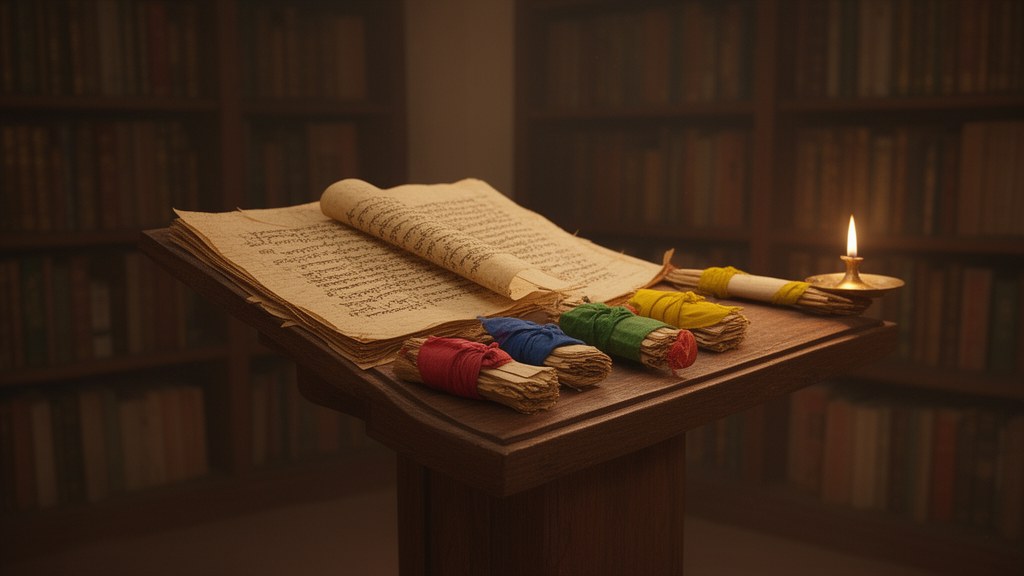
The Sixty Upanishads of the Veda is a scholarly anthology. Deussen’s German work, Sechzig Upanishad’s des Veda, presented sixty Upanishads grouped under the Vedic branches to which they are traditionally attached. An English edition, translated by V. M. Bedekar and G. B. Palsule, was published in India in 1980 under the same title. Readers should confirm edition details, volume numbers, and publisher information against a library catalogue before citing it in academic work.
The collection is useful because it brings many Upanishadic texts into one place. It is not a claim that exactly sixty Upanishads form the authoritative Hindu scripture. Traditions have given different lists, and the number and membership of the Upanishads vary by source.
Who was Paul Deussen?
Deussen was a professor of philosophy at Kiel who worked on Indian thought and on the history of philosophy. He was interested in the Upanishads as sources for Indian philosophical ideas, and his translations introduced many Western readers to these texts in the late nineteenth and early twentieth centuries. Modern readers should treat his selection and translation as one scholar’s work, shaped by the manuscripts and editions available to him and by the interpretive frameworks of his time.
Deussen’s work is best understood as a historical and academic resource. It is not a devotional book in the sense of a Puja manual, and it does not represent the practice of any one Hindu community.
Why the collection is arranged by Veda
The Vedas are traditionally divided into four collections: the Rig Veda, Sama Veda, Yajur Veda, and Atharva Veda. Many Upanishads are attached to one of these Vedas, often through a particular school or recension called a shakha. In the traditional view, the Upanishads belong to the concluding portions of the Vedas and are associated with the later, more reflective layer of Vedic thought known as Vedanta, meaning the end or culmination of the Vedas.
Arranging the texts by Veda helps readers see how different schools preserved and developed ideas. The Yajur Veda, for example, contains both Krishna (dark) and Shukla (bright) branches, and their Upanishads differ in style and arrangement. A reader who looks only at a list of titles can miss these connections. Deussen’s grouping makes the family relationships visible, although the exact attribution of individual texts is itself a subject of scholarly discussion.
The four Vedic branches at a glance
- Rig Veda: the oldest collection of Vedic hymns, traditionally linked to the Aitareya and Kaushitaki Upanishads among the better-known texts.
- Sama Veda: a collection oriented toward chant, with Upanishads such as the Chandogya traditionally associated with it.
- Yajur Veda: a collection of sacrificial formulas, containing both Krishna and Shukla branches, including the Taittiriya, Katha, Isha, and Brihadaranyaka Upanishads.
- Atharva Veda: a collection of hymns and spells, with Upanishads such as the Mundaka and Mandukya traditionally associated with it.
These attributions reflect the traditional and commonly cited scholarly grouping. Readers who need precise attribution for a specific text should check a reliable edition’s introduction, which will usually explain the school and recension for each Upanishad.
The ten principal Upanishads
Within the larger corpus, many readers begin with a smaller group of texts often called the principal or major Upanishads. Commentators, especially in the Advaita Vedanta tradition associated with Shankara, wrote commentaries on a group of ten. The list commonly includes the Isha, Kena, Katha, Prashna, Mundaka, Mandukya, Taittiriya, Aitareya, Chandogya, and Brihadaranyaka Upanishads. Other traditions and scholars may group texts differently, so the list should be presented as a traditional and widely used grouping rather than a fixed rule.
If you are new to the Upanishads, the principal texts are a practical starting point. They are often short enough to read in a single sitting, and they introduce many themes that appear across the wider collection.
Why the number is not always sixty
Readers often encounter different totals. The number sixty in this phrase refers to Deussen’s selection. Another widely cited number is 108, which appears in the Muktika Upanishad. In that text, a teaching is presented as a list of 108 Upanishads associated with the Vedic branches. Other traditions, editions, and scholars use different counts, and some lists include texts that modern scholars regard as later or of a different character.
This variation is not a sign that one list is correct and the others are wrong. It reflects the fact that the Upanishads developed over a long period, that manuscripts survive in many forms, and that communities have used these texts in different ways. When you see a number, ask which list is being used, which edition it comes from, and whether the author explains the selection.
Scripture, tradition, and scholarship
It helps to separate three things. First, the texts themselves are the scriptures or sacred literature used in Hindu traditions. Second, the list of which texts count as Upanishads, and which Veda they belong to, is part of tradition and textual history. Third, modern scholarship studies dates, manuscript evidence, language, and the development of ideas. A reader can respect a text’s place in tradition while also recognizing that scholars debate its origins and composition.
Major themes in the Upanishads
The Upanishads are philosophical and meditative texts, but they are not a single system. Many themes recur across them, and the way those themes are interpreted depends on the text, the commentary, and the tradition. The following overview names some of the most frequently discussed concepts.
Brahman and atman
Two terms appear again and again. Brahman is commonly used for the ultimate reality or the underlying principle of the universe, and atman is commonly used for the self or innermost being. Many Upanishadic passages explore how these two are related. Advaita Vedanta, for example, reads certain passages as teaching non-duality between atman and Brahman. Other schools, including Vishishtadvaita and Dvaita, read the relationship differently. The Upanishads themselves contain varied and sometimes open-ended statements, so readers should avoid treating one interpretation as the only meaning.
Knowledge, meditation, and liberation
Many Upanishadic texts emphasize knowledge, meditation, and inner discipline as paths toward understanding the self or ultimate reality. Liberation, often called moksha or mukti, is discussed in different ways. Some passages describe it as realization of one’s identity with Brahman; others describe it in more devotional or ethical terms. These are interpretations of religious teaching, and they belong to specific traditions as much as to the texts.
Teaching through dialogue and story
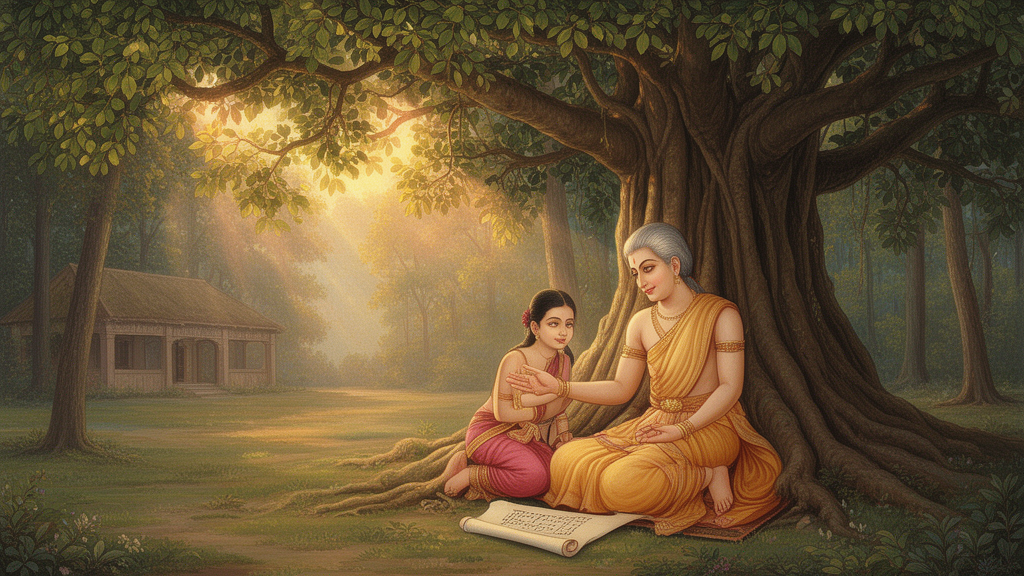
Many Upanishads are structured as dialogues between a teacher and a student, or between sages. The Chandogya and Brihadaranyaka Upanishads, for example, include well-known dialogues and stories. These narrative elements help readers see that the Upanishads were meant to be taught, discussed, and reflected upon, not simply read as abstract doctrine.
How to read a collection of sixty texts
A large anthology can feel intimidating. A practical approach is to proceed in stages.
- Read the introduction first. A good translation explains the Veda, school, date questions, and translation method for each text.
- Start with a short principal Upanishad. The Isha Upanishad is brief and often used as an introduction, although readers should still consult a commentary.
- Read one Upanishad alongside a commentary. Commentaries show how a tradition has understood difficult passages.
- Compare two texts on the same theme. For example, compare how two Upanishads describe the self or knowledge.
- Keep notes on terms. Words such as Brahman, atman, maya, and jnana have different nuances in different contexts.
For readers who want a broader orientation before opening the anthology, our related guides may help. You can start with our general overview of the Upanishads, then read about the Upanishads in English to understand translation choices. For the Vedic background, see our article on the Rig Veda and Upanishads.
A worked example: reading a single theme across texts
Suppose you want to understand the Upanishadic idea of the self. Begin with a short passage in the Chandogya Upanishad, which contains teaching dialogues about the self and Brahman. Then read a related passage in the Brihadaranyaka Upanishad, which also discusses the self in depth. Next, read a commentary from a tradition you want to understand, such as Shankara’s Advaita reading, and then a contrasting reading from another school. You will notice that the texts share vocabulary and questions but do not always give identical answers. That difference is part of what makes the anthology valuable for study.
This method keeps scripture, commentary, and modern interpretation separate. It also prevents a single reading from being presented as the universal meaning of the Upanishads.
Practical reading guidance for different readers
For students of philosophy and religion
Use the collection as a primary-source set. Track the Veda, school, and translation for each passage you cite. Where a translation is interpretive, compare it with another translation or a commentary before drawing conclusions.
For devotional readers
Many people read the Upanishads for reflection and spiritual guidance. Reading can be part of a personal practice, but no text provides a guaranteed spiritual result. Traditions differ about who should study which texts, how to approach them, and whether a teacher or lineage is expected. If you belong to a tradition or sampradaya, consult its teachers and texts.
For general readers
Start with a short introduction and a few principal Upanishads. Use glossaries and notes rather than trying to master every term at once. A reader who approaches the anthology slowly will usually gain more than one who tries to finish it quickly.
Common misunderstandings
- Misunderstanding: sixty is the official number of Upanishads. The number depends on the list. Deussen’s collection contains sixty, but other traditional and scholarly lists differ.
- Misunderstanding: all Upanishads teach the same doctrine. The texts share recurring themes, but they vary in style, content, and emphasis.
- Misunderstanding: a translation is the original text. Every translation involves choices. Use more than one translation for difficult passages.
- Misunderstanding: all Hindus read the Upanishads in the same way. Readings differ by school, region, family, and personal practice.
Frequently asked questions
Is the Sixty Upanishads of the Veda a traditional scripture?
It is best described as a modern scholarly collection based on a selection of Upanishads. Traditional communities have their own lists and ways of using the texts. The collection is useful for study, but it should not be treated as the only traditional canon.
Why is it grouped by Veda?
Upanishads are traditionally associated with particular Vedic branches and schools. Grouping them this way helps readers see the textual families, although some attributions are discussed by scholars.
Which Upanishad should I read first?
Many readers start with the Isha Upanishad because it is short. Readers who want narrative and dialogue may prefer the Chandogya or Brihadaranyaka. Use a translation with notes and, if possible, a commentary.
Do I need Sanskrit to read the Upanishads?
No, but Sanskrit terms are important. Good translations explain key words and note alternatives. Learning a few core terms, such as Brahman, atman, and moksha, will make the texts easier to follow.
Summary and next steps
The Sixty Upanishads of the Veda is a valuable scholarly anthology associated with Paul Deussen. It organizes sixty Upanishads by Vedic branch and helps readers see the wider Upanishadic literature. It is not the only list of Upanishads, and the traditional number 108 appears in other sources. The best approach is to read a clear introduction, begin with principal Upanishads, compare translations and commentaries, and keep scripture, tradition, history, and modern interpretation distinct.
For further study, begin with our article on Paul Deussen and the Sixty Upanishads of the Veda, then explore the Five Upanishads and the essence of the Upanishads for focused overviews. If you are comparing lists, see our notes on the 112 Upanishads and the Eight Upanishads.
Sources and further reading
- Paul Deussen, Sechzig Upanishad’s des Veda (German edition, 1897). Consult a library catalogue for the edition used.
- Paul Deussen, Sixty Upanishads of the Veda, translated by V. M. Bedekar and G. B. Palsule (Motilal Banarsidass, 1980). Check the publisher and volume details before citing.
- Wiktionary entry for ‘sixty’, used for the meaning of the English numeral and the note that the Sanskrit cognate is ṣaṣṭi (षष्टि).