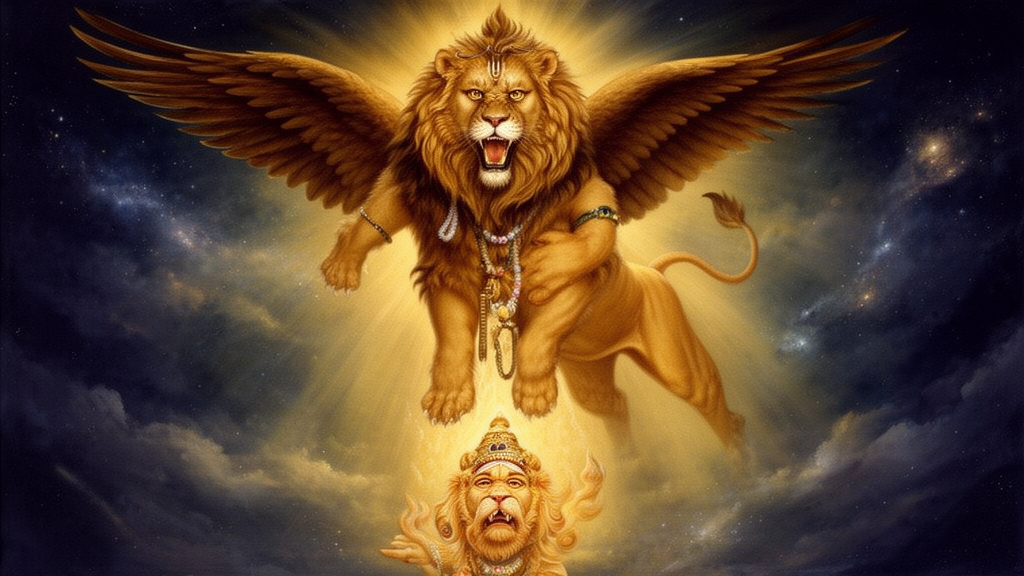
The Sharabha Upanishad is a short Sanskrit text, traditionally classed among the minor Upanishads and associated with the Atharva Veda, that presents Lord Shiva as the supreme god and describes his incarnation as Sharabha, a fierce composite being with features of lion, bird and human. Its central narrative tells how Shiva assumed this form to check Narasimha, the lion-man avatar of Vishnu, after Narasimha became destructive. The text is mainly a hymn of praise to Shiva, and it is read most often within Shaiva devotion.
This guide explains what the text says, how its story is told in different summaries, what its main themes are, and where scholarly and traditional readings differ. It also points to reliable places to read the Sanskrit and English translations. Where a detail comes from a summary rather than a full translation, this article says so.
What the Sharabha Upanishad is
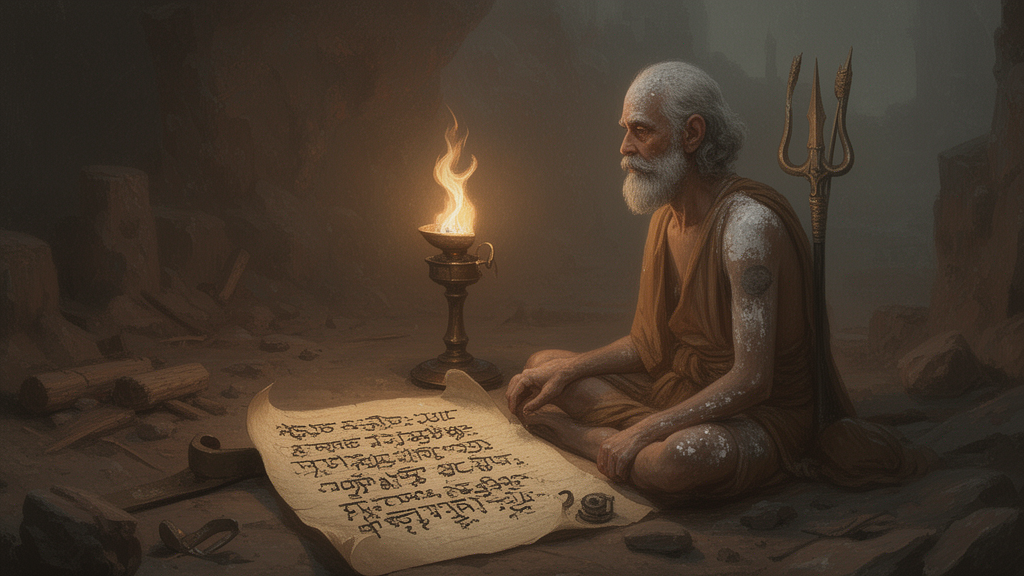
The Sharabha Upanishad (Sanskrit: शरभ उपनिषत्, IAST: Sharabha Upaniṣad) is one of the minor Upanishads associated with the Atharva Veda. Wikipedia describes it as a Shaiva text linked to that Veda, with one chapter and 35 verses plus a prologue and epilogue (Wikipedia, Sharabha Upanishad). Other summaries give different counts. Hinduism Facts says the text contains about 36 verses and notes that it is not clear when it was written (Hinduism Facts). Readers comparing editions should expect small differences in verse numbering, because numbering depends on how the prologue, epilogue and verse divisions are handled.
The text is usually presented as a teaching given by Brahma to the sage Pippalada, which is why it is sometimes called the “Pippaladadharmasastra” (Wikipedia; Vyasa Mahabharata). The opening question in the text is attributed to Pippalada, who asks Brahma which of Brahma, Vishnu and Rudra should be meditated upon. Brahma’s answer forms the body of the text.
Its title also appears in other spellings. Wikipedia lists Sarabha Upanishad and Sharabhopanishad as alternative forms (Wikipedia). Readers searching for the text may encounter all three, and they refer to the same work.
Where the text sits in the Upanishad literature
The word “Upanishad” is used for a large body of texts, and the number of works counted as Upanishads depends on the list being used. The Sharabha Upanishad appears in a Telugu anthology of 108 Upanishads, presented as a teaching narrated by Rama to Hanuman, where it is listed at serial number 50 (Wikipedia; Vyasa Mahabharata). Vyasa Mahabharata adds that it does not appear in two other well-known anthologies, one associated with Colebrooke’s list of 52 popular Upanishads and another in the Bibliotheca Indica collection (Vyasa Mahabharata).
This matters for readers who want to know how “popular” or central the text is. It was not one of the most widely studied Upanishads in the anthologies cited here. Its importance lies mainly within Shaiva tradition, where it is grouped with other Shaiva Upanishads.
How many Shaiva Upanishads?
Sources disagree on the count. Wikipedia describes the Sharabha Upanishad as one of the 14 Shaiva Upanishads (Wikipedia), while Vyasa Mahabharata describes it as one of 13 (Vyasa Mahabharata). The difference probably reflects different lists, not a disputed fact about this text. For this reason, this article does not give a single fixed count of Shaiva Upanishads.
The story of Shiva as Sharabha
The most memorable part of the text is its account of Shiva’s incarnation as Sharabha. The summaries below all describe the same basic plot, but they differ in detail, and the Sanskrit text should be checked for any specific wording.
The basic narrative
According to Hinduism Facts, Narasimha, the lion-man form of Vishnu, killed the demon Hiranyakashipu and drank his blood. Afterward Narasimha became unstable because he could not digest the blood, and he began to harm the world. The gods asked him to calm down, but he did not. Shiva then assumed the form of Sharabha, a part-lion, part-bird, part-divine being, and subdued Narasimha (Hinduism Facts).
Vyasa Mahabharata summarizes the same episode as Sharabha slaying Narasimha because Narasimha was causing destruction in the world. It describes Sharabha as a fierce anthropomorphic combination of eagle, lion and man (Vyasa Mahabharata).
Details from the verses
Hinduism Facts provides a free English rendering of the text by the Sanskrit scholar R. A. Shastri. In that rendering, the text describes the gods’ plea to Sharabha not to take the life of Vishnu, and it describes Shiva, with sharp nails, opening Narasimha’s body and drinking the venomous blood out of compassion. The same passage says that the one clad in Narasimha’s hide came to be called Virabhadra (Hinduism Facts). Since this is a translation by a named scholar and reproduced on a devotional website, readers should compare it with the Sanskrit before quoting it.
Vyasa Mahabharata’s summary of the same section says that after killing Narasimha with his claws, Sarabha wore its hide and came to be called Virabhadra. The same summary says that Sarabha then cut off the fifth head of Brahma and felled Kala, the god of death, with his feet. It also states that Shiva consumed Halahala, the poison that emerged during the churning of the ocean, and that Shiva, pleased with Vishnu’s veneration, gave Vishnu the chakra (Vyasa Mahabharata).
These details appear in the sources as summaries of the text, not as a full verse-by-verse translation available in this article. When a reader needs the exact wording for a verse, the Sanskrit and a full translation should be consulted.
Virabhadra and the question of identity
The text connects Sharabha with Virabhadra, a fierce form of Shiva. Hinduism Facts describes the name as meaning a pacifier of heated ones in its translation (Hinduism Facts). Translations of Sanskrit names vary, and readers should treat such glosses as the translator’s rendering. The sources reviewed here do not establish a single etymology for Virabhadra.
Major themes of the text
The Sharabha Upanishad is primarily a work of praise and theological assertion. Its main themes can be grouped as follows, with the caveat that each depends on the translation or summary consulted.
Shiva as the supreme Lord
The opening verses, as summarized by Vyasa Mahabharata, praise Shiva or Mahesvara as the original God, the creator of Brahma and Vishnu and other divinities, the ruler of the world, and the Lord of Lords (Vyasa Mahabharata). Hinduism Facts similarly describes Shiva as addressed as the Supreme God and creator of Vishnu and Brahma (Hinduism Facts).
This is a devotional claim within the text. It reflects the Shaiva view of Shiva’s supremacy and should be read as the text’s own theology, not as a neutral description accepted by all Hindu traditions. Vaishnava and Shakta readers, for example, may have different understandings of the same figures.
Rudra as the focus of meditation
In the Hinduism Facts translation, Brahma’s answer to Pippalada’s question includes the instruction that Rudra alone should be meditated upon to accomplish all (Hinduism Facts). The text then offers a series of praises (in the translation, a sequence of “adorations”) to Rudra in his various acts. The language is that of devotional praise, and it should be read as such.
Power over death and cosmic dissolution
The text describes Shiva as the one who dissolves the worlds at the time of dissolution and as the ruler of all (Hinduism Facts). It also describes Shiva felling Kala, the god of death, as summarized by Vyasa Mahabharata (Vyasa Mahabharata). These are mythic and theological images. They describe Shiva’s supremacy within the text’s cosmology and should not be read as historical or physical accounts.
Sin, compassion, and the closing verses
Vyasa Mahabharata states that in its last three verses the Upanishad affirms Shiva’s efficacy in burning away sins, but the summary available here is cut off before the full statement. Readers should consult the complete text before summarizing this section. The idea that devotion to Shiva removes sin is a devotional claim found in the text. It is not a promise of a material or worldly outcome, and this article does not present it as one.
Scripture, tradition, and scholarship
Readers encounter the Sharabha Upanishad in three different ways: as scripture within a devotional tradition, as a text in the history of Upanishadic literature, and as a subject of academic study. These approaches overlap, but they answer different questions.
Devotional and tradition-based reading
Within Shaiva devotion, the Sharabha Upanishad is read as a source of praise, a narrative of Shiva’s grace, and a support for the view that Shiva is the highest reality. Its story of Sharabha is also tied to iconography and devotional imagery. Readers and communities who follow Shaivism may treat the text with reverence and use it in devotional settings. How and whether it is recited varies among households and lineages, and this article does not describe any particular ritual use as universal.
Textual and historical questions
The date and historical setting of the text are uncertain. Hinduism Facts says it is not clear when the Upanishad was written (Hinduism Facts). Because the text is presented through an exchange between Brahma and Pippalada, it is also a literary frame, and it does not by itself establish a historical event. Readers should not treat the date of composition as established from the sources reviewed here.
The Sanskrit Documents page for the text lists the work under the Atharva Veda category, identifies it as a Shaiva Upanishad, and gives its numbering as 50 of 108 in the Muktika list (Sanskrit Documents, PDF). It also records that the transliteration and proofreading were done by Sunder Hattangadi, which is useful information for anyone citing the e-text.
Modern interpretation and summaries
Summaries on popular websites, including those reviewed here, are useful for orientation but are not substitutes for a full translation. Each source may condense or reword the text. When a summary and a translation differ, the Sanskrit and the translation should take priority, and the difference should be noted.
Reading the text today
Sanskrit and transliteration
The Sanskrit text is available on Sanskrit Documents, which provides a transliterated file and a PDF (Sanskrit Documents; Sanskrit Documents, PDF). The title is written in Devanagari as शरभ उपनिषत् and in IAST as Sharabha Upaniṣad. Readers who use other transliteration schemes will see different spellings, such as Sarabha or Sharabhopanishad. Consistency matters most when comparing sources.
Note that the Sanskrit Documents HTML page was not fully inspected for this article. The details above come from the metadata and PDF listing, not from a full reading of the transliterated text.
English translations
Hinduism Facts offers a free English translation attributed to R. A. Shastri, presented side by side with the Sanskrit and Hindi on the page (Hinduism Facts). Translation is always an interpretation. When quoting a verse in your own writing, attribute the translation to its translator and check the wording against the Sanskrit.
A practical reading path
- Begin with a summary such as the one in Vyasa Mahabharata to learn the story and structure.
- Read a translation with attention to the translator’s notes and the names used for Shiva and Vishnu.
- Compare the Sanskrit transliteration when a word or verse matters for your study.
- Read the text alongside other Shaiva Upanishads and Puranic accounts of Shiva, noting where accounts differ.
Related Upanishads and further reading on HindusGod.com
Readers who want broader context may find these HindusGod.com draft pages useful. They are currently WordPress drafts, so they may not be public yet; check their status before linking readers to them publicly.
- Meaning of Upanishad explains the term and its role in the wider literature.
- 10 Upanishad and 108 Upanishad cover the common groupings of Upanishads, which helps explain why the number of texts varies between lists.
- Atharva Upanishad and Atharvashikha Upanishad cover other texts associated with the Atharva Veda, the Veda to which the Sharabha Upanishad is linked.
- Adhyatma Upanishad, Advaita Upanishad and Atmabodha Upanishad offer contrasting philosophical emphases for readers comparing theological approaches.
- Aitareya Upanishad and Aranyaka Upanishad are useful for understanding the broader Vedic setting in which Upanishadic texts developed.
- Ashtavakra Upanishad provides another example of a teaching presented in dialogue form.
Frequently asked questions
Is the Sharabha Upanishad a Vaishnava or a Shaiva text?
It is classed as a Shaiva Upanishad (Wikipedia). Its praise is directed to Shiva, and its story presents Shiva’s action in relation to Vishnu’s avatar Narasimha. The text therefore engages with Vaishnava narratives, but its theological orientation is Shaiva.
Why is Shiva called Sharabha?
According to the summaries reviewed here, Shiva took the form of Sharabha to subdue Narasimha after Narasimha became destructive (Hinduism Facts; Vyasa Mahabharata). Sharabha is also described in Puranic lore as one of Shiva’s forms, but the list of forms and their names varies across sources, so readers should check the specific source before citing a list.
Does reading or reciting this text bring a specific result?
The sources reviewed here do not establish any guaranteed material outcome from reading or reciting the text. Devotees may value it for praise, reflection and devotion. Any claim that it brings protection, wealth or other results should be treated as a tradition-specific belief and not as a verified fact.
Summary
The Sharabha Upanishad is a short Shaiva text associated with the Atharva Veda. It presents Shiva as the supreme Lord and tells the story of his incarnation as Sharabha to subdue Narasimha. Its main narrative and themes are consistent across the summaries reviewed here, but the verse count, title spellings and the number of Shaiva Upanishads vary by source. For accurate study, read a full translation, check the Sanskrit, and distinguish the text’s own claims from later devotional and scholarly interpretations.
Sources and further reading
- Wikipedia, Sharabha Upanishad: basic description, attribution to Pippalada, Shaiva classification, verse count, and alternative titles. Note that one reference on that page is marked as a dead link.
- Hinduism Facts, Sharabha Upanishad in Sanskrit, English, and Hindi: summary of the Narasimha narrative and a free English translation attributed to R. A. Shastri. Use the translation as a reading aid and check it against the Sanskrit.
- Vyasa Mahabharata, Sharabha Upanishad: summary of the text’s structure, the Puranic reference to Sharabha as one of Shiva’s forms, and the story of Virabhadra and Halahala. The summary is incomplete for the closing verses.
- Sanskrit Documents, Sharabha Upanishad: transliterated Sanskrit text page with metadata on category and transliteration. This article did not fully inspect the page content.
- Sanskrit Documents, Sharabha Upanishad PDF: metadata confirming Atharva Veda and Shaiva Upanishad classification, the 50 of 108 numbering, and the transliteration credit.