The Sarvasar Upanishad is a short Upanishad that is traditionally described as a summary of the Upanishads. Acharya Prashant has published a Hindi commentary (bhashya) on it, titled सर्वसार उपनिषद् भाष्य, and has presented it in video and eBook formats. This article explains what the text is said to contain, what Acharya Prashant’s commentary offers, and how to separate the scripture itself from commentary and devotional interpretation. It also gives practical steps for reading the text with reliable editions.

In short: the Sarvasar Upanishad is a brief text, often described as having 21 shlokas, that is popularly regarded as a concentrated statement of Upanishadic teaching. Acharya Prashant’s work on it is a modern commentary and course, not a separate scripture. Readers who want the original Sanskrit should consult a critical edition and a translation with a stated source.
What the Sarvasar Upanishad Is
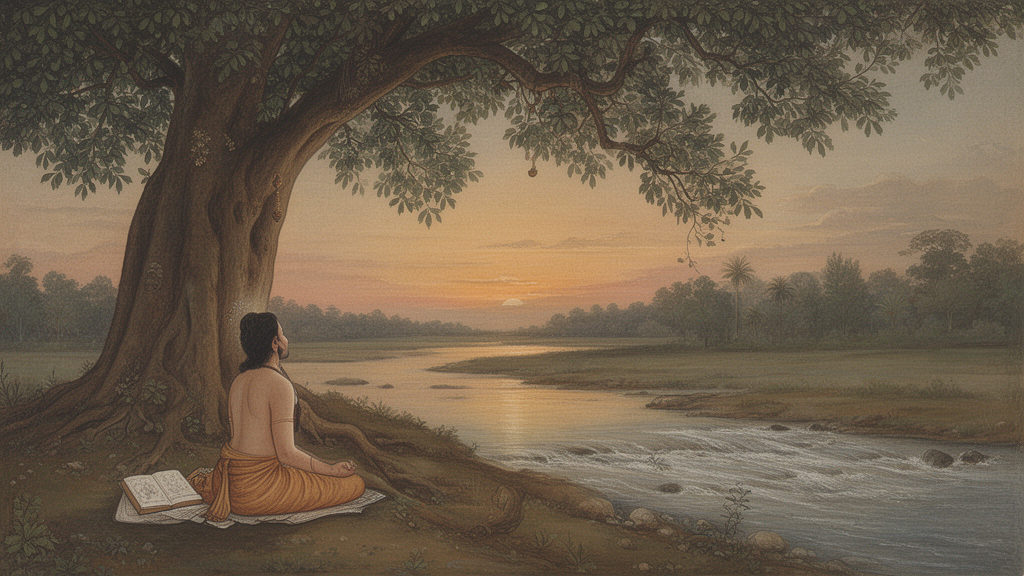
The name is usually written as Sarvasar or Sarvasara Upanishad. Some retail and publisher listings spell it Sarvsaar, so readers searching online may encounter more than one form. All of these refer to the same text: सर्वसार उपनिषद्. The word सर्वसार can be read as “essence of all” (sarva, all; sara, essence). That meaning is part of the title’s appeal, and it explains why the text is often introduced as a summary.
Acharya Prashant’s publisher page for the book describes the Upanishad this way: it is considered special among the 108 Upanishads because it is believed to contain the essence of all the Upanishads, and it is said to convey the wisdom of the Vedic sages in just 21 shlokas. The same description appears on his video course page. These are the publisher’s and teacher’s descriptions. They are useful for understanding how the work is presented, but they are not independent evidence about the text’s history or authorship.
Tradition, text, and modern presentation
It helps to separate three layers when reading about any Upanishad:
- The text: the Sanskrit shlokas, their manuscript history, and their verse structure.
- Tradition: the community claims that the text is authoritative, such as the idea that it summarizes all Upanishads.
- Modern presentation: commentaries, courses, translations, and popular explanations that interpret the text for present-day readers.
For the Sarvasar Upanishad, the sources reviewed for this article describe the text’s reputation and the commentary built on it. They do not provide a full Sanskrit text, a critical edition, a manuscript history, or a verified date of composition. Those details should be checked in a scholarly edition before being presented as fact.
Why the Text Is Called a “Summary” of the Upanishads
The claim that a short Upanishad contains the essence of all the others is a traditional and devotional claim. It is not something a reader can confirm by counting ideas across the full Upanishadic corpus, and it is not a claim that scholars of the Upanishads generally treat as a settled historical fact.
Readers can still use the idea as a starting point. A practical way to test it is to read the Sarvasar Upanishad alongside a few major Upanishads and ask whether the same themes recur:
- Identify the main questions the text raises about the self, the world, and reality.
- Note whether it uses the language of Atman (the self) and Brahman (ultimate reality), which many Upanishadic passages discuss.
- Compare its treatment of knowledge (jnana) with how other Upanishads describe liberation or freedom.
- Record where your reading agrees with a commentary and where it does not.
This method keeps the claim of “essence” as something to examine rather than something to accept automatically. For a wider view of the Upanishads, see the hub-style overview of the meaning of the term Upanishad and the list of the 10 principal Upanishads (URL verified as an existing WordPress draft; it may not yet be public).
Acharya Prashant’s Commentary on the Sarvasar Upanishad
Acharya Prashant’s commentary is presented in Hindi as a bhashya, meaning an explanatory commentary on the text. The publisher listing describes it as a commentary on the Sarvasar Upanishad, available as an eBook and audiobook, and it includes a Hindi description that frames the Upanishad within a broader argument about Sanatan Dharma.
What the publisher description says
The Hindi description on the book page argues that Sanatan Dharma is not defined by ritual habits, festival observance, or birth alone. It argues instead that Vedanta, the philosophical tradition built on the Upanishads, is the core of Sanatan Dharma. It also makes a broader claim that religions depend on a central text, and that the Upanishadic tradition has a textual foundation in the same sense.
These are the commentator’s and publisher’s positions. Many Hindus, scholars, and communities would describe Sanatan Dharma in different ways. Some would emphasize scripture, some ritual and lineage, some devotion to particular deities, and some regional or family practice. A reader should note that the book’s definition is one interpretation.
What the video course offers
The Sarvasar Upanishad video course on Acharya Prashant’s platform is listed with a running time of about three hours and four minutes. Its page describes the course as an introduction to the Upanishads for a general audience. It lists questions it says the sessions address, including: What is the purpose of life? What is the self (atman)? What is death? These questions are part of the course’s framing. They are not quoted from the Upanishad in the sources reviewed.
The course page also says that some of the content is not available on other platforms and that sessions are available through the platform. Readers should check current access terms, pricing, and any lifetime-access conditions directly on the publisher’s site before purchasing.
How to use a commentary responsibly
A commentary can clarify the text, but it is not the text. A careful reader should keep three questions separate:
- What does the Sanskrit shloka say, according to a critical edition or accepted translation?
- What does the commentator say the shloka means?
- What personal or contemporary application does the commentator draw from it?
When these three are blended, it becomes hard to tell whether a claim comes from the scripture or from the commentator. This is especially important for a short text whose interpretation depends heavily on choices of meaning.
Scripture, Commentary, and Modern Interpretation
The Sarvasar Upanishad belongs to a tradition in which texts are read through commentaries, schools, and teachers. Understanding this helps readers avoid two mistakes: assuming that one commentary speaks for all Hindus, and assuming that a modern teacher’s reading is simply what the text “always meant.”
Scripture
The scripture is the Sanskrit text itself. Readers should look for a critical or reputable edition that identifies its manuscript sources, verse numbering, and any variant readings. Verse numbering can differ between editions, so readers comparing books should check which numbering system each uses.
Traditional interpretation
Upanishadic texts have been read within several philosophical schools. Advaita Vedanta, Vishishtadvaita, and Dvaita are among the best-known interpretive traditions, and they read key Upanishadic ideas about Brahman, Atman, and the world differently. A reader who studies this text should be aware that these schools exist and that their readings can diverge.
This is general background on Vedanta rather than a claim about the Sarvasar Upanishad specifically. Before relying on any school’s reading of this particular text, check a scholarly source that discusses it directly.
Modern interpretation
Acharya Prashant’s commentary is a modern interpretation. It uses contemporary language and examples, and it presents the Upanishadic teaching as relevant to everyday life. Such interpretations can help readers engage with the text, but they should be identified as interpretations, especially when they make claims about the nature of religion or who counts as a true practitioner.
Themes Readers Commonly Encounter
Because the sources reviewed do not reproduce the Sanskrit shlokas, the themes below are described at a general level. They reflect the publisher’s and course’s framing and the broader Upanishadic conversation. Readers should verify any specific teaching against the text.
The self and ultimate reality
A central concern of many Upanishads is the relation between the individual self (atman) and ultimate reality (Brahman). The Sarvasar Upanishad is presented as a condensed statement of such teachings. Commentaries commonly explain how knowledge of the self removes the sense of separation from reality, but the exact formulation depends on the commentary.
Knowledge and liberation
Upanishadic literature often treats knowledge as central to liberation, though it also discusses ethical discipline, meditation, and renunciation. Readers should not assume that reading a short text automatically yields liberation. In many traditions, understanding is supported by study, reflection, and practice under guidance.
Life, death, and purpose
The course questions about the purpose of life and the nature of death reflect the existential interests that Upanishads address. They are also questions that many religious and philosophical traditions address differently. The Upanishadic approach to these questions is one perspective among many, and readers should compare it with other texts they respect.
Vedanta, Identity, and the Question of Who Is a Sanatani
The Hindi description on the book page makes a strong claim: that being a Sanatani is not established by festival observance, caste practice, ritual, mythological belief, or birth, and that understanding Vedanta is the defining criterion. This is a normative position. It is the commentator’s argument.
Readers should approach it with care. Hindu practice is diverse. Many communities define their belonging through family, language, region, lineage (sampradaya), devotion to a particular deity, temple worship, or everyday ritual, and many of these practices are sincerely held. A discussion of scripture can coexist with respect for these forms of practice. It does not have to decide who is authentically Hindu.
For readers who want to explore how different traditions relate scripture to devotion, related pages include Katha Upanishad with Acharya Prashant, Mandukya Upanishad with Acharya Prashant, and an overview of Upanishad commentaries by Acharya Prashant (these are verified WordPress drafts and may not yet be public).
Related Upanishad Commentary by Acharya Prashant
Acharya Prashant has commented on several Upanishads, and readers who want to compare his approach may find it useful to read these topics side by side. Each linked page is a separate subject with its own scope:
- Acharya Prashant’s Upanishad commentary, for an overview of his work on Upanishads.
- Niralamba Upanishad with Acharya Prashant, for another short Upanishad that he has discussed.
- Niralamba Upanishad Vol 1 with Acharya Prashant, for the first volume of that commentary.
- Sarvasar Upanishad in Hindi, for the Hindi-language version of this topic.
- Sarvasar Upanishad, for the general topic of the text without the commentator’s name.
For the Bhagavad Gita, which is a different scripture within the Mahabharata, see Acharya Prashant’s Bhagavad Gita commentary and Acharya Prashant’s Geeta page. Comparing a Gita commentary with an Upanishad commentary can clarify how the same teacher handles different texts.
How to Study the Sarvasar Upanishad Carefully
A short text can be read quickly, but its meaning often depends on careful attention to terms, structure, and commentary. The following steps give a practical approach for readers who are new to Upanishads or who want to study with a commentary.
- Find a reliable Sanskrit text. Use a critical edition or a published Sanskrit text with clear verse numbering. Note the edition’s name and date.
- Read a translation alongside it. Choose a translation that states its method and sources. Note where the translator adds explanatory words.
- Learn the key Sanskrit terms. Terms such as atman, Brahman, jnana (knowledge), and moksha (liberation) recur in Upanishadic study. Learn them in context rather than as slogans.
- Read one commentary in full. Acharya Prashant’s bhashya is one option. Compare it with at least one other reading, such as a classical commentary or an academic introduction.
- Write down claims and sources. Mark which points come from the text, which from the commentary, and which from your own reflection.
- Discuss with others who hold different views. Upanishadic study has a long history of debate, and a single reading is rarely the only valid one.
This approach avoids treating a short Upanishad as a set of ready-made answers. It also makes the commentary easier to evaluate.
Frequently Asked Questions
Is the Sarvasar Upanishad a separate scripture from Acharya Prashant’s commentary?
Yes. The Sarvasar Upanishad is the traditional text. Acharya Prashant’s Hindi bhashya and video course are commentary and teaching built on that text. Readers should check the edition and translation they use, since commentary and text are often sold together.
How many shlokas does the Sarvasar Upanishad have?
Acharya Prashant’s publisher and course pages describe the text as having 21 shlokas. Readers should confirm this count against a critical Sanskrit edition, because verse counts and numbering can vary between editions.
Can a short Upanishad be understood without a teacher?
Many people read Upanishads on their own, and a careful reading with reliable translations and commentaries is possible. Many traditions also emphasize study under a teacher, because Upanishadic language is compressed and philosophically technical. A reader who uses a commentary should keep the distinction between scripture and interpretation in mind.
Summary and Next Step
The Sarvasar Upanishad is a short text traditionally regarded as a summary of Upanishadic teaching. Its title, its shloka count, and its claim to contain the essence of all Upanishads are presented in publisher and teacher materials. Acharya Prashant’s Hindi commentary offers a modern interpretation, with a strong argument about the meaning of Sanatan Dharma and Vedanta.
The most useful next step is to obtain a reliable Sanskrit edition and a translation, read the shlokas yourself, and then compare one or more commentaries. Keep the text, the tradition, and the modern interpretation separate in your notes. That habit will help you judge any single claim about the Upanishad, including the claims in this article.
Sources and Further Reading
- Acharya Prashant Books: सर्वसार उपनिषद् भाष्य listing. Supports the existence of the Hindi commentary, its eBook and audiobook formats, its description of Vedanta and Sanatan Dharma, and the publisher’s framing of the Upanishad as a summary of Upanishadic wisdom. This is a publisher page, not an independent scholarly source.
- Acharya Prashant: सर्वसार उपनिषद् video course. Supports the course’s running time, the description of the text as having 21 shlokas and as containing the essence of all Upanishads, and the course questions about life, self, and death. These are the course’s own claims.
- Acharya Prashant Books: Upanishads. Supports the publisher’s general description of Upanishads as Atmavidya or Brahmavidya, a framing attributed in that listing to Adi Shankaracharya. It does not verify the Sarvasar Upanishad’s text or date.
- Sarvasar Upanishad lecture by Acharya Prashant on YouTube. Listed for reference as a video of a talk on the same title. The page content inspected was limited to site navigation and the video title, so the lecture’s content has not been verified here.
Recommended for verification before publication: add a critical Sanskrit edition and a scholarly translation or study of the Sarvasar Upanishad, with full bibliographic details. URL to confirm.