The Samkhya Pravachana Sutra is a foundational text of the Samkhya school, one of the six classical darshanas (schools of philosophical viewpoint) in Hindu thought. It presents Samkhya’s analysis of reality in aphoristic sutras, short statements that are usually read with a commentary. Its central claim is that human suffering arises from misidentifying the self with material nature, and that liberation comes from discerning the difference between puruṣa (consciousness) and prakṛti (nature). This article explains what the text is, how it is organized, what it teaches, and where historical and scholarly uncertainty remains.
Quick answer: what the Samkhya Pravachana Sutra is
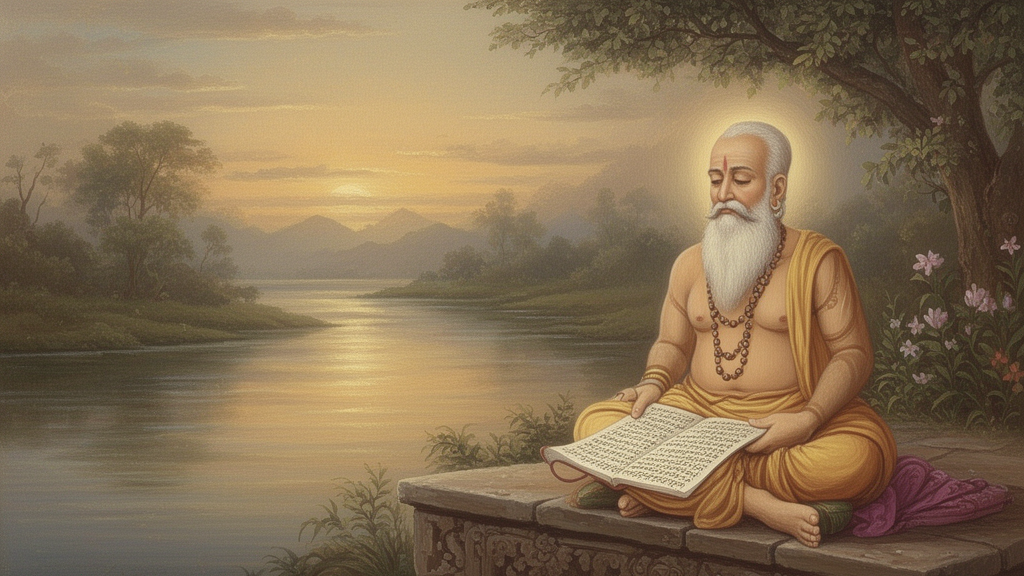
The Samkhya Pravachana Sutra (often spelled Sankhya Pravachana Sutra) is a philosophical text traditionally attributed to the sage Kapila. Its name combines three terms: Samkhya, usually understood as enumeration or discrimination (of categories of reality); pravachana, meaning exposition or discourse; and sutra, an aphorism or compressed statement. Together the name suggests a systematic exposition of Samkhya teaching in condensed form.
Its main subjects are the nature of suffering, the categories that make up the world, the relation between consciousness and matter, and the path to liberation (mokṣa). Most modern scholars do not treat the text as a devotional scripture in the sense of a Purana or a Bhagavad Gita. It is studied chiefly as philosophy, and it is best read with a commentary.
Name, meaning, and the sutra form
Why the title matters
Readers often meet the title in several spellings: Samkhya, Sankhya, and Sāṃkhya. These refer to the same tradition. The diacritics mark long vowels and nasal sounds in Sanskrit; the unmarked forms are common in English publishing. This article uses Samkhya for the school and Samkhya Pravachana Sutra for the text.
What a sutra is
A sutra is a short, dense statement meant to be memorized and expanded by a teacher. Sutra literature is often difficult without explanation, because many words carry technical meanings inside the system. For that reason, students have traditionally relied on commentaries. In the case of this text, the most widely cited commentary tradition is associated with Vijnanabhikshu, a later scholar (dated broadly to the sixteenth century in most reference works). Readers should check the specific edition and commentary they use, since translations and numbering vary.
Traditional attribution and historical questions
The name of Kapila
Samkhya tradition attributes its origin to Kapila, a sage who appears in various Puranic and philosophical texts. In the devotional and traditional view, Kapila is a revered teacher of knowledge. This is a belief within the tradition and should be distinguished from historical proof of who wrote the text.
What scholars say about dating
Academic historians generally regard the attribution to Kapila as traditional rather than historically established. The text as we have it is widely considered to be later than the early development of Samkhya ideas, and scholars differ on its precise date. Some connect its composition with the medieval period, while others place earlier core ideas in the first millennium CE or before. Because dates are uncertain, this article does not give a specific year of composition. Readers who need a historical timeline should consult the academic surveys listed in the references below.
Why the distinction matters
Treating the Kapila attribution as settled history can mislead readers. The better approach is to hold three things apart: what the tradition believes about the text’s origin, what the text itself says, and what historians can reasonably infer from manuscripts, citations, and comparison with other works.
How the text is organized
Six chapters and about five hundred sutras
The text is traditionally divided into six chapters (adhyāyas). The total number of sutras is commonly given as a little over five hundred, but counts vary by edition because of differences in how passages are divided and numbered. For that reason, precise sutra numbers should be checked against the edition you are using before they are cited in study or teaching.
The broad subject of each part
Summaries of the chapters differ among commentators and scholars. In broad terms, the early parts set out the aim of the teaching and the categories of reality; later parts examine causation, the nature of the self, the operation of the constituents of nature, and objections raised by rival schools. Readers should treat any chapter-by-chapter outline as a guide to a specific edition rather than as a fixed universal scheme.
Core teachings: puruṣa and prakṛti
Puruṣa: consciousness that is not an object
In Samkhya, puruṣa is the conscious witness. It is described as pure awareness that is not produced by matter and is not changed by the activities of the body and mind. Samkhya holds that there are many puruṣas, one for each individual, which is a point that distinguishes it from some other Vedantic systems. The doctrine of multiple puruṣas is a teaching of the school and is discussed critically by later philosophers.
Prakṛti: the source of the material world
Prakṛti is the unconscious, active principle from which the physical world, the senses, and the inner faculties develop. It is described as the source of all changing phenomena. Samkhya teaches that prakṛti is not conscious, but it acts in a purposeful-seeming way when it is in proximity to puruṣa. This is one of the central puzzles that commentators address.
The three guṇas
Prakṛti is said to be made of three constituents called guṇas: sattva (associated with lightness, clarity, and harmony), rajas (associated with activity and motion), and tamas (associated with heaviness, inertia, and obstruction). The guṇas are not moral qualities in themselves. They are the basic forces through which the world appears and changes. Later Hindu traditions often use the same three terms in ethical and psychological ways, so readers should note that the Samkhya meaning is primarily metaphysical.
The categories of reality
Samkhya lists a set of categories, commonly enumerated as twenty-five (tattvas), which run from prakṛti through intellect, ego, mind, senses, and elements, to puruṣa. The enumeration is part of the tradition’s method of analysis. Some texts and commentators count and name these categories slightly differently, so readers should compare editions when they study the list.
Suffering, knowledge, and liberation
The threefold suffering
The Samkhya tradition speaks of three kinds of suffering: suffering arising from within the body and mind, suffering arising from external beings and causes, and suffering arising from natural or supernatural forces. This framework is a classical analysis of the problem that Samkhya seeks to solve. It is not a claim about medicine, psychology, or any specific health outcome.
Discrimination as the path
In the Samkhya view, suffering continues because the self is mistakenly identified with the activities of prakṛti. Liberation comes through discriminative knowledge (viveka), the clear recognition that puruṣa is distinct from prakṛti and its products. This knowledge is presented as an intellectual and experiential insight, not as a ritual act that produces a material reward.
What this does not promise
Readers sometimes assume that Samkhya offers a devotional method that guarantees material success, protection, or a particular worldly result. The text does not present that kind of promise. Its stated goal is liberation from suffering through knowledge. Any claim that study of the text yields health, wealth, or other outcomes goes beyond the source.
Relationship to the Samkhya Karika and the Yoga school
The Samkhya Karika as an earlier systematic text
The Samkhya Karika of Ishvarakrishna is another major classical text of the school. It is widely studied as a compact and influential statement of Samkhya doctrine, and it has a well-known commentary tradition of its own. Scholars often compare the two works to see how ideas were stated and developed. Because their historical relationship is complex and debated, claims about which text came first should be checked against current academic surveys.
Yoga and Samkhya
The Yoga school, associated with the Yoga Sutras of Patanjali, accepts much of Samkhya’s metaphysics, including the distinction between puruṣa and prakṛti and the framework of the categories. Yoga adds a theistic element in the form of a special puruṣa called Īśvara and a detailed practical discipline. For readers, this is one reason Samkhya is often studied alongside Yoga, although the two schools are distinct in emphasis and method.
Commentaries and differing interpretations
Commentators within the tradition
Commentaries on the Samkhya Pravachana Sutra have helped shape how it is read. The commentary associated with Vijnanabhikshu is especially important for understanding how later Hindu thinkers reconciled Samkhya with other systems. Readers should keep in mind that a commentary reflects a particular interpreter’s reading and is not identical with the sutras.
Critiques from rival schools
Vedanta thinkers, including Shankara in his commentary on the Brahma Sutra, critiqued aspects of Samkhya, especially the plurality of puruṣas and the independent reality of prakṛti. These critiques are part of the historical argument between schools and should be read as the views of those thinkers, not as settled conclusions about the text.
Religious practice and the text
Samkhya is primarily a philosophical school. It has no single devotional cult comparable to temple worship of a particular deity, and the text is not a universal liturgical manual. Hindu practice is diverse across regions, families, and sampradayas. Some communities value Samkhya ideas within broader devotional or philosophical frameworks, while others study the text mainly in academic or traditional learning settings. Describing it as the one correct Hindu teaching would not reflect this diversity.
Common misunderstandings
- Samkhya is only atheism. The classical Samkhya teaching is often described as non-theistic or lacking a creator God, but the question is discussed within the tradition and has been debated by later schools. Summaries should say that carefully.
- The text is a deity scripture. The Samkhya Pravachana Sutra is primarily an analytical philosophy text, not a collection of stories about gods.
- Each sutra is a complete explanation. Sutras are compressed. Their meaning often depends on the commentary and on the surrounding system.
- The guṇas are personality types. In Samkhya they are metaphysical constituents of prakṛti. Later popular usage may apply the terms to temperament, which is a different application.
How to read the Samkhya Pravachana Sutra
Readers who want to study the text carefully can follow a practical sequence:
- Choose a complete edition or translation that identifies its commentary and numbering system.
- Read a modern introduction to Samkhya before starting the sutras, so that terms such as puruṣa, prakṛti, and guṇa are familiar.
- Read one chapter at a time, noting where the translator follows a particular commentary.
- Compare key passages with a second translation or with a scholarly survey to see where interpretations differ.
- Keep a separate note for three categories: what the text says, what the commentary adds, and what modern scholars infer.
This method helps readers avoid mixing scripture, tradition, and modern interpretation, which the subject requires.
Related reading on HindusGod.com
For a shorter overview of a related Samkhya topic, see the HindusGod.com draft Samkhya Sutra (URL to confirm; the draft may not be public until the owner publishes it). It is useful as a companion to this article for readers who want to compare terms and framing before reading the sutras directly.
Frequently asked questions
Is the Samkhya Pravachana Sutra the same as the Samkhya Karika?
No. They are separate classical texts of the Samkhya school. The Samkhya Karika is a shorter systematic verse work by Ishvarakrishna, while the Samkhya Pravachana Sutra is a sutra text traditionally attributed to Kapila. They share many doctrines, but they differ in form, structure, and historical background.
Do I need a commentary to understand the text?
For most readers, yes. Sutras are compressed, and many terms are technical. A good introduction or commentary makes the reading much clearer, and it helps you see where the translator’s interpretation begins.
Is Samkhya still practiced today?
Samkhya ideas remain part of Indian philosophical study and are present in several Hindu intellectual traditions. Its influence is often strongest in philosophy, Yoga-related study, and academic work rather than in a single organized modern worship community. Practice varies widely, so readers should look for teachers and institutions that identify their own lineage.
Summary
The Samkhya Pravachana Sutra is a classical sutra text traditionally attributed to Kapila and studied as a central statement of the Samkhya school. Its main teachings concern the distinction between consciousness (puruṣa) and nature (prakṛti), the guṇas and categories of reality, and liberation through discriminative knowledge. Its date and authorship are debated, its sutra numbering varies by edition, and its meaning is shaped by commentaries. Readers who approach it with a reliable translation, a clear commentary, and attention to the difference between text, tradition, and scholarship will get the most from it.
Sources and further reading
- Wikipedia, ‘Samkhya’: https://en.wikipedia.org/wiki/Samkhya (general orientation only; not fetched in this run, verify before publication).
- Stanford Encyclopedia of Philosophy, ‘Samkhya’: https://plato.stanford.edu/entries/samkhya/ (scholarly overview of the school; not fetched in this run, verify before publication).
- Internet Encyclopedia of Philosophy, ‘Samkhya’: https://iep.utm.edu/samkhya/ (academic overview of doctrines and history; not fetched in this run, verify before publication).