The Samadhiraja Sutra, also called the King of Samadhis Sutra or the Candrapradipa Sutra (Moon Lamp Sutra), is a Mahayana Buddhist scripture. It is not a Hindu text. Readers of HindusGod.com usually encounter it while studying Indian religious literature, the shared vocabulary of meditation (samadhi), or the wider history of Buddhism in India, Nepal, and Tibet. Its main teaching is that true samadhi, or meditative absorption, rests on understanding that all phenomena share one nature of sameness and emptiness (sunyata), and that a bodhisattva should practice compassion and wisdom from that understanding.
This article explains the sutra’s titles, its uncertain date, its main narrative and themes, its influence on later Indian and Tibetan writers, and the translation and textual questions scholars continue to discuss. Where sources differ, the article says so. Claims about what the sutra says are kept separate from claims about how later communities used it.
Quick answer: what the Samadhiraja Sutra is
In brief, the Samadhiraja Sutra is:
- A Mahayana sutra, which means it belongs to the Buddhist literature that developed the bodhisattva ideal. Wikipedia describes it as a Buddhist Mahayana sutra with the alternative titles King of Samadhis and Candrapradipa.
- Centered on samadhi and the equality of all dharmas. Its full Sanskrit title, as given in the text and in the GRETIL edition, is Arya-sarvadharma-svabhava-samata-vipancita-samadhiraja-nama-mahayana-sutra, which is often rendered as “The Noble Mahayana Sutra ‘The King of Samadhis, the Revealed Equality of the Nature of All Phenomena.’”
- Important to the Madhyamaka school. Wikipedia reports that the sutra is cited by Indian authors including Chandrakirti and Shantideva, and that Alex Wayman called it “perhaps the most important scriptural source for the Madhyamika.”
- Dated with uncertainty. Some scholars place its composition between the 2nd or 3rd century CE and the 6th century, the date of the earliest known manuscript, while others argue that its date cannot be determined.
These points come from encyclopedic and scholarly summaries. Readers who want to study the text itself should begin with the edition and translations listed at the end of this article.
Names and titles of the sutra
The sutra is known by several names, and readers may see more than one form in English, Sanskrit, Tibetan, or Chinese sources. Transliteration of Sanskrit terms in this article follows the simplified forms used by the main sources, with diacritics shown where the source gives them.
- Samadhiraja Sutra (Sanskrit Samādhirājasūtra): “King of Samadhis Sutra.” The word samadhi refers to concentrated, absorbed meditative awareness. In Buddhist usage, samadhi is one of the three trainings alongside ethical conduct and wisdom.
- Candrapradipa Sutra: “Moon Lamp Sutra,” named after the main bodhisattva of the text, Candraprabha. The Wikipedia entry notes that the sutra takes its second name from this figure.
- Tibetan titles: The Tibetan Buddhist Encyclopedia gives the Tibetan title as ting nge ‘dzin gyi rgyal po’i mdo and the Moon Lamp title as zla ba sgron me’i mdo. The full Tibetan title in the Kanjur, as recorded there, is longer and includes the phrase “sameness in the essence of all phenomena.”
- Chinese title: The Tibetan Buddhist Encyclopedia reports that the Chinese have preferred Yueh-teng san-mei ching, which corresponds to Candrapradipa-samadhi-sutra.
The variety of titles reflects the sutra’s transmission across different languages. It does not indicate that different communities read entirely different texts, although the Tibetan, Chinese, and Sanskrit witnesses differ in their details, as discussed below.
Dating and manuscripts
The date of the Samadhiraja Sutra is one of the most debated questions about it. Wikipedia states that some scholars have dated its composition from the 2nd or 3rd century CE to the 6th century, which is the date of the earliest manuscript found, while others argue that its date just cannot be determined. The Tibetan Buddhist Encyclopedia describes the sutra as dating to about the 2nd century CE. Because these sources differ, this article presents the range rather than a single date.
Manuscript evidence also matters. The GRETIL digital Sanskrit text is based on the edition by P. L. Vaidya, published by the Mithila Institute in Darbhanga in 1961 as part of the Buddhist Sanskrit Texts series. GRETIL notes that the text was input with permission from the Digital Sanskrit Buddhist Canon Project, and it uses a reference system based on the Vaidya pagination. GRETIL also warns that its files are for reference purposes and that copyright and terms of use apply to the source files.
Encyclopedic summaries such as Grokipedia state that the sutra survives in Tibetan, in Sanskrit manuscripts from Gilgit and Nepal, and in a sixth-century Chinese translation. Those details are useful for orientation, but they are secondary summaries. Scholars should check the manuscript history against the editions and specialist studies before relying on it for a research paper.
The opening scene and the main dialogue
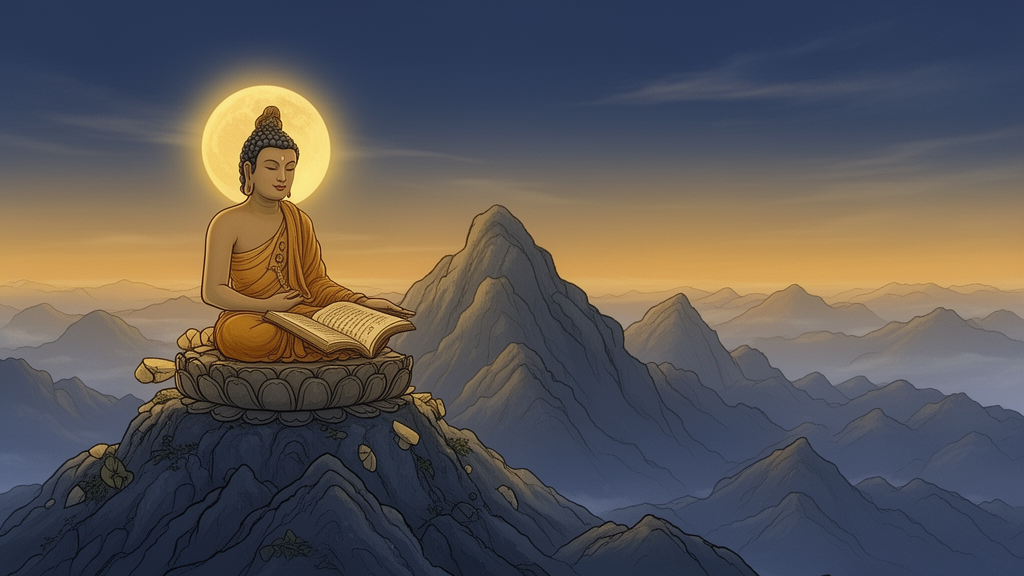
The Sanskrit text in GRETIL opens with the standard formula, “Thus have I heard,” and places the Buddha at Rajagrha on the Gridhrakuta mountain, which is commonly rendered as Vulture Peak. The assembly described in the opening is large and mostly made up of bodhisattvas. This setting is one of the features that marks the text as Mahayana, since it presents bodhisattvas as the main audience.
Wikipedia identifies Candraprabha as the Buddha’s main interlocutor in the Candrapradipa, and the image caption in that article shows a Candraprabha sculpture at Todai-ji in Nara. The dialogue format is useful for readers because it lets the teaching move from a question to a detailed answer. Encyclopedic summaries describe the narrative as beginning with Candraprabha asking about supreme samadhi, moving into the Buddha’s teaching on bodhisattva virtues and on the dangers of attachment, and including stories of past lives. Readers should treat such summaries as guides to the text’s structure and then check the chapter contents in a translation.
The text also includes lists of bodhisattva names. Those lists are part of the Sanskrit style of the sutra and give a sense of the large assembly it describes. They are not, in themselves, a teaching that readers need to memorize.
Core teaching: samadhi and the sameness of all dharmas
The title’s central phrase points to a teaching about the “sameness” or equality of the nature of all phenomena. In Buddhist philosophy, dharma can mean a phenomenon or a teaching. The Sanskrit title speaks of the nature of all dharmas as equal, a theme often connected to emptiness. Grokipedia summarizes the sutra as teaching that realizing the inherent sameness and emptiness of all dharmas is central to its message, along with renunciation, patience, and the rejection of dualistic views. Because this is a summary, the claim should be read as a general description of the text, not a verbatim statement.
Wikipedia reports that the Samadhiraja is a very important source for the Madhyamaka school, which is associated with Nagarjuna and with the analysis of emptiness. The connection is one reason the sutra is studied in philosophical contexts. It is not only a meditation manual.
This point needs careful handling. The Tibetan Buddhist Encyclopedia quotes Andrew Skilton, who has studied the sutra extensively, as saying that the sutra itself “contains no significant exposition of either meditational practices or states of mind.” This means that readers who expect step-by-step meditation instructions in the text may be disappointed. Later commentators sometimes read meditation teachings into the sutra, which leads to the next section.
The bodhisattva path
Summaries of the text emphasize the bodhisattva path, meaning the practice of a being who seeks awakening for the benefit of others. The GRETIL text opens with descriptions of bodhisattvas who have mastered many forms of knowledge, meditation, and compassion. Encyclopedic summaries say the sutra connects meditative insight with moral conduct and with non-dual understanding. These are general descriptions of the text’s emphasis. Specific claims about any chapter should be checked against a translation.
Examples and stories in the text
The sutra includes stories about the Buddha’s past bodhisattva lives and about past buddhas who spread teachings through selfless actions. Grokipedia presents these stories as illustrations of dedication to wisdom and compassion. Such narratives are typical of Mahayana literature, where past-life stories often serve as examples for present practice. Readers should distinguish these stories from historical biography. They belong to the sutra’s literary and devotional world.
Influence in Indian Buddhism
Wikipedia reports that the Samadhiraja was cited by numerous Indian authors, including Chandrakirti and Shantideva, and by later Buddhist writers. This matters because quotation by major philosophers shows that the text was read in influential intellectual circles. The Tibetan Buddhist Encyclopedia makes a related point, quoting Gomez and Silk: the sutra is often cited in Tibetan philosophical literature, probably mostly on the basis of quotations found in Indian texts.
The Tibetan Buddhist Encyclopedia also records a notable detail from Nepal. Gomez and Silk write that in Nepal the Samadhiraja Sutra was counted among the Nine Dharmas, a set of texts so highly revered that its manuscripts were used as objects of worship. This is a reported historical and religious practice. It shows the reverence the text received in one regional tradition, but it does not mean that all Buddhist communities treated the text in the same way.
Influence in Tibetan Buddhism
Tibetan sources have cited the Samadhiraja in philosophical and meditative contexts. The commentary by the Indian scholar Manjushrikirti, called the Kirtimala in Tibetan (grags pa’i phreng ba), survives in Tibetan according to Wikipedia. That commentary is one sign that the text received continuing attention in Tibetan scholarship.
The Tibetan Buddhist Encyclopedia reports that the Kagyu tradition often cites the sutra as an important source for shamatha, or calm-abiding, instructions, particularly through commentary by Gampopa. The same entry also reports that the Kagyu tradition asserts that the Samadhiraja predicted the dharma activity of Gampopa and the Karmapas. This is a tradition-internal claim. It is a devotional and lineage assertion, not a conclusion of historical scholarship. Skilton’s view that the sutra itself does not expound meditation practices stands alongside that tradition’s use of the text. Readers should keep the two claims distinct.
Wikipedia adds that the sutra is widely cited in Tantric Buddhist sources, which promote its recitation for ritual purposes. Ritual use is a part of the text’s later history, but the specific forms of recitation, their frequency, and their meaning differ among communities and lineages. This article does not give ritual instructions, because the sources reviewed here do not describe a single procedure.
Transmission in East Asia and the question of canonical status
The sutra’s reception in East Asia was different. The Tibetan Buddhist Encyclopedia, quoting Gomez and Silk, says the sutra seems to have had a less glorious history in the Far East. It was translated several times there but was seldom quoted. The same source notes that the sutra is not part of any of the sutra collections in the Tibetan and Chinese canons, although it is found as an independent text in both. Grokipedia also states that the sutra had limited adoption in East Asia despite multiple translations, but this is a secondary summary and should be verified against specialist studies.
This point is important for readers who assume that every well-known Mahayana text had the same status across all Buddhist regions. Canonical placement depends on the collection, the period, and the tradition. Readers should not assume that one canon’s list equals the whole history of a text.
Translations and interpretive questions
The title has been translated in several ways, and the variations show that translators emphasize different aspects of the text. The Wikipedia article gives three examples:
- “The Noble Mahayana Sutra ‘The King of Samadhis, the Revealed Equality of the Nature of All Phenomena’” (rendering attributed to Roberts).
- “the samadhi that is manifested as the sameness of the essential nature of all dharmas” (rendering attributed to Luis and Gomez).
- “the Mahayana discourse that is called the king of samadhi, as received from the samadhi elaborated as the sameness in their essence of all phenomena” (rendering attributed to Skilton).
These differences matter. The first emphasizes a noble text and its revealed equality. The second emphasizes a samadhi that appears as sameness. The third stresses how the discourse was received from a particular samadhi. Each translation makes choices about grammar and meaning. Readers who want to quote the text should use a specific translation and attribute it, rather than relying on a retranslation from a summary.
The GRETIL file itself notes that its transliteration emulates Nagari conventions and that many word boundaries are not marked by blanks. It also explains that accents are dropped to facilitate word searching unless indicated otherwise. Readers working with that file should expect a reading text, not a critical apparatus, and should check the Vaidya edition for scholarly reference.
Distinguishing scripture, tradition, and scholarship
A useful way to read the Samadhiraja Sutra is to separate four kinds of claims:
- What the text says. Examples include its title, its opening setting at Vulture Peak, its emphasis on samadhi and the sameness of dharmas, and its dialogue with Candraprabha.
- What traditions believe or do with the text. Examples include Nepalese reverence for manuscripts, Kagyu claims about predictions, and Tantric recitation practices.
- What historical evidence shows. Examples include manuscript dates, the Gilgit and Nepal Sanskrit witnesses, and the Chinese translation history.
- What scholars argue. Examples include the debate over dating, the observation that the sutra contains little meditation instruction, and the view that the sutra has a composite character with affinities to Prajnaparamita literature.
Keeping these categories apart prevents common errors. A tradition’s claim that a text predicted a teacher is not a historical finding. A scholarly date range is not a single fact. A translation’s wording is not the Sanskrit original.
How the sutra relates to Hindu readers and Indian religious life
The Samadhiraja Sutra is a Buddhist text, but it belongs to the Indian religious world in which Buddhism, Jainism, and Brahmanical traditions developed and interacted. Readers interested in Hindu practice should not assume that the sutra represents Hindu teaching, nor should they treat Buddhist and Hindu concepts as identical. The word samadhi, for example, appears in both Buddhist and Hindu contexts, but its meaning in a given text depends on the framework of that tradition.
For readers approaching the sutra from a Hindu background, a respectful way to begin is to notice shared vocabulary and then return to the text’s own categories. Terms such as dharma, bodhisattva, samadhi, and sunyata have particular meanings within Mahayana Buddhism. Explaining them in context helps avoid importing assumptions from another tradition.
This distinction also matters for practice. Many Hindus and Buddhists meditate, but the goals, methods, and authority structures differ. Readers who want guidance on Hindu meditation or devotion can start with pages on the topic, while those studying Buddhist scriptures can use the links below to explore related Mahayana texts.
Related reading on HindusGod.com
The following HindusGod.com pages are WordPress drafts listed in the site’s verified target inventory. They may not yet be public. Readers should treat them as related reading only after the owner confirms that they are live.
- For another Mahayana text on the bodhisattva path and the cosmos, see the Avatamsaka Sutra guide.
- For a text that explores emptiness and the ground of practice, see the Diamond Sutra meaning article.
- For a text on the stages of the bodhisattva path, see the Dasabhumika Sutra overview.
- For a study of dhyana, or meditative absorption as a practice term, see the Dhyana Sutra page.
- For a text on protective and mnemonic formulas, see the Dharani Sutra article.
- For a text centered on a bodhisattva of compassion, see the Avalokiteshvara Sutra page.
- For a Pure Land text often read alongside devotional practice, see the Amida Sutra guide.
- For a Mahayana text centered on a bodhisattva’s vow and merit, see the Akasagarbha Sutra page.
- For a Hindu devotional text on bhakti, see the Bhakti Sutra article, which is useful for comparing devotional and meditative approaches in Indian religion.
- For a broader introduction to the word sutra and its meanings, see the Meaning Sutra article.
- For a text on the Buddhist precepts and the bodhisattva code, see the Brahmajala Sutra page.
Frequently asked questions
Is the Samadhiraja Sutra a Hindu scripture?
No. It is a Mahayana Buddhist sutra. Its audience is shown as bodhisattvas and its teaching is framed within Buddhist concepts such as dharma, emptiness, and the bodhisattva path. It is useful for readers of Indian religious literature, but it should not be presented as Hindu scripture.
What does the title King of Samadhis mean?
The title refers to samadhi, which means concentrated and absorbed meditative awareness. The Sanskrit title describes the samadhi that reveals the equality of the nature of all phenomena. Translators render the phrase in different ways, so the exact wording should be checked against a specific translation.
Why is the sutra also called the Moon Lamp Sutra?
The second title, Candrapradipa, refers to Candraprabha, the main bodhisattva who speaks with the Buddha in the text. Wikipedia notes that the sutra is known by this name after this figure.
Did the sutra influence Madhyamaka philosophy?
Sources say it did. Wikipedia reports that the Samadhiraja is a very important source for the Madhyamaka school and is cited by Chandrakirti, Shantideva, and later Buddhist authors. Scholarly quotation of a text is evidence of its influence, though readers should consult specialist studies for the details.
Is the sutra used in ritual?
Some Tantric Buddhist sources promote its recitation for ritual purposes, according to Wikipedia. Practices differ by tradition and region, and this article does not provide a ritual procedure. Readers who want to follow a practice should consult teachers and texts within their own lineage.
Summary and next steps
The Samadhiraja Sutra is a Mahayana Buddhist scripture known as the King of Samadhis Sutra or the Candrapradipa Sutra. Its central teaching concerns samadhi and the equality of the nature of all phenomena, and it presents a dialogue between the Buddha and the bodhisattva Candraprabha. Its date is debated, its influence on Madhyamaka and Tibetan literature is well attested, and its reception in East Asia was more limited.
For further study, begin with a reputable translation or the GRETIL reading text, compare two or three translations of the title, and consult academic studies for the textual history. Keep scripture, tradition, and modern interpretation separate in your notes, and confirm any claim against the sources listed below.
Sources and further reading
- Samadhiraja Sutra, Wikipedia: used for the description as a Mahayana sutra, its dating debate, its use by Madhyamaka and Tantric sources, the Kirtimala commentary, and the translation renderings attributed to Roberts, Luis and Gomez, and Skilton.
- Samadhirajasutra, GRETIL: used for the edition details, the Vaidya reference, the opening scene at Rajagrha on Gridhrakuta, and the text’s transliteration conventions.
- Samadhiraja Sutra, Tibetan Buddhist Encyclopedia: used for the Tibetan and Chinese titles, the Gomez and Silk observations on reception and canonical placement, the Nepalese Nine Dharmas reference, the Kagyu and Gampopa material, and Skilton’s comment on meditation content.
- Samadhiraj Sutra, Vaidya P. L., Mithila Institute Darbhanga, Internet Archive: listed as a catalogue record for the Vaidya edition. The page was retrieved as a catalogue entry; the archived scan’s contents were not reviewed for this article.
- Samadhiraja Sutra, Grokipedia: a secondary summary used only for general orientation, such as the chapter count reported for Tibetan and Chinese versions and the reference to Gilgit and Nepal manuscripts. Its claims should be verified against scholarly editions before reuse.