The Rudrakshajabala Upanishad is a short Sanskrit text of the Upanishadic tradition that is devoted entirely to the rudraksha, a seed traditionally used as prayer beads and regarded as sacred to Shiva. Its main answer is simple: the text explains where rudraksha is said to come from, how beads are classified and chosen, what benefits are attributed to wearing and reciting with them, and how the Shaiva tradition has read those teachings. It is a specialised text, so its claims should be read as traditional teaching, not as verified facts about health, wealth, or guaranteed outcomes.
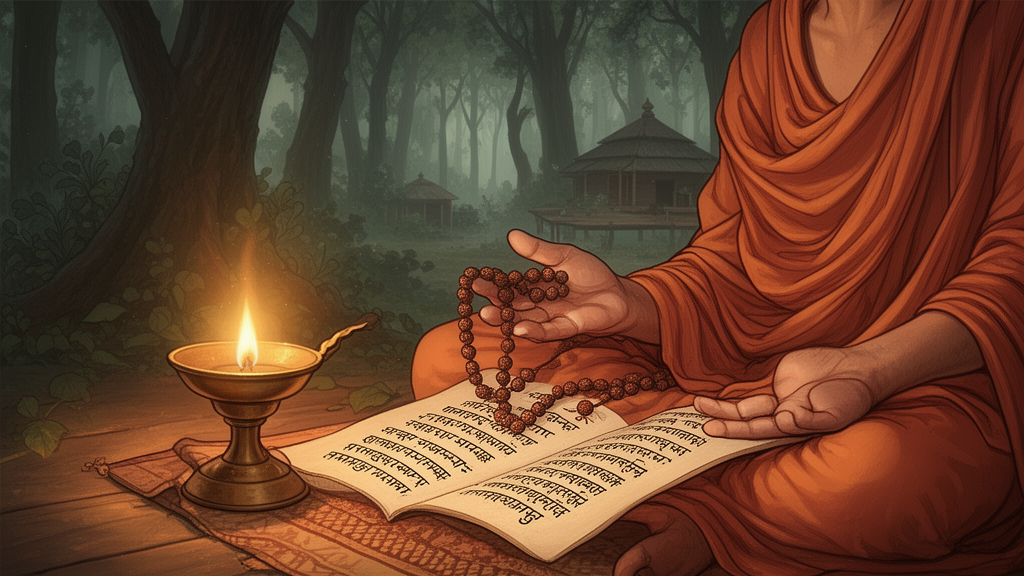
This guide explains the text’s title and variant names, its place in Shaivism and the Samaveda connection, its dialogue structure, the origin story of rudraksha, the selection criteria it describes, and the merit claims it makes. It also notes where sources disagree. For a broader orientation, see our overview of the meaning of the word Upanishad and our list of 108 Upanishads, which places this text within the wider collection.
What the Rudrakshajabala Upanishad Is
The text’s Sanskrit title is रुद्राक्षजाबाल उपनिषत्. It is also known as the Rudraksha Jabala Upanishad, Rudraksha Jabalopanishad, Rudraksha Upanishad, and Rudrakshopanishad. Readers may meet all of these forms in books, websites, and temple literature. They refer to the same text, though transliteration varies from source to source. This guide uses Rudrakshajabala Upanishad for consistency.
According to the Wikipedia article on the text, it is one of the 108 Upanishadic scriptures written in Sanskrit, is dedicated to the rudraksha, and belongs to the Shaiva sect that worships Shiva. The same article describes it as associated with the Samaveda and as one of fourteen Shaiva Upanishads. [1] These are the core identifying facts that most reference sources agree on.
A secondary summary on Grokipedia describes it as a minor Upanishad traditionally attached to the Sama Veda and listed in the Muktika canon of 108 Upanishads. [2] Because Grokipedia is an encyclopedia generated and edited in a wiki-style format, treat its details as secondary and check them against a critical edition or a scholarly translation before relying on them in study.
Where the Text Fits: Upanishads, Shaivism, and the Samaveda
The Upanishadic collection
The word Upanishad is often explained as a sitting near a teacher, and the Upanishads are generally treated as the concluding or philosophical portions of Vedic literature. The Rudrakshajabala Upanishad belongs to the larger group of texts that are counted among the 108 Upanishads, but it is not one of the older or more widely studied principal Upanishads. Its focus is narrow: one sacred object and the practices surrounding it.
The Shaiva connection
Shaivism is a major tradition centred on Shiva, though it includes many schools with different philosophies and practices. The Wikipedia article places the Rudrakshajabala Upanishad among the Shaiva texts, and its subject, the rudraksha, is regarded as sacred to Shiva. [1] This is an important context point: the text speaks from within Shaiva devotion. Vaishnava, Shakta, and other Hindu communities may hold rudraksha in high esteem for their own reasons, but the text’s framework is Shaiva.
The Samaveda link
The Wikipedia infobox lists the Samaveda as the Veda linked to this Upanishad. [1] Grokipedia also describes the text as traditionally attached to the Sama Veda. [2] Vedic attachment is traditional and organisational in many cases: it indicates which Veda a text is associated with in the tradition. It does not by itself establish a date or authorship. Readers who want to study the Samaveda in detail should consult a scholarly introduction to the Vedic corpus rather than relying only on the Upanishad’s attachment.
How the Text Is Structured
A dialogue framework
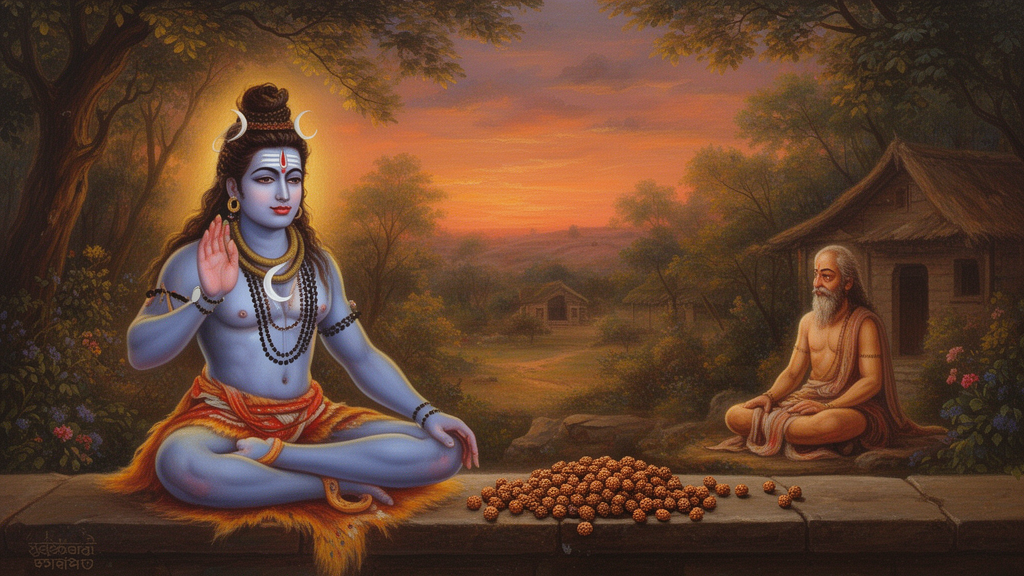
The text is presented as a conversation. The Wikipedia article states that it is told as a dialogue between Kalagni Rudra, described as a form of Shiva, and the sage Sanatkumara. [1] Kalagni Rudra is a fierce or fiery form of Shiva in the traditional sense, and this framing places teaching authority inside Shiva’s own voice.
A disagreement about the interlocutor
Sources do not fully agree on who questions Kalagni Rudra. The Wikipedia article names Sage Sanatkumara. [1] Grokipedia describes a dialogue between the sage Bhusunda and Kalagni Rudra, with additional questions from other sages. [2] The two accounts may reflect different editions, translations, summaries, or interpretive choices. Until the owner or an editor checks a critical Sanskrit edition and a reputable translation, this article reports the Wikipedia version as the primary reference and notes the discrepancy.
Invocation and conclusion
According to Grokipedia’s summary, the text opens with an invocation praising the luminous state of Shiva before moving into the inquiry about rudraksha. [2] Wikipedia’s article also describes an opening invocation to Brahman in its contents section, though the visible excerpt is brief. [1] Neither source should be used to reconstruct the exact wording of the invocation. Readers who need the words themselves should consult a Sanskrit edition with a scholarly translation.
The Origin of Rudraksha: Rudra’s Tears
The most widely repeated theme in this text is the origin of rudraksha from Shiva, often called Rudra in this context. Grokipedia states that the Upanishad explains the beads’ manifestation from Shiva’s eyes during the destruction of the demon Tripura, and that they became trees to help devotees attain liberation. [2] Other traditional accounts describe rudraksha as connected with Shiva’s tears, and the text is commonly summarised this way. The Wikipedia article’s title and summary also refer to the beads as associated with Rudra’s tears. [1]
This origin story is best understood as part of the text’s devotional and mythological framework. It explains why the seed is considered sacred. It is not a botanical claim, and it should not be presented as a scientific account of how rudraksha trees grow. Botanical identification of the plant and its seeds belongs to plant science and regional knowledge, not to the Upanishad.
Myth, scripture, and devotion
Hindu traditions often hold several layers at once: the scriptural statement, the devotional meaning, and the practical custom. A reader can accept the sacred origin as part of Shaiva belief while also recognising that it is a religious narrative. Good reference writing keeps these layers separate, and this article does the same.
Classifying and Selecting Rudraksha Beads
A distinctive feature of the text is its attention to the selection of beads. Grokipedia’s summary says the Upanishad treats size as a criterion: ideal beads are described as resembling the amla fruit, beads of jujube size are considered acceptable, and beads as small as chickpeas are considered inferior. It also says beads that are cracked, worm-eaten, or diseased should be rejected. [2] Because this summary is secondary, readers should verify these exact comparisons against a primary text or translation before treating them as the Upanishad’s own words.
Colour and varna associations
The same secondary summary links bead colour to the four varnas: white for Brahmins, red for Kshatriyas, yellow for Vaishyas, and black for Shudras. [2] The varna system is a historical social classification, and modern Hindu communities differ widely in how they understand it. Many readers today may find this association unfamiliar or uncomfortable. The responsible way to present it is as a textual statement found in some accounts of the Upanishad, not as a universal rule that all Hindus follow. Contemporary practice varies, and many practitioners choose beads by personal devotion, family custom, or guidance from a teacher.
Practical selection in tradition
Where traditional guidance on bead selection is followed, it is usually framed around sincerity, purity of intention, and care in choosing undamaged beads. A devotee who wants to follow the text closely can use its general principles: avoid visibly damaged beads and choose beads according to the guidance of a qualified teacher or community tradition. Specific size, colour, or face choices should be treated as tradition-specific rather than universal.
Mukhi Types: Faces and Associations
Rudraksha beads are commonly described by their mukhi, or natural face-lines. The Grokipedia summary states that the Upanishad discusses types from one to fourteen faces, each linked with particular deities, aspects, or effects. [2] Common listings in the secondary summary include the one-faced bead associated with ultimate liberation, the two-faced bead associated with Ardhanarishvara, and the five-faced bead associated with the Pancha Brahman. [2]
These associations are presented in the secondary summary as textual correspondences, but the exact mapping may vary across editions and later devotional literature. Many popular guides add their own associations, and some of these are not found in the Upanishad. Readers should distinguish three things: what the Upanishad says, what a commentary or later tradition adds, and what a shop, guide, or online seller claims.
Why readers should check the claims
Mukhi-based claims are among the most widely circulated. The safest reading is to treat each association as a religious teaching or tradition-specific claim. A bead is not a medical device or a financial tool, and no bead should be presented as guaranteeing a specific material result.
Merit, Benefits, and Traditional Claims
The Upanishad makes strong claims about the spiritual merit of engaging with rudraksha. According to Grokipedia’s summary, merely uttering the word rudraksha is said to yield the virtue of donating ten cows, seeing a bead doubles that merit to one lakh, touching it multiplies it to one crore, and wearing it confers one hundred crores of virtues and destroys sins accumulated over lifetimes. [2] The summary also says that wearing rudraksha and performing japa with it is described as producing one hundred million virtues. [2]
These are traditional religious claims within the text’s framework. They express the devotional value placed on rudraksha. They are not measurable outcomes, and they should not be read as promises that a person will gain wealth, success, protection, or freedom from illness. The Upanishad’s language about liberation and purification belongs to the religious and philosophical domain of the text.
Devotional meaning versus material expectation
Many traditions teach that the inner attitude of a devotee matters more than the object itself. A reader who approaches the Rudrakshajabala Upanishad as a source of devotional meaning can learn about Shiva, purity, discipline, and the value of japa. A reader who expects a guaranteed material result would be going beyond what the text, as summarised by reliable sources, actually supports.
Practice: Wearing Rudraksha and Japa
The text discusses wearing rudraksha and using it with mantra recitation, or japa. Grokipedia’s summary says the Upanishad links wearing the beads with japa and with divine grace. [2] Wikipedia’s article describes the text as dedicated to the rudraksha as prayer beads. [1] Taken together, these sources support the general statement that rudraksha is used as prayer beads in Shaiva devotion.
Tradition-specific guidance
Ritual details differ across regions, lineages, and families. Some people wear a single bead, some wear strands, and some use a mala for japa without wearing it on the body. The number of beads, the method of stringing, the mantras used, and the timing of practice can all vary. Anyone wanting a specific ritual procedure should ask a qualified guru, temple priest, or family elder from their own tradition.
Care and respect
Rudraksha beads are sacred objects in devotional use. Many practitioners keep them clean, store them respectfully, and avoid wearing them in situations where they would be treated carelessly. These are general courtesies rather than universal rules. Local custom matters.
Scholarly and Textual Notes
Dating and authenticity
The Wikipedia article includes a section titled Critique, and Grokipedia includes a section on textual critique and authenticity. [1][2] The existence of these sections indicates that scholars and encyclopedia editors have discussed the text’s status, but the visible excerpts used for this draft do not provide a fully verified date, author, or manuscript history. This article therefore does not assign a precise date. Dating Upanishads is difficult, and many texts in the collection were shaped over long periods.
Editions and translations
Because the text is known by several names and has been transmitted in Sanskrit and modern-language editions, readers may find differences in verse divisions, sentence wording, and interpretation. A good study approach is to use a reputable translation that identifies its Sanskrit base text and explains its method. When a claim in this article seems significant, the reader should compare the Sanskrit edition, a scholarly translation, and a secondary study.
Distinguishing the categories of information
It helps to sort claims into categories. Scriptural content is what the text itself says. Commentary is what later teachers say about it. Traditional belief is what communities hold as sacred. Historical evidence concerns when and where the text was composed or used. Modern interpretation applies the text to present life. This article follows that distinction and labels the origin story, merit claims, and mukhi associations as textual or traditional claims, not as independently verified historical facts.
How to Read the Rudrakshajabala Upanishad Today
- Begin with the text’s own framework. It is a Shaiva dialogue about rudraksha, not a general handbook on Hindu worship.
- Check the sources. Note whether a claim comes from the Upanishad, a commentary, a secondary summary, or a seller.
- Respect tradition-specific practice. Ask a qualified teacher before adopting a ritual method as your own.
- Avoid guaranteed-outcome claims. Traditional merit and devotional value are not the same as proven health, financial, or material results.
- Read related texts. Our guide to the 10 Upanishads and the Adhyatma Upanishad can help you see how other Upanishads address different themes.
Related Upanishads for Further Study
The Rudrakshajabala Upanishad is one voice among many. Readers who want to compare the Upanishadic style, themes, and Vedic links may find these target guides useful once they are published: the Aitareya Upanishad, the Aranyaka Upanishad, the Advaita Upanishad, and the Atmabodha Upanishad. Each of these addresses a different subject, so comparison should focus on literary form and theme rather than assuming identical teachings.
For a Shaiva-focused reading path, it can also help to look at the Atharvashikha Upanishad and the Ashtavakra Upanishad as separate traditions of study. A good reader keeps the boundaries of each text clear.
Frequently Asked Questions
Is the Rudrakshajabala Upanishad about Shiva?
Yes. The text is classified in the Shaiva tradition and is dedicated to the rudraksha, which is regarded as sacred to Shiva. [1] Its dialogue is framed around Kalagni Rudra, a form of Shiva. [1]
Does the text tell people how many beads to wear?
The secondary summaries discuss bead size, damage, colour, and mukhi types, but they do not provide one universal number of beads for every person. [2] Practice varies by tradition, so consult a qualified teacher for personal ritual guidance.
Are the benefits described in the text guaranteed?
No. The benefits and merit values described in the text are traditional religious claims. [2] They are not guaranteed material outcomes, and they should not be used to promise health, wealth, or protection.
Summary
The Rudrakshajabala Upanishad is a Shaiva Upanishadic text on the rudraksha bead. It is associated with the Samaveda, presented as a dialogue with Kalagni Rudra, and explains the bead’s sacred origin, selection criteria, mukhi types, and merit claims. Its teachings are important within Shaiva devotion, but they are best read as tradition-specific religious teachings. Readers who want to go further should compare a critical Sanskrit edition, a reputable translation, and guidance from their own teacher or community.
Sources and Further Reading
- Rudrakshajabala Upanishad, Wikipedia: used for the text’s name variants, Shaiva classification, Samaveda association, dialogue framework, and general description of rudraksha as prayer beads.
- Rudrakshajabala Upanishad, Grokipedia: secondary summary used for the Tripura origin account, bead size and damage criteria, varna colour associations, mukhi summaries, and merit claims. Treat as secondary and verify against a primary edition.
I appreciate the respectful approach to discussing religious beliefs and traditions. Looking forward to more informative content.