A raksha sutra is a sacred thread tied on the wrist as a symbol of protection, blessing and good wishes. In English it is often called a protection thread, and in many regions it is also known as kalawa. The word raksha means protection and sutra means thread or cord in Sanskrit. This article explains what the thread means, how it is traditionally tied, the mantra commonly recited with it, and how it differs from a related hymn, the Rama Raksha Stotram. Practices vary widely between families, regions and communities, so the guidance below should be read as one common tradition rather than a single rule for all Hindus.
Raksha sutra in English: a direct answer
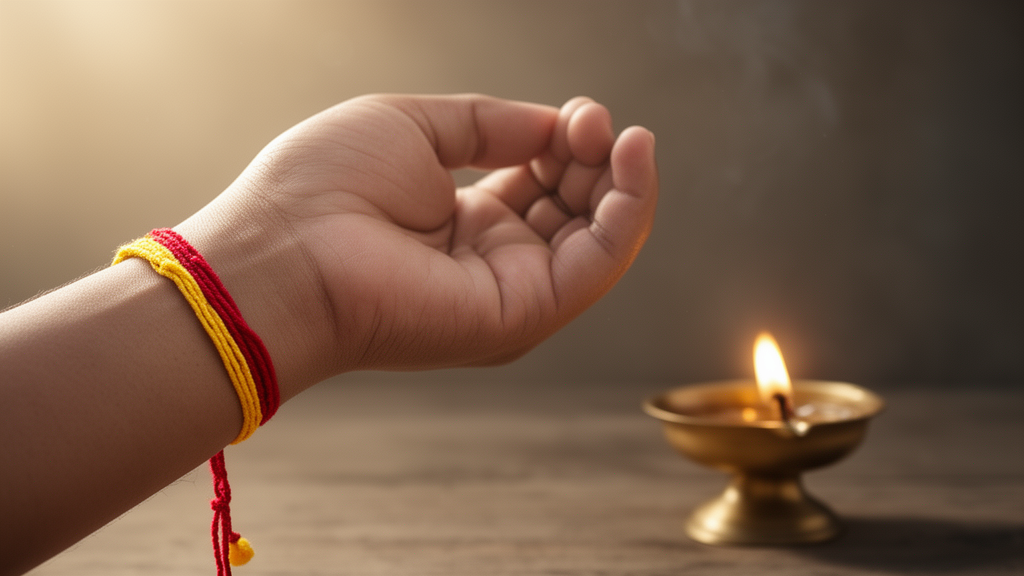
In English, the raksha sutra is a protective thread, usually made of cotton or cotton-based yarn and often red, yellow or multicoloured, that is tied on the wrist during a prayer or ritual. One widely shared Hindu blog describes it as a holy thread tied by Hindus for protection and notes that it is also called kalawa.[1] The thread is worn as a visible sign of a blessing, and it is usually accompanied by a mantra. It is not a scripture in itself. It is a devotional object and ritual practice that appears in many household and festival settings.
If you are looking for the Sanskrit mantra in English letters, the most commonly cited one is covered in the section on the Bali mantra below. If you are looking for the longer hymn that many people also call a protection prayer, the Rama Raksha Stotram is a separate text and is discussed in its own section.
Key terms and how they are used
The English phrase “protection thread” translates the core idea of raksha, but readers will meet several related terms. Each one carries a slightly different emphasis depending on the speaker and region.
- Raksha sutra: the Sanskrit-derived term for a protective thread tied on the wrist.
- Kalawa: a common name used in parts of western India and elsewhere for the wrist thread, as noted by the Hindu Blog page cited above.[1]
- Rakhi or rakhri: a word for the thread tied during the festival of Raksha Bandhan, which is associated with the bond between siblings in many families. Rakhi is a specific ritual context within the wider tradition of protective threads.
- Raksha stotra or stotram: a hymn of praise. The Rama Raksha Stotram is one such hymn, and it is a text rather than a thread.
- Mantra: a sacred utterance, usually in Sanskrit, recited for a specific purpose or devotional intention.
Keeping these terms separate helps avoid confusion. A reader who searches for “raksha sutra” may be looking for the thread, the mantra, the festival, or the hymn, and the same words are sometimes used loosely for all four.
The sacred thread as a devotional object
A raksha sutra is best understood as a devotional object that carries intention. Its meaning comes from the act of tying, the prayer offered at the time, and the relationship between the giver and the person who receives it. Devotees commonly describe the thread as a reminder of divine protection, a way to keep a prayer present through the day, or a sign of care within a family or community.
These are devotional and cultural explanations. They are not a scientific claim, and the thread should not be presented as a guarantee of safety, health, wealth or any particular outcome. A responsible reading treats the thread as a sacred expression of trust and intention, while recognising that people hold different beliefs about why it works, if they believe it does.
What the thread is made of and how it is chosen
Materials are not uniform. Many threads are made of cotton, silk or a mixed yarn. Colours and knots may follow local custom, family practice or the purpose of the prayer. Some families buy the thread from a temple or a religious shop, while others prepare it at home. Where a thread has been blessed by a priest or consecrated at a shrine, that is a specific practice of a particular family or temple tradition rather than a universal requirement.
Why people tie it on the wrist
The wrist is the most common place for the thread because it is visible, easy to keep on, and close to the hand used for prayer and daily work. Other traditions use similar protective threads on the arm, neck or waist. The choice of place is generally a matter of custom, and the reasons given are devotional rather than medical or physical.
Raksha sutra and the Rama Raksha Stotram: two different things
People searching for protection prayers often mix together two related but distinct items. The Rama Raksha Stotram is a hymn in Sanskrit, and the raksha sutra is a thread. They can be used together in devotional practice, but they are not the same thing, and a text about one should not be read as a text about the other.
What the Rama Raksha Stotram is
The Rama Raksha Stotram is a hymn in praise of Lord Rama. Several English-language sites describe it as a powerful hymn composed by the sage Budha Kaushika, and they tell a traditional story in which Lord Shiva instructs the sage to write it.[2][3] The Shlokam page, which provides Sanskrit lyrics with English meaning, describes the text as also called Rama-Kavacham, a shield of protection by Lord Rama.[2] That page also explains that the opening verses are introductory and meditative, that the core of the stotram runs through a range of verses, and that later verses are benefit statements and additions drawn from other sources.[2]“
The Thousand Vishnu Shloka site describes the hymn as consisting of 38 verses and presents it with Sanskrit, transliteration and English meaning.[5] The number of verses and their grouping can differ between editions, so readers who compare texts should check which edition they are using.
Where the story of the hymn comes from
The origin story of the Rama Raksha Stotram is part of the devotional tradition. The Shlokam page says there is a reference to the hymn in the Rig-Veda.[2] That claim is made by a devotional website and should be checked against a scholarly edition of the Rig-Veda before it is repeated as historical fact. Academic readers generally distinguish a hymn’s traditional attribution from its date of composition, and this article does not assert a specific historical date for the text.
Where the two practices meet
Some devotees recite the Rama Raksha Stotram while wearing a protective thread, and others keep the two practices separate. Neither approach is required by the texts examined here. The Hindu Blog page on the wrist thread gives its own tying guidance and does not link the thread to any particular hymn.[1] A reader who wants the hymn in English should consult a source that presents the Sanskrit, transliteration and English meaning together, and a reader who wants guidance on the thread should consult a source that explains tying customs.
The Bali mantra used with the thread
The Hindu Blog page presents a mantra in Sanskrit, transliteration and English context for use with the holy thread. The verse is commonly cited in this context and reads, in the transliteration given by the source, as follows: Yain Baddho Bali Raja Danvendro Mahabal Thain Thvamanubandnami Rakshe Ma Chal Ma Chal.[1] The Sanskrit form on the same page is येन बद्धो बली राजा दानवेन्द्रो महाबल : । तेन त्वामनुबध्नामि रक्षे मा चल मा चल।।.[1]
The mantra names King Bali, described in the verse as a powerful demon-king. In the common tradition associated with this mantra, Bali is the one who was bound, and the thread is the means by which the protection is tied. The page does not provide a full English translation of the verse, and this article does not offer one, because a precise translation should be checked against a reliable Sanskrit edition and a named commentary. Readers who want to understand the full meaning should look for a scholarly translation and note which tradition it follows.
Using transliteration respectfully
Transliteration is useful for readers who cannot read Devanagari, but it is not identical to the Sanskrit. Spellings vary between websites, and the same verse may appear with different vowels, consonants or line breaks. When you compare sources, look at the Sanskrit first and treat the transliteration as an aid. The same principle applies to the English word-by-word meaning that many sites provide.
How the thread is traditionally tied
The Hindu Blog page gives several practical points that are common in popular guidance.[1] These points are useful for understanding the practice, but they should be treated as one tradition’s advice rather than a universal ritual. Families and communities differ in their customs, and some follow different days, hands or counts.
- Timing: the page says the best days to tie the thread are Tuesday or Saturday, during the morning hours.[1]
- Hand: according to the same page, men and unmarried girls wear the thread on the right hand, and married women wear it on the left hand.[1]
- Posture: the palm should be closed while the thread is tied.[1]
- Wrapping: the thread should go around the hand three times, according to the page.[1]
These are presented as traditional guidance. They are not described as mandatory in the source, and other families may follow different practices. Where your family or temple has its own custom, that custom should be followed in preference to a general guide.
Common variations
Customs for the wrist thread can differ by region and family. Some families tie the thread at a temple after a puja. Others tie it at home on a festival day. Some prefer a specific colour, and some keep the thread on until it wears out rather than removing it at a fixed date. Where a source gives a rule about hand, day or count, it is worth asking whether that rule is part of your own tradition.
Respect and care
Because the thread is a religious object, many people treat it with care. They avoid tying it while in a state they consider impure, they keep it clean, and they may remove it before certain activities. These practices vary, so a reader should follow the guidance of their own family or priest where that guidance exists.
Raksha Bandhan and the rakhi thread
In many parts of India, a protective thread is also tied during the festival of Raksha Bandhan, when sisters tie a rakhi on the wrist of a brother and the brother offers a gift or promise of protection. This is a family and cultural custom with its own rituals and regional variations, and it is distinct from the general wrist thread discussed above. The sources reviewed for this article do not provide a verified account of the festival’s history, calendar or regional observances, so readers who need the festival date for a specific year should check a current calendar from a reliable source rather than relying on last year’s date.
The rakhi is best understood as one specific form of the wider tradition of protective threads. Not every raksha sutra is a rakhi, and not every rakhi is a Hindu wrist thread for daily protection. Keeping the categories separate helps readers understand which custom they are reading about.
Protective traditions in the wider Hindu devotional world
Raksha sutras sit alongside other devotional practices that express trust in divine protection. Many Hindu households use prayers, mantras, images, lamps and sacred objects in similar ways. The Rama Raksha Stotram is one of these practices, and devotees often connect it with the figure of Hanuman, who is closely associated with Rama in the Ramayana tradition. The Shlokam page, for example, identifies Shri Hanuman as the centre of the hymn’s recitation context.[2]
Readers who want to explore these connections can read the related HindusGod.com articles below. They cover different ways the same protective idea appears in Hindu devotion, and each one follows its own tradition.
- Raksha Sutra: an overview of the protective thread is a good starting point for readers new to the subject.
- Raksha Sutra meaning and the word’s origins explains the terms in more detail.
- Hanuman Raksha Sutra and Hanuman-centred protection covers the Hanuman connection.
- Sri Rama Raksha Sutra and the Rama protection tradition looks at the Rama-focused practice.
- Rama Raksha Sutra in Kannada is useful for readers who want the topic in another language.
What the sources can and cannot verify
It is important to separate three kinds of statements. The first is what a scripture or text says. The second is what a tradition or community believes or does. The third is what historians or scholars can document. For the raksha sutra, most of the material available in English online belongs to the second category, with some texts in the first category, and very little to the third.
- Textual claims: the Sanskrit lyrics of the Rama Raksha Stotram and the mantra linked to the wrist thread can be checked against Sanskrit editions. Scholarly work on Sanskrit devotional literature is the best place to compare variants.
- Traditional claims: the story of Budha Kaushika receiving the hymn through Shiva is a traditional account presented by devotional sites.[2][3][5] It is part of the devotional tradition and should not be presented as verified history.
- Practical guidance: the timing, hand and wrapping rules for the thread come from popular guidance.[1] They reflect one tradition’s advice.
- Benefit claims: several devotional sites say that reciting the hymn protects from difficulties, cures eye illness or helps clear debts.[3] These are devotional beliefs. They are not medically or financially verified, and this article does not present them as guaranteed outcomes.
Where sources disagree, the honest approach is to say so. For example, the number of verses in the Rama Raksha Stotram is given as 38 by some sites,[5] while the Shlokam page describes a structure in which some verses form the core text, some describe its benefits, and others are appended from other works.[2] Both descriptions can be true of different editions or different ways of counting, but readers should check which edition a given page uses.
Using the thread and the hymn in daily devotion
For a devotee who wants to use a protective thread in daily life, a simple and respectful approach is to start with the tradition your family follows. Ask an elder, a priest, or a trusted teacher about the local custom for tying, the day, the hand and the mantra. Then decide whether you want to recite a hymn, offer a short prayer or simply keep the thread as a reminder of faith.
If you want to learn the Rama Raksha Stotram, choose a Sanskrit text with transliteration and an English meaning from a source that names its edition. Read the meaning slowly, and note which parts describe the deity and which parts describe the benefits of reciting. Recitation can be part of a daily routine, a festival observance, or a request for help at a difficult time. None of these approaches requires a guaranteed result, and many devotees say their practice is about trust and gratitude rather than a transaction.
Common misunderstandings
Several misunderstandings appear often in popular writing about raksha sutras. Clearing them up helps readers approach the subject accurately.
- The thread is not a magic amulet. It is a devotional object whose meaning depends on the intention and tradition of the person who wears it.
- The thread is not the same as the Rama Raksha Stotram. One is a thread and the other is a hymn, although they are sometimes used together.
- There is no single correct hand or day. The guidance on hand and timing varies by family and region.
- The mantra should not be treated as a formula. Its meaning, pronunciation and purpose are tied to the tradition that uses it.
Frequently asked questions
Is raksha sutra the same as kalawa?
In many popular sources the two terms are used for the same wrist thread, and the Hindu Blog page notes that the raksha sutra is also known as kalawa.[1] Usage varies by region and family, so the local name may differ.
Which hand should the thread be tied on?
One popular source says men and unmarried girls wear it on the right hand and married women on the left.[1] Other families may follow different customs, so it is best to check with your family or local tradition.
Is there a single correct mantra for the thread?
The most common mantra linked to the wrist thread in the sources reviewed is the verse that names King Bali.[1] Some families use other prayers or no mantra at all.
Does reciting the Rama Raksha Stotram guarantee protection?
Devotional sources describe the hymn as a source of protection and blessing.[2][3][5] These are beliefs held by devotees. They are not guaranteed outcomes, and this article does not claim otherwise.
Summary and next steps
A raksha sutra is a protective thread tied on the wrist, commonly called kalawa in some regions, and often accompanied by a mantra. Its meaning is devotional and cultural, and its practice varies by family, region and tradition. The Rama Raksha Stotram is a separate hymn in praise of Lord Rama, traditionally attributed to Budha Kaushika, and it is sometimes recited alongside protective threads. When you read about these practices, separate the scriptural text, the traditional belief, the practical guidance and any historical claim. If you are learning the mantra or the hymn, use a source that names its edition and translation, and follow the guidance of your own family or teacher where it exists.
Sources and further reading
- English Raksha Sutra Mantra – Lyrics in English, Hindu Blog: used for the description of the raksha sutra, the kalawa name, the Bali mantra in transliteration and the tying guidance (timing, hand, palm and wrapping).
- Sri Rama Raksha Stotram, Sanskrit lyrics with English meaning, Shlokam: used for the description of the hymn, its alternative name Rama-Kavacham, the traditional attribution to Budha Kaushika and Shiva, the verse structure and the Sanskrit and transliteration of the opening verses.
- Ram Raksha Stotra in English, Bhaktinidhi: used to show that devotional sites describe the hymn’s traditional benefits; these are devotional claims rather than verified outcomes.
- Ram Raksha Stotram, Lyrics, Meaning and Benefits, ThousandVishnuShloka: used for the description of the hymn as having 38 verses and its traditional origin in a dream from Lord Shiva.
For further study, readers should consult a scholarly edition of the Rama Raksha Stotram and a reliable academic or institutional source on Sanskrit devotional literature. Those sources were not fetched for this draft and should be added and checked before publication.