The power of Holy Communion is usually discussed in terms of what the bread and cup mean to believers. In Christian teaching, Holy Communion (also called the Lord’s Supper or the Eucharist) is a meal of bread and wine or grape juice, received in memory of Jesus’ death. Its “power” is understood in different ways: as a reminder of Christ’s sacrifice, a public declaration of faith, a sign of the New Covenant, and a source of spiritual nourishment. This article explains what the practice is, where it comes from in the New Testament, what different Christian voices say about its meaning, and where those views differ.
HindusGod.com serves readers interested in Hinduism, so it is worth stating plainly at the outset that Holy Communion is a Christian sacrament. This article describes it on its own terms. It does not present Holy Communion as a Hindu ritual, and it does not treat Christian teaching as one view among many within Hinduism.
The Direct Answer: What Is the Power of Holy Communion?

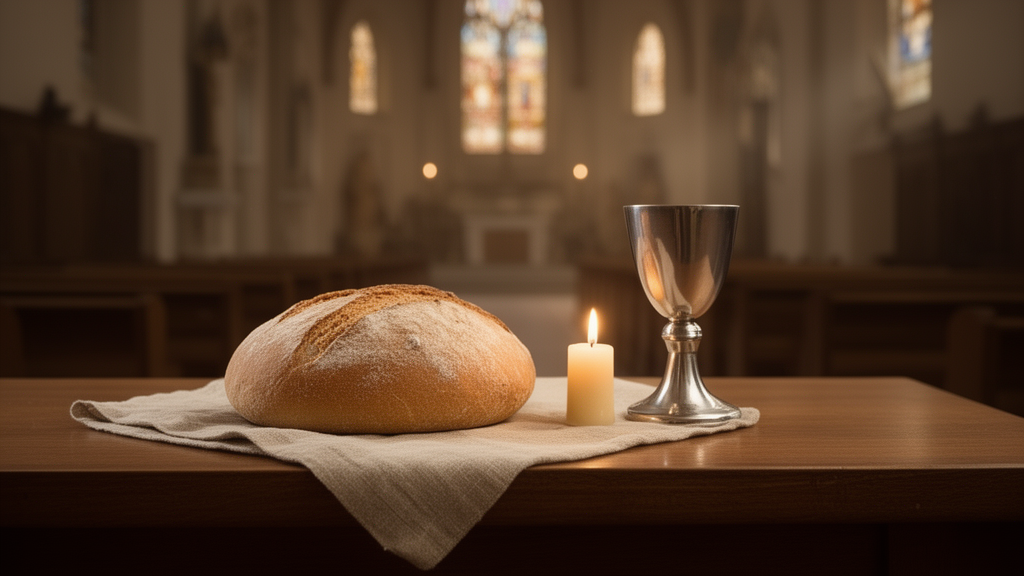
In brief, Christians who take Holy Communion say its power lies in its meaning rather than in any physical magic. The bread points to the body of Jesus, and the cup points to His blood. Believers are told to do this “in remembrance” of Him (Luke 22:19), and Paul writes that taking the bread and cup “proclaim[s] the Lord’s death till He comes” (1 Corinthians 11:26, as quoted in a Joseph Prince Ministries article). For many Christians, the practice therefore combines memory, thanksgiving, public witness, and personal faith.
Beyond that shared core, the emphasis differs. Some traditions stress remembrance, others the real presence of Christ in the sacrament, and others the communal life of the church. Any statement about the “power” of Communion should therefore be read as a statement of belief within a particular tradition.
Where the Practice Comes From
Holy Communion is traced to the Last Supper, the final meal Jesus shared with His disciples before His crucifixion. The accounts most often cited are in the Gospel of Luke and in Paul’s first letter to the Corinthians. According to Luke 22:19–20, Jesus took bread, gave thanks, and told the disciples to remember Him through it, and He described the cup as the “new covenant in My blood.” Paul repeats the instruction in 1 Corinthians 11:24–25.
A ChurchLeaders article describes Communion as one of two sacraments or ordinances recognized by many churches, the other being baptism. The same article notes that Jesus broke bread and blessed a cup, and that He instructed His followers to continue the practice as a memorial and proclamation (ChurchLeaders, “Why Do We Take Communion? 7 Biblical Reasons for the Lord’s Supper”). This is a statement of how many churches read the texts, not a neutral historical finding, but it accurately reflects the sacramental framework in which the practice is usually discussed.
Why the Gospel Accounts Matter
Readers who want to study the practice closely should compare the Gospel accounts and Paul’s letter directly, using a reliable Bible translation. The wording differs slightly among the texts and among English translations. Even small differences in phrasing have been discussed for centuries, and many scholars treat the Last Supper as a central but interpreted event rather than a simple record of a ritual manual.
Remembrance: The Foundation of the Practice
Remembrance is the most common theme in Christian explanations of Communion. The phrase “Do this in remembrance of Me” (Luke 22:19) is repeated in many churches when the sacrament is celebrated. Believers are asked to recall the sacrifice of Jesus, not only as a historical event but as a turning point in their relationship with God.
The ChurchLeaders article describes the bread and cup as tangible objects that tie memory to a specific event: Jesus’ crucifixion and resurrection. It also says Communion is not meant to be a gloomy service, but a celebration of what Christians regard as central to their faith. Some churches use solemn tones; others use joyful worship. Both approaches appear in Christian practice.
Remembrance in Practice
- Many believers spend time reflecting on the death and resurrection of Jesus before taking the bread and cup.
- Some congregations read the Last Supper passages during the service.
- Others use prayers of thanksgiving, which is the meaning of the Greek word eucharistia, from which “Eucharist” comes.
These are descriptions of common practice, not requirements shared by every Christian community. Local customs vary widely.
Proclamation: Telling the Story Through the Meal
Paul’s letter adds a second theme: proclamation. In 1 Corinthians 11:26, he links the repeated meal with announcing the Lord’s death “till He comes.” The ChurchLeaders article describes Communion as a public declaration of faith rather than a private act. In this view, the meal says something to the gathered congregation, to newcomers, and to the wider world about what Christians believe concerning Christ.
This emphasis explains why many churches treat Communion as part of worship, not only as a private devotion. It is also one reason some congregations explain the practice to visitors before they take part.
Covenant, Forgiveness, and the Cup
The cup is commonly connected to the idea of covenant. Luke 22:20 describes it as the “new covenant in My blood,” and a Joseph Prince Ministries article states that Paul teaches the blood of Jesus brings forgiveness of sins, citing Colossians 1:14 and Ephesians 1:7. Those passages are central to many Christian understandings of salvation, though interpretations of atonement vary across denominations.
A Word Empowerment Ministries article describes the cup as representing the “forgiveness” and “sealing of the New Covenant” and presents Communion as a reaffirmation of God’s promises. That article is written from a specific ministry perspective and uses language, such as calling Communion a “spiritual weapon,” that is not typical of all churches. Readers should treat such statements as the view of an individual ministry rather than a universal Christian teaching.
What the Covenant Imagery Means
Covenant language appears throughout the Bible, and it describes a binding relationship between God and people. Christians who speak of the New Covenant generally refer to a relationship established through Christ, in contrast to older covenants described in the Hebrew Scriptures. The precise theology of the New Covenant is discussed extensively in Christian scholarship and is not identical across traditions.
Healing and Wholeness: What Some Teachers Claim
Some ministries teach that Holy Communion has a healing dimension. A Joseph Prince Ministries article states that the bread represents the body of Jesus that was scourged and broken, and that believers can partake in expectation of “divine health.” It cites Isaiah 53:5 and 1 Peter 2:24, which speak of healing through His wounds. The article also says that believers should partake with the expectation that God’s healing is available.
Other Christian voices do not link Communion directly to physical healing in this way, and many traditions consider the sacrament primarily as a means of remembrance, proclamation, and spiritual union. Readers should distinguish three things here: what the Bible passages say, what a particular ministry teaches about those passages, and what the wider church teaches.
This article does not endorse claims that Holy Communion guarantees physical healing, financial blessing, or protection from harm. Such promises are not supported by the New Testament passages cited in the sources and should be read as ministry interpretations. Anyone facing illness should seek qualified medical care alongside spiritual support.
Related Posts on HindusGod.com
Readers exploring the healing theme may find these related drafts useful once they are published: The Healing Power of the Holy Communion (URL to confirm; target draft) and Health and Wholeness Through the Holy Communion (URL to confirm; target draft). Both are currently drafts and may not be public.
Names and Traditions: Communion, the Lord’s Supper, and the Eucharist
Christians use several names for the same general practice, and the names often reflect different emphases. The ChurchLeaders article identifies three common terms:
- Communion, which emphasizes fellowship with Christ and with other believers.
- The Lord’s Supper, which emphasizes its institution by Jesus and its future completion at the heavenly banquet.
- Eucharist, from the Greek eucharistia, meaning “thanksgiving,” which emphasizes gratitude for Christ’s sacrifice.
These terms are not interchangeable in every church. Some Christian traditions teach that the bread and wine become the body and blood of Christ in a real sense; others understand Christ to be spiritually present; still others regard the elements as symbols. The sources reviewed for this article do not fully document these positions, so readers who want a detailed account should consult primary doctrinal statements from each tradition, such as Catholic, Orthodox, Lutheran, Reformed, Anglican, and Baptist teaching documents, and read them directly.
Liturgical Differences
Denominations differ in how often they celebrate Communion, who may receive it, how the elements are prepared, and what words are said. Some churches offer Communion weekly; others monthly or on special occasions. Some restrict participation to baptized members, while others invite all who follow Christ. These are matters of tradition and local practice, not universal rules.
Common Liturgical Resources
Readers interested in how the service is structured may find these HindusGod.com drafts relevant once they are published: Common Worship Holy Communion (URL to confirm; target draft), which may cover one liturgical tradition, and Holy Communion Book (URL to confirm; target draft).
How Believers Take Communion
Because practices vary, this section describes common patterns rather than a single required method. In many churches, the service begins with prayer or a reading from Scripture, often including the Last Supper passages. The bread and cup are then shared with the congregation. Some churches pass trays through the pews; others invite people forward to receive the elements at the altar or table. Many invite believers to take a moment of personal reflection or prayer before or after receiving.
Participation rules matter. Many churches ask believers to examine themselves before partaking, a theme drawn from 1 Corinthians 11:28, which in the KJV reads “let a man examine himself.” Some congregations understand this as reflection on one’s faith and conduct; others use it to describe a formal process of church membership or confession. Readers unsure about participation should ask the local church leadership about its practice.
Practical Guidance for Visitors
- Ask whether guests are welcome to take Communion in that congregation.
- Note whether the church uses grape juice or wine, and whether gluten-free options are offered.
- Follow the local custom for receiving the bread and cup, including whether to wait for a signal.
- If you are not a member of a Christian church, consider observing quietly if you have questions.
Common Misunderstandings
Several misunderstandings appear often in discussions of Holy Communion. The first is that Communion works like a charm, producing a result whether or not the person understands or believes. Most Christian teaching instead emphasizes faith, reflection, and the grace of God, though the exact role of the sacrament in grace is interpreted differently across traditions.
A second misunderstanding is that every Christian church teaches the same explanation of the bread and cup. As the earlier section shows, the sacrament’s meaning varies. A third is that Communion is only a symbol with no spiritual significance. Many Christians would reject that description, while also disagreeing among themselves about how the sacrament works.
A fourth misunderstanding is that Communion guarantees material outcomes. Sources cited in this article describe healing and blessing as hopes or teachings of specific ministries. They do not establish that the sacrament produces measurable results. Scholars of religion distinguish devotional belief from empirical evidence, and this article follows that distinction.
A Note for Readers from Other Traditions
Readers who practice Hinduism, or who study it, may find that many religions include shared meals, offerings, and acts of communal devotion. Drawing such comparisons can be useful for understanding, but each tradition should be described in its own terms. Holy Communion is a Christian sacrament with its own scriptural basis and theology, and it should not be equated with Hindu prasad or puja without careful, sourced comparison.
Frequently Asked Questions
Is Holy Communion the same as the Eucharist?
Often yes, but the terms emphasize different aspects of the practice. “Eucharist” comes from a Greek word meaning thanksgiving. Some churches prefer one term over another, and their doctrinal understanding may differ.
Why do Christians take bread and wine?
The elements come from the account of the Last Supper, in which Jesus gave bread and a cup to His disciples and asked them to remember Him (Luke 22:19–20). The bread is commonly connected to His body and the cup to His blood. Churches differ on whether the elements are symbolic, spiritually received, or otherwise understood.
Can a non-Christian take Communion?
Most churches set conditions for participation, and these conditions vary. Visitors should ask the local congregation what is expected.
Closing Takeaway
The power of Holy Communion, as Christians describe it, lies chiefly in its meaning: remembrance of Christ’s sacrifice, proclamation of faith, reflection on the New Covenant, and participation in the life of the church. The sources reviewed show that many Christians hold these ideas, while some ministries also teach that the practice brings healing or blessing. Those claims are best read as ministry teaching rather than universal doctrine.
For readers who want to go further, the most reliable next step is to read the Last Supper passages in a trusted Bible translation and then compare how different church traditions explain them.
Sources and Further Reading
- The Power Of The Holy Communion, Joseph Prince Ministries: a ministry article on the bread and cup, healing, and forgiveness. Cited for the ministry’s teaching on these points; the healing interpretation is not a universal Christian view.
- Why Do We Take Communion? 7 Biblical Reasons for the Lord’s Supper, ChurchLeaders: a pastoral article on remembrance, proclamation, and the names of the sacrament, with reference to Luke 22:19–20.
- The Power of Communion, Word Empowerment Ministries: a ministry article presenting Communion as covenant and spiritual reinforcement. Cited as one ministry’s perspective.
- The Healing Power of the Holy Communion: HindusGod.com target draft (URL to confirm; not necessarily public).
- Health and Wholeness Through the Holy Communion: HindusGod.com target draft (URL to confirm; not necessarily public).
- Common Worship Holy Communion: HindusGod.com target draft (URL to confirm; not necessarily public).
- Holy Communion Book: HindusGod.com target draft (URL to confirm; not necessarily public).