This article explains Perceval and the Holy Grail: who Perceval is, how his story first connected him with a mysterious Grail, and how later authors changed him. Perceval belongs to the Arthurian legends of medieval Europe, which are Christian-influenced literary traditions and not part of Hindu scripture or worship. HindusGod.com covers Hindu deities, texts, and practices, so this post is an explainer about a European legend for readers who want to understand the story and its sources.

In short, Perceval is a knight of King Arthur’s court and the original hero of the quest for the Grail in the earliest surviving French romance. The French poet Chrétien de Troyes introduced him in the late 12th century. Chrétien’s Perceval, the Story of the Grail is unfinished, and the Grail in that text is a golden serving dish, not yet a ‘holy’ relic. Later writers changed the story considerably, and in many later versions the quest is taken up by Galahad.
Who is Perceval?
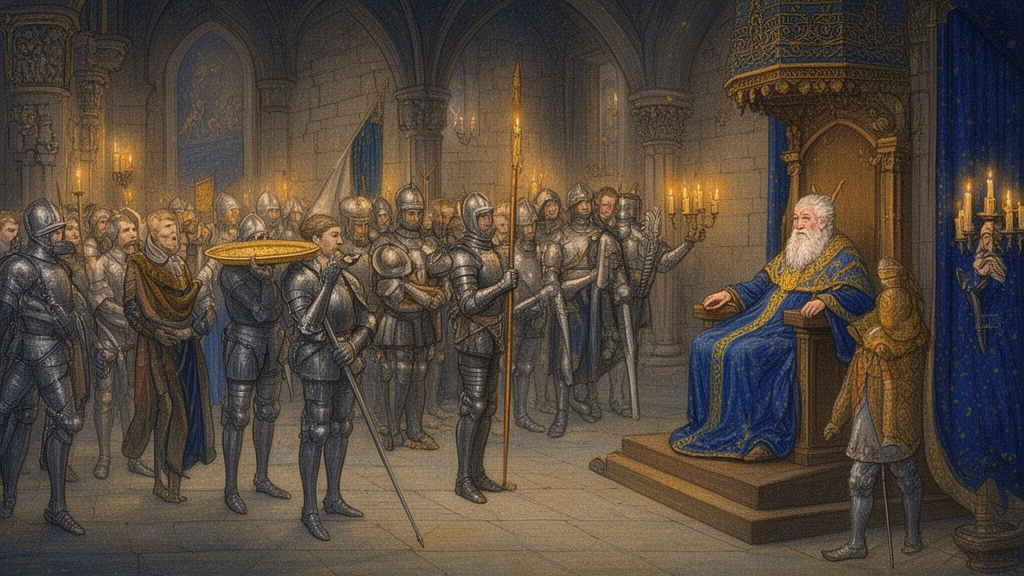
Perceval is a figure in the legend of King Arthur who often appears as one of the Knights of the Round Table. Reference works give several spellings and forms of his name, including Percival, Parzival, Parsifal, and, in Welsh tradition, Peredur. Readers may encounter any of these in different books, operas, and translations.
The name variants usually point to different linguistic and literary traditions rather than to different characters. The English Wikipedia article on Perceval notes that the name ‘Peredur’ may derive from the Welsh words for spear and hard or steel, though this etymology is an interpretation and not a settled fact.
Common threads across versions
Across many retellings, Perceval has a recognizable pattern:
- He is of noble birth, and in many versions the last surviving son of a family of knights, with brothers killed in battle.
- His mother, after losing her husband and sons, raises him in isolation in a forest so that he will not become a knight.
- He encounters knights and chivalry by chance, goes to Arthur’s court, and must learn the code of knighthood.
- He is marked by a naivety that makes him a learner, and his failure or success in understanding sacred mysteries becomes a central test.
The French Wikipedia article on Perceval summarizes this pattern and notes that his isolated upbringing makes him naive, a feature that turns him into an archetypal ‘fool’ figure in many stories. The degree of emphasis varies from version to version.
Chrétien de Troyes and the first Grail romance
The earliest surviving literary treatment of Perceval comes from Chrétien de Troyes, a French poet writing in Old French. According to the English Wikipedia article on Perceval, the Story of the Grail, the poem was written between about 1182 and 1190, and it is dedicated to Philip I, Count of Flanders, who is also the source Chrétien claimed to be using.
An unfinished romance
Chrétien’s poem is about 9,000 lines long and breaks off before the story is resolved. It then follows an adventure of Gawain that also remains incomplete. Scholars have proposed various reasons for the break, including the death of Philip of Flanders in 1191 while on crusade at Acre, or the death of Chrétien himself. The exact reason is not known, and this uncertainty is worth stating plainly because it affects how readers interpret the unfinished ending.
The Grail as a golden dish
One of the most important points for readers is that Chrétien’s Grail is not described the way later readers expect. The Wikipedia article on the poem states that Chrétien describes the Grail in the central scene as a golden serving dish, and that he does not call it ‘holy.’ A lance also appears at the same moment and is treated as equally significant. This is a textual observation about one medieval French romance, and it shows that the sacred quality of the Grail was developed further by later writers.
The continuations
After Chrétien’s death or break-off, other authors wrote continuations. Together they add roughly 54,000 lines to Chrétien’s 9,000, and they are known collectively as the Perceval Continuations or the Four Continuations. These continuations gradually added religious meaning to the Grail and developed the broader quest narrative. Scholars read them as a body of related texts, and their authors and dates are discussed in specialist scholarship rather than settled in a single source.
The Welsh Peredur
The Welsh romance Peredur son of Efrawg offers a different version of the same character. In this text the corresponding figure is called Peredur. The English Wikipedia article on Perceval notes that it is generally accepted that Peredur was a well-established figure before he became the hero of this Welsh tale. This suggests that the character existed in earlier Welsh material and that Chrétien’s French work was one of several streams that shaped the legend.
Readers should be cautious about treating any single retelling as the original. The relationship between the Welsh and French texts is discussed by specialists, and the sources do not establish a simple line of descent. The comparison is useful because it shows how one figure can appear in different languages with different emphases.
Why Peredur matters for the Grail story
- The Welsh text is a separate literary witness to the character, not simply a translation of Chrétien.
- Its name and setting keep a link to older Welsh traditions, which is why scholars look at it when studying the legend’s origins.
- Comparing it with the French romances helps readers see which features are shared and which were added by individual authors.
From Perceval to Galahad
Perceval was the original hero of the Grail quest in the earliest literature, but he was not the only knight later associated with the Grail. The English Wikipedia article on Perceval states that he is best known for being the original hero of the quest for the Grail before being replaced in later literature by Galahad, who was first introduced in the early 13th century.
This shift is one of the most significant developments in Grail literature. In the later tradition, Galahad is presented as a more purely devoted knight, and the Grail becomes more explicitly a sacred object. Perceval’s story then becomes one of partial success and personal failure rather than the pure achievement attributed to Galahad. Readers who know only the later version may be surprised by Perceval’s earlier prominence.
Parzival and Parsifal in later literature
The German poet Wolfram von Eschenbach wrote a major version of the story titled Parzival, which is a different and very influential retelling. Its treatment of Perceval, his failure and redemption, and the nature of the Grail became important sources for later writers. The English Wikipedia article on Perceval lists Parzival among the names and works associated with the character.
The form ‘Parsifal’ is widely known through later musical and dramatic works. The English Wikipedia article identifies Parsifal as one of the alternative spellings of the name, and the article’s illustration credit refers to a 1910 painting of Parsifal. Readers should note that the modern operatic and artistic treatments are later reinterpretations, not medieval texts, and they often change plot details and symbolism.
Which version are you reading?
Because the name appears in several forms and across several genres, it helps to ask three questions:
- Is the text medieval, such as Chrétien or the Welsh Peredur, or a later retelling?
- Does it call the Grail a dish, a stone, a cup, or a relic? The answer changes the meaning of the quest.
- Is the hero named Perceval, Parzival, Parsifal, or Peredur? Each name often marks a different literary tradition.
Belief, text, tradition, and scholarship
Discussions of the Grail often mix several kinds of claims. It helps to separate them:
- Text: What a particular medieval or modern work actually says. Chrétien describes a golden dish and a lance, for example.
- Tradition: Later practices of retelling, illustrating, and interpreting the story, which may add religious or symbolic meaning.
- Belief: The devotional or faith convictions of readers and communities that may treat the Grail as sacred. These are not historical claims and should be presented as beliefs.
- Scholarship: Academic interpretations of authorship, dates, sources, and influences. Scholars often disagree, and their conclusions are provisional.
A common error is to treat a later symbolic reading as if it were the earliest meaning. Chrétien’s poem, for example, does not present the Grail with the explicit religious language that appears in later continuations.
Why the Perceval legend still matters
Perceval’s story is valuable for readers because it shows how a single figure can change across centuries. The English Wikipedia article on Perceval notes his presence in modern culture, and the wide range of spellings suggests a long afterlife in literature, opera, and art. For students of medieval literature, the legend is a case study in how authors borrow, adapt, and reinterpret older material.
For general readers, the most useful takeaway is that the Holy Grail is not a single fixed object in the earliest sources. The idea developed gradually across texts written in different languages and periods.
Frequently asked questions
Who was the original Grail hero?
In the earliest surviving literary account, the original hero of the Grail quest is Perceval, introduced by Chrétien de Troyes in Perceval, the Story of the Grail. Later literature often replaced him with Galahad.
Is Perceval the same as Parsifal?
Perceval and Parsifal are alternative forms of the name used in different languages and traditions, and they are generally treated as the same literary figure. Some later versions also change the plot, so readers should check which text they are reading.
Is the Grail described as holy in the earliest text?
According to the English Wikipedia article on Chrétien’s poem, the Grail in the central scene is a golden serving dish, and the poem does not call it ‘holy.’ Later continuations and retellings added explicitly religious meaning.
Related reading on HindusGod.com
The following pages are current WordPress drafts on HindusGod.com. Their links may not be public until the owner publishes them, so readers may see them only after publication. They cover related Grail topics from different angles:
- Story of the Holy Grail for a broader narrative overview of the Grail legend.
- History of the Holy Grail for historical context and how the idea developed over time.
- The High History of the Holy Grail for a look at a medieval prose cycle that shaped later versions.
- In the Quest of the Holy Grail for the quest narrative and its knights.
- Parsifal and the Holy Grail for the later Parsifal tradition in more detail.
- Lancelot Holy Grail for Lancelot’s place in the Arthurian quest.
- Books About the Holy Grail for further reading on the subject.
- History’s Greatest Mysteries the Holy Grail for a discussion of popular mysteries surrounding the Grail, which should be read alongside scholarly sources.
Sources and further reading
- Perceval, English Wikipedia: overview of the character, names, the Welsh Peredur, and Galahad’s later role. Secondary source; check its cited works.
- Perceval, the Story of the Grail, English Wikipedia: date, dedication, unfinished state, Grail description, and continuations. Secondary source; check its cited works.
- Perceval, French Wikipedia: character background, family details, and the Perceval story in several versions. Secondary source in French.
- Perceval, Encyclopaedia Britannica: general reference on the hero of Arthurian romance.
- Perceval, Merriam-Webster: dictionary definition of the name.
Summary
Perceval is the original hero of the Grail quest in Chrétien de Troyes’s late 12th-century French romance, where the Grail is a golden dish rather than an explicitly holy relic. The Welsh Peredur, the German Parzival, and later Parsifal are related versions of the same figure, and later literature often gave the quest to Galahad. For readers, the most reliable approach is to identify the specific text, separate what it says from later tradition and belief, and check scholarly sources for disputed points.