The Parashurama Kalpa Sutra (Sanskrit: परशुरामकल्पसूत्रम्, romanized Paraśurāmakalpasūtram) is a text on Shri Vidya worship. Wikipedia describes it as a Shakta Agama ascribed to the Kaula tradition, and it is treated as a sacred guide by Shri Vidya practitioners who worship the goddess Lalita. Its authorship is traditionally attributed to Parashurama, whom Hindu tradition counts as the sixth avatar of Vishnu. Its ritual scope is often described in terms of ten sections, though the exact structure and origin story vary between sources.
This article explains what the text is, how it is attributed, which deities it is associated with, how its structure is described, and where the evidence is traditional rather than academically settled. It is written for readers who want an accurate overview, not for a specific initiation or ritual procedure.
Quick answer: what is the Parashurama Kalpa Sutra?
It is a Sanskrit text connected with Srividya sadhana, the practice centred on Tripurasundari (Lalita). Its name combines Parashurama, the traditional author, with kalpa sutra, a term used for aphoristic manuals of procedure. Devotional sources present it as a systematic guide to mantra, nyasa, homa, and Sri Chakra worship. Academic and reference sources place it within the Shakta Agama and Kaula currents rather than the Vedic literature.
Understanding the name
Parashurama and “Kalpa Sutra”
The name identifies the traditional author. Parashurama is the sage associated with the sixth avatar of Vishnu. The second part of the title, kalpa sutra, indicates a compact, instructional style. In Hindu usage, a kalpa is a manual of ritual procedure, and a sutra is a short aphoristic statement. Readers should not assume that every text with “kalpa sutra” in its title belongs to the same tradition; the Parashurama text is a Shakta-Tantric work in Shri Vidya circles.
Spelling variants
You will see several spellings in English: Parashurama, Parashuram, Paraśurāma, and Parashurama Kalpasutra. The Wikipedia article uses “Parashurama Kalpasutra”, one archive.org record uses “Parashuram Kalpa Sutra”, and devotional websites use “Parashurama Kalpa Sutra”. These all refer to the same text. This article uses “Parashurama Kalpa Sutra” for consistency.
Where the text sits in Hindu literature
Shakta Agama and Kaula association
Wikipedia classifies the text as a Shakta Agama, a Hindu text on Shri Vidya practices, and links it to the Kaula tradition. Shaktism is the tradition centred on the Goddess as the supreme reality, and Shri Vidya is one of its major esoteric streams. The Agama classification places the text among ritual-liturgical works that differ from the Vedic corpus and from the Puranas. Readers who want to explore the wider category can compare it with other Shakta texts, but should keep in mind that categories such as Agama, Tantra, and Kaula are used with some looseness in modern writing.
Belief, text, and scholarly classification
It helps to separate three layers. The textual layer is the Sanskrit work and its editions. The traditional layer is the belief that Parashurama and Dattatreya transmitted this knowledge. The scholarly layer is the classification of the text by its form, lineage, and likely period. The traditional attribution is a matter of devotional belief and lineage claim. It is not, on its own, a historical dating of the work.
Traditional attribution and transmission
Parashurama as author
Wikipedia reports that authorship is traditionally attributed to Parashurama, a disciple of Dattatreya. Devotional sources such as Srividya Sadhana describe the sage as the one who organized the teachings into the Sutra. This is the attribution of the tradition. It should be presented as a claim of that tradition unless an independent historical source confirms it.
Dattatreya Samhita and Sumedha
Wikipedia states that the text has its origins in the Dattatreya Samhita and was compiled by Sumedha, a disciple of Parashurama. The Mahaavidya Sadhana Centre instead describes the text as derived from the Dattatreya Samhita and “condensed and structured” by Parashurama together with his disciple Sumedha. The two accounts differ on who did the compiling. Both agree on the Dattatreya Samhita as a source and on Sumedha as a disciple-figure. Readers should treat these as competing traditional accounts rather than a single settled history.
Transmission through the Dattatreya Sampradaya
Srividya Sadhana describes the text as part of the Dattatreya Sampradaya, a lineage that traces the teaching through Guru Dattatreya to Parashurama. Sampradaya means a lineage of transmission. Within Srividya, different lineages have different emphases, so the Sampradaya framework explains why one community may treat the text as central while another uses different manuals.
Deities and worship contexts
Lalita and Tripurasundari
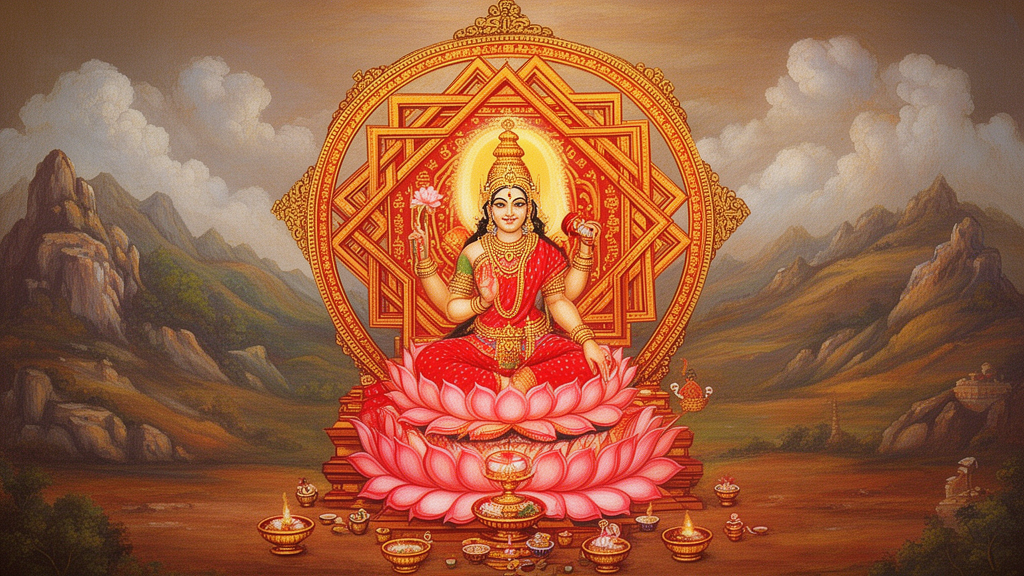
The text is sacred for Shri Vidya worshippers of the goddess Lalita, whom Wikipedia describes as a manifestation of Adi Parashakti. Srividya Sadhana calls Lalita Tripurasundari the Divine Mother and presents worship of her as the highest of spiritual practices, since, in that devotional view, it encompasses the benefits of other forms of worship. That is a devotional claim within Srividya belief, not a universal statement about Hinduism.
Associated deities
Wikipedia lists Ganesha, Bala Tripurasundari, Matangi, and Varahi as deities whose worship also uses the text. Srividya Sadhana names Maha Ganapathi, Rajamatangi (also known as Raja Shyamala), Maha Varahi, and Bala Tripurasundari as parivara devatas, or associated deities, of Lalita. The two sources agree on the core group. Their wording differs slightly, so use the names as the sources give them.
Why the associated deities matter
In Srividya practice, these deities are often approached within a larger framework of the goddess and her retinue. Ganesha is invoked as the remover of obstacles in many Hindu contexts, and the text’s Ganesha portion is described as a protocol for his worship. Varahi appears in the Sutra as a boar-headed goddess whose worship has its own section. Readers should note that these associations come from the devotional and reference descriptions; a detailed ritual procedure should be checked against a reliable edition and a qualified teacher within the relevant lineage.
The ten-part structure as described by sources
Devotional sources describe the Sutra as having ten parts. Srividya Sadhana calls them khandas, and the Mahaavidya Sadhana Centre lists the following sections by name, with short descriptions in its own words:
- Deeksha Vidhi: initiation and preliminary preparation.
- Gana Nayaka Padhati: a protocol for worshipping Ganesha.
- Srikramam: procedures for worship and meditation on the Sri Chakra.
- Lalita Kramam: rituals and meditations for Goddess Lalita.
- Navavarana Pooja: the nine-enclosure worship.
- Shyama Kramam: worship of the fierce form of the Divine Mother, described as Kali or Shyama.
- Varahi Kramam: worship of Varahi.
- Para Kramam: advanced techniques associated with higher states of consciousness.
- Homa Vidhana: fire-ritual procedures.
- Sarva Sadharana Kramam: general principles for practitioners.
Srividya Sadhana also describes a progression from foundational practices in Ganapati Krama toward higher practices in Para Krama. Both descriptions present the ten parts as a sequence of increasing depth. The sequence is the devotional presentation of these sources. Whether the actual text is arranged in the same order, and how the sections are numbered in particular manuscripts or printed editions, should be checked against the edition being used.
Note on verification: the list above comes from two devotional websites, not from a critical edition inspected in this review. HindusGod readers should treat it as a description of the text’s traditional outline.
Editions, commentaries, and sources to consult
Archive.org editions
The Internet Archive hosts at least two catalog records relevant to the text. One is titled Parashuram Kalpa Sutra with Vritti of Ramesvara and Nira Kshira Vivek of Paramahans Mishra, credited to Ramamurti Sharma and to Sampurnanand University Varanasi. Its title indicates an edition that includes a commentary (vritti) by Ramesvara and a companion work, the Nira Kshira Vivek by Paramahans Mishra. A second record, titled Parashurama Kalpa Sutra, is also listed. Catalog records confirm that editions exist and are accessible; they do not by themselves confirm the text’s contents, its date, or the accuracy of any claim in this article. Users should open the scan and check the Sanskrit and commentary directly.
Commentary and modern interpretation
A commentary such as the Ramesvara vritti is a traditional interpretation of the Sutra, not the Sutra itself. When a devotional website explains the text, it is usually offering a modern or sectarian reading. Readers should keep three categories apart: what the Sanskrit says, what a commentary explains, and what a teacher or website adds.
Belief, tradition, and scholarship
Discussion of this text involves overlapping categories. The following distinctions help:
- Devotional belief: that Parashurama received and transmitted the teaching; that worship of Lalita is the highest practice; that the Sutra guides the sadhaka toward union with the Divine Mother.
- Traditional lineage: the Dattatreya Sampradaya narrative and the Dattatreya Samhita as a source.
- Textual evidence: the existence of editions and commentaries, such as the archive.org records above.
- Scholarly classification: the designation as a Shakta Agama within the Kaula current, as reported by Wikipedia.
The sources reviewed for this article do not provide a verified date of composition, a critical-edition comparison, or a published academic study of the Sutra’s ten-part structure. Claims about exact dating, the historical identity of Parashurama, or the historical existence of Sumedha should be treated as traditional unless supported by specialist scholarship. Where the sources disagree, as they do on who compiled the text, the disagreement should be stated.
Regional and community differences
Srividya is practised across South India and beyond, and it has several lineages, temple traditions, and household practices. Sources with different community roots describe the Parashurama Kalpa Sutra in different terms. Srividya Sadhana writes from within the Dattatreya Sampradaya and emphasizes guru transmission and initiation. Mahaavidya.org presents the text in the context of structured sadhana courses. Wikipedia describes it in encyclopedic terms. None of these is a complete account of how every Srividya practitioner uses the text.
Initiation, mantra use, and fire rituals in Srividya are often tied to a qualified guru within a lineage. The text’s ritual sections should not be read as instructions that anyone can follow without teacher guidance. This article does not provide ritual steps.
How to study the text responsibly
- Start with a reliable overview, such as the Wikipedia entry, to learn the name, attribution, and deities.
- Compare at least one primary edition, such as an archive.org scan, before relying on a summary of its sections.
- Note whether a source is describing the text, a lineage, or a practice.
- For initiation or ritual practice, seek guidance from a teacher within a recognized lineage.
Related HindusGod.com pages
For a broader introduction to the Kalpa Sutra category, see the Kalpa Sutra overview (target draft; may not be public yet). A companion article on the Hindi-language version of the topic is available as the Kalpa Sutra in Hindi guide (target draft; may not be public yet). For another Sutra-style devotional text, readers can explore the Devi Sutra article (target draft; may not be public yet), though its relevance to Srividya should be checked before linking further. Only these three targets were judged relevant from the verified draft list; other Sutra topics in that list concern Buddhist or unrelated texts and were not linked.
Frequently asked questions
Is the Parashurama Kalpa Sutra the same as a Vedic kalpa sutra?
Not according to the sources reviewed here. Wikipedia classifies it as a Shakta Agama on Shri Vidya practices. Vedic kalpa sutras are a separate genre within the Vedanga literature. Shared terminology should not be taken as shared tradition.
Who is the text meant for?
Devotional sources present it as a guide for Srividya practitioners, particularly those within the Dattatreya Sampradaya. Its content is specialized, and most sources emphasize guru guidance.
Is there a verified date for the text?
The sources reviewed for this article do not provide a verified date of composition. Traditional attributions to Parashurama describe a legendary origin rather than a documented historical date.
Sources and further reading
- Parashurama Kalpasutra, Wikipedia: used for the Shakta Agama and Kaula classification, traditional attribution to Parashurama and Dattatreya, the Dattatreya Samhita origin, compilation by Sumedha, and associated deities.
- Parashuram Kalpa Sutra with Vritti of Ramesvara and Nira Kshira Vivek, Internet Archive: used to confirm the existence of an edition with a commentary by Ramesvara and a companion work. Contents not verified in this review.
- Parashurama Kalpa Sutra, Internet Archive: used to confirm a second archived record of the text. Contents not verified in this review.
- Mahaavidya Sadhana Centre, Parashurama Kalpa Sutra guide: a devotional source used for the ten section names and descriptions, the Dattatreya Samhita origin, and the Parashurama and Sumedha account. Treat as a sectarian presentation.
- Srividya Sadhana, Parashurama Kalpa Sutra: a devotional source used for the Dattatreya Sampradaya framing, the ten khandas, associated deities, and the Ganapati Krama to Para Krama progression.
Source not usable for content: the Amritananda Srividya forum thread (forum.amritananda.org) returned only a loading message and an error notice during inspection, so no claims are drawn from it.
Final takeaway
The Parashurama Kalpa Sutra is a central Srividya text attributed to Parashurama, linked to the Dattatreya Samhita, and devoted to the worship of Lalita Tripurasundari and related deities. Its ten-part structure is well described in devotional sources, but the sources do not provide a verified critical edition or a settled date. Readers who want to go further should consult an edition and a qualified teacher within a recognized lineage.