Neil Gaiman’s short story Chivalry is a modern comic fantasy about an elderly widow who buys the Holy Grail at a charity shop and then has to decide whether to give it up to a visiting knight. The story was first published in the collection Smoke and Mirrors: Short Fictions and Illusions (Harper Perennial, 1998), and it is listed there at pages 33 to 47. This post explains the plot, the Grail legend behind it, the story’s main themes, and the 2022 graphic novel adaptation. It also explains how this story relates to HindusGod.com’s focus, which is limited.
Direct answer: what is the Neil Gaiman Holy Grail short story?
The Holy Grail short story most readers mean is Gaiman’s Chivalry. In it, Mrs. Whitaker, a widow in present-day Britain, buys what turns out to be the Holy Grail for 30p at a second-hand shop. A knight named Galaad, who says he is a Knight of the Round Table, then arrives in search of the cup. The story is a light, humorous piece that mixes medieval romance with everyday English domestic life.
Three points help readers approach it:
- Form: It is a short story, not a novel, and it was first published in a 1998 collection.
- Source material: It draws on Arthurian romance and the medieval Grail tradition, but it is a modern invention rather than a retelling of a single medieval text.
- Adaptation: It was adapted as a graphic novel by Neil Gaiman and Colleen Doran, published in 2022.
Why this story appears on a Hindu devotional site
HindusGod.com publishes material on Hindu deities, scriptures, festivals, and devotional practice. Chivalry is not part of any Hindu scripture, and its Grail imagery comes from Christian and Arthurian traditions. Readers should not read the story as a Hindu text, and this post does not claim any Hindu source for it.
The story is still useful for readers who want to compare how different traditions treat sacred objects. Hindu worship often centers on images, vessels, and offerings used in puja, and the Grail is a sacred vessel within a different religious world. Any comparison should be kept general. The Grail’s religious meaning in Christianity, and its role in medieval romance, are separate subjects from Hindu practice, and they should not be merged.
The plot of ‘Chivalry’ in brief
The story is short, and this summary only covers its main movements. Plot details differ slightly among summaries, and where they do, this post notes the difference.
The discovery at the second-hand shop
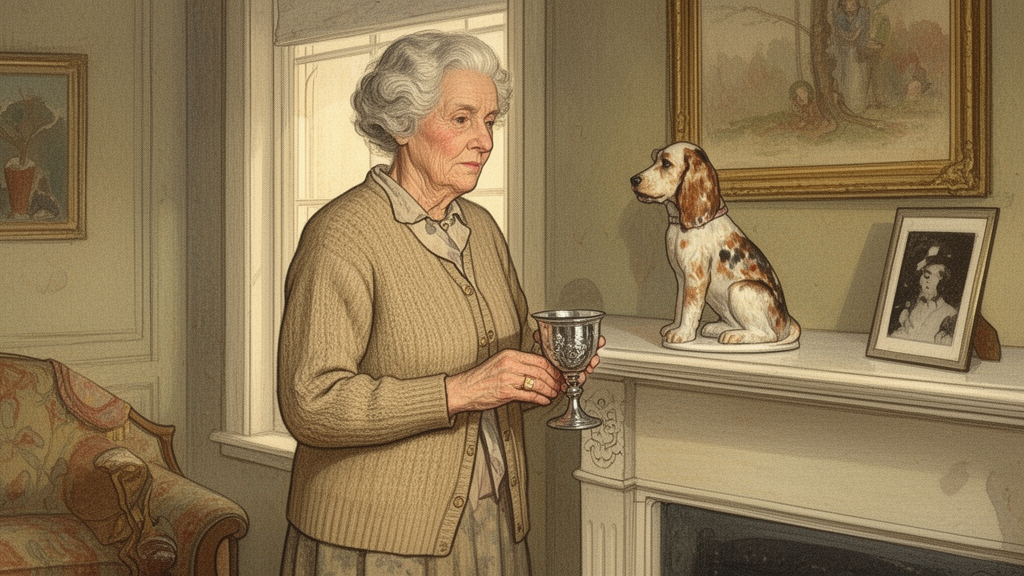
Mrs. Whitaker visits a charity shop each Thursday after collecting her pension at the post office. The shop is staffed by volunteers, and on the day in question the volunteer is Marie, a teenager who is reading a magazine. Mrs. Whitaker browses the shelves, buys some paperbacks, and then lifts a worn fur coat to find a walking stick, an old book on chivalry, and the Grail itself. Its price is written on a sticker on the base. She pays for it and takes it home, where she cleans it and places it on her mantelpiece.
The knight arrives
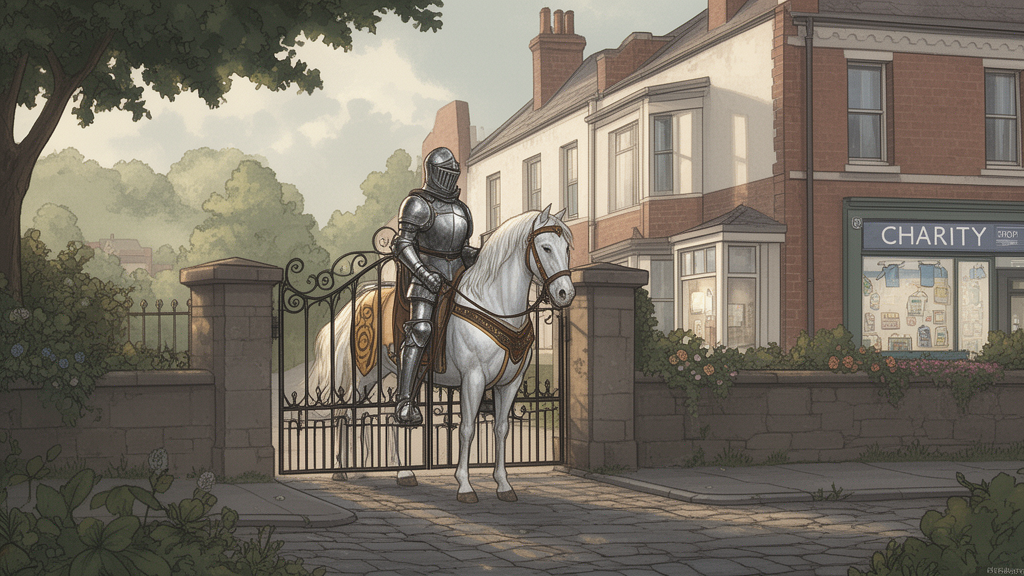
The next day, a visitor named Galaad appears at her door in armor, on a horse, and says he is on a quest for the Holy Grail. He presents a letter he says comes from King Arthur, and Mrs. Whitaker lets him in. When he sees the cup, he kneels and asks to take it, offering gold. She refuses, and he leaves.
Escalating offers
Galaad returns and makes further offers. Summaries describe the objects differently. The Short Story Guide describes a sword with a gold and silver hilt and a jewel that makes its wielder invulnerable. Writing Atlas identifies the sword as Balmung. Both agree that Mrs. Whitaker declines the sword. Galaad also helps around the house and speaks with her about his family and her own past, and the story treats these scenes with warmth and comedy.
The final offer
In the last major exchange, Galaad brings three objects in exchange for the Grail: the Philosopher’s Stone, the Egg of the Phoenix, and an apple of the Hesperides. According to the Writing Atlas summary, the apple can make someone young and beautiful forever. Mrs. Whitaker tastes the juice, feels what youth was like, and is drawn to the knight. She then tells him to put the apple away, and she agrees to trade the other two objects for the Grail. After he leaves, she cries.
The ending
In the closing scene, Mrs. Whitaker returns to the shop, finds another book and an oil lamp, and decides against buying the lamp because she has nowhere to put it. The ending is quiet and wry, and it returns the story to its ordinary setting.
The Holy Grail: a legend with several traditions
The Holy Grail in Gaiman’s story is a cup with a long and varied history in European literature. This post does not present a single authoritative origin story, because scholars and traditions differ on how the Grail legend developed.
The Grail in medieval romance
In medieval French and German romance, the Grail appears as a mysterious object connected with knights, quests, and religious meaning. The Grail is the focus of several Arthurian stories, and the knights who seek it, such as Perceval and Galahad, have different roles across texts. Readers interested in those texts can explore the internal HindusGod.com draft articles listed below, though those pages are not yet confirmed as live.
The Grail in Christian belief
In Christian tradition, the Grail is often linked with the cup used at the Last Supper, though medieval texts developed this link in different ways. In the story, Mrs. Whitaker explains to a friend that the cup is the one Jesus drank from at the Last Supper. That is a character’s explanation within the fiction, not a statement of scholarly fact. Readers should separate that character’s belief from the historical questions about relics and legends.
Why Gaiman uses the Grail
The Grail gives the story its premise: a sacred object of enormous fame is treated as a pleasant ornament. Gaiman places a legendary object in a charity shop, and the comedy comes from the contrast between the object’s reputation and Mrs. Whitaker’s practical, unimpressed attitude. The story’s humor depends on readers already knowing the Grail’s legendary status.
Themes readers often discuss
The following are interpretations drawn from reviews and summaries. They are not facts stated by Gaiman in the sources reviewed for this post.
Temptation and eternal youth
The apple of the Hesperides is the story’s most direct temptation. Writing Atlas summarizes it as offering eternal youth and beauty, and it links that offer with the story’s emotional turn. Mrs. Whitaker’s refusal of the apple, with her comment that such things should not be offered to old ladies, is one of the story’s sharpest moments. Readers may see it as a comment on aging, dignity, and what people consider worth desiring.
Ordinary life and the extraordinary
The story places chivalric romance in a modern British setting. The knight rides through the street, and few people react. Reviewers note this contrast between the fantastic and the everyday. The story’s point is not that magic is absent from the world, but that Mrs. Whitaker treats it with a practical sense of what she needs.
Humor and kindness
Goodreads reviews of the graphic novel describe the story as humorous and sweet. Those descriptions are reader and publisher opinions, not scholarly findings, but they help explain why the story is often recommended to readers who want light fantasy.
The 2022 graphic novel adaptation
Chivalry was adapted as a hardcover graphic novel with Neil Gaiman as writer and Colleen Doran as illustrator. Goodreads lists it as 72 pages, first published on April 5, 2022. Reviews on that page describe Doran’s art as drawing on Golden Age illustration and illuminated manuscript styles, and a review quotes Doran saying she had wanted to adapt the story for many years. Those points come from publisher and reader material and are best checked against the publisher’s own listing before purchase.
The adaptation lets readers see the knight, the house, the shop, and Mrs. Whitaker in visual form. Readers who know the prose story may find the comic version a different experience, because the pacing, illustrations, and dialogue work differently on the page.
How to read the story
- Start with the prose. The short story is brief, and its comedy depends on timing and tone.
- Notice the shop. The second-hand shop, with its donated objects and volunteers, is central to the story’s setting.
- Compare summaries carefully. Summaries differ on minor details, such as the name of the sword. Check the original text when a detail matters.
- Separate the legend from the fiction. The Grail’s medieval and Christian meanings are background to the story, not claims made by the story itself.
Related reading on HindusGod.com
The following HindusGod.com posts are related Grail topics. These are WordPress drafts, so they may not be public yet. Links should be confirmed before publication.
- Read Story of the Holy Grail for an overview of the Grail as a narrative object (URL to confirm; draft status).
- Read The High History of the Holy Grail for a look at medieval Grail romance (URL to confirm; draft status).
- Read History of the Holy Grail for historical background (URL to confirm; draft status).
- Read Books About the Holy Grail for further reading ideas (URL to confirm; draft status).
- Read In the Quest of the Holy Grail for the medieval quest tradition (URL to confirm; draft status).
- Read Lancelot Holy Grail for the Arthurian knight connected with the Grail stories (URL to confirm; draft status).
- Read Perceval and the Holy Grail for one of the principal Grail knights (URL to confirm; draft status).
- Read Parsifal and the Holy Grail for a related Grail narrative (URL to confirm; draft status).
- Read Monty Python and the Holy Grail Screenplay for another comic take on the Grail legend (URL to confirm; draft status).
- Read Da Vinci Code Holy Grail for a modern popular treatment of the Grail idea (URL to confirm; draft status).
Frequently asked questions
Is ‘Chivalry’ a Hindu story?
No. It is a modern Western short story. It is not part of any Hindu scripture, and this post does not claim any Hindu source for it.
Who wrote ‘Chivalry’?
Neil Gaiman wrote it. The source record lists it in Smoke and Mirrors: Short Fictions and Illusions, published by Harper Perennial in 1998.
Is the Grail in the story the same as the Grail in medieval legends?
The story draws on the Grail legend, but it is a new fictional use. Medieval Grail romances, Christian tradition, and Gaiman’s story are distinct, and readers should not treat them as one fixed account.
Is there a graphic novel version?
Yes. A graphic novel adaptation with art by Colleen Doran was published in 2022. Check the publisher’s listing for current editions and availability.
Summary
Neil Gaiman’s Chivalry takes the Holy Grail out of medieval romance and places it in a charity shop, where an elderly widow treats it as a pleasant ornament. The story’s comedy comes from that contrast, and its temptation scene, with the apple of the Hesperides, gives it an emotional turn. Readers who want to understand the Grail legend should separate the story’s fiction from the medieval and Christian traditions it draws on. For HindusGod.com readers, the story is best approached as a piece of Western literature, not as Hindu teaching.
Sources and further reading
- NowComment, ‘”Chivalry,” by Neil Gaiman (1998)’, https://nowcomment.com/documents/210411. Used for the publication details in Smoke and Mirrors, pages 33 to 47.
- Short Story Guide, ‘”Chivalry” by Neil Gaiman Summary, Plot Synopsis’, https://www.shortstoryguide.com/chivalry-by-neil-gaiman-summary-plot-synopsis/. Used for plot summary and the description of the sword offer.
- Writing Atlas, ‘Chivalry by Neil Gaiman (Summary)’, https://writingatlas.com/story/3533/neil-gaiman-chivalry/. Used for plot details, the named sword, and the three offered objects.
- Goodreads, ‘Chivalry by Neil Gaiman’, https://www.goodreads.com/book/show/57344241-chivalry. Used for graphic novel page count, publication date, and reader and creator comments.
- shortsonline, ‘Chivalry – Original Text’, https://xpressenglish.com/our-stories/chivalry/. Used to confirm the story’s setting in a charity shop and the volunteer character. Read the original text for exact wording.
Readers who want the full story should read the original text in a published edition. The summaries above are paraphrases, not quotations.