The phrase “Yeats Upanishads” usually refers to The Ten Principal Upanishads, an English translation published in 1938 by the Irish poet W. B. Yeats and the Indian mendicant teacher Shri Purohit Swami. It is a translation of ten major Upanishads, prefaced by Yeats, and it is one of Yeats’s final works. It is not a scholarly critical edition, and it should be read as a translated and interpreted English rendering of Sanskrit texts.
Quick answer: what the Yeats–Swami translation is
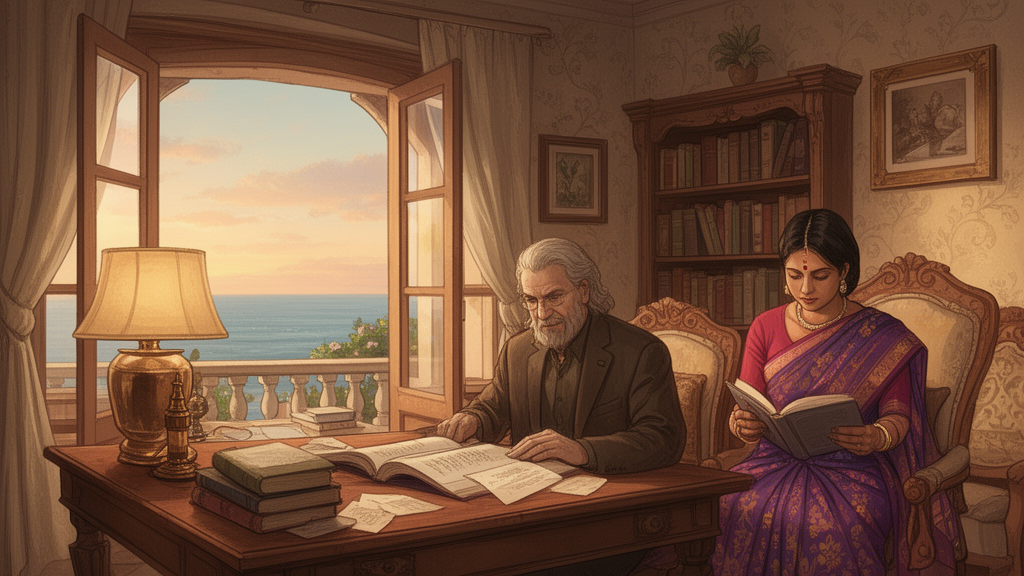
The book came from a collaboration between two people with different strengths. Shri Purohit Swami knew Sanskrit, English, Hindi and Marathi. Yeats knew only English, but he wanted the Upanishads rendered in clear, modern English. The two worked through the 1930s, and the bulk of the translation was done on the Western Mediterranean island of Majorca between 1935 and 1936. The book was published in 1938.
For readers, the most important points are these. The text is a translation, not the Sanskrit original. It is shaped by two translators with a shared literary goal. It presents Vedantic teachings in fluent English. To understand the original wording, verse structure and traditional commentary, readers should consult Sanskrit editions and scholarly translations as well.
Who translated the Upanishads with Yeats
Shri Purohit Swami
Shri Purohit Swami was the Indian partner in the project. According to the Wikipedia article on the book, he knew Sanskrit as well as English, Hindi and Marathi. That linguistic background mattered because the translation depended on his reading of the Sanskrit texts, while Yeats worked on the English. Readers who want more detail on Swami’s own life and teaching should look for biographical sources beyond the translation itself, since the book’s preface and introduction do not replace a full biography.
W. B. Yeats and his interest in the Upanishads
Yeats had a long-standing interest in Indian religious thought. The Wikipedia account notes that the Irish theosophist writer George William Russell, known as Æ, often quoted passages of the Upanishads to Yeats during their forty-year friendship. Yeats’s reaction, as recorded there, was that he would one day find out whether Æ really knew what he was talking about.
Yeats had read earlier translations, including versions associated with Anquetil-Duperron. According to the same account, those earlier translations left him unconvinced. Anquetil-Duperron’s work is itself linked to the Persian Sirr-i-Akbar, a version associated with the Mughal mystic Dara Shukoh. These connections are historically interesting, but the details of how each text was transmitted should be checked in specialist sources before being repeated as settled fact.
A translation built on conversation
When Yeats met Shri Purohit Swami, he proposed that the two translate the ancient texts as though they had been written in common English. The Wikipedia article says he supported this approach by quoting a line attributed to Aristotle: “To write well, express yourself like the common people, but think like a wise man.”
This explains the book’s style. The translation aims for plain, direct English rather than the formal diction of many nineteenth-century translations. Readers who want a more literal, word-by-word rendering should compare it with other editions. A readable translation can gain clarity while losing some of the grammatical and terminological precision that specialists value.
Yeats’s own reservations
Yeats was not writing as a Sanskrit scholar. He was a poet, and he was interested in how the texts sounded in English. The book reflects that perspective. It should be read as a work of literary and spiritual translation, with the interpretive choices of its translators visible on the page.
The working method and timeline
The project unfolded over several years. According to the Wikipedia article:
- The translators communicated by letter between 1931 and 1938. Much of the correspondence concerned the translation.
- Yeats could not travel to India as he had planned, so most of the translation was done in Majorca in 1935–1936.
- The book was published in 1938.
The same article links the period to Yeats’s health. It refers to a Steinach operation performed in 1934 by the Australian sexologist-physician Dr. Norman Haire, and quotes a 1935 letter in which Yeats describes a “second puberty” and a renewed ferment of imagination. This is a biographical detail about the poet, not a claim about the Upanishads, and it should be presented only as context for the period in which the book was written.
Date and process details are useful, but they should be checked against a biography or scholarly study of Yeats before a longer historical account is published. The Wikipedia article is a useful starting point, not a final authority.
What the book contains
The translation opens with a Preface by Yeats and then presents ten Upanishad sections. A table of contents preserved in an online edition lists the following sections in the order shown there:
- Preface
- I. The Lord
- II. At Whose Command?
- III. From The Kathak Branch Of The Vedas
- IV. Questions
- V. At The Feet Of The Monk
- VI. At The Feet Of Master Mandooka
- VII. From The Taittireeya Branch Of The Vedas
- VIII. At The Feet Of Master Aitareya
- IX. The Doctrine Of The Chandogyas
- X. Famous Debates In The Forest
Many readers know these texts by conventional names such as Isha, Kena, Katha, Prashna, Mundaka, Mandukya, Taittiriya, Aitareya, Chandogya and Brihadaranyaka. The translators’ headings describe the sections in their own way, so readers should check the relationship between the English headings and the standard names before citing them in academic work. The number of principal Upanishads is also a matter of classification. Traditions and scholars do not always agree on which texts belong to the “principal” group, and this is one reason the phrase “Ten Principal Upanishads” should be understood as the title of this selection rather than a universal list.
How to read Yeats’s version alongside the Upanishads
Readers often approach the Upanishads through translations alone. That can be useful, but it helps to separate four layers of material.
- The Sanskrit text: the words attributed to a particular Upanishad, transmitted within a Vedic school or branch.
- The translation: an English rendering that makes choices about meaning, tone and sentence structure.
- Traditional commentary: the explanations developed within Vedanta and other Hindu traditions, which may differ among teachers and lineages.
- Modern interpretation: scholarly, literary or personal readings, including Yeats’s own preface and the translators’ choices.
The Yeats–Swami book belongs mainly to the third and fourth layers as they appear in English. It is valuable because it makes the texts accessible, but it does not settle every question about the original Sanskrit.
Translation choices and their effects
A translator who aims for common English must decide how to render technical terms. Words that carry specific meanings in Sanskrit may be simplified, explained or left in a more general form. For this reason, readers should not assume that every English sentence corresponds one-to-one with a Sanskrit phrase. Where a concept is central, such as the meaning of Brahman or Atman in a passage, it is helpful to compare multiple translations and consult introductory scholarship.
Scripture, commentary and devotion
Hindu readers approach the Upanishads in different ways. Some study them within a teacher-disciple relationship. Others read them devotionally, as part of daily reflection. Some traditions place special weight on particular commentaries. The book’s English presentation does not represent any single ritual or sectarian reading of the texts. When this article describes the teachings of the Upanishads in general terms, it does so as an introduction, not as a complete doctrinal summary.
Belief, text, tradition and scholarship
Discussion of the Yeats translation often mixes four kinds of claims, and it is useful to keep them apart.
- Textual claims describe what a particular Upanishad says, ideally with a reference to a named edition or translation.
- Traditional claims describe what a school, teacher or community holds about the texts.
- Historical claims concern dates, people, publication and reception, which require documentary evidence.
- Devotional claims express personal faith or meaning, which are not the same as historical or textual proof.
The Yeats–Swami book touches all four. Its preface and publication history are historical matters. Its English wording is a textual interpretation. Its reception among readers can be devotional, literary or academic. Keeping these categories separate avoids overstating what the book proves.
Why the book still matters to readers
The translation’s continuing interest lies in the combination of a poet’s ear and a teacher’s familiarity with the Sanskrit. Readers who come to Hindu scripture through English may find the book a clear starting point. Readers who already know the Upanishads may value it as an example of how a major modern poet encountered Indian philosophical texts.
It is also a reminder that translation is itself an act of interpretation. Yeats and Swami wanted the texts to speak directly to an English reader. Whether that goal succeeds in every passage is a question readers can test by comparing the book with other editions.
Related HindusGod reading
If you are exploring the Upanishads more broadly, these HindusGod.com draft pages cover related topics. Their links will become public only if the owner later publishes the target posts:
- For a general overview of the Upanishads, see Upanishads.
- For an introduction to English-language presentations, see About Upanishads in English.
- For a compact collection of essential teachings, see Essence of the Upanishads.
- For the wider collection of Upanishad texts, see 112 Upanishads.
- For another modern English interpretation, see Aurobindo Upanishads.
- For a free-access overview of the texts, see Free Upanishads.
- For a note on a smaller grouping within the larger literature, see 18 Upanishads.
Frequently asked questions
Is the Yeats translation the complete Upanishads?
No. The book presents a selection of ten principal Upanishads in English, with a preface by Yeats. The Upanishad literature is much larger, and traditions do not all classify texts in the same way.
Did Yeats know Sanskrit?
According to the Wikipedia article, Yeats knew only English, while Shri Purohit Swami knew Sanskrit as well as English, Hindi and Marathi. This is why the collaboration was important.
Should I read this translation instead of a Sanskrit edition?
It depends on your purpose. For an accessible English reading, the book can be useful. For close study of wording, meter or technical terms, compare it with the Sanskrit text and with scholarly translations.
Summary
The Yeats–Swami Ten Principal Upanishads is a 1938 English translation produced through a long collaboration between a major poet and a teacher who knew Sanskrit. It aims at clarity and modern English expression. Readers should treat it as a translation and interpretation, compare it with other sources, and separate textual, traditional, historical and devotional claims. A useful next step is to read the translation’s preface and sections alongside a scholarly introduction and a Sanskrit-based edition.
Sources and further reading
- The Ten Principal Upanishads, Wikipedia: background on the translators, the 1930s collaboration, the Aristotle quotation, the 1935 letter and the 1938 publication date.
- The Ten Principal Upanishads index, online edition: the table of contents and the description of the book’s preface and ten sections.
- The Ten Principal Upanishads, Internet Archive catalogue entry: a catalogue record for an edition of the book. The captured page did not show the full text in the review.