The Vedanta Sutra, also called the Brahma Sutras, is a short, aphoristic text that systematically summarizes the teachings of the Upanishads. It is one of the three foundational texts of the Vedanta school of Hindu philosophy, usually listed with the principal Upanishads and the Bhagavad Gita. The text is studied as philosophy and as scripture, and its interpretation has differed sharply among later Vedanta schools. This article explains what the text is, how it is structured, and how different traditions have read it.
Direct answer: what is the Vedanta Sutra?
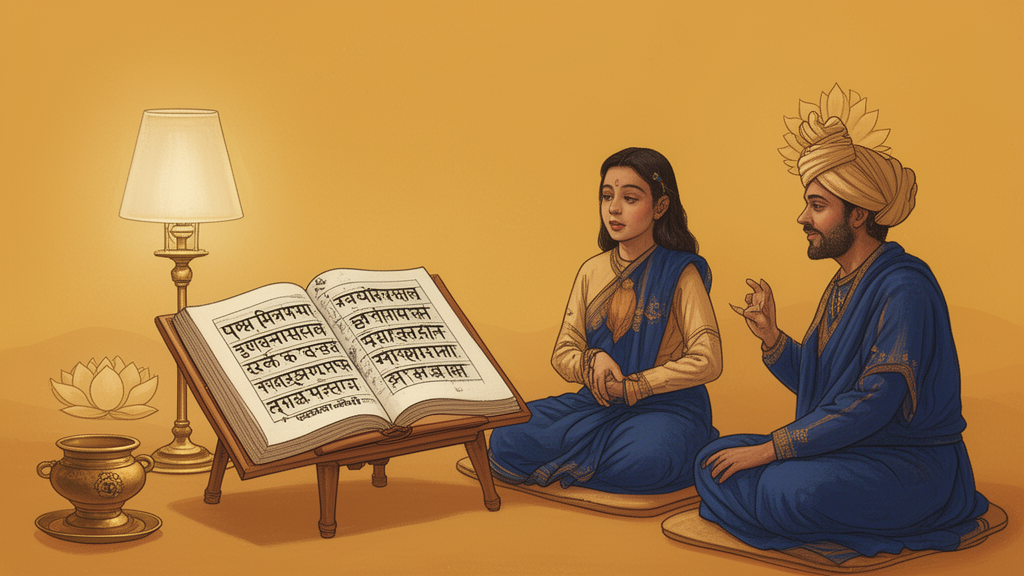
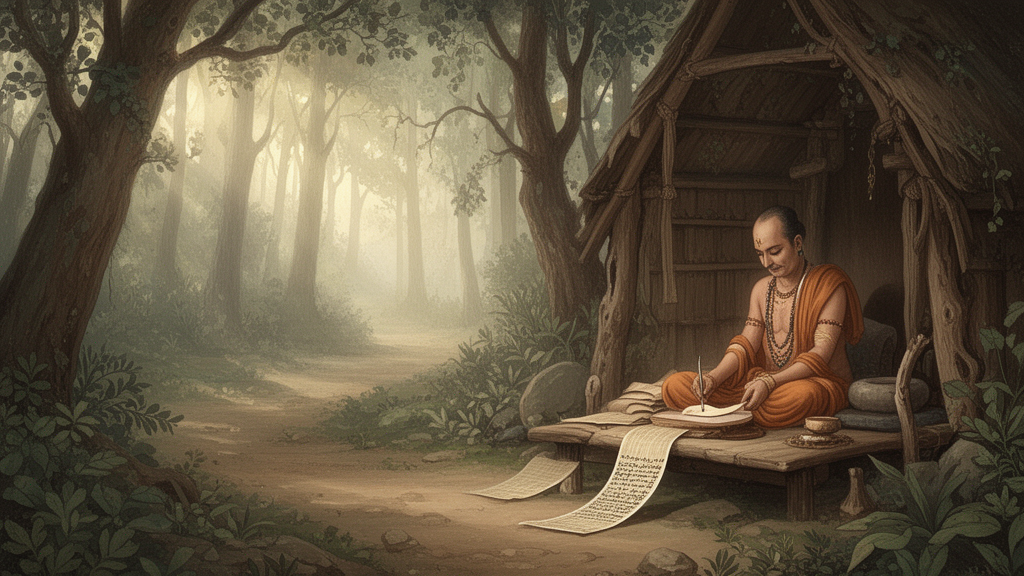
The Vedanta Sutra is a compact collection of sutras, or aphorisms, that aims to explain and harmonize the teachings of the Upanishads on Brahman, the ultimate reality. Its brevity is deliberate: sutras were written to be memorized and then expanded through commentary. The text is traditionally attributed to a sage named Badarayana, and Wikipedia’s Vedanta article places its completion in the 5th century, a dating that scholars treat as an estimate rather than a fixed date.
In short, the Vedanta Sutra is a philosophical framework for understanding the Upanishads, not a narrative scripture like the Ramayana. Its meaning comes largely from the commentaries written on it, which is why readers often encounter it through a specific teacher’s interpretation.
Other names for the text
Readers will meet several titles for the same work. The Wikipedia article on the Brahma Sutras notes that the text is also known as the Vedanta Sutra (Sanskrit: वेदान्त सूत्र), as the Shariraka Sutra, and as the Bhikshu-sutra. The Wikipedia entry gives these alternative titles and the Sanskrit forms; the exact connotations of each title are discussed in the commentarial tradition rather than settled by a single source.
The spelling varies across publications. You may see “Brahma Sutra”, “Brahmasutra”, “Brahma-sutras”, or “Vedanta-sutras”. All refer to the same core text. Diacritics also differ between sources; this article uses the common English forms and keeps the Sanskrit titles visible where helpful.
Author and date: tradition and scholarship
The traditional attribution to Badarayana is a belief held within the Vedanta tradition. It is not a claim that a modern historian can confirm from the text alone. Scholars generally treat the work as a product of a long textual process, with dating estimates varying by source. The Wikipedia Vedanta article describes the Brahma Sutras as completed in the 5th century, but it also presents the earlier period of Upanishadic thought as the background that preceded the sutras. Readers should therefore distinguish three things: the devotional or tradition-based attribution to Badarayana, the historical estimate of when the text took its present form, and the academic discussion of how the sutras relate to earlier Upanishads.
This distinction matters. A Vedanta teacher may present the text as revealed truth in its harmonizing role, while a historian examines manuscripts, commentary traditions, and philosophical context. Both approaches can coexist, but they answer different questions.
Structure: four chapters, four sections each
The Vedanta Sutra is divided into four chapters, called adhyayas. Each chapter has sections called padas, and the sutras within them are grouped into topics called adhikaranas. The Wisdom Library’s online edition of the Shankara commentary shows this layout clearly, with entries such as Chapter I, Section I, Adhikarana I. That structure lets a reader locate a specific argument, which is useful when comparing commentaries.
An adhikarana is best understood as a unit of argument. It usually states a question raised by a passage of the Upanishads, gives a possible objection, and then resolves the question in line with the sutrakara’s conclusion. This makes the text more like a legal or logical treatise than a list of teachings.
Chapter 1: harmonizing views on Brahman
The first chapter is concerned with establishing what Brahman is and how the scattered descriptions of Brahman in the Upanishads fit together. Wikipedia’s contents outline labels it as the harmonisation of views on Brahman. The chapter’s purpose is to show that apparently different passages point toward one ultimate reality rather than contradictory accounts.
The same chapter also introduces the idea of superimposition, or adhyasa, which the Wisdom Library’s edition places at the head of its introduction. Many commentators treat this idea as an entry point into the whole work, because it explains why the ordinary self identifies with body and mind. How different schools interpret adhyasa is one of the major differences among Vedanta traditions.
Chapter 2: rejection of competing theories
The second chapter addresses rival philosophical positions. Wikipedia’s contents list it as the rejection of competing theories. The sutras examine views from other schools and argue against them on grounds of consistency with the Upanishads and with reason. Readers who are new to Indian philosophy should note that this is a debate-style chapter. It assumes familiarity with the positions it critiques, so commentaries often explain those positions in detail.
Chapter 3: the means to spiritual knowledge
The third chapter discusses how liberating knowledge is attained. Wikipedia’s outline separates two subtopics: the nature of liberating knowledge, and upasana, meaning worship or meditation. Upasana is a concept that different traditions understand in different ways. Some treat it as meditative contemplation on Brahman, while others place devotion, ritual, or personal worship at its center. The text itself is more abstract, which is why the commentaries diverge here.
Chapter 4: the benefits of spiritual knowledge
The fourth chapter concerns the results or fruits of knowledge, including what happens after realization. Wikipedia lists it as the benefits of spiritual knowledge. Scholars and practitioners often describe this section as the culmination of the argument. Its claims are philosophical and soteriological, meaning they concern liberation within the tradition’s framework. They are not empirical or practical promises about health, wealth, or worldly success, and they should not be read that way.
Why commentaries matter
The Vedanta Sutra is so compressed that it is difficult to understand without commentary. Many aphorisms can be read in more than one way, and the most influential readings came from later teachers who wrote extended commentaries called bhashya. The most widely studied is the commentary attributed to Adi Shankara, known as the Shankara Bhashya. The Wisdom Library lists an English translation of this work, first published in 1936 by Swami Vireshwarananda, which includes the Sanskrit text, a transliteration, and an English rendering of both the sutras and the commentary.
Other commentators shaped other schools. The Wikipedia Vedanta article organizes the classical schools into several groups, including Bhedabheda, Advaita, Vishishtadvaita, Dvaita, and Shuddhadvaita, and it associates figures such as Ramanuja, Madhva, and Chaitanya Mahaprabhu with later Vaishnava Vedanta developments. The article presents these as different philosophical systems that each claim the sutras and the Upanishads as their base.
One text, several readings
Because the sutras are open to multiple readings, the question “what does the Vedanta Sutra teach?” has more than one answer. Advaita Vedanta, associated with Shankara, reads the text as supporting non-dual identity between the individual self and Brahman. Vishishtadvaita, associated with Ramanuja, reads it as supporting qualified non-duality, where the world and souls are real modes of a personal Supreme Being. Dvaita, associated with Madhva, emphasizes a fundamental difference between the individual soul and the Supreme. Chaitanya’s school, in the Achintya Bheda Abheda reading, holds that difference and non-difference are both real in a way that is beyond ordinary logical description.
These are academic and tradition-based summaries, and each school would describe its own position in more detail. A reader should not assume that one of these readings is the only correct interpretation of the text, nor that a single school represents all Hindus. Many Hindus do not study Brahma Sutra commentaries at all, and devotional traditions often approach the Upanishads and Vedanta through worship rather than philosophy.
How the Vedanta Sutra relates to the Upanishads
The sutras are often described as the third of the three canonical texts of Vedanta, after the Upanishads and the Bhagavad Gita. The relationship is one of systematization. The Upanishads present teachings in dialogues, stories, and short statements. The Vedanta Sutra gathers those statements, resolves apparent conflicts, and organizes them under themes. This is why the text is sometimes described as an attempt to reconcile the Upanishads.
For a reader beginning with Vedanta, it helps to read a major Upanishad first, such as the Chandogya or Brihadaranyaka, and then read the sutras and their commentaries. The sutras will make more sense when you already know the passages they discuss. The Wikipedia Upanishads listing shows the traditional divisions and affiliations of the principal Upanishads, which can help you find a starting point.
Reading the text: editions and translations
If you want to read the Vedanta Sutra directly, choose an edition that clearly identifies the translator, the commentary included, and the publisher. The Wisdom Library’s entry for the Shankara Bhashya notes two sources for its edition: Motilal Banarsidass, a major Indian publisher, and an archive.org scan. The page states that the online text is publicly accessible and recommends buying a print edition for the latest version. That advice reflects a general principle: an online scan may differ from a modern critical edition in spelling, formatting, or pagination.
When you compare translations, check whether the translator provides the Sanskrit, transliteration, and commentary. Note also whether the translation follows a particular school. A translation of Shankara’s commentary presents Advaita Vedanta as interpreted by Shankara; it is not a neutral summary of all Vedanta. Quotations from translations are copyrighted in many editions, so this article describes the text in its own words rather than quoting long passages.
Devotional, scholarly, and practical perspectives
The Vedanta Sutra can be approached in at least three ways. A scholar may study its logic, its place among Indian philosophical schools, and its manuscript history. A devotee in a Vaishnava or Shaiva tradition may read it through the lens of that tradition’s theology, where worship, grace, and the relationship with a personal deity are central. A student of meditation may focus on the discussion of knowledge and contemplation in the third chapter.
None of these approaches is more authentic than the others in every setting. The key is to label the approach. When a teacher says the sutras teach a particular doctrine, ask whether that reflects the sutras themselves, a commentary, or the teacher’s own school. Keeping these layers separate helps avoid confusing scripture with interpretation.
The text also should not be treated as a practical guide to worldly results. Its discussions of liberation and knowledge concern a philosophical and religious goal within Vedanta. They do not offer guaranteed outcomes in health, finance, or personal success, and any claim that studying the text will produce such results goes beyond what the sources support.
Connecting the Vedanta Sutra to related HindusGod.com content
If you are exploring the Vedanta Sutra through a specific school or lineage, a related HindusGod.com draft discusses the ISKCON context. Link: Vedanta Sutra ISKCON (target draft; public status to confirm before publication). This page is relevant because it addresses how a Gaudiya Vaishnava community approaches Vedanta-related material, which differs from Advaita and other schools described above.
Other listed HindusGod.com target drafts, including unrelated entries such as sutra topics from other traditions, do not address the Brahma Sutras directly and are not linked here.
Frequently asked questions
Is the Vedanta Sutra the same as the Brahma Sutras?
Yes. The Wikipedia entry for the Brahma Sutras identifies the Vedanta Sutra as one of its names. Both titles refer to the same aphoristic text on the teachings of the Upanishads.
Who wrote the Vedanta Sutra?
The Vedanta tradition attributes the text to Badarayana. Scholarly work on the text treats its authorship and date as matters of estimate and debate, so readers should distinguish the traditional attribution from historical conclusions.
Do I need to read commentaries to understand it?
Most readers do. The sutras are very brief, and their meaning depends heavily on how later commentators interpreted them. Reading a commentary, and noting which school it represents, is the most practical way to approach the text.
Summary
The Vedanta Sutra, or Brahma Sutras, is a concise philosophical text that organizes and reconciles the teachings of the Upanishads. It has four chapters covering the nature of Brahman, rival theories, the means to knowledge, and its benefits. Its traditional author is Badarayana, while its date and exact form are discussed by scholars. Its meaning varies across Advaita, Vishishtadvaita, Dvaita, and other Vedanta schools. To study it responsibly, read the sutras alongside a clearly identified commentary, and keep scripture, tradition, and modern interpretation distinct.