The Vajra Suchika Upanishad, also written Vajrasuchi or Vajrasūcī Upaniṣad, is a short Sanskrit text that asks a direct question: what makes a person a Brahmana? Its answer is that birth, body, class, learning, ritual action, and outward virtue do not by themselves define a Brahmana. The text argues that the true Brahmana is the person who has directly realized the Atman, the non-dual self, and lives with inner peace and self-control. Because it challenges the idea that social status is fixed by birth, it is one of the most discussed minor Upanishads.
This guide explains what the text says, where it fits in Upanishadic literature, how its manuscripts and translations survive, and which questions about its date and authorship remain unsettled. It separates what the text itself argues from later commentary, traditional belief, and modern scholarly interpretation.
What the Vajrasuchi Upanishad Is
The name and its meaning
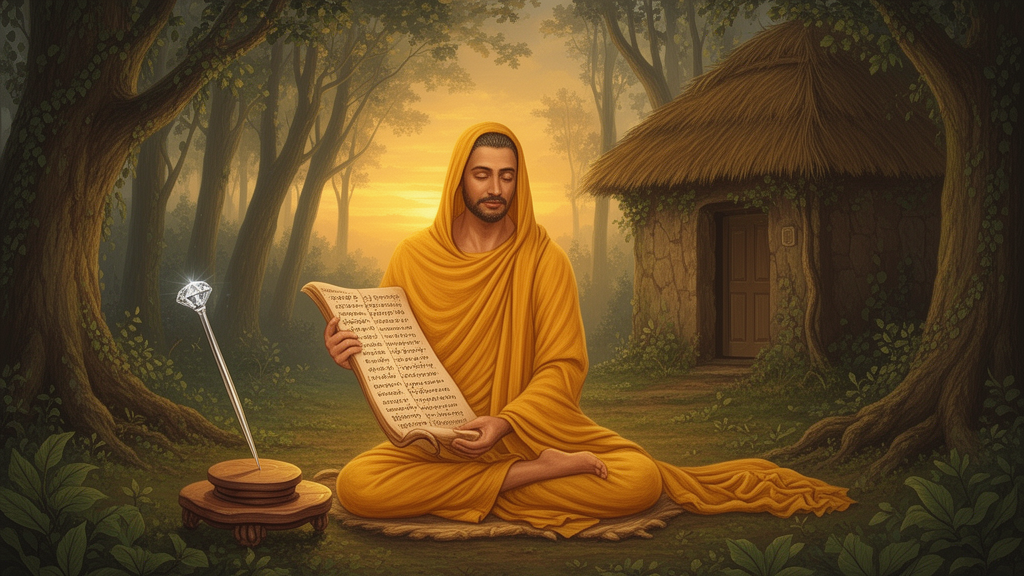
The Sanskrit word vajrasūcī is usually translated as “diamond-pointed needle” or “diamond needle.” One translation in the Sanskrit Documents collection explains the name as a needle that pierces ignorance, rebukes the ignorant, and adorns those who have wisdom as their eyes. The Australian Council of Hindu Clergy’s translation notes that the name signals a teaching that is precious and potent and that can lead to moksha, or liberation. These are interpretive readings of the title, but they agree on the core image: a hard, sharp instrument that cuts through false assumptions.
Where it sits in Upanishadic literature
The Vajrasuchi Upanishad is classified as one of the 22 Samanya Upanishads, a group of minor texts, and it is identified as a Vedanta text. Wikipedia and the Vyasa Mahabharata both list it as attached to the Samaveda. Wikipedia’s entry gives its length as nine verses, though verse divisions can vary between editions, so readers comparing texts should check the edition in use.
The term Upanishad usually refers to texts that present the philosophical teachings of the Vedas, often focused on the nature of Brahman and the Atman. The Vajrasuchi Upanishad follows that pattern, but its main concern is social as well as metaphysical. It uses the language of Vedanta to argue about how a person should be classified.
The Central Question: Who Is a Brahmana?
The text opens by noting that the four varnas are Brahmana, Kshatriya, Vaishya, and Shudra, and that the Brahmana is traditionally regarded as the most important of them. It then asks what a Brahmana truly is. The Vyasa Mahabharata translation of the opening verse puts the question as: is it the individual soul, the body, birth, knowledge, deeds, rites, or virtue?
This structure matters. The text does not simply declare a new answer. It tests each candidate in turn, shows its limits, and then offers a positive definition.
Testing each candidate
The argument proceeds through a series of rejections, each introduced by a question about whether a given factor could define a Brahmana:
- The soul (jiva). The text argues that the soul is not a Brahmana because the same soul takes many bodies across past and future lives, shaped by karma. If the soul were the criterion, every embodied being would share the same status.
- The body (deha). The body is made of the five elements and shows the same aging and death in all people, from the highest caste to the Chandala. The text also observes that there is no fixed colour for each varna, a point that undermines the idea that the body reveals caste.
- Birth or class (jati). The text lists sages whose origins were unusual: Rishyasringa born of a deer, Kausika from reed, Jambuka from a jackal, Valmiki from an anthill, Vyasa from a fisher-girl, Gautama from a hare’s back, Vasistha from Urvasi, and Agastya from a pot. These sages are described as Brahmanas through their knowledge, not through conventional birth.
- Knowledge (jnana). Kshatriyas and others also possess knowledge and have realized the highest truth, so knowledge alone does not confine Brahmana status to one group.
- Action (karma). All beings act under the influence of accumulated karma, so action does not distinguish one class from another.
- Virtue (dharmika). Kshatriyas and others are described as generous donors of gold and as practitioners of charity, so generosity or righteousness in general does not decide the question.
The Sanskrit text uses the terms jiva, deha, jati, jnana, karma, and dharmika for these candidates. Readers who want to check the sequence can compare the Sanskrit in the Sanskrit Documents edition with an English translation.
The positive answer the text gives
After rejecting the candidates, the Upanishad defines the Brahmana as one who has directly realized the Atman as a non-dual self, free from class, quality, and action, and beyond the defects that affect ordinary experience. Such a person is described as having realized the self “like a berry in the palm of the hand,” as possessing the qualities of truth, knowledge, and bliss, and as being free from desire, greed, and hypocrisy. The text adds that a person with these qualities is the Brahmana according to the intention of the Veda, Smriti, Itihasa, and Purana. Without these qualities, the text says, Brahmana status cannot truly be achieved.
The Vedanta Spiritual Library’s translation, by Dr. A. G. Krishna Warrier and published by the Theosophical Publishing House in Chennai, carries this argument in English. The Vyasa Mahabharata translation summarizes the same movement from rejection to realization. These are translations, so the exact wording differs between them, and readers should treat English phrases as renderings rather than the original words.
The Australian Council of Hindu Clergy’s document summarizes the conclusion as saying that spiritual realization and good conduct alone determine a person’s caste. That summary is a useful reading, but it is a commentary-style summary rather than a verse-by-verse translation, so it should be read as an interpretation of the text.
Examples and Illustrations Used in the Text
The Upanishad relies on concrete examples. The list of sages born in unusual ways is its clearest illustration. Each example does a specific job in the argument: if respected sages can be counted as Brahmanas without conventional birth, then birth cannot be the final test.
The text also uses ordinary observations. Death and aging affect every human body alike. Kshatriyas, not only Brahmanas, can be learned and generous. These examples keep the argument grounded in what listeners could see around them, rather than only in abstract doctrine.
Readers should note that the stories about the sages come from the wider Indian tradition of narratives, sometimes expressed in the Puranas and epics. The Upanishad uses them as evidence within its argument, but their details belong to the traditions that tell those stories, and different retellings vary in their accounts of each sage’s birth.
Manuscripts, Editions, and Translations
How the text survives
According to the Vyasa Mahabharata overview, manuscripts of the text were discovered and collected during the colonial period. By the early nineteenth century, eight copies from North India and five from South India were known. Most were in Sanskrit in Devanagari script, and two were in Telugu. Some survive on palm-leaf manuscripts, and some are damaged. The same source notes that the manuscripts differ in wording, but that their focus and central message are the same.
This variation is typical of many minor Upanishads, which were copied, edited, and transmitted across regions and communities. When you read a translation, it helps to know which edition it follows.
Translations worth comparing
- Dr. A. G. Krishna Warrier’s translation, published by the Theosophical Publishing House in Chennai, is available through the Vedanta Spiritual Library and through a PDF hosted by Spiritual Minds. It presents the text with an English rendering of the opening invocation and the argument.
- The Madras Giridhar translation, hosted on the Sanskrit Documents site, states that it is taken from Thirty Minor Upanishads, translated by Narayanasvami Aiyar and published by the Adyar Press in Madras. The site also provides the Sanskrit text in Devanagari, which is useful for readers who want to check transliterations.
When comparing translations, look at how each one renders key terms such as jiva, jati, and brahmana. Some translators keep the Sanskrit word, while others use English terms like soul, class, or caste. Each choice shapes the reader’s understanding of the argument.
Authorship and Date: What Is Uncertain
The attribution to Sankaracharya
Several manuscripts discovered by the early 1800s attribute the Vajrasuchi Upanishad to Sankaracharya, also known as Adi Shankara, the Advaita Vedanta scholar. Wikipedia and the Vyasa Mahabharata both note that the date and author are unclear. Indian tradition often attributes works to revered teachers, and scholars treat such attributions with caution. The Vyasa source notes that Adi Shankara is traditionally linked to the eighth century, but the attribution alone does not prove that he wrote the text.
For devotees and followers of Advaita Vedanta, the attribution can be meaningful as a traditional link. For historians, it is a claim that needs independent evidence, and the current sources do not settle it.
The Buddhist Vajrasuchi
The Vyasa source records that a Buddhist text titled Vajrasuchi, attributed to Ashvaghosha, a second-century CE figure, was published from Nepal in 1835. It shares a similar message with the Hindu text. This created complications in dating and attribution. The Vyasa article also reports that scholars consider the authenticity of the Buddhist text, and whether Ashvaghosha wrote it, seriously doubtful.
The existence of a similarly titled Buddhist work is therefore a reason for caution. Titles and themes can travel between traditions, and a shared name does not establish shared authorship. Readers should treat claims that link the two texts directly as questions for further scholarly study, not settled facts.
How Different Traditions Read the Text
The Vajrasuchi Upanishad is read in different ways, and it is important not to present one reading as the only one.
- As a scriptural teaching on Brahman. Readers within Vedanta often focus on the definition of the Brahmana as one who realizes the non-dual Atman. In this reading, the text’s main purpose is spiritual, and social classification is secondary to self-knowledge.
- As a critique of caste by birth. Modern readers often highlight the text’s argument that birth does not define a Brahmana. The Vyasa source describes it as a sustained philosophical attack on the division of human beings and as asserting that any human being can achieve the highest spiritual state.
- As a text with its own internal tensions. Some scholars and readers point out that the text still refers to the four varnas and to the honour of the Brahmana in the opening lines. It argues against birth-based status, yet it begins from the varna framework. Readers can hold both observations at once.
These readings are interpretations. They do not mean that the text itself makes a modern political claim. The safest approach is to quote the text’s arguments and then identify which reading you are offering.
Why the Text Matters Today
For many readers, the Vajrasuchi Upanishad is important because it shows that Hindu philosophical literature contains sustained arguments about status, knowledge, and self-realization. Its method is useful in itself: it asks what a term means, tests each possible meaning, and then gives a reasoned definition. Students of Indian philosophy often value it for that method.
The text also raises practical questions. If spiritual realization and good conduct determine who is a Brahmana, what does that mean for ritual roles, marriage, and community life? Answers differ across communities and periods. The text does not give a full social programme, and practices associated with caste have their own histories beyond this short Upanishad. Readers who want to understand the lived history of caste should consult historical and sociological studies, not only this text.
Finally, the text is a reminder that scripture can be read for its ethical and spiritual meaning. Many devotees approach it through daily recitation, contemplation, or study. Such practices are part of individual and community devotion, and the text does not promise any material or social result from reading it.
Frequently Asked Questions
Is the Vajrasuchi Upanishad the same as the Vajrasuchi by Ashvaghosha?
No. The Vyasa source reports that the Buddhist text with a similar title was published in 1835 and that its attribution to Ashvaghosha is considered seriously doubtful by many scholars. Shared titles and themes do not prove shared authorship.
Does the Upanishad reject the four varnas completely?
The text argues that none of the usual markers, such as birth, body, knowledge, action, or virtue, makes someone a Brahmana in the highest sense. It locates the true Brahmana in realization of the Atman and in qualities such as freedom from desire and hypocrisy. Its exact social implications are interpreted differently by readers, so it is best to describe its argument precisely rather than assume a single policy.
Which edition should I read first?
Start with a translation that identifies its source edition, such as the Theosophical Publishing House translation by Dr. A. G. Krishna Warrier or the Madras Giridhar translation from Thirty Minor Upanishads. If you read Sanskrit, compare the Devanagari text with the translation to check key terms.
Summary
The Vajrasuchi Upanishad, or Vajra Suchika Upanishad, is a minor Samanya Upanishad connected with the Samaveda and classified as a Vedanta text. Its title means “diamond-pointed needle.” The text tests several possible definitions of a Brahmana and concludes that the true Brahmana is one who realizes the non-dual Atman and possesses qualities such as truth, self-control, and freedom from desire. Its manuscripts survive in multiple versions, its authorship and date remain uncertain, and it is read in different ways by different traditions. For readers, the best next step is to read a reliable translation, note its edition, and compare the arguments with scholarly discussions of caste and Vedanta.
Related Reading on HindusGod.com
- For a general introduction to the term and the collection, see our guide to the meaning of Upanishad (URL to confirm; target draft, may not be public yet).
- For how the Upanishads are grouped by number, see our overview of the 108 Upanishads (URL to confirm; target draft).
- For another short Vedanta text on the nature of the Atman, see our article on the Atmabodha Upanishad (URL to confirm; target draft).
- For a non-dual Advaita teaching, see our article on the Advaita Upanishad (URL to confirm; target draft).
- For a text centred on the self as beyond ordinary identity, see our article on the Adhyatma Upanishad (URL to confirm; target draft).
- For another Upanishad often read in the Advaita context, see our article on the Ashtavakra Upanishad (URL to confirm; target draft).
- For a broader list of Upanishads and their categories, see our guide to the 10 principal Upanishads (URL to confirm; target draft).
- For Upanishads associated with the Atharva Veda, see our article on the Atharva Upanishad (URL to confirm; target draft).
Sources and Further Reading
- Vajrasuchi Upanishad, Wikipedia. Used for the Sanskrit title, classification as a Samanya Upanishad, Vedanta affiliation, attachment to the Samaveda, verse count, and the note that the date and author are unclear.
- Vajrasuchi Upanishad, Vyasa Mahabharata. Used for the summary of the text’s argument, the manuscript history, the Sankaracharya attribution, and the discussion of the Buddhist Vajrasuchi.
- Vajrasuchika Upanishad, Vedanta Spiritual Library. English translation by Dr. A. G. Krishna Warrier, Theosophical Publishing House, Chennai. Used for the structure of the argument and the definition of the Brahmana.
- vajrasUchika (with trans), Sanskrit Documents. Sanskrit text in Devanagari, with a translation credited to Madras Giridhar from Thirty Minor Upanishads. Used for the Sanskrit terms and sequence of candidates.
- Vajrasuchika Upanishad PDF, Spiritual Minds. Used to confirm the Krishna Warrier translation credit and publisher. Full text was not inspected for this article.
- Vajra Suchika Upanishad PDF, Australian Council of Hindu Clergy. Used for the explanation of the name and the summary that spiritual realization and good conduct determine caste in the text’s view. Full document was not inspected for this article.
For further study, consult a critical edition of the Samaveda-attached minor Upanishads and scholarly works on Vedanta and caste. Specific academic titles should be added only after they have been checked.