The Vaisesika Sutra, also written Vaiśeṣika Sūtra, is an ancient Sanskrit text at the foundation of the Vaisheshika school of Hindu philosophy. It is traditionally attributed to the sage Kanada, and it is best known for its system of categories, its atomic theory of nature, and its account of the soul’s bondage and liberation. This article explains what the text covers, how it is structured, which commentaries and translations are available, and where scholars remain uncertain.
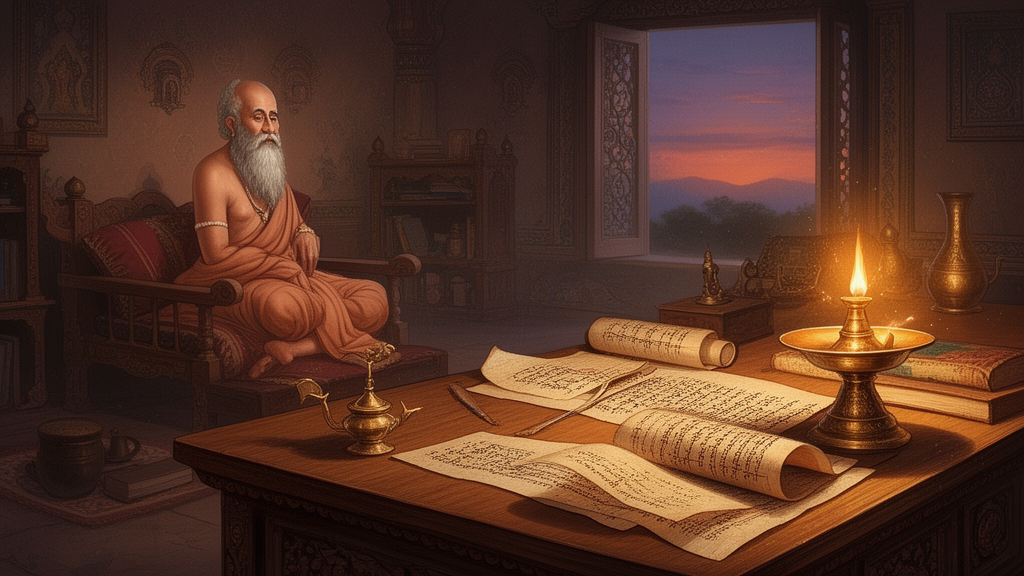
Direct answer: what the Vaisesika Sutra is

The Vaisesika Sutra is a foundational text of one of the classical schools of Hindu philosophy. Wikipedia’s article on the Vaisheshika school places it among the orthodox schools of Hindu philosophy, alongside Samkhya, Yoga, Nyaya, Mimamsa, and Vedanta. The sutra is a concise aphoristic text, and its later understanding depends heavily on commentaries written centuries after it was composed.
The Wisdom Library edition of the Sinha translation describes the work as a type of moksha-shastra, a doctrine of emancipation. Its stated purpose is to explain the nature of the soul, its suffering, and its cycle of birth, death, and rebirth under the law of karma. The same edition notes that the text is also famous for its system of physics and metaphysics and for its atomic theory of nature. Those are the two sides readers usually encounter first: the philosophy of liberation and the analysis of the physical world.
Names and spellings
Readers will meet several spellings of the title and author. The Wisdom Library listing gives the Sanskrit title as Kaṇāda Vaiśeṣikasūtra and lists transliterations including Vaisheshikasutra, Vaisesikasutra, and Vaisesika-sutra. Wikipedia uses Vaiśeṣika Sūtra and also gives the alternate name Kaṇāda Sūtra. These variants refer to the same text, and the choice of spelling usually reflects a particular publisher or scholarly convention.
The school name is spelled Vaisheshika in many English sources and Vaiśeṣika in diacritical transliteration. This article uses Vaisesika Sutra for the text, matching the primary keyword, and uses Vaisheshika when referring to the school as a whole, following the common spelling in the Wikipedia article.
Who is said to have written it
Tradition and the Wikipedia article attribute the sutra to Kanada, a sage also known as Kashyapa. Wikipedia notes that, according to some scholars, the sage was known by that second name as well. The attribution to a single named author is part of the textual tradition. It should be read as a traditional attribution rather than as a confirmed biographical fact, because the sources reviewed do not establish the author’s life or dates.
Historical uncertainty is significant here. A PDF excerpt of the Sinha translation states that we do not know when or by whom the name Vaisesika was first applied to the teachings of Kanada. It also notes that within the Sutras the word appears only once. This means that the label Vaisesika, as applied to the teaching, is itself a later development that scholars have examined. Readers should therefore distinguish between the text’s traditional author, the school’s later identity, and the modern historical question of how and when the texts took shape.
How the sutra is organized
The sutra is divided into books, and each book into chapters. The table of contents for the Sinha edition, hosted by Wisdom Library, lists the following books, using that edition’s English titles:
- Book I: Of the Predicables, with chapters on substance, attribute, and action, and on genus and species
- Book II: Of Substances, with chapters on earth, waters, fire, air, and ether, and on the five bhutas, time, and space
- Book III: Of Soul and Mind, with chapters on the marks of inference and on the inference of soul and mind
- Book IV: Of the Origin of Bodies, with chapters on atoms and on tangible atomic products
- Book V: Of Investigation of Action, with chapters on voluntary and non-volitional action
- Book VI: Of the Investigation of Dharma and A-Dharma, with chapters on Vedic duties and on the production of dharma and adharma
- Book VII: Of the Examination of Attributes and of Combination, with chapters on colour, taste, smell, touch, and magnitude, and on number, separateness, and conjunction
- Book VIII: Of Ordinary Cognition by means of Conjunction or Combination, with chapters on presentative cognition
- Book IX: Of Ordinary and Transcendental Cognition, with chapters on perception of non-existence and transcendental perception, and on inferential cognition
- Book X continues the series, though the portion of its title visible in the listing is incomplete
The book titles show the sutra’s general method. It begins with categories of reality, moves to substances and their qualities, treats soul and mind, examines atoms and the formation of bodies, and then turns to action, dharma, cognition, and related topics. Readers who are new to the text can use the book titles as a map before reading the aphorisms themselves.
The central categories: padartha
A recurring theme in the Vaisheshika tradition is the system of categories, usually called padartha. Wikipedia’s article includes a section titled Categories or Padārtha under its metaphysics heading. Book I of the sutra, as listed in the Sinha edition, is organized around predicables, and its chapters treat substance, attribute, action, genus, and species.
These categories give the school its analytical framework. Substances are the bearers of qualities and actions. Attributes and actions depend on substances. Genus and species help the mind classify things that share features. A reader does not need to master the whole system to understand the basic idea: the school tried to describe reality as a set of distinct kinds of things and their relations.
Atomic theory and the physical world
The sutra is widely known for its atomic theory, and the Sinha edition’s book titles reflect this. Book II discusses earth, waters, fire, air, ether, the five bhutas, time, and space. Book IV is titled Of the Origin of Bodies and has a chapter titled Of Atoms, followed by a chapter on tangible atomic products.
When reading these sections, it helps to separate three things. The first is what the text says, which is the sutra’s own analysis. The second is the commentary tradition, which explained and sometimes developed these ideas over time. The third is modern science, which is a different discipline with different methods. Modern readers often compare the Vaisheshika atomic theory with later scientific atomism, but such comparisons are scholarly interpretations, not statements found in the sutra itself. They should be presented as comparisons, not as evidence that the sutra anticipated particular modern discoveries.
Soul, mind, and liberation
The sutra’s concern is not only physics. Book III, Of Soul and Mind, addresses how the soul is known through inference, and the Wisdom Library summary says the text describes the soul’s suffering and its movement through the cycle of births and deaths under karma. This places the sutra firmly within the broader Indian concern with liberation, or moksha.
Book VI, which investigates dharma and adharma, connects ethics and ritual with the soul’s future. The chapter titles refer to Vedic duties and to the production of dharma and adharma. In the sutra’s framework, these terms are part of the analysis of action and its results. Readers should note that the sutra’s technical use of dharma and adharma is not identical to the everyday use of dharma as moral duty or as a general term for religious life in later Hindu practice.
Cognition and inference
Epistemology, or the study of how knowledge is acquired, occupies several books. Book VIII treats ordinary cognition through conjunction or combination, beginning with presentative cognition. Book IX considers ordinary and transcendental cognition, including perception of non-existence, transcendental perception, and inferential cognition.
The Wikipedia article on the school includes a section on syllogism in its epistemology discussion. Syllogism is the form of reasoning used to draw conclusions from premises, and it appears in many classical Indian philosophical traditions in different forms. When readers encounter inference in the sutra, they should check the specific chapter and the commentary, because the classical schools developed their own accounts of what counts as valid knowledge and how it is structured.
The commentaries
The sutra is aphoristic, so its meaning is often clarified through commentaries. The Wisdom Library description of the Sinha edition lists three commentaries included in the work:
- The Upaskara of Shankara Mishra
- The Vivriti of Jayanarayana Tarkapanchanana
- The Bhashya of Chandrakanta
The same description states that the edition includes the original Sanskrit text, a word-for-word translation, an English text, and these commentaries. The Wikipedia article on Vaisheshika also has a Commentaries subsection under its development section, which indicates that the commentarial literature is part of the school’s historical development.
Commentaries are not the same as the sutra. When a passage is explained by a commentator, the explanation reflects that commentator’s reading. Readers who want to study the text closely should keep the sutra’s words, the translator’s rendering, and the commentator’s interpretation separate.
Translations and where to read the text
The Sinha translation is one of the most accessible English editions cited in the sources reviewed. The Wisdom Library entry gives the date as 1923 and lists the ISBN for the book version. The Internet Archive hosts a scanned edition titled The Vaisesika sutras of Kanada, translated by Nandalal Sinha. A PDF version is also hosted on an Internet Archive server.
Wisdom Library states that the full text with commentary is publicly accessible online, and it recommends buying a book edition for the latest edition. Readers should check each source’s terms, because free online copies may differ in scan quality, pagination, and editorial apparatus. Scholarly work on the Vaisheshika school may also use different translations and transliteration systems, so a comparison of more than one edition is useful for serious study.
The Internet Archive also hosts a separate entry for a Vaisesika Sutra of Kanada attributed to Debasish Chakrabarty. The sources reviewed for this article did not include enough of that entry’s content to describe its translation or commentary, so this article does not rely on it for claims.
Belief, text, tradition, and scholarship
Discussions of the Vaisesika Sutra often mix four kinds of statements. A useful reading practice is to label each claim as one of the following:
- Textual claim: what the sutra or a named commentary says, such as the book titles or the stated subjects of each book.
- Traditional claim: what a school or community holds, such as the attribution to Kanada or the view that the text teaches liberation.
- Historical claim: what evidence shows about dates, authorship, or manuscript transmission. The sources reviewed leave the dating of the text unresolved.
- Scholarly interpretation: modern analysis, comparison with other systems, or assessment of the atomic theory.
Keeping these categories apart prevents common errors. A statement that the sutra teaches atoms is a textual claim. A statement that its atoms match modern physics is an interpretation. A statement that Kanada wrote the text in a particular century would require historical evidence that the sources reviewed do not provide.
Relation to other schools
The Wikipedia article on Vaisheshika lists it among the orthodox schools of Hindu philosophy, and its navigation links place Vaisheshika beside Nyaya in the same group. The Nyaya school also appears in the list of sutra literature on the same page. Scholars often discuss these two schools together because of their related interests in categories, inference, and reality. The sources reviewed for this article do not provide enough detail to explain the full historical relationship between them, so readers should consult academic studies for that topic.
The Vaisheshika school is also listed within a broader series of Hindu philosophies on the Wikipedia page. That placement is useful for orientation, but it does not mean that all Hindus study or accept the same philosophy. Hindu philosophical traditions differ in their views of Brahman, the soul, liberation, and the authority of texts, and the Vaisheshika school is one important strand among them.
A practical way to begin reading
For a first reading, it helps to follow a simple sequence rather than starting at random. A reader can begin with the introduction and Book I to learn the categories, then move to Book III for soul and mind, Book IV for atoms and bodies, and Book IX for cognition. Each book can be read with its chapter titles in view, so the reader knows where the argument is heading.
A reader might also compare one passage across two editions. The Sinha edition includes word-for-word renderings, while a commentary explains the sense of the passage. Comparing the sutra’s wording, the translation, and the commentary helps a reader see which part is the text and which part is interpretation. This method is slower than skimming, but it is more reliable for study.
Key terms
- Sutra: a short aphoristic text. Its meaning is often clarified by commentary. The HindusGod.com article on Meaning Sutra covers the general sense of the term, subject to that draft’s publication status.
- Padartha: a category or class of reality in the Vaisheshika system.
- Bhuta: an element or basic physical category, discussed in Book II of the Sinha edition.
- Dharma and adharma: terms used in the sutra’s analysis of action and its results, distinct from the broader devotional and ethical senses of dharma.
- Moksha: liberation from the cycle of birth and death, described in the Wisdom Library summary as the aim of the teaching.
- Karma: the law of action and its consequences, which the summary identifies as part of the soul’s rebirth cycle.
Related scriptural and sutra topics
The Vaisesika Sutra is one example of the sutra form in Indian literature, and readers often ask how it differs from other sutra texts. Its focus on categories and atomism sets it apart from texts focused mainly on devotion or ritual. For readers exploring other sutra genres, the HindusGod.com article on Bhakti Sutra addresses devotional sutra literature, and the article on Ashvalayana Sutra covers a ritual sutra tradition. Both are linked here only for comparison, and their publication status should be confirmed before publishing this post.
Readers interested in meditation and practice may also consult the article on Dhyana Sutra, which deals with a different tradition of sutra literature. The Agama Sutra article may be useful for readers who want to see how the word agama is used in other contexts. These comparisons help readers see that sutra is a literary form, not a single doctrine.
Frequently asked questions
Is the Vaisesika Sutra the same as the Nyaya Sutra?
No. The Wikipedia navigation lists the Nyaya Sutras and the Vaiśeṣika Sūtra as separate entries in the sutra literature. The two schools are commonly discussed together, but they are distinct texts and traditions.
Does the sutra describe modern atoms?
The sutra describes atoms within its own philosophical system. Comparing that account with modern atomic science is an interpretive exercise, not a textual claim. Readers should avoid saying that the sutra anticipated specific modern discoveries unless a specialist source makes that argument.
Which edition should a beginner read?
A beginner may start with the Sinha translation because it includes the Sanskrit text, an English rendering, and commentaries, as described in the Wisdom Library entry. Readers who need a current scholarly edition should check publisher information and recent academic editions before buying.
Summary
The Vaisesika Sutra is a classical Sanskrit text associated with the sage Kanada and with the Vaisheshika school of Hindu philosophy. Its books cover categories of reality, substances, soul and mind, atoms, action, dharma and adharma, and cognition. Its commentators, translators, and modern readers have explained it in different ways. A careful reader distinguishes the sutra’s words from the commentarial tradition, the traditional attribution from historical evidence, and the classical analysis from modern comparison.
Sources and further reading
- Vaiśeṣika Sūtra, Wikipedia: used for the description of the text as an ancient Sanskrit foundation of the Vaisheshika school and for the attribution to Kanada, also called Kashyapa, with the caveat that some scholars hold this view.
- Vaisheshika, Wikipedia: used for the school’s place among orthodox Hindu philosophies, its section headings on development, commentaries, categories or padartha, atomism, and syllogism.
- Vaisheshika-sutra with Commentary, Wisdom Library: used for the 1923 Sinha translation, the summary of the text, its book and chapter structure, and the three commentaries listed in the edition.
- The Vaisesika sutras of Kanada, translated by Nandalal Sinha, Internet Archive: used to identify the translation and its availability as a scanned edition.
- The Vaisesika sutras of Kanada PDF, Internet Archive: used for the note that the origin of the name Vaisesika is not known and that the word appears once in the Sutras. Readers should consult the full edition for context.