You can read the Upanishads online free through several reputable sites. For a first reading, ZION.FM offers Sanskrit and English texts with audio, Project Gutenberg provides a public-domain English translation you can download in several formats, and Religions.app lets you read the principal Upanishads with study tools. Each site presents the texts differently, so the best choice depends on whether you want audio, a classic translation, or a study environment. This guide explains what the Upanishads are, compares free online options, and shows how to read them with attention to translation, tradition, and scholarship.
What the Upanishads Are

The Upanishads are philosophical texts written in Sanskrit that form the concluding part of the Vedas. The Religions.app introduction describes them as texts that form the foundation of Vedanta philosophy and Hindu metaphysics, and it says they were composed over several centuries. The ZION.FM introduction describes them the same way, as ancient philosophical texts forming the concluding part of the Vedas, exploring the nature of Brahman, Atman, and ultimate reality.
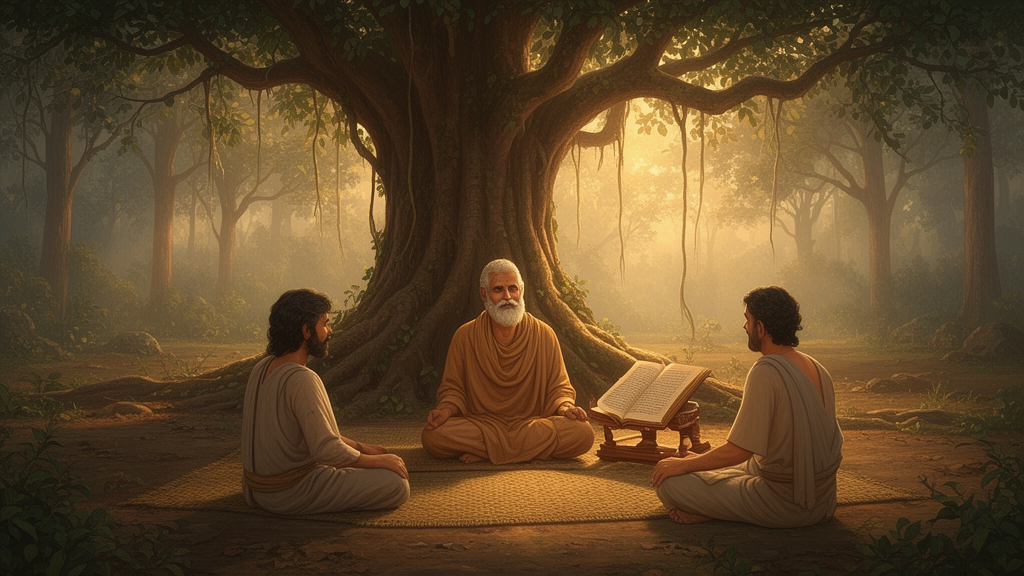
The name is commonly explained as referring to sitting near a teacher. The Vedapath introduction states that the word literally means sitting near a teacher and that the texts are concluding portions of the Vedas, known as Vedanta, meaning the end of the Vedas. Religions.app adds that the teachings were transmitted orally from guru to student before being written down. That oral background matters: many passages are structured as dialogues between a teacher and a seeker, which is why the texts often read more like conversations than legal or ritual manuals.
Three ideas recur across the sources. Brahman is the ultimate reality. Atman is the self. Moksha, or liberation, is the goal of the path that the texts describe. Vedapath explicitly lists these themes, along with the relationship between the individual and the cosmos. Each Upanishad develops them in its own way, which is one reason a single summary can never capture the whole collection.
Scripture, Commentary, and Summary
When you read online, it helps to separate three layers. The first is the text itself, the Sanskrit verses and their traditional divisions. The second is a translation, which is one person’s rendering of those verses into another language. The third is commentary or summary, which may be traditional, scholarly, or written by a website for readers. Some free pages include automatically generated summaries. The Project Gutenberg page for the Paramananda translation, for example, notes that its description is an automatically generated summary. A summary can help orientation, but it is not the text and should not be cited as if it were.
Choosing a Free Online Edition
Free editions differ in what they provide. Some emphasise audio, some offer a classic English translation, and some present the Upanishads alongside other scriptures. The table of contents for each site also varies. The options below are the ones checked for this guide. Before relying on any site for long study, read its own terms of use and check whether the translation and edition details are clearly identified.
ZION.FM: Sanskrit and English with Audio
ZION.FM describes its Upanishads page as offering Sanskrit and English texts with audio, and it lists the Isha, Katha, Brihadaranyaka, Chandogya, and Mandukya Upanishads among those included. It presents the collection as a set of chapters, each with a short heading. This format suits readers who want to listen while following the text or who prefer short, separate sessions.
The page’s own summary states 18 chapters and 108 verses. Those figures describe the collection as organised on that site, not a universal count of the Upanishads. Some chapter headings on the page are generic labels, such as ‘Chapter 1’ and ‘Chapter 2’, rather than the names of specific texts. Readers who want to confirm which Upanishad a passage belongs to should check the source title and numbering carefully before quoting it.
Project Gutenberg: A Public-Domain English Translation
Project Gutenberg hosts The Upanishads translated by Swami Paramananda, who is listed with dates 1884 to 1940. The Gutenberg page states that the book is in the public domain in the United States, lists English as the language, and offers formats including EPUB, plain text, Kindle versions, and an HTML zip file. Its reading level note gives a reading ease score of 68.6, described as neither easy nor difficult to read.
This is a useful option for readers who want a complete English translation they can download and keep. It is a single translator’s rendering, however. Its preface reflects the translator’s own aims, and its subject tags describe the book as Sanskrit literature translated into English and as a work on mysticism in Hinduism. Those tags help explain how the book is classified, but they do not settle how any specific verse should be understood.
Vedapath: Sanskrit, Transliteration, and Listening
Vedapath presents Upanishads in English with a catalogue of 60 texts. Its introduction says each text can be explored with Sanskrit, transliteration, translations, and enrichment in 31 languages. It also groups the Upanishads into categories, including Mukhya (principal), Yoga, Vedic (general), Shaiva, Sannyasa, and Shakta and Vaishnava texts. The page notes that the Mukhya Upanishads are the ones recognised by Adi Shankaracharya, and that the sectarian Yoga, Shaiva, Vaishnava, and Shakta Upanishads are a separate group.
Vedapath’s descriptions of individual texts are useful for orientation. For example, its description of the Adhwayataraka Upanishad presents it as a Yoga Upanishad associated with the Atharvaveda and frames yoga as a path toward saving knowledge. This is the site’s own interpretive summary, so readers should treat it as a guide to that text rather than a neutral statement of fact. The page also lists verse counts and approximate listening times, which can help plan study.
Religions.app: Principal Upanishads with Study Tools
Religions.app presents the Upanishads as part of a larger comparative study platform. Its Upanishads page lists the principal Upanishads with chapter counts, including the Isha, Kena, Katha, Mundaka, Mandukya, Taittiriya, Aitareya, Chandogya, Brihadaranyaka, and Prashna Upanishads. Its counts are labelled as chapters, so they should be read as that site’s structure rather than as a universal numbering system.
The site describes its reader as offering parallel passages from other world religions. That can be helpful for comparison, but it also means that readers should keep the Upanishads’ own internal context in view. Comparisons work best when each tradition is described on its own terms first.
Archive.org: A Larger Two-Volume Collection
The Internet Archive page for ‘112 Upanishads’ describes a two-volume set with Sanskrit text, an English translation, and an introduction and index of verses. The page’s title says that the set is available to download, borrow, and stream. The title alone shows that the collection is described as containing both Sanskrit and English material. Because the page’s main text was mostly navigation when retrieved for this guide, readers should open the item directly and check the translator, edition, and date before citing it.
How Many Upanishads Are There?
Readers often ask for a single number, but the sources do not agree on one. ZION.FM describes its collection as 18 chapters, Religions.app lists nine principal Upanishads with several chapter counts, Vedapath lists 60 texts, and the Internet Archive uses the title ‘112 Upanishads’ for a two-volume edition. These differences reflect the choice of collection, not contradictions about the texts themselves.
Vedapath’s description helps explain this variety. It says that the Mukhya (principal) Upanishads are those recognised by Adi Shankaracharya, and that the group also includes sectarian Yoga, Shaiva, Vaishnava, and Shakta Upanishads. A list of ‘the Upanishads’ may therefore include different groups depending on whether it is limited to principal texts or extended to later sectarian works.
For practical reading, the best approach is to start with the principal Upanishads, which most editions include, and then explore the wider groups. The principal texts named in the sources include Isha, Kena, Katha, Mundaka, Mandukya, Taittiriya, Aitareya, Chandogya, Brihadaranyaka, and Prashna. If you find a site that gives a total number, check which group that number includes before comparing it with another source.
How to Read the Upanishads Online
Free online reading is easiest when you have a clear plan. The texts are dense and often poetic, and a single passage may be interpreted in more than one way within the same tradition. The steps below are practical suggestions, not rules from any single scripture.
- Pick one edition and stay with it for a while. Switching translations often makes it hard to follow an argument.
- Begin with the Mukhya texts. Vedapath identifies these as the principal Upanishads recognised by Adi Shankaracharya.
- Read the Sanskrit alongside the translation if you can. Vedapath and ZION.FM both present Sanskrit with English, which helps you notice where a translator has chosen one interpretation over another.
- Note the speakers and listeners. Many Upanishads are dialogues, and knowing who is speaking often clarifies the teaching.
- Use audio for repetition. ZION.FM and Vedapath both offer audio or listening features, which can help with pronunciation and memory.
- Write down questions instead of answers. Unresolved questions are a normal part of Upanishadic study and are better brought to a teacher, commentary, or scholarly reference.
Translation Choices Matter
Translation is interpretation. Words such as Atman, Brahman, and moksha have been rendered in various ways, and English terms cannot carry all of their Sanskrit associations. The Gutenberg edition, for instance, is a translation by one translator working at a particular time. Another translation may read the same passage differently. When a phrase seems surprising, compare two English translations or consult a Sanskrit glossary before deciding what the text ‘means’.
If you quote a free online translation, name the translator and the edition. Do not present a paraphrase or a website’s summary as a direct quotation. This is a basic habit of accurate study and an important courtesy to the translators and publishers whose work you are using.
Common Misreadings to Avoid
One common mistake is to treat a single Upanishadic statement as the whole of Hindu belief. The Upanishads are one part of a broader tradition that includes many deities, temple practices, devotional movements, and philosophical schools. Vedanta is a major philosophical current that draws on the Upanishads, but it is not the only way Hindus understand the divine or live their faith.
A second mistake is to read Upanishadic teachings as an instruction manual for quick results. The sources describe the texts as philosophical and contemplative. Vedapath’s description of the Adhyatma Upanishad, for example, presents liberation as knowledge that removes ignorance, and it describes discipline and contemplation as the means of reaching that insight. It does not promise any material outcome.
Belief, Tradition, and Scholarship
The Upanishads can be approached in several ways, and it is useful to keep these approaches distinct. A believer may read them as revealed or as the teachings of wise sages that shape daily life. A historian may ask when and where different texts were composed and how they changed over time. A philosopher may analyse their arguments about the self and reality. A comparative scholar may place them beside other religious texts. Each approach can be respectful, but they answer different questions.
What the Texts Say
On the textual level, the sources consistently describe the Upanishads as exploring Brahman, Atman, and liberation. Religions.app says they explore the nature of ultimate reality, the self, and the path to enlightenment. ZION.FM describes them as exploring the nature of Brahman, Atman, and ultimate reality. These are descriptions of the texts’ main concerns, which can be checked by reading the texts themselves.
What Traditions Teach
Different Hindu traditions read the Upanishads in different ways. Vedapath’s categories show that some Upanishads are associated with yoga, some with Shaiva, Vaishnava, or Shakta traditions, and some are classified as Sannyasa texts. Traditional teachers and schools may emphasise different passages or interpret the same passage in different ways. A reader should note the tradition behind any commentary or teaching they encounter.
What Historical and Scholarly Sources Add
The sources in this guide provide general descriptions of the Upanishads and their categories, but they do not offer detailed historical dating for each text. Religions.app says the texts were composed over several centuries, and Vedapath associates the principal group with Adi Shankaracharya’s recognition. Readers who want precise dating or manuscript history should consult academic editions and specialist scholarship, which this guide has not reviewed in detail. Where dates are uncertain, the honest answer is that scholars and traditions may disagree.
Using HindusGod Upanishad Guides with Free Texts
Free online editions are the text; a guide can help you understand the context. HindusGod has draft guides on related topics that may be useful once they are published. The following pages are currently draft links, so they may not be public yet. Check the live site before sharing them.
- For a beginner’s overview of the free reading options, see the free Upanishads guide.
- For a general introduction to the collection, see the Upanishads overview.
- For a note on why counts vary, see the 112 Upanishads article and the 18 Upanishads article.
- For texts grouped by number, see the Eight Upanishads, Five Upanishads, and Four Upanishads pages.
- For a summary-style reading path, see the Essence of the Upanishads page.
- For a modern commentary tradition, see the Aurobindo Upanishads page.
- For a first look at the collection in English, see About Upanishads in English.
Frequently Asked Questions
Are the Upanishads free to read online?
Several sites offer free access. ZION.FM, Project Gutenberg, Religions.app, and Vedapath all describe free reading in their own pages. Terms of use, audio features, and premium features vary, so check each site before relying on it. Project Gutenberg states that its eBooks are free and that the translation is in the public domain in the United States.
Which free edition should a beginner choose?
A beginner who wants to listen may find ZION.FM useful, because it presents Sanskrit and English texts with audio. A reader who wants one complete English translation to download may prefer the Gutenberg edition. If you want Sanskrit, transliteration, and translation together, Vedapath may suit you.
Do all Hindus read the Upanishads the same way?
No. Hindu traditions differ in their scriptures, practices, and philosophical emphases. The Upanishads are central to Vedanta, but other schools and communities give different weight to them and read them in different ways. A reader should not assume that one interpretation represents all Hindus.
Closing Thoughts
Reading the Upanishads online is most rewarding when you combine accessible editions with patience. Start with a reliable free text, note the translator and edition, and keep the difference between scripture, translation, commentary, and summary in mind. The sources agree that the Upanishads explore Brahman, Atman, and liberation, but they show that the collection itself is organised in different ways. That variety is part of the tradition, and it is worth understanding before you read.
Sources and Further Reading
- ZION.FM, The Upanishads: used for the description of the Upanishads as the concluding part of the Vedas, the listed principal texts, and the availability of Sanskrit and English texts with audio.
- Project Gutenberg, The Upanishads by Swami Paramananda: used for the translator’s dates, public-domain status in the United States, available formats, and reading level note. The page’s summary is marked as automatically generated.
- Vedapath, Upanishads in English: used for the meaning of the word Upanishad, the Vedanta description, the categories of Upanishads, and the note on Adi Shankaracharya’s recognition of the Mukhya Upanishads.
- Religions.app, Read the Upanishads Online Free: used for the description of the Upanishads as a foundation of Vedanta, the list of principal Upanishads, and the note on oral transmission from guru to student.
- Internet Archive, 112 Upanishads (Sanskrit Text, English Translation, An Exhaustive Introduction Index of Verses): used only for the item title and its stated availability to download, borrow, and stream. Verify the edition details on the item page before citing.
Note: The HindusGod links above are draft targets that may not be publicly visible until the owner publishes them.