Upanishad Brahmayogin is the scholarly name given to Rāmachandrendra Sarasvati, a sannyasin and Advaitin scholar who lived around the late 18th century and is credited with commentaries on all 108 Upanishads of the Muktika canon. This post explains who he was, why the name “Brahma Yogin” appears in several forms, what his commentaries are, and where the evidence is limited. It also clarifies that he is not the author of the separate Brahma Upanishad, a common point of confusion.
Who was Upanishad Brahmayogin?
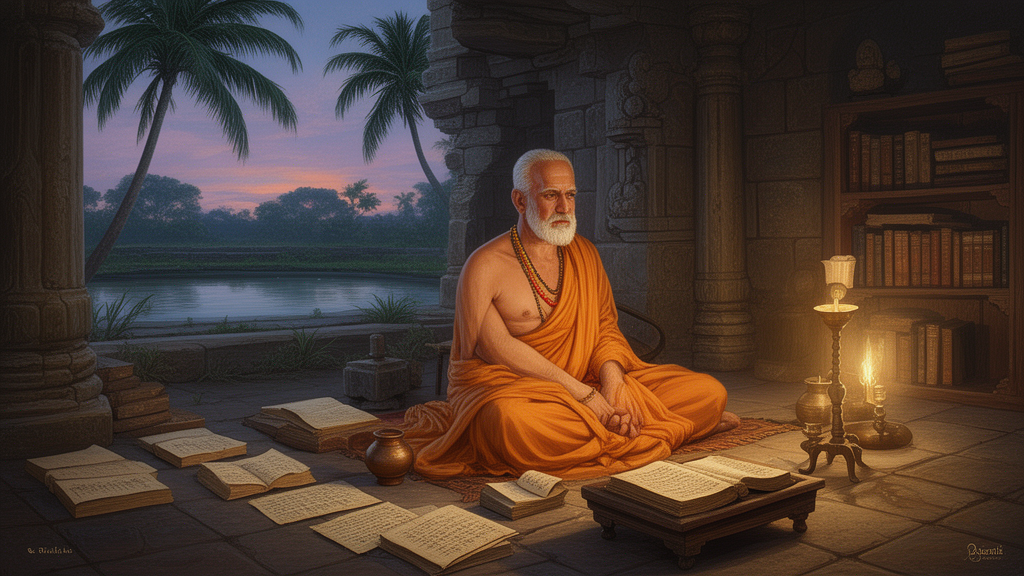
According to the Wikipedia entry on the figure, Upanishad Brahmayogin is the cognomen of Rāmachandrendra Sarasvati, dated to about 1800 CE, and he is described as a sannyasin and Advaitin scholar of the Upanishads (Wikipedia: Upanishad Brahmayogin). The name is a title earned through scholarship rather than a birth name. He was born Śivarāma of the Vādhūla gotra in Brahmapuram, a village on the river Palar, and he took the initiation name Rāmachandrendra when he entered sannyasa (Wikipedia: Upanishad Brahmayogin).
In Sanskrit, yogin refers to a practitioner of yoga or a person absorbed in spiritual discipline, while brahma refers to Brahman, the ultimate reality in Advaita Vedanta. The title therefore signals a teacher of Brahman-knowledge rather than a deity or a text. Readers should not treat the word “Brahma” here as a reference to the god Brahma.
Why the name appears in several forms
Sources record several variants. Wikipedia notes that he came to be known for his scholarship by names such as Upanishad-brahma-yogi, Upanishad-brahmendra and Upanishad-brahman (Wikipedia: Upanishad Brahmayogin). Library catalogues and archive listings use spellings such as “Upanishad Brahmam” and “Upanishad Brahma Yogin” for the commentary volumes (Internet Archive: 108 Upanishads with Upanishad Brahmam Commentary; Internet Archive: 108 Upanishads – Sanskrit Commentary).
When searching, readers may encounter all of these forms. The spelling used on this page follows the common English form “Brahmayogin” for the scholar and “Brahma Upanishad” for the separate text.
Life, family and dating
Wikipedia reports that his father was Śivakāmeśvara and that the commentaries on the 108 Upanishads were the fulfilment of his father’s wish (Wikipedia: Upanishad Brahmayogin). He was initiated into sannyasa by Vasudevendra Sarasvati in Kanchipuram, where he settled and eventually founded a matha of his own, the Upanishad Brahmendra matham (Wikipedia: Upanishad Brahmayogin).
The dating needs care. The same Wikipedia entry gives “fl. 1800 CE” in its opening line, but elsewhere it places him in the middle of the 18th century, based on accounts that he was an older contemporary of the composer-saint Tyagaraja (1767–1847 CE) (Wikipedia: Upanishad Brahmayogin). Because these dates rest on traditional tales of association, readers should treat the timeline as approximate and not as a fixed historical record.
The commentaries on the 108 Upanishads
The central claim associated with this scholar is that he wrote commentaries on all 108 Upanishads of the Muktika canon. The Muktika list is a Telugu anthology in which the Upanishads are narrated by Rama to Hanuman, as described in the Wikipedia article on the Brahma Upanishad (Wikipedia: Brahma Upanishad). The sources say that the commentaries sit alongside the root texts in printed editions.
A digitised edition titled 108 Upanishads – Sanskrit Commentary is listed on the Internet Archive in volumes, and an archive PDF describes the commentary as that of a Sri Upanishad-Brahma-Yogin of a Kanchi Advaita Mutt, printed side by side with the text of the Upanishads (Internet Archive: 108 Upanishads – Sanskrit Commentary; Internet Archive PDF: Yoga Upanishads with commentary (1920)). Our review of the archive listing pages confirmed the titles and volume structure, but the full commentary text was not inspected in this research pass, so we do not quote it here.
An English-language edition is also associated with the Adyar Library. Wikipedia states that his works have been translated and published by the Adyar Library (Wikipedia: Upanishad Brahmayogin). A search-result excerpt of a 1950 Adyar Library edition, edited by Pandit A. Mahadeva Sastri, was also identified, but that PDF was not opened, so its contents are noted only as a lead for readers.
The scale of his literary output
Wikipedia reports that he annotated the colophons of his works with the number of granthas each contained, which may have been meant to prevent interpolation. Based on these annotations, the entry estimates his works at over 45,000 granthas (Wikipedia: Upanishad Brahmayogin). A grantha is a unit of counting used in Indian manuscript culture, often based on a fixed number of syllables, so the figure describes his own count and should not be compared directly with modern word counts. Besides the Upanishad commentaries, the same source names independent works such as the Paramādvaita-siddhānta-paribhāṣā and the Upeya-nāma-viveka.
Advaita Vedanta and the matha tradition
The sources describe him as an Advaitin, meaning that his teaching falls within the non-dual school of Vedanta associated with Śaṅkara. In this school the Upanishads are read as sources of knowledge about the identity of the individual self (ātman) with Brahman. Mathas are monastic centres that preserve scholarship and teaching lineages. Wikipedia notes that his samadhi is located on the banks of the Sarva Teertham tank in Kanchipuram, alongside four other samadhis (Wikipedia: Upanishad Brahmayogin).
Devotees and students may approach his commentaries as part of a living lineage, while historians may treat them as texts to be studied for their interpretive method. Both perspectives are legitimate, and this post does not assert that either one is the only valid reading.
Not the same as the Brahma Upanishad
Many readers searching for “brahma yogin” are looking for the Brahma Upanishad, which is a different text. The Brahma Upanishad is a Sanskrit text among the 32 Upanishads attached to the Krishna Yajurveda and is classified among the 19 Sannyasa Upanishads (Wikipedia: Brahma Upanishad). It is presented as a dialogue between Sage Pippalada and Shaunaka Mahashala and discusses the self, its four states of consciousness, and meditation on the formless Brahman (Wikipedia: Brahma Upanishad).
The Wikipedia article says the third chapter rejects ritual and external religious observance and declares that the highest state for a person is one devoted entirely to knowledge (Wikipedia: Brahma Upanishad). This is a teaching of the text, not the position of the commentator. For a fuller introduction to that text, see our draft guide to the Brahma Upanishad (URL status: WordPress target draft, may not be public yet). For related terms, see Brahma Meaning (URL status: WordPress target draft, may not be public yet).
The article also records a dating disagreement within itself. The infobox gives “before 3rd-century CE,” while the chronology section says the date of composition is unknown. We report both and do not resolve the question here.
How to read these sources today
Readers who want to study the commentaries should separate three kinds of material: the root Upanishad text, the commentary, and modern secondary scholarship. A commentary explains a text from within a school of thought, so its claims are interpretations of scripture rather than scripture itself. Modern introductions, including Wikipedia, are useful for orientation but should be checked against the editions and academic sources they cite.
- Start with the root text of a specific Upanishad, then read the commentary alongside it.
- Compare the title used by a given edition, since the same scholar appears under several names.
- Check dates and attributions in printed introductions, which may reflect traditional accounts.
For broader context on the Upanishads as a group, readers can consult our overview of the 108 Upanishads (URL status: WordPress target draft, may not be public yet) and our guide to the meaning of Upanishad (URL status: WordPress target draft, may not be public yet). Readers interested in Advaita themes may also find the Advaita Upanishad (URL status: WordPress target draft, may not be public yet) useful.
What the sources do not establish
Several questions remain open. The sources reviewed do not provide a verified list of every commentary title by this author, a confirmed manuscript history, or a secure birth year. They also do not establish how each commentary compares with other Advaita commentaries of the period. Claims about his exact dates, his relationship to Tyagaraja, and the grantha count should be treated as traditional or secondary-source claims until checked against the printed editions and academic work on the Kanchipuram mathas.
Frequently asked questions
Is Upanishad Brahmayogin the same as the Brahma Upanishad?
No. Upanishad Brahmayogin is the name of a scholar who wrote commentaries on Upanishads. The Brahma Upanishad is a separate Sanskrit text in the Krishna Yajurveda tradition.
What did he write?
The sources credit him with commentaries on all 108 Upanishads of the Muktika canon and with independent works such as the Paramādvaita-siddhānta-paribhāṣā and the Upeya-nāma-viveka.
Where can I read the commentaries?
Digitised editions are listed on the Internet Archive, and the Adyar Library is named as having published translations of his works. Access and licensing should be checked on each site before use.
Summary
Upanishad Brahmayogin, known also as Rāmachandrendra Sarasvati, was an Advaitin sannyasin credited with commentaries on the 108 Upanishads of the Muktika canon. His dating is approximate, his name appears in several forms, and his commentaries are best read alongside the root texts and modern scholarship. Readers who want to explore the Brahma Upanishad, which is a different text, can start with the verified sources listed below.
Sources and Further Reading
- Wikipedia: Upanishad Brahmayogin: biography, name variants, commentary claims, and dating discussion. Used as a secondary overview; its references (Rao 1983; Raghavan 1994; Saraswathy 2006) should be checked directly.
- Wikipedia: Brahma Upanishad: structure, dialogue format, Krishna Yajurveda attribution, and the Muktika listing of the text. Used as a secondary overview of the root text.
- Internet Archive: 108 Upanishads with Upanishad Brahmam Commentary: listing of a digitised edition. Only the catalogue page was reviewed.
- Internet Archive: 108 Upanishads – Sanskrit Commentary (1-4 of 8 Volumes): volume listing. Only the catalogue page was reviewed.