The Tripuratapini Upanishad is a medieval Sanskrit text, classified as one of the eight Shakta Upanishads and linked to the Atharvaveda. It presents the goddess Tripura as the primordial power and holds that the universe arose from the union of Shiva and Shakti. Its final chapter reads the goddess as the ultimate reality, Brahman, in an Advaita-style discussion. This guide explains what the text says, how it is structured, when it was likely composed, and how different traditions and scholars approach it.
The short answer: what the Tripuratapini Upanishad is
The Tripuratapini Upanishad (Sanskrit: त्रिपुरातापिनी उपनिषद्, IAST: Tripurātāpinī Upaniṣad) is one of the minor Upanishads of Hinduism. Wikipedia describes it as a medieval Sanskrit text that is one of the eight Shakta Upanishads and is attached to the Atharvaveda. [1] The Vyasa Mahabharata site gives the same classification and adds that the text is a notable goddess and tantra-related work. [3]
Three themes define it:
- Cosmic union: the text asserts that the universe was created by the union of Shiva and Shakti, and that existence depends on both the feminine and the masculine. [1][3]
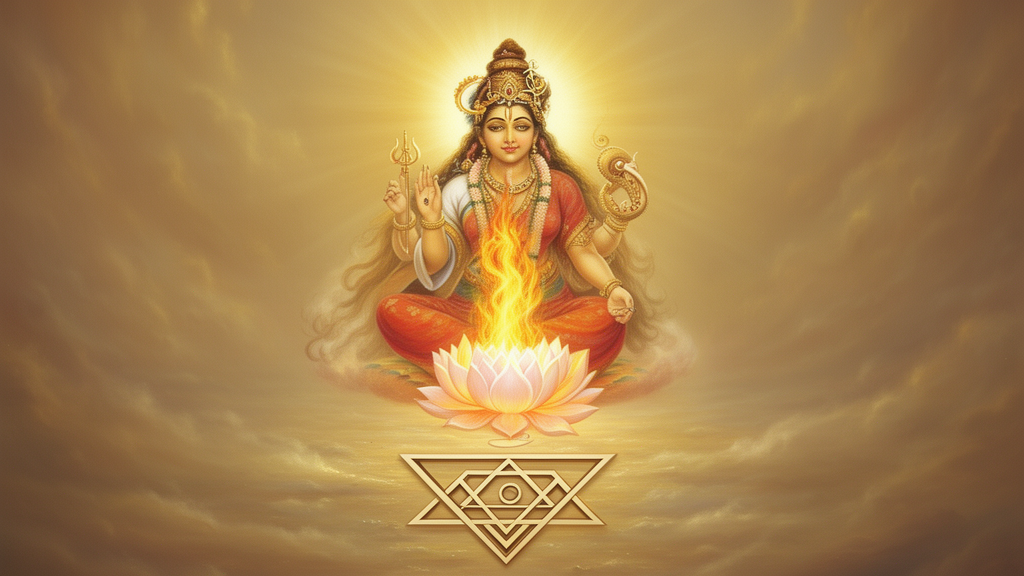
- Tripura as supreme goddess: Tripura is presented as the primordial power and the great goddess of three cities. [1]
- Contemplative practice and non-dual realization: the text describes mantras for remembering the goddess and yantra (tantra chakras) as means of worship, and its last chapter treats Shakti as Brahman, with the Atman identical to Brahman. [1][3]
Readers should keep in mind that these descriptions come from scholarly summaries, translations, and devotional websites. The Upanishad itself is the primary text, and the sections below separate what the text says from what later commentators and modern writers add.
Name and meaning of the title
The title combines Tripura and Tapini, but sources do not gloss it identically. Wikipedia’s infobox gives the sense as “devotee of the three cities.” [1] A separate editorial note on the Sacred Texts of Hinduism website reads Tripura as a reference to Shakti, the Divine Mother worshipped in Sri Vidya traditions, and Tapini as indicating a contemplative, esoteric, or mystical teaching. [4] Both glosses appear in reputable-looking sources, so this guide does not treat either as the single correct meaning. A reader who wants to resolve the question should compare a critical Sanskrit edition with a scholarly study of the title.
The name Tripura is also the core of the text’s theology. The opening section describes the Lord, Sadasiva, taking the forms of Prajapati, Vishnu and Rudra and being styled Goddess Tripura. [5] In the translation by Dr. A. G. Krishna Warrier, published by the Theosophical Publishing House, the three abodes (earth, atmosphere and heavens, or heavens, earth and the nether world) are said to be fashioned by this primeval power. [5] The translation’s wording varies between sources, so the summary here is a paraphrase of that translation rather than a direct quotation.
Dating and historical setting
What scholars and sources say about the date
The author and exact century of composition are unknown. Wikipedia states that the text was likely composed, in the same period as other Shakta Upanishads, between the 12th and 15th centuries CE. [1] The Vyasa Mahabharata site gives the same range. [3] This is a scholarly estimate, not a documented date of composition, and it should be treated as such.
Tantra and the wider background
Wikipedia notes that the text is relatively late within the Upanishadic collection, but that Shakta Tantrism has roots in ancient times. It also states that the interaction between Vedic and Tantric traditions can be traced back to at least the sixth century. [1] Wikipedia further reports Geoffrey Samuel’s view that the surge in Tantric developments in the late medieval period was, in part, a way of confronting Islamic invasions and political instability in and after the 14th century CE in parts of India and Tibet. [1] This is one scholarly interpretation attributed to a named author. It explains a historical context and should not be read as a settled account of why the text was written.
Commentaries
According to the Vyasa Mahabharata summary, the Tripuratapini Upanishad, along with the Tripura Upanishad, attracted scholarly commentary (bhasya) in the second half of the second millennium, including work by Bhaskararaya and Ramanand. [3] Commentaries are later interpretive works. They are not the scripture itself, and a reader should note which commentator is being described.
How the text is structured
The Vyasa Mahabharata summary states that the text consists of five chapters, and that each chapter calls itself an Upanishad. [3] The Wikipedia infobox also lists five chapters, linked to the Atharvaveda. [1]
Modern translations show that the opening portion moves through several distinct movements:
- Invocatory verses: the text begins with peace invocations that resemble the opening prayers found in other Upanishads. The Sanskrit Documents edition presents these before the main discourse. [2]
- Tripura and the three abodes: the first chapter describes the Lord taking the forms of Prajapati, Vishnu and Rudra, styled as Goddess Tripura, and describes the three abodes and the seed syllable hrim. [5]
- Mantra analysis: the text takes well-known Vedic verses and examines their syllables and divisions. The Sanskrit Documents edition includes the Savitri (Gayatri) verse and the Tryambaka verse within its discussion, and then analyzes their parts. [2]
- Metaphysical discourse: later sections, including the final chapter, present Shakti as Brahman and the Atman as identical with Brahman. [1][3]
Because the chapter divisions are described differently across editions and translations, readers who want to cite a specific passage should check the chapter and section numbers in the edition they use.
Key teachings
The union of Shiva and Shakti
The best-known teaching is that the universe was created through the union of Shiva and Shakti. [1][3] In the translation by Warrier, verse I-6 states that the worlds, the Vedas, the sciences, legends, codes, medical works and astronomical treatises are said to have proceeded from this union. [5] The idea is important for Shakta readers because it treats the feminine principle as necessary to creation rather than as a secondary aspect of the divine.
The text’s wording on this point is clear in translation, but the philosophical meaning is interpreted differently by different schools. Advaita-oriented readers may treat the union as an expression of one underlying reality. Devotional Shakta readers may focus on Shakti as the active power through which Shiva’s presence is experienced in the world. Both readings draw on the same verses, so a reader should identify which interpretation is being offered.
Tripura as the primordial power
Wikipedia summarizes the text as presenting Tripura as the primordial power and the great goddess of three cities. [1] The name is associated with the three realms or abodes, and the Sri Vidya traditions connect Tripura with Tripura Sundari, a form of the Divine Mother. [4] Sources describe Tripura in both cosmological and devotional terms, so the text can be read as a metaphysical account and as an object of worship.
Three Vedas, 108 letters and the division of the text
Verse I-5 in Warrier’s translation says the supreme sovereign, the goddess of the three cities, is the embodiment of the three Vedas and of supreme knowledge consisting of 108 letters. The translation adds that the first four divisions elucidate Brahman, the second pertains to Sakti or Power, and the third to Siva, the Good. [5] The Sanskrit Documents text contains the phrase shatakshari in a similar context. [2] The count of 108 letters is therefore a claim made within the text itself, not a historical fact about the Upanishad.
Mantra, sound and the analysis of syllables
The text’s teaching on mantra is one of its distinctive features. Wikipedia reports that the text describes mantras to remember the goddess. [1] The Sacred Texts editorial note describes the work as emphasizing mantra and sacred sound, contemplative worship, and inward realization. [4] In the early sections, the text explains the syllables of a mantra, including a discussion of the syllable tat and the principle of desire. [5] These passages are esoteric and dense. Readers new to them should use a commentary or a scholarly guide and avoid treating a single translation as the final word.
Yantra, kamakala and the path of worship
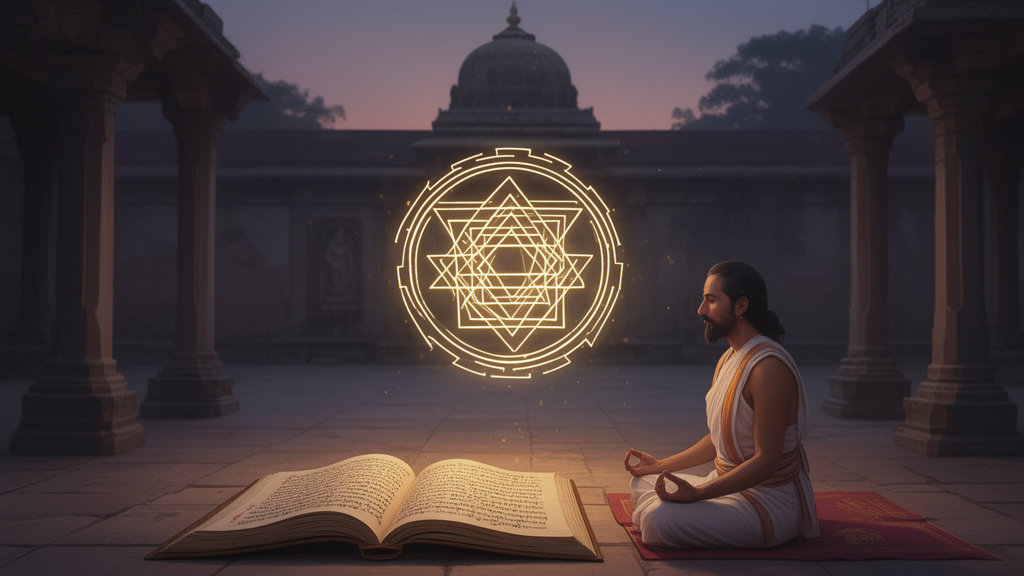
Wikipedia states that the text presents tantra chakras (yantra) as means of her worship and describes the wheel of kamakala. [1] Yantra worship is widely practiced in Shakta and Sri Vidya contexts, but the way a yantra is drawn, consecrated, and used varies by lineage and teacher. The Upanishad’s description is a textual teaching. Actual worship instructions should be sought from a qualified teacher within a specific tradition.
The final chapter and Advaita
The last chapter, according to Wikipedia, is an Advaita-style discussion of the goddess, Shakti, as the ultimate reality Brahman. It asserts that one’s Atman is identical with Brahman. [1] The Vyasa Mahabharata summary repeats this account. [3] The Sacred Texts editorial note describes the text’s metaphysical position as Advaita-oriented and its goal as liberation through realization of the Self and ultimate reality. [4] These are summaries of the text’s position. The meaning of liberation in the text should be read in the context of the Upanishad’s own vocabulary and its commentators.
Philosophical school: Shaktadavaitavada
Wikipedia states that the philosophical premises of the Tripuratapini Upanishad belong to the Shaktadavaitavada tradition, literally the path of nondualistic Shakti. [1] This classification describes a school of interpretation, not a claim that the text was composed by a particular founder. Readers who encounter other Advaita or Vedanta texts should note that the Tripuratapini Upanishad combines Advaita-style language with a strong focus on Shakti and mantra.
Scholarly discussions often place such texts within Shakta, Tantric, and Vedantic currents at once. The Sacred Texts website classifies the text under Shakta Upanishads and lists its philosophy as connected to Shaktism and Vedanta in the sources it summarizes. [4] This overlap is one reason the text is hard to classify in a single category.
Traditions and communities
Shaktism and Sri Vidya
The Tripuratapini Upanishad is often connected with Sri Vidya, a Tantric tradition centered on the goddess Tripura Sundari. [4] Sri Vidya practice includes mantra, yantra, and initiation, and its forms vary across lineages. A reader should not assume that every Shakta community or temple follows the same practices described in the text.
Manuscript and naming variants
Manuscripts of the text are also found under the titles Tripuratapinyopanisad and Tripuratapinyupanisad. The Vyasa Mahabharata summary notes that the second form differs in structure and verses from the first, even though the message is similar in both. [3] Readers who consult different editions should expect variation in verse numbering, wording, and chapter division.
Listing in the Muktika anthology
The Vyasa Mahabharata summary reports that, in a Telugu-language anthology of 108 Upanishads of the Muktika canon, narrated by Rama to Hanuman, the Tripuratapini Upanishad is listed at number 80. [3] This is a detail about how the text is classified in one anthology. It is not evidence about the text’s date or authorship.
Scripture, commentary and modern interpretation
The Tripuratapini Upanishad raises several interpretive questions. Readers benefit from separating four kinds of statements:
- What the text says: for example, that Shiva and Shakti are the source of the universe, and that the goddess is the three-cities sovereign. [1][3][5]
- What a tradition believes: for example, that Tripura is worshipped in Sri Vidya lineages and that yantra worship is a path to realization. [1][4]
- What scholars estimate: for example, that the text was likely composed between the 12th and 15th centuries CE. [1][3]
- What modern writers explain: for example, that the text integrates devotion, mantra, meditation, and sacred geometry into a single realization-oriented framework. [4] This is an editorial interpretation, not a statement in the Upanishad itself.
When these categories are mixed, readers can come away with false certainty. A devotional account may be sincere and meaningful within its community without being a historical record. A scholarly estimate may be useful without being final. A translation may be accurate in one place and interpretive in another.
How to read the text responsibly
- Start with a translation that names its translator. The Warrier translation hosted by Vedanta Shastras Library is attributed to Dr. A. G. Krishna Warrier and published by the Theosophical Publishing House. [5] Check the copyright status before reproducing long passages.
- Compare with a Sanskrit edition. The Sanskrit Documents edition gives the Devanagari text and can be used to check the wording of mantras and verses. [2]
- Read a commentary or study alongside the text. The Ram Kumar Roy commentary (Varanasi: Prachya Prakashan, 1986) is catalogued on the Internet Archive, which shows that a commentary exists, but the catalogue entry alone does not establish its content or quality. [6]
- Ask a qualified teacher about practice. Mantra recitation, yantra worship, and initiation are tradition-specific. The text describes them, but it does not replace guidance within a living lineage.
Practical examples of how the text is used
Readers who approach the Tripuratapini Upanishad for study often begin in one of three ways.
- A comparative study: placing the text beside other Shakta Upanishads or Atharvaveda-linked texts to see how each handles the goddess, the mantra, and the Advaita conclusion.
- A mantra study: examining how the text analyzes syllables from the Gayatri and Tryambaka verses, and comparing the analysis with commentaries. [2][5]
- A devotional reading: reading the opening invocations and the teaching on Tripura with attention to devotion, while noting that the text’s philosophy is open to multiple interpretations.
In each case, a reader benefits from identifying whether a statement belongs to the text, to a commentator, or to a modern explanation.
Related Upanishads on HindusGod.com
Readers who want a broader view of the Upanishadic literature can explore related HindusGod.com guides. The meaning of the word Upanishad is a useful starting point for understanding the genre. For the wider collection, the guide to the 108 Upanishads explains how the anthology is organized, and the overview of the ten principal Upanishads covers the older texts that many readers encounter first. Because the Tripuratapini Upanishad is connected with the Atharvaveda, readers may also find the Atharva Upanishad and the Atharvashikha Upanishad helpful for comparison. [1][3] Readers interested in the Advaita context can compare it with the Advaita Upanishad and the Atmabodha Upanishad. Those topics are separate guides, and their links should be checked before publication.
The Shakta-related guides are also relevant. The Annapurna Upanishad is another goddess-centered text in the same broad collection, and readers who want to understand how Upanishads treat deities may find the Bahvricha Upanishad useful as a companion page. [3]
Frequently asked questions
Is the Tripuratapini Upanishad one of the main Upanishads?
It is generally described as a minor Upanishad, one of the medieval texts classified among the Shakta Upanishads. [1] The principal Upanishads and the minor Upanishads are distinct categories in most references.
Who is Tripura in this text?
Tripura is presented as the primordial power and the great goddess of three cities. [1] The Sri Vidya traditions associate her with Tripura Sundari. [4]
Does the text say that Shiva and Shakti created the universe?
Yes. Wikipedia and the Vyasa Mahabharata summary both state that the text asserts the universe was created by the union of Shiva and Shakti. [1][3] Verse I-6 in Warrier’s translation makes a similar claim. [5]
Is the text the same as the Tripura Upanishad?
No. Wikipedia notes that the Tripuratapini Upanishad and the Tripura Upanishad have both attracted commentary, which indicates that they are separate texts. [1] Readers should check the specific title and edition they are using.
Can I use this text for mantra practice?
The text contains mantra analysis and describes mantras for remembering the goddess. [1][2] Mantra practice should follow the guidance of a qualified teacher within a tradition. This article does not provide a practice instruction.
Summary
The Tripuratapini Upanishad is a medieval Shakta text, linked to the Atharvaveda, that presents Tripura as the primordial power and the source of the universe through the union of Shiva and Shakti. Its teachings on mantra, yantra and the final chapter’s Advaita discussion have made it significant in Sri Vidya and Shaktadavaita contexts. Its date is estimated rather than documented, its title is glossed in more than one way, and its meaning has been read in several traditions. Readers who approach it with attention to the difference between text, belief, tradition and scholarship will find it both a rich source for study and a text that rewards careful reading.
Sources and further reading
- Tripuratapini Upanishad, Wikipedia: general overview, dating estimate, classification, themes and scholarly references (secondary source).
- Tripuratapini Upanishad, Sanskrit Documents: Sanskrit text in Devanagari, used to check the wording of invocations and mantra passages (text edition).
- Tripuratapini Upanishad, Vyasa Mahabharata: summary of structure, commentaries, manuscript variants and anthology listing (secondary summary).
- Tripuratapini Upanishad, Sacred Texts of Hinduism: editorial note on the title, Sri Vidya context and Advaita-oriented reading (secondary editorial source).
- Tripura Tapini Upanishad, Vedanta Shastras Library: English translation by Dr. A. G. Krishna Warrier, published by the Theosophical Publishing House (translation; check copyright before quoting at length).
- Tripura Tapini Upanishad with Commentary by Ram Kumar Roy, 1986, Internet Archive: catalogue record for a commentary edition (catalogue entry; content not verified here).