The Holy Night is a short Christmas story by the Swedish writer Selma Lagerlöf. It is told as a grandmother’s tale: a man goes out on a cold night to find fire for his wife and newborn baby, and the animals and the surly shepherd he meets react in ways that seem unnatural. The story turns on a single act of compassion. It is a Christian-themed literary legend set in a Christmas setting, not a Hindu scripture, and this guide explains what the text says, where it comes from, and how readers from different backgrounds can approach it.
Quick answer: what is The Holy Night?
The Holy Night is a short story by Selma Lagerlöf that presents a Christmas legend in the voice of a grandmother telling it to a child. A man walks through the night asking for fire to warm his wife and baby. He passes sleeping sheep, three dogs that do not bite him, and a hard-hearted shepherd who guards a fire. The story is valued for its moral arc: the shepherd’s heart opens after a small act of kindness, and the darkness gives way to a sense of wonder.
Three points help readers place the work:
- Genre: a literary Christmas tale, presented as a story told by a grandmother rather than as scripture.
- Author: Selma Lagerlöf (1858–1940), a Swedish author who became the first woman to receive the Nobel Prize in Literature in 1909.
- Tradition: the story draws on Christmas and Christian imagery. It is not part of the Hindu scriptural canon, and it should be read as Swedish literature with Christian themes.
What happens in the story
The story opens with a child and her grandmother on a Christmas Day when the rest of the household has gone to church. The grandmother begins with the phrase that frames the whole tale: a man went out at night to borrow fire. He asks people for help, saying that his wife has a little baby and he must light a fire to warm them both. Because it is very late, the households he visits are asleep, and no one answers.
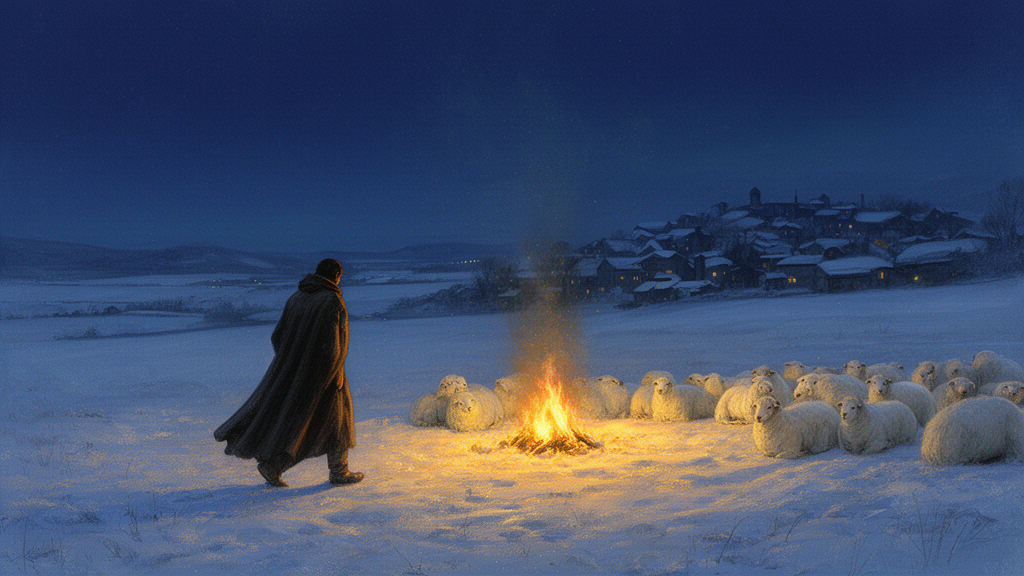
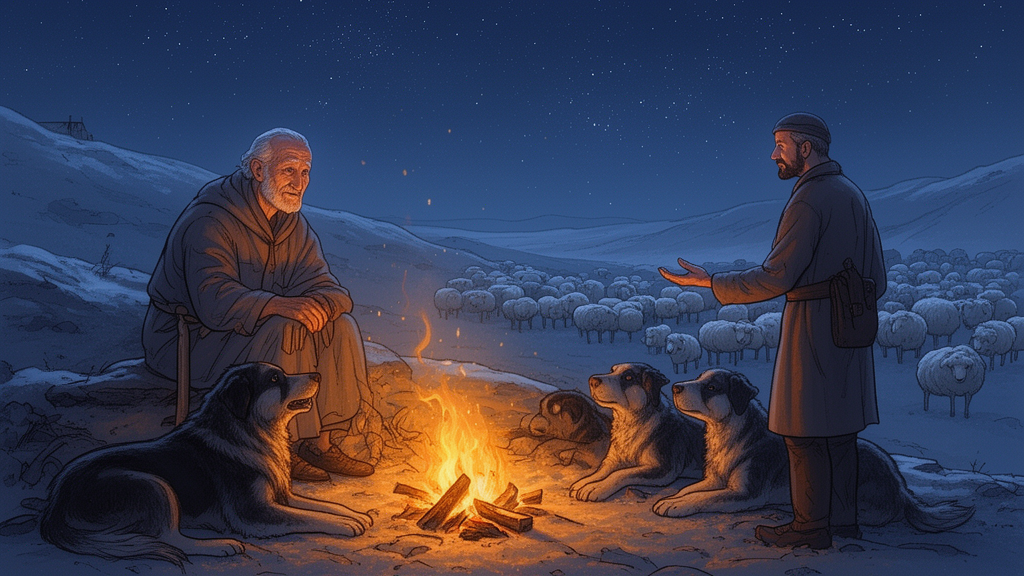
He keeps walking until he sees the glow of flames in the distance. The fire is burning in the open air, and around it lie a flock of white sheep and an old shepherd watching over them. The shepherd is described as surly and disagreeable, a man who is cross with everyone. This characterisation matters, because the story later depends on the contrast between his hardness and what he witnesses.
The dogs that do not bite
Three large dogs rest at the shepherd’s feet. When they wake, they open their jaws as if to bark, but no sound comes out. They rush at the visitor, and one seizes his leg, one his hand, and a third leaps at his throat. In the retelling, their teeth do not harm him. The grandmother’s account stresses that the man feels no hurt at all.
The sheep that part for him
The man wants to reach the fire, but the sheep lie so tightly packed that he cannot pass between them. He steps across their backs and walks to the fire. Not one of the animals moves or stirs. The child asks why, and the grandmother promises that the answer will come later in the story.
The staff and the shepherd’s change
As the man nears the fire, the shepherd looks up. The retelling then describes a hurled staff that swerves away from its target, and embers that leave the visitor’s hands unburned. The shepherd watches each of these events in bewilderment. Summaries of the story describe the turning point as a small act of compassion that cracks open the shepherd’s hardened heart, after which the darkness fills with angels and song. The exact details of how the shepherd acts should be read in the full text, since the plot summary on the Ririro page is a condensed version.
Why the shepherd’s change is the centre of the tale
Most readers take the story’s core to be the shepherd’s transformation. The animals and the miraculous details do much of the narrative work, but the emotional weight falls on the question of whether a hard person will open to a stranger in need. A Goodreads summary of the book makes the same point: the shepherd discovers the spirit of Christmas after the man returns to his cold grotto. Note that this is a reader-facing summary, not an academic reading, so it should be treated as an interpretation of the plot rather than a fact about the text.
The story can be read as a lesson in hospitality and generosity. The visitor asks for something simple, warmth for a newborn. The shepherd’s refusal would have been easy, and the story suggests that the miracles are a way of showing that the request was never really about fire alone. This reading is interpretive. The text itself does not state a doctrine, and readers should avoid claiming that the author intended a single fixed meaning.
Themes readers commonly identify
- Compassion as a turning point: the shepherd changes through an act of kindness rather than through argument.
- The protective and the wild: the dogs, which should attack, are restrained, and the sheep, which should scatter, remain still.
- Light in darkness: fire, embers, and glowing flames run through the story as signs of warmth, shelter, and hope.
- Storytelling as frame: the grandmother’s voice gives the tale a sense of oral transmission, and the child’s questions help the reader follow the logic.
About Selma Lagerlöf
Selma Ottilia Lovisa Lagerlöf (1858–1940) was a Swedish author. According to a Goodreads author biography, she became the first woman to receive the Nobel Prize in Literature in 1909, awarded “in appreciation of the lofty idealism, vivid imagination and spiritual perception that characterize her writings.” The same biography reports that she was born in the forested countryside of Sweden, was told many classic Swedish fairy tales, and later used folklore in her writing. The biography also says she was a teacher for about ten years before her first novel, Gösta Berling’s Saga, was published.
These biographical details come from a reader-facing bio. Readers who want to confirm the Nobel citation or her career timeline should consult the Nobel Prize’s own website or an academic biography. The Goodreads bio also contains statements about her personal life that rely on the views of later researchers. Those statements are outside the scope of this article and are not necessary to understand The Holy Night, so this guide does not repeat them.
Google Books describes Lagerlöf as best known in the English-speaking world for her children’s novel The Wonderful Adventures of Nils. It also says The Holy Night appears to be one of a number of legends she wrote about Christ and the Christmas season. The word “appears” signals that the attribution is a bibliographic judgement, and readers should treat it as a description rather than a settled fact.
Dating the story and its editions
Dates for this story vary by source, so readers should avoid false precision. A ThoughtCo overview says the story was written sometime during the early 1900s. The Goodreads listing for a 32-page hardcover edition gives a first-published date of January 1, 1904, but that is the date listed for that edition record, not a verified date of first publication of the original Swedish text. Readers who need the original publication details should check a Swedish bibliographic source or a library catalogue.
The Internet Archive holds a record titled The Holy Night: a Christmas story, attributed to Lagerlöf (1858–1940), which shows that the story has been published as a standalone Christmas book in several formats and that digital copies exist. Google Books describes a picture-book edition of the tale, illustrating that the story has been adapted for young readers as well as presented in collections.
A discrepancy in summaries
Plot summaries do not always agree. The ThoughtCo overview describes the story as being about a beggar who finds compassion in a shepherd on Christmas Eve. The Ririro text and summary, by contrast, describe a man who goes out to borrow fire for his wife and baby. Both descriptions point to the same central encounter, but the characterisation of the visitor differs. The safest course is to rely on the text itself and to describe the visitor as a man seeking fire for his family, as the grandmother’s opening does.
How to read The Holy Night from a Hindu perspective
HindusGod.com serves readers who study Hinduism, its deities, scriptures, festivals, and devotional life. The Holy Night does not belong to that body of literature. It is a Swedish Christmas story with Christian imagery, and it should be presented as such. Readers who are curious about how a Hindu reader might approach it can still find value in the broader questions it raises about hospitality, compassion, and the transformation of a hard heart.
There are two distinctions that help this kind of reading:
- Text: what the story itself says, including the grandmother’s narration, the animals’ behaviour, and the shepherd’s change.
- Interpretation: the meanings that readers, critics, and religious communities draw from the story, which vary.
A reader from a Hindu background may come to the story with its own vocabulary of dharma, seva, and compassion, but comparisons of this kind should be made carefully. The text does not refer to Hindu ideas, and claims that it reflects a particular Indian teaching would require a separate, sourced comparative study that is not provided here.
Distinguishing belief, tradition, and scholarship
- Belief: Christian readers may treat the angels and the night of birth as sacred narrative. The story presents these elements as part of a Christmas legend.
- Tradition: Swedish Christmas storytelling and literary folklore shape the tone, including the grandmother’s voice and the idea of a tale told on Christmas Day.
- Scholarship: literary critics examine Lagerlöf’s style, her use of folklore, and her spiritual themes. This article does not cite a specific critical study, so readers should consult academic work for detailed analysis.
Reading the story with care
Several practical habits help readers get the most from the tale:
- Read the story aloud if possible, since the grandmother’s voice and the child’s questions are central to its rhythm.
- Notice the moments where the story describes expected danger, such as dogs and sheep, and then reverses them.
- Pay attention to the shepherd’s first reaction and to the moment when his attitude begins to shift.
- Compare two or three editions or translations to see how the wording and the details of the miracles differ.
Because this is a short work, readers may be tempted to rely on summaries. Summaries can compress important moments, so they are most useful as a guide to a full reading rather than as a replacement for it.
Related reading on HindusGod.com
Readers interested in sacred texts and the idea of scripture may find the following pages useful for comparison. These are current WordPress drafts and may not yet be public; the links will work only after the owner publishes those posts:
- For a general overview of how religious communities describe their sacred writings, see holy scriptures on HindusGod.
- For a discussion of what the phrase holy book means in different contexts, see holy book meaning.
- For a broader look at the word text in religious settings, see holy text.
- For a reference on the general category of holy books, see holy book.
Frequently asked questions
Is The Holy Night a Hindu text?
No. It is a Swedish Christmas story by Selma Lagerlöf with Christian imagery. It should not be presented as Hindu scripture, and this article does not claim any Hindu origin or canonical status for it.
Who wrote The Holy Night?
Selma Lagerlöf, a Swedish author who lived from 1858 to 1940. Goodreads records that she was the first woman to receive the Nobel Prize in Literature, in 1909.
What is the main lesson of the story?
Interpretations vary. Many readers focus on the shepherd’s change of heart after a small act of compassion. The text itself leaves room for different readings, so the lesson is best understood as one reader’s interpretation rather than a fixed doctrine.
Is the story suitable for children?
Picture-book and children’s editions exist, according to Google Books. Readers should choose an edition suited to the child’s age. The story contains dogs that threaten to attack and a moment of danger that is quickly resolved in the narration.
Summary
The Holy Night is a short Swedish Christmas tale in which a man seeking fire for his family passes through a night of unexpected obstacles that do not harm him. Its power lies in the shepherd’s change after a small act of kindness. The story is best read as Swedish literature with Christian imagery rather than as a Hindu text. Readers who want more depth should consult the full edition, check the Nobel Prize’s own biography of Lagerlöf, and look for academic studies of her work.
Sources and further reading
- The Holy Night: a Christmas story, Lagerlöf, Selma, 1858–1940, Internet Archive: a catalogue record and digital copy listing for the story.
- The Holy Night by Selma Lagerlöf, Ririro: a reading text and plot summary used for the story’s narrative details.
- The Holy Night, Goodreads: an edition listing and author biography, used for the Nobel reference and the edition date.
- Overview of The Holy Night, ThoughtCo: a secondary overview used for the description of the story’s date range and plot.
- The Holy Night, Google Books: a publisher description of a picture-book edition.