The Holy Innocents is a 1988 novel by the Scottish writer Gilbert Adair. It follows three young cinephiles in Paris during the turbulent months of 1968: Matthew, an American studying film, and the French twins Guillaume and Danielle. The book is a work of fiction, not a religious text, and the phrase “holy innocents” in its title should be read as a literary choice rather than a scripture reference. This guide explains what the novel is about, the works that inspired it, its editions, its reception, and how readers can approach the title, with links to related HindusGod.com draft pages where they add useful context.
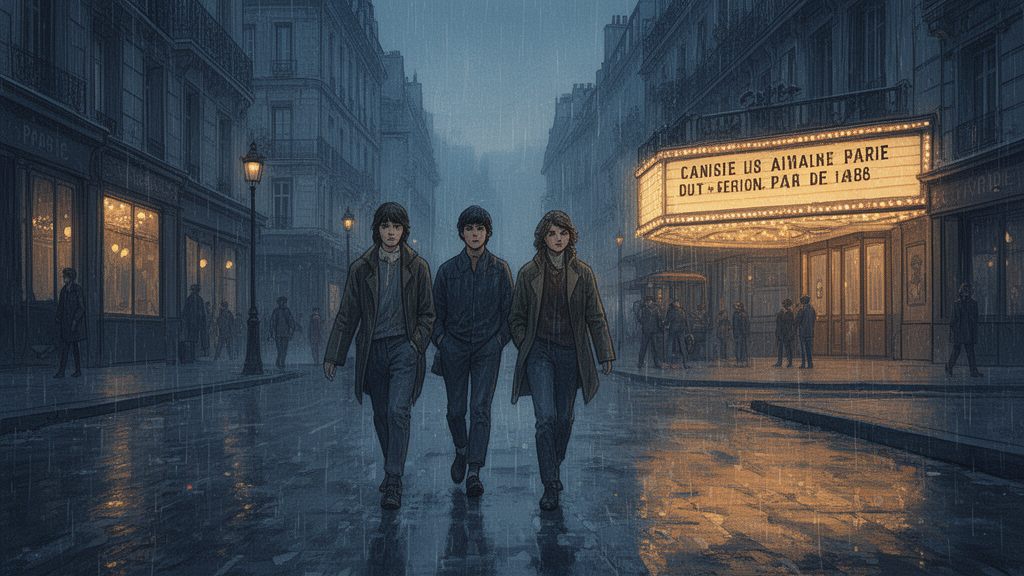
Quick answer: what is The Holy Innocents by Gilbert Adair?
The Holy Innocents is a novel first published in 1988 by Heinemann, with the ISBN 978-0-434-04578-5 listed on the book’s Wikipedia entry. Wikipedia describes it as a novel by Scottish writer Gilbert Adair about three young cinephiles: two French siblings and an American stranger who enters their world. Its central subjects are obsession, youth, and the intensity of a shared passion for cinema.
The novel is set in 1968 and is frequently discussed alongside the May uprising in France. Readers should know that the book contains mature sexual content and that it treats sibling intimacy in a way many readers find uncomfortable. Anyone searching for this title is most likely looking for a literary guide, and this article keeps to what the book and its published record show.
What the novel is about
The story centers on Matthew, an American studying in Paris, and the twins Guillaume and Danielle. Their first bond is cinematic. Matthew studies film, and the twins are fascinated by the medium. They meet and grow close through their shared love of movies, spending evenings at Paris’ Cinémathèque, where they live, in the novel’s telling, for the cinema alone.
The three central characters
Matthew is the outsider in the group. He arrives as a student and is drawn into the twins’ private world. The twins are presented as clever, aristocratic, and deeply involved with each other. Several published summaries describe their relationship as incestuous. Goodreads’ book description presents the siblings as “young, clever and aristocratic, and incestuously involved,” and Wikipedia notes that Matthew discovers that Danielle and Guillaume’s relationship “goes beyond the usual sibling intimacy.”
The novel’s interest lies less in plot mechanics than in how these three characters test one another. Their relationships shift between friendship, rivalry, desire, and a shared sense of being apart from the world outside.
Paris, the Cinémathèque, and May 1968
The Cinémathèque is central to the book’s setting. According to Wikipedia’s plot summary, French Culture Minister André Malraux fires Cinémathèque director Henri Langlois, and this act serves as a prelude to the May uprising. The Cinémathèque closes, and the country falls into confusion. The three young people hardly notice at first, because their small world has been disrupted and they do not know what to do.
This historical backdrop matters. The novel’s private world of film and games is repeatedly set against public upheaval. Matthew and the twins begin with the cinema as their universe, and the closure forces them to find another structure for their days.
From cinema to shared household
Matthew’s connection to the twins grows beyond the Cinémathèque. The summary on Wikipedia explains that he is invited to dinner at their house and then to spend the night. He later moves in with them while their father, a famous poet, and stepmother leave for an extended stay in the country.
Inside the apartment, the three live in their own world. They stop going to school, play cinematic trivia games with rising stakes, and enjoy their youth without regard for the city outside. Wikipedia describes them as living “the lives of innocents,” while also noting neglect of everyday responsibilities and a sense of detachment from the wider world.
The novel ends with the three returned to society in May 1968, where they find the streets under siege. This ending turns the book’s private games into a reckoning with a public world they had largely ignored.
Literary influences: Cocteau and Melville
Adair’s novel is not written in isolation. Wikipedia states that its themes were inspired by Jean Cocteau’s 1929 novel Les Enfants Terribles, whose English title is commonly given as The Holy Terrors, and by the 1950 film of the same name directed by Jean-Pierre Melville.
Readers who know Cocteau’s novel will recognize a shared interest in adolescent isolation, a closed world of private rules, and the tension between childhood play and adult desire. The comparison helps explain why Adair’s characters seem both playful and dangerous. Note that this article relies on the Wikipedia statement for the influence; readers who want to trace the connection in detail should consult the original novel and film and an academic study of Adair’s work, which this draft did not retrieve.
Why the influence matters for readers
- Cocteau provides the literary template of siblings who create a sealed inner world.
- Melville’s film adds a cinematic reference point, which fits a novel about cinephiles.
- Adair’s 1968 setting places that inner world against a real political crisis.
Together these references show that the book is in conversation with earlier European art about youth, desire, and the power of films. It is best read as a literary work that draws on earlier texts, not as a fresh invention cut off from them.
Themes: obsession, youth, and innocence
The novel’s central theme is obsession, which Wikipedia describes as beginning cinematically. The three characters are obsessed with films, with the games they play about films, and with one another. This obsession gives the book its momentum and its sense of enclosure.
Youth is the second major theme. The characters are young enough to believe their private world can be sealed off from history, and the book tests that belief when the streets of Paris erupt. The title’s word “innocents” is ironic in tone: the characters live like innocents in the sense of being unaware of consequences, but the novel does not present them as innocent in a simple moral sense.
Belief, text, and interpretation
Readers should separate three things. The first is what the novel says, which is a fictional story. The second is the interpretation of scholars and critics, which can differ on whether the book is celebratory, critical, or ambivalent about its characters. The third is personal reading, which varies widely. No single reading should be presented as the only correct one. Reader comments on Goodreads, for example, range across the rating scale, which shows that responses to the book are divided.
Publication history and editions
The novel was first published in 1988 by Heinemann in the United Kingdom, according to the Open Library entry and Wikipedia. The Open Library record lists a Heinemann 1988 edition as “The holy innocents: a romance” with ISBN 0434045780, and an E.P. Dutton 1989 American edition under ISBN 0525247882.
Open Library also lists a June 1989 Minerva paperback titled “The Holy Innocents,” with 160 pages and ISBN 0749390093. Goodreads lists a 154-page hardcover, first published on January 1, 1988. The page count difference reflects different editions and should be checked against the specific copy you plan to buy or borrow.
The Internet Archive record for the title is identified as holyinnocents0000adai. Availability for borrowing or streaming depends on Internet Archive terms and may change, so check the current page before recommending it to readers.
Choosing an edition
- Check the publisher, year, and ISBN on the copy you are considering.
- Compare page counts, since the sources list 154 and 160 pages for different editions.
- Read the publisher’s note or introduction, if the edition includes one, to see whether it discusses the text’s origin.
About Gilbert Adair
Gilbert Adair was born on 29 December 1944 and died on 8 December 2011. Wikipedia’s biography describes him as a Scottish novelist, poet, film critic, and journalist. Its infobox gives Edinburgh or Kilmarnock as possible birthplaces, so readers should note that sources differ on the birthplace. Wikipedia also states that he was born in Edinburgh in the body text.
Adair attended Kilmarnock Academy and graduated with an MA in French from the University of Glasgow in 1967. He lived in Paris from 1968 to 1980, a period that helps explain why the novel’s Paris setting feels so specific. The Goodreads author biography gives the same Paris years and also notes that Adair was known for his work in film criticism and for the translation of Georges Perec’s novel A Void, written without the letter e.
Adair’s other work includes the translation of Perec, film criticism, and novels such as Love and Death on Long Island and The Dreamers. Wikipedia notes that Adair’s translation of A Void won the Scott Moncrieff Prize in 1995.
Reception and awards
Wikipedia reports that Adair won the Authors’ Club Best First Novel Award in 1988 for The Holy Innocents. This is one of the few awards directly tied to the novel in the sources reviewed.
Reader reception is more mixed. On Goodreads, the book has an average rating of 3.63 from 3,473 ratings and 356 reviews, based on the page reviewed. The rating distribution includes 817 five-star ratings and 130 one-star ratings. The spread suggests that readers either connect strongly with its tone and themes or find them difficult. Because these are reader ratings, they show popular response rather than scholarly consensus.
How to weigh reception
- Award information comes from a biographical source and shows professional recognition at publication.
- Goodreads ratings reflect general reader opinion and change over time.
- Critical essays are not reviewed in this article and would be needed to make a scholarly claim about the novel’s reputation.
Film adaptations and the Dreamers question
Adair is known as a novelist whose work was adapted for film. The Google Books description of a Dutton edition says that his novels Love and Death on Long Island and The Dreamers were adapted into films, with the later adapted by Adair himself. Wikipedia’s Adair biography also lists Love and Death on Long Island (1997) and The Dreamers (2003) among films made from his work.
Many readers connect The Holy Innocents with the 2003 film The Dreamers. This article did not verify that specific relationship from the fetched sources, so the owner should confirm the adaptation history with a reliable source before publishing any claim that the film is based on this novel. Readers can also compare the novel with the Melville film it cites as an influence, since that connection is documented on Wikipedia.
The title and the word “holy”
Because this site focuses on Hinduism, readers may arrive at this page while searching for religious terms. The novel does not belong to Hindu scripture, Hindu devotional literature, or any sacred text. Its title is part of a literary tradition of naming works with ironic or resonant phrases, and the word “holy” should be understood in that light.
Readers looking for religious texts can explore related HindusGod.com draft pages that discuss how the word “holy” is used in different contexts. Each link leads to a draft that may not yet be public, so check its status before sharing it.
- Holy Book Meaning explains how the phrase “holy book” is used in general religious discussion.
- Holy Scriptures covers the broader category of scripture, which differs from a modern novel.
These destinations are helpful only for readers who want to distinguish sacred texts from literary works. Readers who want the novel itself should start with the entries below.
How to approach the novel
The Holy Innocents is short, with around 154 to 160 pages depending on edition. Its pace is steady, with the emotional and political tension building as the three characters move from the Cinémathèque into the apartment and then back into the streets.
- Read the historical note first. Knowing about Langlois, the Cinémathèque closure, and May 1968 will clarify why the story turns when it does.
- Track the games. The characters’ trivia games reveal their values and their shifting power dynamics.
- Compare with the influences. Cocteau’s novel and Melville’s film offer clear comparisons for the novel’s themes.
- Check the content. The book contains sexual content and depicts sibling intimacy, which some readers will find distressing.
Who may find it useful
Readers interested in cinephilia, Paris in 1968, and European literature about youth are the most likely audience. Readers who prefer a conventional coming-of-age plot may find its shape unusual, because the characters’ inner world matters more than external events.
Common questions about the novel
Is The Holy Innocents a religious book?
No. The sources reviewed describe it as a novel about three young cinephiles in Paris. It is not a scripture, devotional text, or religious commentary.
When is the novel set?
The novel is set in 1968, during the months that include the closure of the Cinémathèque and the May uprising in France.
Who wrote The Holy Innocents?
The novel was written by Gilbert Adair, a Scottish novelist, film critic, and translator who lived in Paris from 1968 to 1980.
What inspired the novel?
Wikipedia states that its themes were inspired by Jean Cocteau’s 1929 novel Les Enfants Terribles and by Jean-Pierre Melville’s 1950 film of the same name.
Summary
The Holy Innocents is a 1988 novel by Gilbert Adair about three young cinephiles in Paris during 1968. Its story moves from the Cinémathèque closure to a shared apartment, then back into the public crisis of May 1968. Its influences include Cocteau and Melville, its first edition was published by Heinemann, and it won the Authors’ Club Best First Novel Award in 1988.
The novel is best approached as literature about obsession, youth, and cinema, with clear content warnings. Readers who want to verify its details should check the editions, the historical background, and critical discussions before drawing firm conclusions.
Sources and further reading
- The Holy Innocents (Adair novel), Wikipedia: plot, publication details, influences, and the Cinémathèque and May 1968 context.
- Gilbert Adair, Wikipedia: author biography, awards, and translation work.
- The Holy Innocents, Goodreads: book description, reader ratings, and genre listings.
- The Holy Innocents, Open Library: edition details, ISBNs, and publisher information.
- The holy innocents, Internet Archive: catalog record for the digitized item.
- The Holy Innocents: A Romance, Google Books: short author description and adaptation note.