The Surya Upanishad is a short Sanskrit text of Hinduism that presents the Sun god Surya as the ultimate reality, Brahman, and as identical with the inner self, or Atman. It is one of the minor Upanishads, is associated with the Atharvaveda, and is usually grouped among the Samanya Upanishads. In brief, it is a devotional and meditative text. It teaches that Surya is the source, sustainer, and dissolver of the universe, and it links solar worship with mantra, meditation, and self-knowledge.
This guide explains what the text says, how it is structured, where it sits in the Upanishadic and Atharvaveda traditions, and how readers can distinguish scripture from later commentary, devotional belief, and modern practice. Where sources differ or where the evidence is thin, this article says so.
What the Surya Upanishad Is

The Sanskrit title is usually written as Sūryopaniṣat. Manuscripts are also found under the spelling Suryopanisad, which is a common variant in English and other transliterations. A catalogue of Sanskrit texts at Sanskrit Documents lists a companion title, Sūryātharvaśīrṣam, which points to the text’s association with the Atharva tradition and is sometimes rendered as Surya Atharvashirsha. Readers may therefore encounter several names for the same work.
The Upanishads are generally understood as the concluding portions of the Vedas, often called Vedanta, and they explore the nature of Brahman and Atman. Most of the older and better-known Upanishads are philosophical dialogues. The Surya Upanishad is different in tone. It is brief, ritual-oriented in places, and organized around a sacred mantra for the sun. Commentators and modern summaries therefore often describe it as a practical or devotional Upanishad rather than an abstract philosophical treatise.
The Wikipedia article on the text summarizes its central claim by saying that the sage Atharvangiras, to whom the Atharvaveda is traditionally attributed, extols Surya as ultimate truth and reality, Brahman, and as the creator, protector, and destroyer of the universe. It also says that the Sun is identical with one’s Atman, or self. These statements describe what the text asserts within its own framework. They are not a historical claim about who wrote it.
Place in the Atharvaveda and the Upanishadic Canon
The Surya Upanishad is traditionally linked to the Atharvaveda. Wikipedia lists it among the 31 Upanishads associated with that Veda, and classifies it as one of the Samanya Upanishads, a general category of Upanishads that are not attached to a single major philosophical school. That classification is a textual and bibliographic grouping, not a statement about the text’s importance to every community.
The Upanishadic canon is not uniform. Different lists exist, and the number of Upanishads varies by source, edition, and tradition. The Muktika canon, a collection of 108 Upanishads presented in a Telugu-language anthology, is one well-known list. In that list, which is described as narrated by Rama to Hanuman, the Surya Upanishad appears at number 71. Readers should treat this as one recorded list rather than as the only authoritative enumeration. Traditions that focus on other Vedic branches, or on Vaishnava, Shaiva, or Shakta devotion, may organize sacred literature differently.
Date and authorship
The author and the century of composition are not known. This is important for readers who want a precise historical timeline. The text claims an attribution to the sage Atharvangiras, but scholarship does not establish that ancient figure as the historical author. Most summaries of the text therefore say that dating is uncertain. Any article that gives a confident single century should be treated with caution unless it cites a specific scholarly study.
How the Text Is Structured
The Surya Upanishad is short, and its structure can be read in a few broad movements. Different editions divide the text in slightly different ways, so the outline below is a reader’s guide rather than a fixed chapter scheme. Where specific verses are involved, readers should compare the Sanskrit text with a reliable edition and translation.
The opening invocation
The Sanskrit text of the Surya Upanishad, as presented on the Stotra Nidhi website, begins with a peace invocation. The first line asks that the gods allow us to hear what is auspicious, and the passage ends with a triple invocation of peace. Grokipedia describes this opening as a peace invocation drawn from the Rig Veda. That attribution should be checked against a primary Vedic edition before it is repeated as a settled fact, because the common Vedic peace formula appears in more than one context.
The invocation is followed by a short Sanskrit sentence that announces the subject. Read in plain English, it signals that the teaching about Surya in the Atharvangiras tradition is about to be explained. The passage frames the text as instruction, not narrative.
The Surya mantra and its components
The Wikipedia summary of the text states that the Upanishad opens by explaining the Atharvaveda mantra for the Sun. It names several components of that mantra. Brahma is described as the source of the Surya mantra. Its poetic meter is Gayatri. Its deity is Aditya, the sun. The mantra pairs the phrase “hamsa so’ham,” meaning “I am he,” with Agni, the fire. Narayana, identified with Vishnu, is named as the seed syllable, or bija, of the mantra.
These associations are central to the text. They show how the Surya Upanishad combines solar devotion with the wider Vedic and Vaishnava vocabulary of seed syllables, meters, and deities. Traditional teachers often explain such associations as a way of organizing the mantra’s power and meaning. Modern readers can treat them as the text’s internal theology, while recognizing that the associations are specific to this Upanishad.
The four aims of life
Wikipedia also states that the mantra is said to remind and help the reciter attain the four worthy human goals, known as the puruṣārthas. These are Dharma, which means ethics, duties, and righteousness; Artha, which means prosperity and means of livelihood; Kama, which means pleasure, emotion, and love; and Moksha, which means liberation and spiritual freedom. This framework appears widely in Hindu thought, so it helps place the Surya Upanishad within a common Hindu vision of a balanced life.
Core Teachings: Surya as Brahman and Atman
The central theological claim of the Surya Upanishad is that Surya is not merely a visible celestial body. The text treats the sun as a manifestation of the highest reality. The phrase commonly rendered in English is that what the Sun is, that the seeker is. This is a teaching of identity, and it is the reason the text is studied alongside other Upanishads that explore Atman and Brahman.
Creator, sustainer, and dissolver
According to the Wikipedia summary, the text says that all beings arise from the Sun, are sustained by the Sun, and vanish into the Sun. The summary quotes this teaching from an English rendering. Because translations differ, this article paraphrases the idea rather than reproducing that rendering. The teaching places Surya in the three cosmic functions of creation, preservation, and dissolution, a pattern found in many Hindu traditions that attribute those functions to different deities.
Readers should note that this is the Upanishad’s own claim. Other traditions may describe creation, preservation, and dissolution through Brahma, Vishnu, Shiva, or the Goddess. The Surya Upanishad elevates the sun within its own framework and does not present that framework as the only valid view of the cosmos.
Surya and Narayana
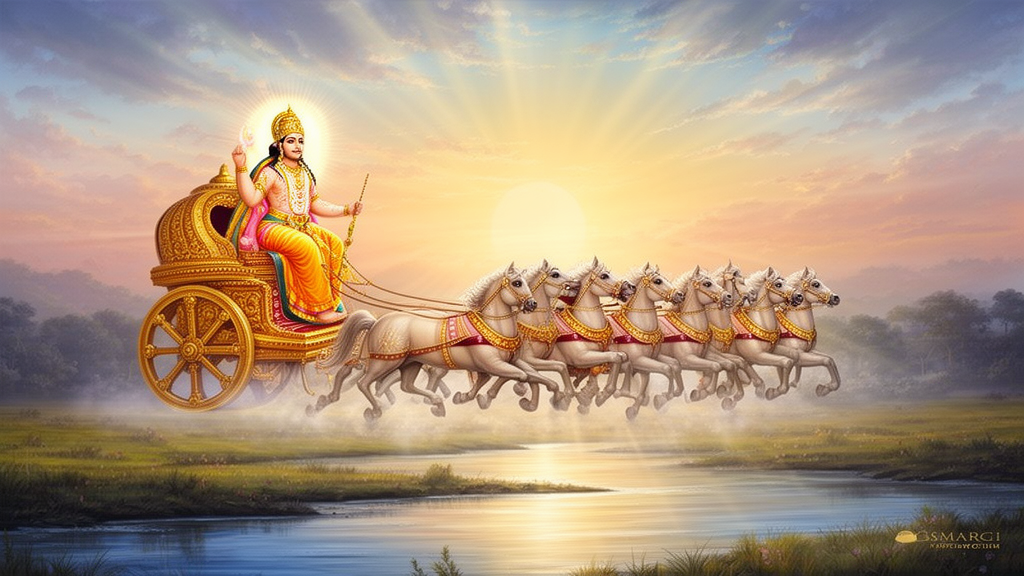
The Wikipedia summary states that Surya is the same as Narayana, and it describes Surya as seated in a golden chariot pulled by seven horses, driving the wheel of time, bringing prosperity, and offering refuge from darkness. Grokipedia gives a similar description and adds that the meditative passage presents Surya as golden-hued, with four arms. Those visual details come from secondary summaries. Readers who need the exact wording should consult a Sanskrit edition with a reliable translation and commentary.
This identification of Surya with Narayana shows a notable feature of the text. A solar hymn here moves toward a Vaishnava vocabulary, which means the text should not be read only as a sun-worship manual. It also reflects a broader pattern in Hindu literature, where one deity is often described in terms of another while keeping a distinct devotional identity.
Light, knowledge, and the inner witness
Popular commentaries often describe Surya as the inner witness, or sakshi, and as the light of knowledge within the heart. Those interpretations are common in devotional teaching, but they are not always stated in the same words in the text as summarized by Wikipedia. This article treats such language as commentary. It is not presented as a direct verse-by-verse translation.
A careful reader can distinguish three layers here. The first is what the Upanishad says about Surya. The second is the traditional or devotional explanation offered by teachers. The third is a modern reader’s reflection. Keeping these layers separate avoids confusing scripture with later interpretation.
Recitation and Practice
Many readers ask how the Surya Upanishad is used in practice. The answer depends on tradition, lineage, and personal discipline. Some people study the text as scripture. Others recite it as part of sun worship, morning devotion, or a broader Vedic practice. Ritual details are not uniform, and this article does not provide a universal procedure.
Japa and sun-facing practice
Grokipedia states that recitation, or japa, is traditionally practiced facing the sun at dawn, midday, or dusk. The same secondary summary says that these times are associated with different reported fruits. Because the claim comes from a secondary source, readers should verify it against a reliable Sanskrit edition and a teacher within a recognized lineage before presenting it as the text’s official instruction.
What the text is said to promise
Some summaries say the text promises material benefits such as wealth, long life, relief from disease, or freedom from sin when the mantra is recited. Secondary sources differ in how they describe these promises, and some popular websites make health or prosperity claims without citing the text. This article does not endorse such claims. Religious promises of fruit or merit belong to the teachings of particular traditions. They are not guarantees that a reader can verify through medicine, economics, or everyday experience.
A respectful approach is to describe these promises as traditional claims, state their source, and explain that devotees may understand them in different ways. Some understand the benefits as spiritual purification or inner steadiness. Others take them more literally. The article therefore presents the promise as a reported teaching rather than as a verified outcome.
A practical reading path
Readers who are new to the text can approach it in a structured way. The steps below are a study method, not an instruction to perform a ritual.
- Read a reliable translation to understand the overall argument, such as the Wikipedia overview and a scholarly or lineage-based translation.
- Compare the Sanskrit text with a transliteration, using a source such as the Stotra Nidhi edition, so that the opening invocation and key terms are familiar.
- Note which claims are scriptural, which are commentary, and which are modern devotional applications.
- Consult a teacher or community that practices sun worship, and ask how the text is used in their tradition.
- If you plan to recite the mantra, follow the pronunciation and timing guidance of your own lineage rather than a generic online schedule.
This method helps readers avoid two common errors. The first is treating a single website’s summary as the whole tradition. The second is treating all devotional claims as historical or verifiable facts.
Scripture, Belief, Tradition, and Scholarship
The Surya Upanishad is discussed in several different ways, and these categories should not be merged. A clear distinction helps readers understand what they are reading.
- Scripture: The Sanskrit text itself, in its manuscripts and printed editions, which states the teachings and mantras.
- Tradition: The way Hindu communities, teachers, and lineages receive, recite, and interpret the text, including regional and sectarian differences.
- Devotional belief: What worshippers hold about Surya, the mantra, and the benefits of recitation. Belief is sincere and central to practice, but it is not a historical proof.
- Scholarship: Academic study of the text’s language, date, manuscripts, relationships with other texts, and historical context. Scholarly conclusions may be provisional and may differ from traditional claims.
When these categories are clear, the article can respect devotion without presenting it as verified history, and it can present scholarship without dismissing the living tradition. For example, the claim that Surya is Brahman is a teaching of the text. The claim that the text was composed by a specific ancient sage is a traditional attribution. The claim that the text is of uncertain date is a scholarly observation.
Regional and Textual Variations
The Surya Upanishad circulates in several forms. Manuscripts use different titles, and printed editions may vary in verse division, spelling, and accompanying commentary. The Telugu anthology mentioned above lists the text in a particular place, which is one regional and textual context. Other anthologies and online editions may order or name the Upanishads differently.
Readers may also see Surya described in regional devotional literature, temple practice, and local festivals. Those forms of sun worship are not necessarily identical to the Upanishad’s teaching. A temple tradition, household practice, or regional hymn may draw on the same solar deity while following a different liturgy. Where a practice belongs to a specific community or place, this article does not present it as a universal Hindu custom.
The text also appears alongside other Atharvaveda-related materials and Upanishads. Some readers study it with the Atharvashikha Upanishad, which also appears in the list of verified internal target drafts for this site, while others focus on the Surya text itself. Each approach reflects a different study focus.
Examples of How the Text Connects to Wider Hindu Thought
A concrete example can help. Consider the teaching that Surya is the source of all beings. In a philosophical reading, this may be understood as a claim about the origin of the cosmos and the interdependence of life. In a devotional reading, it may be understood as gratitude for the sun’s light and warmth. In a meditative reading, it may invite the seeker to recognize the same light as the light of consciousness. These are not contradictory. They are different levels of engagement with the same text.
Another example is the four aims of life. A reader may ask whether the Surya Upanishad encourages renunciation or household life. Because the text names Artha and Kama alongside Dharma and Moksha, it does not present worldly life as wholly opposed to liberation. This fits a broader Hindu pattern in which the four aims are pursued in balance, although traditions differ in how they rank them. The article therefore avoids simplifying the text into a single moral position.
A third example is the identification of Surya with Narayana. A reader from a Shaiva or Shakta background may study the same sun-centered language while also noticing that many traditions understand the supreme reality through other forms. The Surya Upanishad does not require a reader to abandon a personal deity. It presents Surya within its own theological logic, and readers can study that logic while retaining their own tradition’s viewpoint.
Common Questions About the Surya Upanishad
Is the Surya Upanishad a Vedic text?
It is associated with the Atharvaveda and is usually counted among the Upanishads, which are attached to the Vedas. It is not one of the earliest or most widely commented Upanishads. Its exact composition date is uncertain, so the phrase Vedic association should be understood as a traditional and textual link rather than a precise historical date.
What is the main message of the text?
The main message is that Surya is the highest reality, the source of creation, the sustainer of beings, and the dissolver of the universe. The text also identifies the Sun with the inner self. Devotional readers often use the text as a basis for sun worship and meditation.
Should I recite the Surya mantra?
Recitation is a personal and traditional decision. If you wish to recite the mantra, learn the pronunciation, meaning, and timing from a qualified teacher or community within your tradition. Avoid treating any promised fruit as a guaranteed result. The text’s reported benefits are spiritual and traditional claims, and they should be approached with care and discernment.
Why do some websites list health or wealth benefits?
Some websites summarize traditional claims about the text’s fruits, while others add promises that are not found in the text as summarized in the sources reviewed here. Readers should separate claims from the Upanishad, claims from later devotional writing, and claims that lack a source. This article does not treat health, wealth, or protection as verified outcomes.
Key Takeaway
The Surya Upanishad is a compact Sanskrit text that presents the Sun god Surya as the supreme reality and the inner self. Its importance lies in the way it combines a solar devotional focus, a Gayatri-linked mantra, Vaishnava identifications, and the Upanishadic teaching of Atman and Brahman. The text is best read with a clear sense of its scriptural claims, traditional interpretations, devotional practices, and scholarly uncertainties. Start with a reliable translation, compare the Sanskrit, consult a teacher in a recognized lineage, and keep those layers distinct.
Sources and Further Reading
- Surya Upanishad, Wikipedia: used for the text’s classification as a minor Upanishad linked to the Atharvaveda, its Samanya classification, the attribution to Atharvangiras as stated in the text, the mantra components, the four aims, and the statement that the date and author are unknown.
- Surya Upanishad, Stotra Nidhi: used for the presence of a peace invocation and an opening sentence in Sanskrit with transliteration. Readers should compare it with a critical edition and a scholarly translation.
- Surya Upanishad, Sanskrit Documents: listed as a Sanskrit text source for the alternate title Sūryātharvaśīrṣam. This source was identified in research but its page content was not inspected during this review, so it should be checked directly before relying on it.
- Sri Surya Upanishad, Vaidika Vignanam: an English-language devotional text collection listed for further reading. Its page content was not inspected during this review, so readers should verify the edition and translation before use.
- Surya Upanishad, Grokipedia: a secondary, AI-assisted encyclopedia entry consulted for descriptions of the chariot, the meditative verse, and the reported fruits of recitation. Its claims are not treated as primary evidence and should be checked against a Sanskrit edition.
Further reading within HindusGod.com may include the following related drafts, which become public only if the owner later publishes them: Surya Upanishad in Telugu, Meaning of Upanishad, 10 Upanishad, 108 Upanishad, Atharva Upanishad, Atharvashikha Upanishad, and Atmabodha Upanishad.