The Upanishads are a collection of philosophical texts in Sanskrit that form the concluding portion of the Vedas, and they are central to Hindu thought about the self, ultimate reality, and liberation. This guide explains what the Upanishads are, which texts are most often studied, the core ideas they explore, and why different schools read them in different ways. It separates what the texts say, what traditions teach about them, and what modern scholars conclude from historical evidence.
Editorial note for the owner: the keyword phrase “sept upanishads” was not supported by the research sources available for this draft. The supplied sources define “sept” as a family division in Scotland and Ireland or as an abbreviation for September, not as a term related to the Upanishads. This draft therefore targets the Upanishads themselves. Please confirm the intended keyword before publication.
Direct answer: what are the Upanishads?
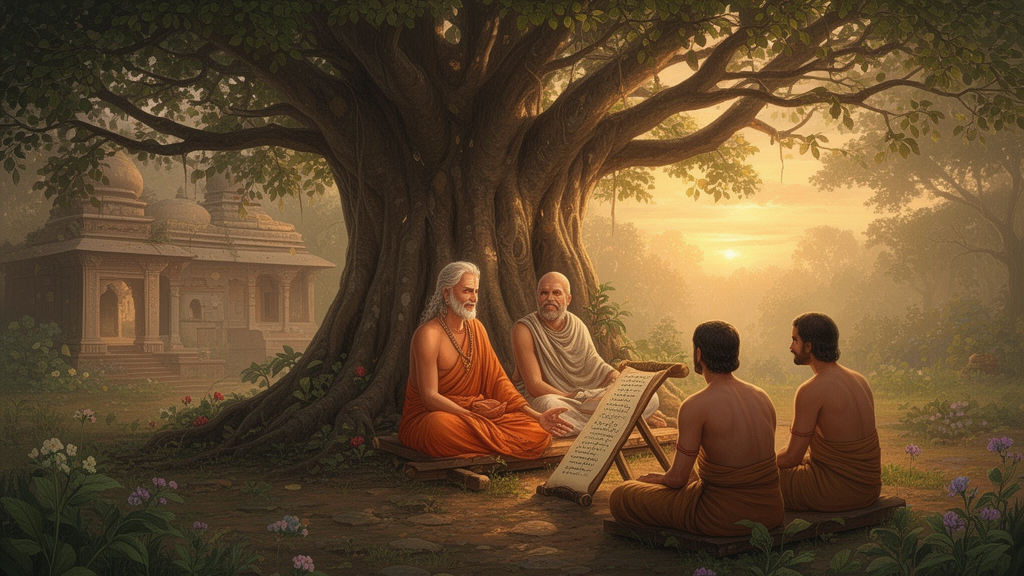
The word upaniṣad is usually understood to mean something like “sitting near” a teacher, and the texts were traditionally taught in close, personal instruction. They are associated with the Vedas, the oldest scriptural layer of Hinduism, and are often called Vedanta, meaning the end or culmination of the Veda. Their discussions focus on questions such as what the self (ātman) is, what ultimate reality (brahman) is, and how a person comes to understand their relationship to it.
Readers should keep one distinction in mind from the start. The Upanishads are scripture within Hindu tradition, but they are also philosophical texts that were debated, commented upon, and reinterpreted over many centuries. Their meaning is therefore best approached through the texts themselves, the commentaries of named teachers, and the living traditions that study them.
How the Upanishads relate to the Vedas
Hindu tradition groups its scriptures into śruti, which is considered revealed, and smṛti, which is remembered tradition. The Upanishads are generally placed within śruti, as part of the Vedic corpus. Each Veda has its own collection of Upanishads attached to it, and these were typically associated with particular schools or recitation traditions called śākhās.
Traditionally, the Vedic texts were divided into ritual sections (the Saṃhitā and Brāhmaṇa layers) and later reflective sections. The Upanishads belong largely to the reflective layer. Where earlier texts focus heavily on sacrifice and hymns, the Upanishads more often ask what the sacrifice and the cosmos ultimately rest upon. Scholars describe this shift in emphasis as one of the defining features of the Upanishadic period, although the exact chronology is debated.
A note on dating
Many scholars regard the older prose Upanishads, such as the Bṛhadāraṇyaka and Chandogya, as among the earliest, but they do not agree on precise dates. Some dates given in popular books are estimates or rely on contested theories. Readers should treat any single date as provisional unless it is supported by a specific academic source.
The principal Upanishads
Over two hundred Upanishads are known in manuscript collections, but a smaller group is generally regarded as the earliest and most authoritative. Commentators such as Śaṅkara (associated with Advaita Vedanta) gave special attention to these principal texts. Commonly studied principal Upanishads include:
- Bṛhadāraṇyaka Upanishad: a long prose text known for dialogues on the self and for teachings associated with the sage Yājñavalkya.
- Chāndogya Upanishad: a prose text with well-known teachings on sound, the sacred syllable Om, and the identity of the individual self with ultimate reality.
- Taittirīya Upanishad: known for its teaching on the layers of the self and for ethical instructions to students.
- Aitareya Upanishad: associated with the Ṛg Veda and focused on the origin of the self and the world.
- Kena Upanishad: opens with the question of what power moves the mind and senses.
- Īśa Upanishad: a short text, often read in relation to living in the world with awareness of the divine.
- Kaṭha Upanishad: a dialogue between the boy Naciketas and Yama, the lord of death, about what happens after death.
- Muṇḍaka Upanishad: distinguishes lower knowledge from higher knowledge and includes the image of two birds on one tree.
- Māṇḍūkya Upanishad: a very short text that analyses Om through four states of consciousness.
- Praśna Upanishad: structured as questions posed to a teacher, often on the origin of life and the role of the vital breaths.
- Śvetāśvatara Upanishad: a later principal text that uses theistic language and discusses the relationship between the individual soul and the Lord.
Lists differ. Some collections group texts differently, and the Muktikā Upanishad, which is itself part of a collection, is traditionally cited as listing 108 Upanishads. Readers who encounter other totals, such as those discussed in some HindusGod.com draft pages on numbered Upanishads (for example, 112 Upanishads), should check which list an author is using. The number of texts is a matter of how a collection is defined, not a single fixed count.
Core ideas: ātman and brahman
Two terms appear again and again in the Upanishads. Ātman refers to the innermost self. Brahman refers to the ultimate reality that underlies the cosmos. A central theme in many Upanishadic passages is the question of how these two relate.
The Chāndogya Upanishad contains the phrase tat tvam asi, usually translated as “that you are.” It appears in a teaching given by a father to his son and is widely cited in Vedanta as a statement of identity between ātman and brahman. Translators render the phrase in different ways, and the exact context should be checked in a full translation before quoting it. Readers should also note that the identity taught in this passage is understood differently across schools.
Different schools, different readings
- Advaita Vedanta reads many Upanishadic passages as teaching non-dual identity between ātman and brahman, so that the apparent multiplicity of selves is understood as a result of ignorance.
- Viśiṣṭādvaita, associated with Rāmānuja, reads the Upanishads as teaching a qualified non-dualism, in which the individual self is real but dependent on the Lord.
- Dvaita, associated with Madhva, emphasises a real distinction between the individual self and the supreme being.
These are scholarly and theological readings within particular lineages. They are not the only ways Hindus approach the Upanishads, and many devotees relate to them through worship, recitation, or family teaching rather than through formal philosophy.
Ethics, knowledge, and practice
The Upanishads are not only abstract metaphysics. Several texts give practical instruction. The Taittirīya Upanishad, for example, includes guidance to students on speaking truthfully, fulfilling duties, and treating teachers and guests with respect. The Īśa Upanishad is often read as a call to live in the world while recognising that everything belongs to the divine, a teaching that has been interpreted in ethical and renunciatory terms.
For readers who want to study the texts, a practical approach is to begin with one short Upanishad, read it in two or three translations, and note where translators disagree. Commentaries by named teachers help explain difficult vocabulary and context. A helpful entry point is the broader overview available in the HindusGod.com guide Upanishads, which can be read alongside primary texts.
Choosing a translation
- Look for a translation that identifies its Sanskrit edition or textual basis.
- Compare translations of key terms such as ātman, brahman, and māyā.
- Read introductions and notes, which often explain school-specific readings.
- Use an English overview, such as About Upanishads in English, to orient yourself before moving to longer texts.
Traditional, textual, and scholarly perspectives
Readers benefit from distinguishing four kinds of statements about the Upanishads:
- Scriptural content: what a specific passage says, which should be checked against a named edition and translation.
- Traditional belief: what a community or lineage holds about the texts, such as their divine origin or their role in liturgy.
- Historical evidence: manuscripts, inscriptions, and datable references, which are often limited and debated.
- Scholarly interpretation: academic proposals about authorship, composition, and meaning, which may differ from traditional views.
Many modern writers combine these categories without marking them, which can mislead readers. A careful reader asks whether a claim comes from the text, from a tradition, or from a scholar’s reconstruction.
Uses in devotional life
Upanishadic verses are recited in many Hindu households and temples, sometimes as part of daily recitation, sometimes at rites of passage, and sometimes in study circles. The practices vary considerably by region, school, and family. Some communities recite selected Upanishads in the original Sanskrit, while others use vernacular commentaries. No single pattern applies to all Hindus.
Devotional recitation is not presented in the texts as a guaranteed method of achieving a particular result. The Upanishads themselves emphasise knowledge, self-restraint, and insight, and many traditions teach that these develop through sustained study, guidance from a teacher, and practice over time.
Other Upanishad topics on HindusGod.com
Readers interested in specific parts of this subject may also find these draft pages useful once the owner publishes them: Aurobindo Upanishads discusses the commentaries of Sri Aurobindo, Essence of the Upanishads offers a summary-style introduction, and Five Upanishads and Eight Upanishads explore how different collections are grouped. Because these pages are currently drafts, their links will not be public until the owner publishes them.
Frequently asked questions
Are the Upanishads the same as the Vedas?
No. The Upanishads are part of the Vedic corpus but are generally distinct from the earlier hymn and ritual collections. They are often regarded as the concluding and most philosophical portion of the Vedas.
Do all Hindus read the Upanishads?
No. Engagement varies by tradition, region, education, and family practice. Some Hindus study them in depth, some know them through commentary, and others may never read them directly.
Where should a beginner start?
Many introductions suggest starting with a short principal Upanishad, such as the Īśa or Kena, and reading it with a reliable translation and commentary.
Summary
The Upanishads are foundational Hindu philosophical texts that explore the self, ultimate reality, and the path to knowledge. They are part of the Vedic tradition, they include a set of principal texts studied across many schools, and they have been interpreted in differing ways. A careful reader distinguishes what the text says, what traditions teach, and what scholars conclude. A good next step is to read one principal Upanishad in a trusted translation and compare it with a commentary from a tradition you wish to understand.
Sources and further reading
- Upanishads, Wikipedia: general overview of the texts, their position in the Vedic corpus, and their main themes. Use as an orientation source only; verify specific claims against primary texts.
- Muktika Upanishad, Wikipedia: supports the traditional reference to a list of 108 Upanishads.
- Upanishads, Sacred Texts Archive: public-domain English translations of several Upanishads, including older nineteenth-century renderings that should be compared with modern scholarly editions.