The Saubhagyalakshmi Upanishad is a short, late Sanskrit text that presents Goddess Lakshmi as the source of auspiciousness, prosperity, and spiritual fulfillment. It is classed among the Shakta Upanishads and is linked in traditional classification to the Rigveda. Its teaching combines devotional worship of Lakshmi, ritual mantra and yantra practice, and a section on yogic meditation that leads toward non-dual realization of Brahman. This guide explains what the text says, how it is organized, and where readers should be careful about claims. It draws on a secondary summary of the text, which is noted in the sources at the end, so readers who want to study the Sanskrit should consult a critical edition or a reliable translation.
What the Saubhagyalakshmi Upanishad teaches
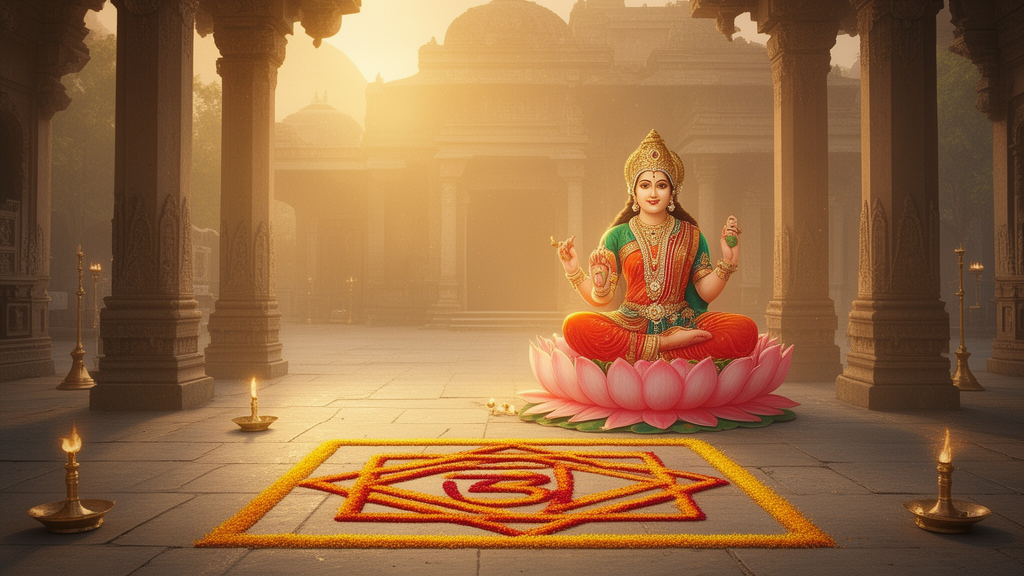
In short, the Upanishad teaches a path of worship centred on Lakshmi, understood as the bestower of wealth, family wellbeing, and auspicious fortune, and also as a higher consciousness that can be known through disciplined practice. The text frames this knowledge as the Saubhagyalakshmi Vidya, a term usually translated as the knowledge of auspicious Lakshmi.
The text is not a single kind of teaching. It moves through three sections: a ritual section centred on a mantra and a yantra, a yogic section on breath control and inner sound, and a section describing subtle body-centres called chakras. Readers who approach it expecting only a prosperity manual, or only a philosophical treatise, will find both elements present.
Name, spelling, and title
The title appears in English in several forms, including Saubhagya Lakshmi Upanishad and Saubhagyalakshmi Upanishad. The Sanskrit title is सौभाग्यलक्ष्म्युपनिषत्. The word saubhagya denotes good fortune or auspiciousness, and Lakshmi is the name of the goddess associated with prosperity and grace. The compound therefore points to Lakshmi in her auspicious aspect.
Spelling variation is common in English-language books and websites. A reader who searches for one form may find another in a different translation or commentary, but the referent is the same text.
Where the text sits in Upanishadic literature
The term Upanishad covers a large and varied body of texts. Many are considered part of the Vedic tradition, while others are later works in different devotional or yogic streams. The Saubhagyalakshmi Upanishad belongs to the later, minor group. For an overview of the category and how the word itself is used, see our guide on the meaning of Upanishad, which is a draft that may not yet be public.
Shakta classification and Rigvedic attachment
According to the summary used for this article, the Upanishad is classified among the Shakta Upanishads, texts associated with the worship of the Goddess as supreme. It is also said to be attached to the Rigveda tradition. This attachment is traditional and classificatory. It does not mean that the Upanishad is a Rigvedic hymn collection, and scholars treat such attachments with care when discussing the text’s composition.
The same summary links the Upanishad to the Shri Sukta, a Rigvedic hymn to Shri or Lakshmi. The connection is important for the text’s devotional vocabulary, because many later Lakshmi texts draw on the imagery and mantras of that hymn. Readers should treat the link as a textual relationship that the Upanishad itself and later commentators describe, rather than as proof of a single date or author.
The Muktika list
The summary places the Upanishad within the 108 principal Upanishads listed in the Muktika canon. It is described as the 105th item, following the Jabali Upanishad and preceding the Sarasvatirahasya Upanishad. The Muktika list is a traditional enumeration associated with the Upanishadic corpus. For readers exploring the larger set, our page on 108 Upanishads (draft) gives an overview of that enumeration, and our list of 10 Upanishads (draft) introduces some of the most widely read major texts.
Because numbering and ordering can vary between editions and traditions, readers who need a precise sequence should check the list against a scholarly edition of the Muktika text.
The three khandas: structure of the text
The summary divides the Upanishad into three khandas, or sections. Each section moves from one focus to another, which helps explain why the text seems to combine ritual, yoga, and subtle physiology.
First khanda: the Saubhagyalakshmi Vidya
The first section is described as the core of the Vidya. It includes meditation on a fifteen-syllable mantra derived from the Shri Sukta, along with nyasa, a ritual practice of placing sacred syllables on parts of the body. The summary also describes worship of the Saubhagyalakshmi Yantra, a diagrammatic form in which the seed syllable Shrim sits at the centre. For this yantra practice, the summary states that 16,000 recitations are prescribed for invocation.
The first khanda also describes a mantra associated with the seer Bhrigu, which the summary calls a one-syllable Rama mantra written as “Aim Klim Sauh.” The same summary states that the practice involves 12 lakh japas, or repetitions, and offerings to nine powers of Lakshmi, including Vibhuti, meaning glory, and Unnati, meaning elevation. The text is said to present these powers as purifying the practitioner, using images of fire and wind.
A careful note is needed here. The summary calls the Rama mantra one-syllable, but the syllables it quotes are three. That inconsistency suggests the secondary source may have condensed or garbled the passage, so this detail should be checked in a primary edition before it is repeated as a fact.
Second khanda: Jnana Yoga and inner sound
The second section shifts from external ritual to inner practice. According to the summary, it instructs qualified aspirants in pranayama, or breath control, withdrawal of the senses, and meditation on the Pranava, the syllable Om. The aim is to pierce the granthis, or psychic knots, and to experience inner sounds, moving from subtle nada to divine forms. The summary describes the process as culminating in nirvikalpa samadhi, a state of absorption without differentiation, in which the ego dissolves and the practitioner realizes the Turiya state, the fourth dimension of consciousness.
The same section, as summarized, recommends moderation in diet and sleep, seclusion, and kumbhaka, or breath retention, while visualizing Vishnu as a means of destroying sins said to have accumulated over seven lifetimes. This is a notable point for readers, because it shows that the Upanishad links Lakshmi worship with the worship of other deities within one framework. Traditions differ on how such links should be understood, and this article reports the text’s description without endorsing any particular theological reading.
The phrase “qualified aspirants” matters. The summary presents these practices as suitable for those prepared for them, which is consistent with how many yogic texts describe advanced instruction. Readers should not treat the description as a self-taught protocol.
Third khanda: the nine adhara chakras
The third section, as summarized, describes nine adhara chakras, or base centres, from the muladhara at the root to the sahasrara at the crown. Each centre is associated in the summary with particular petals, lingas, and pithas, which are seats or locations of power. These correspondences belong to the tradition of subtle-body description found in many tantric and yogic works. They are symbolic maps rather than anatomical claims, and readers should treat them as part of a spiritual vocabulary.
Lakshmi as described in the text
The Upanishad does not present Lakshmi only as a giver of material gifts. The summary describes her as the supreme, golden-hued consciousness, called Hiranyavarna, who embodies the auspicious essence of the universe. The golden hue is a recurring image in Lakshmi texts and is connected in this summary to the Shri Sukta.
Hiranyavarna and the Shri Sukta
The name Hiranyavarna, meaning golden-coloured, points to the Rigvedic Shri Sukta, where the goddess is praised through golden imagery. The Upanishad builds on that vocabulary and reads it in a metaphysical key. In this reading, the goddess is not only the figure who grants wealth, but the consciousness in which the universe’s good fortune is grounded.
This interpretation should be distinguished from the older hymnic context. The Shri Sukta is a hymn of praise and request. The Upanishad treats the same imagery as a basis for meditation and realization. Readers who want to explore the hymn itself should look for a critical edition and a translation with notes, rather than relying on a summary.
True wealth and selfless practice
A central theme of the summary is nishkama, or selfless practice. The Upanishad is said to emphasize that siddhis, or perfections such as prosperity and progeny, are attained through selfless practice. It also warns that ego-driven rituals yield no fruit. This is an important qualification. The text, as summarized, does not promise that a ritual performed for personal gain will produce a guaranteed result. Instead, it frames outcomes as connected to the attitude with which practice is undertaken.
The same concern appears in many devotional traditions, where the inner disposition of the worshipper is treated as central. A reader who wants to understand the text should therefore note that wealth and family are discussed within a wider teaching about purpose, humility, and spiritual maturity. The Upanishad does not present worship as a transaction.
Practices in the text and how traditions handle them
Practices such as mantra recitation, yantra worship, and pranayama appear in many Hindu traditions, but the form and authority of each practice vary. The Upanishad’s instructions should be read as one tradition’s description, not as a universal rule for all Hindus.
Mantra and yantra worship
Mantra and yantra practice are tradition-specific. A yantra is a geometric diagram used as a focus of worship, and a mantra is a sacred sound or formula. In the summary, the Saubhagyalakshmi Yantra is described as having the seed syllable Shrim at its centre. Practitioners in many lineages receive mantras and yantra instruction from a teacher, and the procedure, counts, and rules for initiation can differ widely.
The figure of 16,000 recitations and the figure of 12 lakh japas are given in the summary as text-specific prescriptions. They should be reported as what the text describes. They are not general recommendations for every reader, and no source cited here establishes how they are practised in contemporary communities.
Pranayama and meditation
Breath control and meditation on Om appear in many yogic texts. The Upanishad’s second section describes them in the context of jnana yoga, or the path of knowledge. The summary connects them with inner sound and the eventual realization of Brahman. Readers should understand that the text describes a sequence of experiences as a goal of practice, not as a result that any individual can guarantee through technique alone.
Because pranayama and kumbhaka can be physically demanding, readers should approach breath practices under the guidance of a qualified teacher, especially where health conditions are present. Traditional texts often include such cautions, and modern readers should follow them.
Manuscripts, dating, and what remains uncertain
Readers often want to know when a text was composed, who wrote it, and how it survived. The secondary summary used for this article lists sections on manuscripts, transmission, authorship, and dating. However, the excerpt that was reviewed for this article does not provide verified manuscript details, dates, or authorship evidence, so this article does not state them.
This gap matters. Upanishads are often transmitted in multiple recensions, and minor texts may have passed through many hands. Dating claims for such works are usually debated by scholars. Readers who need dates or manuscript histories should consult scholarly editions, university libraries, and reputable academic surveys of the Upanishads, and check the specific claims against those works.
The distinction between belief and scholarship is important here. Traditional attachment to the Rigveda, the Muktika list, and the Shakta classification are internal or classificatory claims. Historical dating is a separate question that requires evidence. The two should not be merged.
Connections to Shakta worship
The Upanishad’s classification among Shakta texts links it to traditions that understand the Goddess as supreme. In this framework, Lakshmi is not simply one goddess among many but a form of the divine principle. That view is part of certain Shakta and Shri Vidya traditions, though the Upanishad is only one text among many.
Readers should not assume that all Lakshmi worship is Shakta worship. Lakshmi is widely worshipped in Vaishnava, Shaiva, and folk contexts, and the meanings attached to her differ by region and community. The Saubhagyalakshmi Upanishad belongs to a specific textual stream, and its emphasis on yantra and mantra should be read in that light.
For readers interested in how Upanishads relate to different philosophical streams, our draft on the Advaita Upanishad may help. It introduces non-dual themes that also appear in the Saubhagyalakshmi Upanishad’s final realization, though the two texts belong to different textual contexts.
Reading the text responsibly: practical guidance
Readers who want to study the Saubhagyalakshmi Upanishad can follow a simple method that keeps scripture, tradition, and scholarship distinct.
- Find a reliable edition. Look for a Sanskrit text with a translation and notes, preferably from a university press, a scholarly series, or a recognized library collection.
- Read the text before the commentary. Note which statements come directly from the Upanishad and which come from a later commentator or modern author.
- Separate the three kinds of claims. Keep scriptural description, traditional belief, and scholarly interpretation in different notes.
- Check numbers and syllables. Counts such as 16,000 recitations or the syllable count of a mantra should be verified in the text itself.
- Seek a teacher for practice. Mantra initiation, yantra worship, and advanced breath practices are commonly taught within a lineage.
This method helps avoid two common errors: treating a single retelling as the only version, and presenting a devotional practice as a guaranteed result.
Why the spiritual aim matters
The text’s teaching about nishkama, or selfless practice, gives a useful frame for modern readers. Whether a reader approaches the Upanishad for study, devotion, or personal reflection, the text itself asks for a disposition that is not ego-driven. This does not mean that worship is irrelevant to material life. It means that the Upanishad places material well-being within a larger understanding of purpose.
Frequently asked questions
Is the Saubhagyalakshmi Upanishad a major Upanishad?
It is generally described as a minor Upanishad. It is classed among the Shakta Upanishads according to the summary used here, and it is part of the wider Upanishadic corpus discussed in traditional lists such as the Muktika canon.
What is the Saubhagyalakshmi Vidya?
The Vidya is the knowledge or teaching of auspicious Lakshmi. In the text, it is presented through a mantra, a yantra, and ritual practices described in the first khanda.
Does the text promise wealth to readers who recite its mantras?
The summary says the text links worship with prosperity and progeny, but it also emphasizes selfless practice and warns that ego-driven rituals yield no fruit. No outcome should be treated as guaranteed, and readers should not present ritual performance as a material transaction.
Should beginners practise the yantra or breath techniques described here?
Beginners should study the text first and seek guidance from a qualified teacher before attempting mantra counts, yantra worship, or advanced breath retention. The text itself describes some practices as meant for qualified aspirants.
Closing takeaway
The Saubhagyalakshmi Upanishad offers a compact view of Lakshmi as the source of auspiciousness and the ground of inner realization. Its three khandas move from mantra and yantra, to breath and meditation, to subtle centres of the body. Its strongest message, as summarized, is that worship should be undertaken with selfless purpose rather than ego-driven expectation. The best next step is to read a reliable edition, compare translations, and keep scripture, tradition, and modern interpretation clearly separate.
Sources and further reading
- Saubhagyalakshmi Upanishad, Grokipedia summary: used for the classification, the three-khanda outline, the mantra and yantra details, the Muktika placement, and the nishkama teaching. This is a secondary, AI-assisted encyclopedia entry and should be checked against a primary Sanskrit edition before any detail is treated as settled.
Further reading to consult, not yet linked in this draft: a critical Sanskrit edition of the Upanishad, a translation with notes from a university press, and an academic survey of the Upanishadic literature. URL to confirm before publication.
Related HindusGod.com drafts, which may not be public yet: Meaning of Upanishad, 10 Upanishad, 108 Upanishad, Adhyatma Upanishad, Advaita Upanishad, Aitareya Upanishad, Annapurna Upanishad, Ashtavakra Upanishad, Atmabodha Upanishad, Bahvricha Upanishad.