A rosary japamala Malayalam book is a Malayalam-language prayer book that guides readers through the Catholic rosary, known in Malayalam as japamala or kontha. Such a book usually provides the opening prayers, the Apostles’ Creed, the Our Father, the Hail Mary, the Glory Be, and the meditations on the mysteries, arranged so a person can pray the rosary from start to finish. If you are looking for one, check that it is a Catholic edition, that it lists the mysteries and the days on which they are prayed, and that the Malayalam text is clearly printed or displayed.
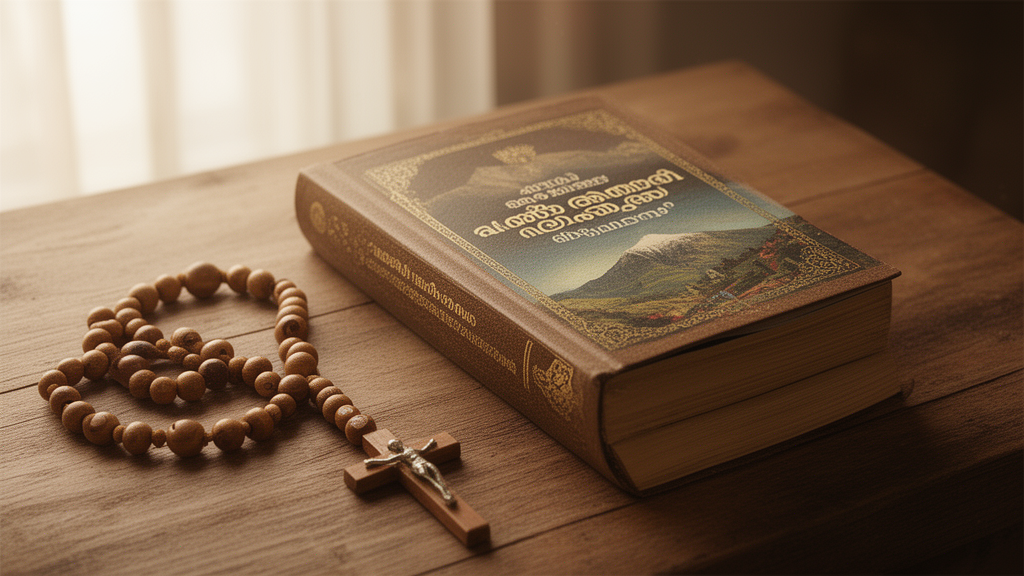
This article explains what the Malayalam rosary book contains, how the prayer sequence is organized, what the mysteries are, and what to look for when comparing editions. It covers the Catholic rosary only. The word japa mala is also used in Hindu contexts for prayer beads used in mantra repetition, but those practices and texts are different and are not the subject of this post.
Quick answer: what a Malayalam japamala book is

A Malayalam japamala book is a devotional guide written in Malayalam for Catholics who pray the rosary in their own language. Several Malayalam Catholic websites publish the full rosary text online, which shows the typical structure that printed books also follow:
- An opening prayer, often an introductory prayer asking for grace to pray the rosary with devotion.
- The Apostles’ Creed, recited at the start.
- Introductory prayers for faith, hope, and love, followed by a series of ten Hail Marys for each decade.
- A short prayer after each decade, commonly called the Trinity praise (Glory Be) on some pages, and the Fatima prayer on others.
- The meditations on the mysteries, grouped by day of the week.
The Malayalam Catholic Bible site Malayalam Catholic Bible: Japamala (Rosary) page presents the rosary in this sequence, with prayers in Malayalam and a title that begins with the Malayalam phrase for fifty-three beads, a traditional form of the rosary text used on that site. Other Malayalam sites, such as Mother of Divine Mercy’s Malayalam rosary page, follow a similar order. Differences in wording and layout between editions are normal, so the text in one book may not match another word for word.
Understanding the key Malayalam terms
Japamala and kontha
Japa means repeated prayer, and mala means garland or string. In Malayalam Catholic usage, japamala refers to the rosary as a prayer and to the beaded string used to count prayers. The term kontha (കൊന്ത) is also common, and several Malayalam pages list both names together, as the Mother of Divine Mercy and Nelson MCBS sites do. Readers searching for a book may see either term, and both usually refer to the same devotion.
Decades and the bead count
A standard rosary has five decades. Each decade consists of one Our Father followed by ten Hail Marys, with a meditation on one mystery. The Malayalam pages reviewed show this same structure, with each decade ending in a short prayer. Some pages describe the fifty-three bead form as an older or alternative pattern used in certain communities. Because local usage varies, check the book’s own instructions rather than assuming one count for every parish.
The prayer sequence in a Malayalam rosary book
A printed or digital Malayalam book usually follows the order below. The exact wording differs by edition and publisher, so treat this as a structural guide rather than a substitute for the book itself.
- Opening prayer. Many editions begin with a prayer asking God to accept the rosary and help the person pray with attention and devotion.
- Apostles’ Creed. The creed states core Catholic beliefs about God, Jesus Christ, the Holy Spirit, the Church, and the resurrection. The Malayalam pages reviewed include the full text.
- The Our Father and the initial beads. The opening section includes one Our Father, three Hail Marys asking for faith, hope, and love, and a Glory Be.
- The decades. Each decade includes an Our Father, ten Hail Marys, a Glory Be, and a short closing prayer, along with a meditation on the mystery for that decade.
- Closing prayers. Editions often end with a prayer to Mary, sometimes including a request to pray for us, followed by a final prayer.
Some Malayalam pages place the Glory Be as a praise to the Trinity after each decade, while others show the Fatima prayer (“O my Jesus, forgive us our sins…”) in the same position. The Mother of Divine Mercy page and the HolyfireMedia page both include this Fatima-style prayer after decades. A reader should follow the sequence in the book they own.
The mysteries of the rosary
The mysteries are short scenes from the life of Jesus and Mary that the person prays about during each decade. In the Catholic tradition, the rosary is usually prayed through four sets of mysteries. The Malayalam pages reviewed show the joyful, luminous, and other sets with Malayalam titles, and the day-of-week rules are part of what a good book should state clearly.
Joyful mysteries
The joyful mysteries cover the Annunciation, the Visitation, the Nativity, the Presentation, and the finding of the child Jesus in the Temple. The Malayalam text on the Mother of Divine Mercy page and the Nelson MCBS page describes these events in similar terms. The HolyfireMedia page states that the joyful mysteries are prayed on Mondays and Saturdays.
Luminous mysteries
The luminous mysteries include the Baptism of Jesus in the Jordan, the Wedding at Cana, the proclamation of the Kingdom of God, the Transfiguration, and the Institution of the Eucharist. The HolyfireMedia page lists these as prayed on Thursdays. Several Malayalam pages refer to these as the “light” or “luminous” mysteries, which may appear as a translation of the Malayalam term.
Sorrowful and glorious mysteries
The sources I reviewed show the Malayalam rosary structure in detail for the joyful and luminous sets, but I did not confirm the full day-of-week schedule for the sorrowful and glorious sets from the pages inspected. Readers should check their own book or a current parish or diocesan resource before relying on a specific day for these sets. Schedules can also vary between traditions and published editions.
How to choose a Malayalam rosary book
Many people search for a japamala book to pray at home, in church, or with family. A useful edition should make the prayer order, the mysteries, and the day schedule easy to follow. Use the following checklist when comparing books or online editions.
- Catholic origin. The book should identify its publisher or diocese, and its prayers should match Catholic usage, including the Apostles’ Creed and the Hail Mary text.
- Clear Malayalam text. Check that the print is readable, the script is consistent, and the prayers are not split confusingly across pages.
- Mysteries and days. The book should list the four sets and, ideally, the days of the week on which they are prayed. If it presents a single fixed schedule, check whether it is the one your community follows.
- Transliteration option. Some sites offer Malayalam text with a Roman-script version, sometimes called Manglish. This can help readers who are learning to read Malayalam script, but a transliteration should be checked against the Malayalam text.
- Format. A printed booklet may be easier to use in church, while a digital edition can be convenient for travel. Print editions usually show the full text in one place, which many readers find easier to follow.
Availability and price change, so verify any listing before you buy. One Kochi bookshop listing, St Paul Book Centre, shows a Malayalam Japamala Holy Rosary book in its Malayalam and Prayer Books categories at a listed price of ₹20.00, with the product page also showing a stock count. Those details were shown on the product page at the time of review, but they may have changed. Amazon’s listing for a Malayalam Japamala ebook describes it as a guide to the practice and significance of the rosary in the Catholic tradition. That description is the seller’s or platform’s description, not an independent review of the book’s contents.
Practical example: praying the rosary with a Malayalam book
Imagine a reader who wants to pray the rosary in Malayalam at home on a weekday. The reader might follow this order using a book or a trusted online edition:
- Make the sign of the cross and say the opening prayer printed in the book.
- Recite the Apostles’ Creed while holding the crucifix.
- Pray one Our Father, three Hail Marys for faith, hope, and love, and one Glory Be.
- Announce the first mystery for the day indicated in the book, then pray one Our Father, ten Hail Marys, and one Glory Be.
- Say the closing prayer after the decade, such as the Fatima prayer if the edition includes it.
- Repeat steps 4 and 5 for the remaining four decades.
- Finish with the closing prayers printed at the end of the book.
This example shows the ordinary flow of a rosary. A local parish, religious community, or family may use a different pace, a shorter form, or additional intentions. Those variations are part of the Catholic devotional tradition and should be followed according to local practice.
Belief, text, tradition, and scholarship
When reading any rosary book, it helps to separate four kinds of statements:
- Scripture-based material. The mysteries draw on events described in the Gospels, such as the Annunciation and the Wedding at Cana. Readers can compare the events with the relevant Gospel passages in a Bible edition they trust.
- Prayer texts. The Our Father, Hail Mary, and creed are prayers used in Catholic worship. Their wording is fixed in certain editions but may vary slightly between translations.
- Devotional belief. Catholics believe that praying the rosary is a way to honour Mary and to reflect on the life of Christ. Statements about grace, intercession, and the spiritual value of prayer are matters of faith, not claims that can be tested in the way historical facts can.
- Historical and scholarly questions. The historical development of the rosary, including when it took its present form, is discussed by historians of Catholic devotion. The sources reviewed for this post do not provide a verified history of the rosary’s origin, so this article does not make historical claims about it.
Keeping these categories distinct helps readers judge what a book is teaching. A good Malayalam rosary book will usually present its prayers as devotional texts and its mysteries as meditations on Gospel events, without treating them as historical commentary.
Common questions when using a Malayalam japamala
Is a Malayalam rosary book the same as a Hindu japa mala?
No. The Catholic rosary and Hindu japa practice share a general idea of counting repeated prayers on beads, but they use different prayers, scriptures, and theological frameworks. A reader looking for a Catholic Malayalam rosary should choose a book produced for Catholic prayer. A reader interested in Hindu japa beads should consult sources on Hindu practice, since the prayers and rules are different.
Can I pray the rosary in Malayalam without a book?
Yes, if the prayers are memorized or available on a trusted page. Many people use a book because it gives the full text and the mysteries in one place. Using a book is a practical choice, not a requirement set by the sources reviewed.
Do different editions contain the same prayers?
The core prayers are broadly similar, but wording, formatting, and extra prayers vary by publisher, diocese, and community. Before using an edition in a parish or group, check whether it matches the prayer form used there.
Does praying the rosary guarantee a particular result?
Catholic teaching presents prayer as a form of trust in God and a means of spiritual growth. The sources reviewed do not support any claim that a particular rosary guarantees a specific material outcome, and this article makes no such promise.
Finding related books on HindusGod.com
HindusGod.com has several draft pages on Christian and Catholic devotional books and related topics. Readers interested in a broader selection of rosary-related titles may also want to compare the following draft pages. Because these pages are currently WordPress drafts, their links may not be public until the owner publishes them.
- For English-language rosary guidance, see Holy Rosary Book (draft page, may not be public yet).
- For a related English prayer book topic, see Rosary Book in English (draft page, may not be public yet).
- For another Malayalam Christian liturgical book, see Malayalam Qurbana Book (draft page, may not be public yet).
- For a Malayalam Christian service book on a related theme, see Malankara Orthodox Good Friday Service Book Malayalam (draft page, may not be public yet).
- For a general overview of religious books, see Holy Book (draft page, may not be public yet).
- For a definition-focused article on the term, see Holy Book Meaning (draft page, may not be public yet).
Other verified draft titles in the supplied list concern Mahabharata, Bhagavad Gita, and Hindu texts. They were not used here because they do not directly address the Catholic rosary.
Summary and next steps
A rosary japamala Malayalam book is a practical guide for praying the Catholic rosary in Malayalam. The most useful editions show the prayer sequence clearly, list the mysteries and their days, and make it easy to see where each decade begins and ends. Compare a few editions, check the publisher, and confirm the schedule with your parish or community if you plan to use it in a group.
For a first step, read the prayer order in a trusted online edition, such as the Malayalam Catholic Bible or Mother of Divine Mercy pages, and then choose a printed or digital book that matches your devotional practice. Before purchasing, confirm the current price, availability, and edition details directly with the seller.
Sources and Further Reading
- Japamala Malayalam: Mother of Divine Mercy. Used for the Malayalam rosary structure, the names used for the prayer (Japamala and Kontha), and the presence of the opening prayer, Apostles’ Creed, and decade prayers.
- Japamala (Rosary): Malayalam Catholic Bible. Used for the sequence of prayers and the Malayalam page structure of a rosary text.
- Holy Rosary Malayalam / Japamala: Nelson MCBS. Used to show that Malayalam rosary pages use both Japamala and Kontha terminology.
- Malayalam Holy Rosary (Japamala): HolyfireMedia. Used for the day-of-week schedule for the joyful mysteries (Monday and Saturday) and luminous mysteries (Thursday), and for the Fatima prayer after decades.
- Japamala ജപമാല Holy Rosary: St Paul Book Centre, Kochi. Listing only; used to note a retailer listing with a displayed price and category. Not inspected in full, so price and stock must be rechecked.
- Japamala Malayalam (Malayalam Edition): Amazon listing. Listing description only; used to describe how the ebook is marketed. Not inspected in full.
Readers who want to explore the Catholic rosary further should consult official Catholic prayer books and diocesan resources, as well as a current Malayalam Catholic Bible for the Gospel passages connected with the mysteries.