The Pranagnihotra Upanishad is a short, minor Upanishad of Hinduism. It presents the Vedic fire sacrifice as an inner process: the body becomes the place where the gods are honored and the life force is offered. This guide explains the meaning of its title, where it sits in the Upanishadic literature, and the main teachings that secondary sources attribute to it, with notes on where those sources disagree.

What the Title Means
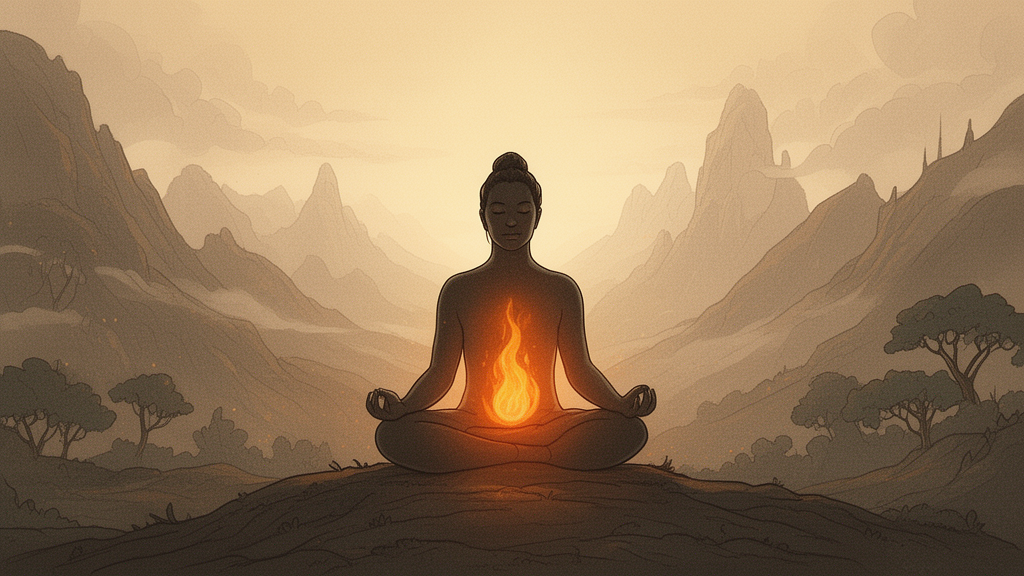
The word Pranagnihotra is a compound of three Sanskrit terms: prana (breath, life, vital energy), agni (fire), and hotra (oblation or sacrifice). The title is commonly rendered as the fire offering made to the prana, or life breath. Wikipedia’s entry on the text summarizes the contrast directly: an agnihotra is a fire sacrifice to external gods, while a pranagnihotra is its equivalent in the human body.
Readers who already know the outer ritual will recognize the pattern. The Upanishad keeps the structure of a fire offering but moves the altar inward. For background on the wider category of texts, see our Meaning of Upanishad guide (URL to confirm as public; currently a WordPress draft).
Where the Text Sits in Upanishadic Literature
Vedic association and length
Wikipedia describes the Pranagnihotra Upanishad as having 23 verses and as attached to the Atharva Veda. It is listed among the 22 Samanya Upanishads and is placed within the Vedanta school of Hindu philosophical literature.
The Muktika anthology
In the anthology of 108 Upanishads associated with the Muktika canon, the text is listed at number 94. In that collection’s framing, it is narrated by Rama to Hanuman. The Muktika list is a traditional anthology, so this placement reflects how the collection is organized rather than a separate historical dating. Our 108 Upanishad overview explains that list in more detail (URL to confirm as public).
Points where sources disagree
A second encyclopedic summary, Grokipedia, describes the text as belonging to the Krishna Yajurveda tradition. The Wikipedia entry instead associates it with the Atharva Veda. Because these attributions differ, readers should check the Veda association in the edition they use. Traditional attributions and modern library classifications do not always agree, and we have not verified the claim against a primary edition.
Core Teachings Attributed to the Text
The following points are drawn from secondary summaries. They describe what the text is said to teach. They are not a substitute for reading a translation.
God within the self
Wikipedia summarizes the Upanishad as asserting that the universal soul, or God, is within one’s own self. In this reading, all the Vedic gods are embodied in the human body, and each bodily function is linked to a divine presence.
Eating as sacrifice
The text is described as treating eating as an allegorical sacrifice offered to the gastric fire. Daily life is likewise described as a ceremony offered to the God within. This is one of the most concrete examples of the inner reinterpretation of ritual.
Liberation without outer rites
According to Wikipedia’s summary, the Upanishad suggests that a person who does not perform external rituals such as the Vedic Agnihotra, and who lacks knowledge of Samkhya or Yoga philosophy, can still attain moksha (liberation). The route described is realizing that the universal soul within the individual self is the all-pervading Brahman. The same summary says this realization helps a person move through suffering and life’s changes.
Virtue as worship
In its final passages, the text is said to present virtuous conduct, including non-violence, compassion, patience, and remembrance of others, as worship of the God within. The concluding assertion, rendered in the Wikipedia summary as “all the gods are enclosed in this body here,” should be checked against a translation before quotation, since the summary is a paraphrase.
Ritual, Interiority, and Tradition
The Pranagnihotra Upanishad should be read within a wider tradition in which outer Vedic rites remained important. The text’s emphasis on inner realization does not, in these summaries, replace the outer Agnihotra for every reader. Instead, it is presented as a teaching that makes internal offering available to those who cannot or do not perform external ritual.
Practice varies widely among Hindu communities. Some readers treat the text as philosophical reading. Others approach it as devotional or meditative material. Any instruction derived from it should be understood as tradition-specific. We have not verified any specific daily practice, breath routine, or ritual sequence from the text, so this article does not provide one.
Devotion, Scripture, and Scholarship
It helps to separate four kinds of statements about this text:
- Textual claims: what the Upanishad says, such as the presence of God within the self and the idea of the body as a sacrificial site.
- Traditional belief: how the text is received within a community, including its place in an anthology and its use in devotion.
- Scholarly classification: how the text is dated, assigned to a Veda, or grouped with other Upanishads.
- Modern devotional explanation: contemporary commentary that applies the teaching to daily life.
Our sources cover the first and parts of the second and third. We did not verify a dating of the text, and we do not present one here.
Reading the Text Responsibly
Start with a complete translation that identifies its translator, publisher, and edition. Grokipedia reports one English rendering by Dr. A. G. Krishna Warrier published by the Theosophical Publishing House in Chennai. We did not verify that publication record against the publisher, so confirm it before citing. Compare at least two translations where possible, because summaries and translations may differ in wording and in how they interpret inner sacrifice.
When you read the Upanishad alongside commentary, mark which statements come from the text and which come from the commentator. This is especially important for claims about the body, the senses, or the fire within, because these are the points where interpretations diverge most.
Frequently Asked Questions
Is the Pranagnihotra Upanishad the same as the Agnihotra?
No. The Agnihotra is an external fire ritual. The Pranagnihotra Upanishad presents an inner counterpart in which the body and the life breath take the place of the outer altar.
Does reading this Upanishad guarantee liberation?
The text itself presents realization of the God within as the path to moksha. That is a doctrinal claim within the tradition, not a promise about any reader’s outcome. Different communities understand liberation and the means to it in different ways.
Which Veda does it belong to?
Wikipedia associates it with the Atharva Veda. Grokipedia describes it as Krishna Yajurveda. These sources disagree, so check the attribution in your chosen edition.
Summary
The Pranagnihotra Upanishad is a short text of 23 verses that reframes the Vedic fire offering as an inner sacrifice. Its title joins prana, agni, and hotra. Its teachings, as summarized in secondary sources, present God within the self, eating and daily life as offerings, and virtue as worship. Because sources differ on its Veda association and the text is brief, read it in a verified translation and treat secondary summaries with care.
Sources and Further Reading
- Pranagnihotra Upanishad, Wikipedia (general summary; etymology, verse count, Veda association, Muktika listing)
- Pranagnihotra Upanishad, Grokipedia (secondary summary; reports a Krishna Yajurveda attribution and a translator; not verified against a primary edition)
A verified scripture edition with translation has not yet been added to this post. Scripture edition link: URL to confirm.