Darshan shastra (दर्शनशास्त्र, darśana śāstra) refers to the classical Indian philosophical texts and traditions that examine reality, knowledge, the self, and liberation. In the most common usage, it means the six classical schools known as Ṣaḍ-darśana: Nyaya, Vaisheshika, Samkhya, Yoga, Purva Mimamsa, and Uttara Mimamsa (Vedanta). Each school is traditionally associated with a founding sage and is usually studied through its sutras, which are short, codified Sanskrit aphorisms with commentaries.
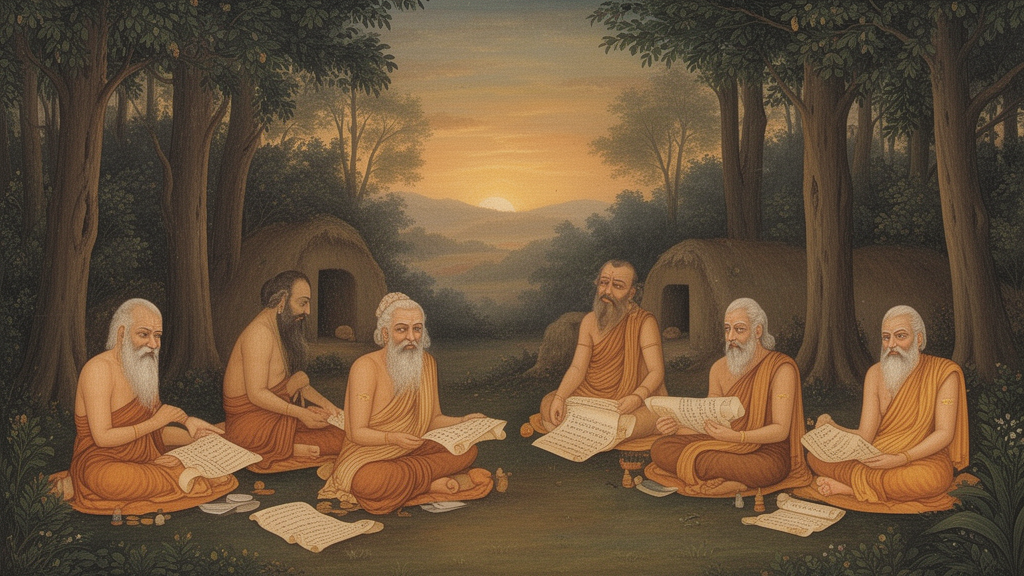
This guide explains what the term means, how the six schools are grouped, why the classification into astika and nastika needs careful handling, and how different communities read these texts. It separates what the texts say, what traditions believe about them, and what modern scholars conclude. The short answer is that darshan shastra is best understood as a family of systematic viewpoints, not one single doctrine.
What Darshan Shastra Means
The word has two parts. Darshan comes from the Sanskrit root drish, meaning “to see.” A source on ancient Indian thought explains that the word refers to a viewpoint or direct vision of truth, and that the six classical systems are often described as different “visions” of reality (Ancient Science, Darshan Shastra). Shastra means a treatise, science, or systematic teaching.
A second meaning appears in devotional and educational writing. One Vaishnav-oriented source notes that darshan is commonly understood as seeing a deity, but in the phrase darshan shastra it is taken to mean a method that reaches a clear and decisive conclusion (Kripalu Vedic Wisdom). Readers will therefore see both “viewpoint” and “conclusive insight” used in different sources. Both meanings point to the same idea: a disciplined way of seeing what is real.
Darshan shastra is also not the same as devotional darshan, which usually means the sacred sight of a deity in a temple. The two words share a root but refer to different practices.
The Six Classical Schools
The six schools are most often listed as follows. Attributions below describe traditional authorship, as given in the sources cited, and are not dated historical claims.
Nyaya: Logic and Valid Knowledge
Nyaya is traditionally associated with Gautama, also called Akshapada. Its central concern is how knowledge is obtained and how valid inference works. According to the Ancient Science overview, Nyaya focuses on epistemology and on a structured system of reasoning (Ancient Science, Darshan). Devotional writers often present Nyaya’s inferential method as a way to reason from the visible world toward a creator, and that application is a theological reading rather than the only way Nyaya is studied.
For example, a student reading a Nyaya text will see the school’s careful attention to the means of knowledge, such as perception and inference, before any conclusion about the world is accepted. This method is one reason Nyaya remains important in Indian logic, even for readers who do not share its theological conclusions.
Vaisheshika: Analysis of the World
Vaisheshika is traditionally linked to Kanada (also spelled Kaṇāda). It is concerned with the categories that make up reality. The Ancient Science source describes the school as concerned with metaphysics and with a picture of the universe built from eternal atoms (Ancient Science, Darshan). Vaisheshika is often paired with Nyaya because the two schools share a great deal of vocabulary and method, and many later texts treat them together.
Samkhya: Spirit and Matter
Samkhya is traditionally attributed to Kapila. It explains reality through two principles, Purusha (consciousness or spirit) and Prakriti (nature or matter). The Encyclopedia of Authentic Hinduism summary states that Samkhya Sutras explain the extent of mayic creation and that the entire material creation is worth discarding in the sense of being seen clearly as not the self (Encyclopedia of Authentic Hinduism). That phrasing is the text tradition’s own emphasis; a general reader should read it as a description of the school’s aim, not as a call to reject the world in daily life.
Samkhya is also a major source for later Yoga thought, which is why the two schools are often discussed side by side.
Yoga: Practice and Mental Discipline
Yoga is traditionally associated with Patanjali, whose Yoga Sutras are the classical text of the school. The Ancient Science overview describes Yoga as built on Samkhya and as offering practical techniques such as meditation and breath control for overcoming mental fluctuations and reaching liberation (Ancient Science, Darshan). Other sources describe the Yoga Sutras as a practical process of purifying the mind so that a seeker can prepare for deeper study (Kripalu Vedic Wisdom).
It is important not to confuse the philosophical Yoga school with modern fitness forms of yoga. The classical text is a philosophical and meditative system, and its practices are understood within a particular framework of liberation.
Purva Mimamsa: Vedic Interpretation and Ritual
Purva Mimamsa is traditionally attributed to Jaimini. Its focus is the correct interpretation of the Vedic injunctions about ritual action, known as karma-kanda. The Ancient Science source states that the school emphasizes correct performance of Vedic rituals to attain worldly and heavenly results (Ancient Science, Darshan). The Encyclopedia of Authentic Hinduism reports the tradition that Jaimini wrote the Purva Mimamsa Sutras to help people understand Vedic karma prescribed for different varnas and ashramas (Encyclopedia of Authentic Hinduism).
Scholars usually treat Mimamsa as a school of textual hermeneutics as well as ritual theory. Its method of reading and ordering texts influenced later Sanskrit thought broadly.
Uttara Mimamsa (Vedanta): The Upanishadic Inquiry
Uttara Mimamsa, commonly called Vedanta, is traditionally associated with Vyasa, who is credited in tradition with the Brahma Sutra. The Encyclopedia of Authentic Hinduism describes the Brahma Sutra as having four chapters, each with four sections, and as presenting the Upanishadic theme in short aphoristic form (Encyclopedia of Authentic Hinduism). Ancient Science describes Vedanta as focused on the knowledge section of the Upanishads and on the nature of Brahman and its relation to the soul (Ancient Science, Darshan).
Vedanta is the most internally varied of the six. Later commentators developed major sub-schools, including Advaita, Vishishtadvaita, Dvaita, and others, which read the Brahma Sutra and the Upanishads in different ways (Wikipedia, Hindu philosophy). This means that “Vedanta” in a single sentence can refer to several distinct philosophical positions.
Astika and Nastika: A Classification That Needs Care
Traditional Indian classification divides philosophies into astika and nastika. Many modern encyclopedias describe the distinction as one between schools that accept the authority of the Vedas and those that do not. Wikipedia’s overview of Hindu philosophy groups the six schools as “orthodox” and lists Charvaka, Ajivika, Buddhism, and Jainism among “heterodox” traditions (Wikipedia, Hindu philosophy).
The sources supplied for this article do not agree on how the terms should be applied. The Ancient Science overview says the six classical schools all accept the Vedas as authoritative (Ancient Science, Darshan). The Kripalu source, written from a devotional Vaishnav perspective, uses astika to mean theistic and nastika to mean atheistic, and places Nyaya, Vaisheshika, and Mimamsa under nastika while placing Samkhya, Yoga, and Vedanta under astika (Kripalu Vedic Wisdom).
Readers should therefore treat these labels with care. The Kripalu usage reflects one devotional classification, and it is not a neutral academic consensus. A simple rule for beginners is that astika is often used for schools that accept Vedic authority, while nastika is used for a range of non-Vedic or critical traditions. Any specific label should be checked against the scholar or tradition being cited.
Why the Schools Are Written as Sutras
The six darshan shastras are commonly described as sutra literature. A sutra is a compact statement, often a few words long, meant to be memorized, explained, and expanded through commentary. The Encyclopedia of Authentic Hinduism and the Kripalu source both state that the classical darshan texts are written in this form (Encyclopedia of Authentic Hinduism; Kripalu Vedic Wisdom).
This form matters for understanding the texts. A single sutra can carry several meanings, and the commentary tradition often decided how it was read. For that reason, a student who reads only a short translated sutra without commentary may miss the school’s internal debates. Readers who want to study the sutras directly should use a reputable critical edition or translation and note the commentator being followed.
Shared Questions Across the Six Schools
Although the schools disagree sharply, they share recurring questions. Several sources describe them as working on similar concerns: how we know what is true, what the world is made of, how a person should live, and how liberation or freedom from suffering can be attained (Ancient Science, Darshan).
- Epistemology: How knowledge is acquired and tested, for example through perception, inference, or scriptural testimony. Nyaya is especially associated with this question.
- Metaphysics: What exists and what its basic nature is. Vaisheshika, Samkhya, and Vedanta address this in different ways.
- Practice: How mental discipline, action, or devotion shapes the seeker. Yoga and Mimamsa emphasize practice in very different forms.
- Liberation: What it means to be free from bondage or suffering. The sources describe this as a shared goal of the classical systems, though each school defines it differently.
These shared questions are useful for beginners. They show that the schools are not random lists of opinions but organized responses to recognizable problems.
Where Traditions and Communities Differ
Darshan shastra is studied in several living contexts: Sanskrit colleges, university departments of philosophy, sampradaya-based teaching lineages, and general devotional education. These settings often emphasize different things. A university course may focus on argument structure and historical development, while a devotional teaching may focus on how a text supports a particular theology.
The differences within Vedanta are the clearest example. Wikipedia’s overview lists Advaita, Vishishtadvaita, Dvaita, Dvaitadvaita, Shuddhadvaita, Achintya Bheda Abheda, and Akshar-Purushottam Darshan among Vedanta sub-schools (Wikipedia, Hindu philosophy). Each reads the same basic Vedantic texts with different conclusions about the relation between Brahman, the world, and the individual soul. A reader who meets a claim such as “Vedanta teaches X” should ask which Vedanta school is meant.
Regional and community traditions also shape how texts are recited, taught, and honored. Some communities give a central place to one school; others study several together. For this reason, no single school should be presented as the universal Hindu view. Hindu philosophical life is plural, and the six classical schools are one major part of a larger intellectual history that also includes Shaiva, Shakta, Vaishnava, and other traditions.
Scripture, Tradition, Belief, and Scholarship
When reading about darshan shastra, it helps to separate four kinds of statements:
- Text: What a named sutra or commentary says, ideally checked against an edition or translation.
- Tradition: What a lineage teaches about authorship, meaning, or practice, such as the attribution of a sutra to a traditional sage.
- Belief: What devotees hold about God, liberation, or grace, which may not be a claim historians can test.
- Scholarship: What historians and philologists conclude about dates, authorship, and the development of ideas.
A balanced article or study session keeps these categories separate. Traditional attributions to sages such as Gautama, Kanada, Kapila, Patanjali, Jaimini, and Vyasa are important parts of the tradition’s self-understanding. They are not the same as a verified historical biography, and dates for these texts remain a matter of scholarly debate.
How to Begin Studying Darshan Shastra
A beginner can approach the subject in a clear sequence. The steps below are a study method, not a required ritual or a guaranteed path to any result.
- Learn the six names and their traditional associations. Start with Nyaya, Vaisheshika, Samkhya, Yoga, Purva Mimamsa, and Vedanta, using the overview in this article as a map.
- Read one school at a time. Samkhya and Yoga are often studied together, and Nyaya and Vaisheshika share method and vocabulary. Taking them in pairs can make the differences clearer.
- Use a reliable translation with commentary. Choose an edition that names its translator and the commentary it follows. Note whether the translation is devotional, academic, or both.
- Check the classification you are reading. When you see astika or nastika, confirm whether the author means Vedic authority or theism.
- Separate the school from its later sub-schools. This is especially important for Vedanta.
- Consult a teacher or lineage where appropriate. Traditional study often depends on guided reading, and a qualified teacher can explain how a community reads a text.
Frequently Asked Questions
Is darshan shastra the same as Hindu religion?
No. Darshan shastra is a body of philosophical texts and traditions within Indian thought. Hindu religious life includes worship, festivals, temple practice, devotional literature, and many philosophical positions. Some Hindus study darshan shastra closely; others know it only in general terms. Both are part of the wider tradition.
Do all six darshanas accept God?
The answer depends on the school and on the definition used. Vedanta and some Yoga readings often include a concept of Ishvara or Brahman, while Samkhya is commonly described as a dualistic system without a creator God in its classical form. Devotional sources such as the Kripalu article read the schools through a theistic lens, so readers should compare multiple academic and traditional descriptions before drawing conclusions.
Which school should a beginner read first?
There is no single answer. Many beginners start with Yoga Sutras for their practical framing, or with Nyaya for its structured approach to reasoning. Readers who are more interested in the nature of reality may start with Samkhya or Vedanta. The best starting point depends on the reader’s interest and the translation available.
Summary
Darshan shastra refers to the classical systems of Indian philosophy, most commonly the six schools of Nyaya, Vaisheshika, Samkhya, Yoga, Purva Mimamsa, and Vedanta. Their name combines the idea of seeing or viewpoint with the idea of systematic teaching. Each school has its own traditional authors, sutra literature, commentary tradition, and set of questions about knowledge, reality, action, and liberation.
The most useful way to study them is to keep three things separate: what the texts say, what traditions teach about them, and what scholars conclude. Pay attention to school names, sub-schools, and the meaning of labels such as astika and nastika. Readers who approach the material this way can gain a clearer picture of one of the most important strands of Indian intellectual history.
Sources and Further Reading
- Hindu philosophy, Wikipedia: used for the orthodox and heterodox grouping, the list of Vedanta sub-schools, and the overview of the schools.
- Darshan Shastra, Ancient Science: used for the meaning of darshan from the root drish, the list of the six schools with brief summaries, and the view that the six schools accept Vedic authority.
- Darshan, Ancient Science: used for the summaries of each school’s focus and for the description of the shared goal of liberation.
- Darshan Shastra, Schools of Philosophy, Kripalu Vedic Wisdom: used for the devotional reading of darshan as conclusive insight, the astika and nastika classification it proposes, and the description of the sutra form. This is a devotional source and its classifications should be compared with academic work.
- (61) Darshan Shastras, Encyclopedia of Authentic Hinduism: used for the traditional attributions of the six texts and the summary of the Brahma Sutra structure. This is a tradition-based source.
Related HindusGod.com Articles (target drafts; links may not be public until published)
- Darshan Shastra: a general overview of the term for readers who want a further introduction.
- 6 Darshan Shastra: a companion piece on the six classical schools.
- Hindu Darshan Shastra: a related article on the place of darshan shastra within Hindu thought.
- Sanskrit Darshan Shastra: a related article on the Sanskrit terminology used in these texts.
- Brahman Shastra: a related article on the concept of Brahman, which is central to Vedanta.
- 6 Shastra: a related article on the broader grouping of six traditional texts or systems.