The phrase “Peter full of the Holy Spirit” refers to a Christian scriptural description of the apostle Peter. In the Book of Acts, Luke writes that Peter, after being filled with the Holy Spirit, spoke boldly to religious leaders and to crowds in Jerusalem. The phrase is drawn from the New Testament, not from a Hindu text, and this post explains it within Christian scripture and tradition. Where Hindu and Christian ideas are discussed, the aim is to describe each separately rather than equate them.
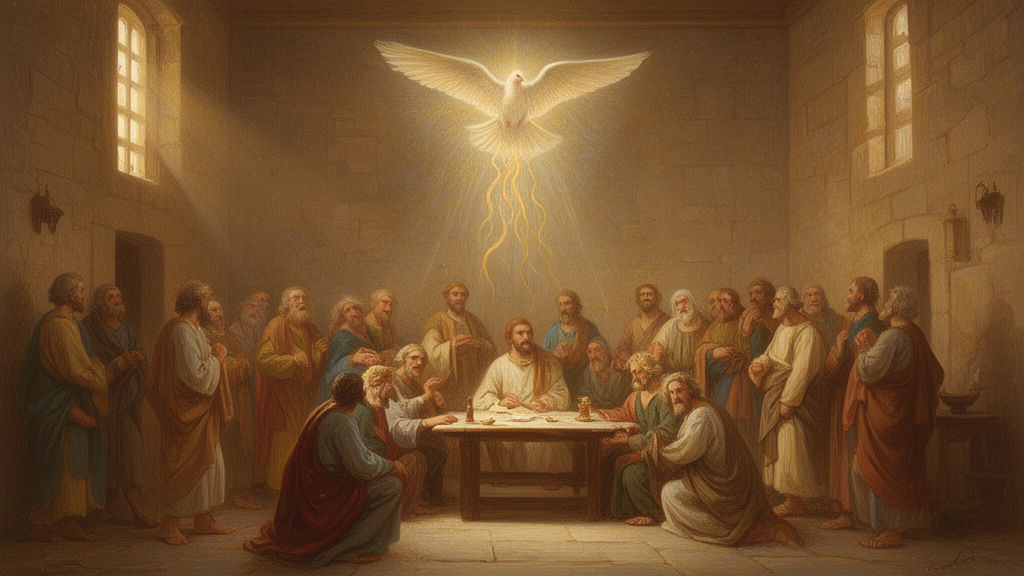
The short answer: in the New Testament, being “filled with the Holy Spirit” describes a state of empowerment for witness and speech, most clearly in the events of Pentecost and in later moments when Peter addresses opponents. Christian communities understand this as a gift from God that transforms a fearful man into a public teacher. They differ, however, on how the Spirit’s work is understood, on Peter’s later role, and on how the experience applies to believers today.
Who Was Peter?

Peter is one of the best-known figures in the New Testament. Before he was a leader of the early Christian movement, he was a fisherman. The biographical sketch in the Bible Encyclopedia on Bible Hub describes him as a fisherman from Bethsaida on the Sea of Galilee who later lived with his family at Capernaum. It also identifies him as the son of Jonas or John and the brother of Andrew.
Names and Their Meaning
Peter was born with the name Simon, and the Gospels also use the form Simeon in the same family line. According to the Bible Encyclopedia, Jesus gave him the Aramaic surname Cephas at their first recorded meeting in John 1:35–42, and the Greek equivalent is Petros, or Peter. Both names are commonly translated as “rock” or “stone.” The Bible Christian profile makes the same point and notes that the name is linked to what Jesus saw in Peter’s future role rather than to his character at that time.
Readers encounter both forms. In English Bibles, “Peter” is the standard name. “Cephas” appears in some passages, especially in Paul’s letters. Recognizing both names helps readers follow the same person through different parts of the New Testament.
Calling and Early Discipleship
The Gospels describe Peter’s call to follow Jesus in more than one stage. Bible Hub’s encyclopedia distinguishes an initial meeting, a later call to constant companionship, and a final selection as an apostle, though it notes that some interpreters read these differently. The Bible Christian profile cites Matthew 4:18–20 for the invitation to become “fishers of men.” Christian readers see this as the beginning of a long formation that later includes Peter’s public role after Jesus’ death and resurrection.
What “Full of the Holy Spirit” Means in Acts
The Book of Acts is the main New Testament source for the idea that Peter was filled with the Holy Spirit. Christians across many traditions read Acts as a continuation of the Gospel of Luke, describing the early community after Jesus ascended. The phrase “filled with the Holy Spirit” appears several times in Acts and is used for different people, so it is important to read each passage in its setting.
Verification note: The specific verses discussed here (Acts 2 and Acts 4) were not included in the source pages retrieved for this draft. Before publication, check the exact wording in a current scripture edition, such as the New International Version on Bible Gateway or another translation the editor chooses.
Pentecost and the Gift of the Spirit
In Christian tradition, Pentecost is the event in Acts 2 when the disciples gather in Jerusalem and are described as receiving the Holy Spirit. The scripture describes sound, wind-like imagery, and speech in different languages. Peter then addresses the crowd. Many Christians regard this as the first public proclamation of the Gospel by the Spirit-filled community. This is a traditional and scriptural reading; it is not a historical claim that can be checked outside Christian sources.
Pentecost is also a Jewish festival in the biblical setting, and Christian churches observe Pentecost as a feast marking the Spirit’s coming. Readers interested in its wider background should consult a reference work on the Jewish festival calendar and early Christian liturgy, because these details are described differently across traditions.
Peter Speaking with Boldness
Later in Acts, Peter is again described as filled with the Holy Spirit when he speaks before religious leaders in Jerusalem after healing a man. The passage is often used to illustrate boldness: a person who had earlier been fearful now speaks directly to authorities. Christian commentators note the contrast with the Gospel accounts of Peter’s denial of Jesus, which the Wikipedia article on Saint Peter discusses in its section on Peter’s denial of Jesus.
This contrast is central to how many readers understand the phrase. The Spirit is presented not as a sign of perfection but as an enabling presence. The Bible Christian article makes this point in devotional language, describing Peter as a man who was impulsive and fallible before he became a public leader. Scholars would describe this as a theological interpretation of the narrative rather than a psychological report.
From Denial to Leadership
The Gospels record that Peter denied knowing Jesus during the events before the crucifixion. The Wikipedia article on Saint Peter includes a section on this denial and on Peter’s later appearances after the resurrection. The Bible Encyclopedia also notes Peter’s recorded confession of Jesus as the Christ and the rebuke that followed, which shows both his leadership and his mistakes in the Gospel narratives.
For readers, this story is useful because it shows the difference between a dramatic moment and a long process. Christians often describe Peter’s development in three steps:
- Peter is called from his work as a fisherman and follows Jesus.
- Peter makes mistakes, including denial, and is later restored in the Gospel accounts.
- Peter, after the Spirit’s coming described in Acts, speaks publicly and leads the early community.
These steps are a way of reading the narrative. Each step is described in the New Testament, but how they connect (for example, whether Peter’s restoration is the direct cause of his later boldness) is an interpretive question that different commentators answer differently.
Peter in Christian Traditions
Peter’s role is interpreted very differently across Christian churches, and this affects how the phrase “Peter full of the Holy Spirit” is understood. The Wikipedia article on Saint Peter has separate sections on the Catholic Church, the Eastern Orthodox Church, the Syriac Orthodox Church, the New Apostolic Church, and The Church of Jesus Christ of Latter-day Saints, reflecting these differences. Readers should treat those sections as summaries and consult each church’s own teaching for official positions.
Points of Shared Reading
Across many traditions, Christians agree that Peter is a leading apostle, that he is associated with the Gospel accounts of Jesus’ ministry, and that Acts presents him as a key speaker in the early church. Many also accept the Gospel passages in which Jesus names Peter and gives him a particular role. The degree of authority attached to those passages is where views diverge.
Points of Difference
The Catholic and Orthodox traditions read Peter’s role in ways that shape their understanding of church leadership, and the Wikipedia article contains a section on the primacy of Peter. Many Protestant readers do not accept the same conclusions from the same passages. The article also notes Protestant rejection of Catholic claims. These differences are doctrinal, and they belong to the traditions that hold them. This post does not settle them.
Belief, Text, and Scholarship
It helps to separate three kinds of statement:
- Scripture: what a passage says, such as Acts describing Peter as filled with the Spirit.
- Tradition and belief: what churches teach about the Spirit’s work and about Peter’s authority.
- Scholarship: historical and literary questions, such as who wrote particular letters and how the texts were formed.
For example, the Wikipedia article on Peter includes a Writings section that discusses New Testament texts, pseudepigrapha, and non-canonical sayings. Those topics belong to scholarship and history rather than to the devotional reading of Acts.
Peter and the Letters Attributed to Him
Two New Testament letters bear Peter’s name. The First Epistle of Peter is listed in the New Testament, and the Wikipedia article on that letter has sections on authorship, the oldest surviving manuscripts, its audience, its outline, and its historical context, including social discrimination and official persecution of Christians. The article also covers the passage known as the Harrowing of Hell and debated questions about the letter’s teaching on women.
Many churches have traditionally connected these letters to Peter. Scholars have discussed whether he wrote them directly, and this is a matter of historical and literary analysis. Readers who want to explore this should start with the authorship section of the First Epistle of Peter article and compare it with a published commentary. This post does not assume that Peter personally wrote each letter, and it does not treat the traditional attribution as settled historical fact.
Practical Ways to Read This Passage
People who read Acts devotionally often use a simple method. The steps below describe a general reading approach, not an official Christian practice.
- Read Acts 2 and Acts 4 in full, using a translation you trust, and note each time the phrase “filled with the Holy Spirit” appears.
- Compare the Gospel account of Peter’s denial with the Acts account of his later speech. Write down what changes and what the text does not explain.
- Read a short commentary from your own tradition, then one from a different tradition, and compare how each treats Peter’s boldness.
- Pray or reflect in the way your church or community recommends, without assuming that a particular experience will be the same for every reader.
Some Christians connect this passage with personal courage in speaking about faith. Others focus on the community’s growth or on the Spirit’s role in leadership. Both are interpretive applications, and readers should distinguish them from what the text itself reports.
Common Misunderstandings
Being filled does not mean being perfect
Peter’s story shows a leader who was also a failed disciple. The Spirit’s presence in Acts does not erase the Gospel record of his mistakes. Careful readers keep both facts in view.
The phrase is not a formula for guaranteed results
Some popular writing presents the Spirit’s filling as a method for success, wealth, or protection. The biblical narrative does not support those promises for readers in general. The text describes courage, speech, and community growth within a specific historical setting. Claims about personal outcomes go beyond what the passage says.
Peter is not the only person described as Spirit-filled
Acts uses similar language for other followers of Jesus. Looking at those passages helps show that the phrase describes a recurring pattern in the early community rather than a single unique honor for Peter.
Related Reading on HindusGod.com
HindusGod.com focuses on Hinduism, so readers who arrive here looking for Christian scripture may want to know that the site also has related posts on the Holy Spirit in other contexts. The posts below are WordPress drafts at the time of writing, so their links may not be live until the owner publishes them. Each link is listed only where its topic relates to the discussion above.
- For a broader overview of how the Spirit is described in a devotional setting, see And the Holy Spirit.
- For the biblical idea of the Spirit’s activity in the early church, see Acts of the Holy Spirit.
- For the concept of anointing, which appears in Christian usage alongside being filled, see Anointing of the Holy Spirit.
- For personal reflection on encountering the Spirit, see Encountering the Holy Spirit and Experiencing the Holy Spirit.
- For the theme of guidance and direction, see Guided by the Holy Spirit.
- For a devotional format, see Holy Spirit Devotional.
- For a historical overview of how the Spirit has been understood, see History of the Holy Spirit.
- For reading recommendations, see Books on the Holy Spirit.
- For a more personal angle on relationship with the Spirit, see Friendship with the Holy Spirit and Communion with the Holy Spirit.
- For how the Spirit is discussed in the context of acknowledgment and prayer, see Acknowledging the Holy Spirit.
Frequently Asked Questions
Where in the Bible does it say Peter was full of the Holy Spirit?
The phrase is associated with the Book of Acts, which describes Peter as filled with the Holy Spirit when he speaks publicly. The exact verses should be checked in the translation you use, because the wording differs slightly across English Bibles.
Is the Holy Spirit the same concept as a Hindu deity or divine power?
No. In Christian belief, the Holy Spirit is understood as the third person of the Trinity, not as a deity in the Hindu pantheon. Comparisons between Christian and Hindu ideas of spirit, divine presence, or empowerment exist, but they require careful study of each tradition on its own terms. This post does not make that comparison.
Does being filled with the Spirit guarantee success or protection?
The biblical account does not present the Spirit’s filling as a guarantee of material outcomes. In Acts, the filling is connected with speech, courage, and the community’s mission. Any broader promises belong to particular teachings rather than to the text itself.
Takeaway
The phrase “Peter full of the Holy Spirit” comes from Acts and describes a moment when a fearful follower of Jesus speaks with courage. Its meaning depends on the passage, the Christian tradition reading it, and the scholarly questions about the texts. For readers, the most useful approach is to read the passages carefully, separate what the text reports from later interpretation, and compare how different churches understand Peter’s role.
Sources and Further Reading
- Saint Peter, Wikipedia: used for the article’s sections on Peter’s names, denial, leadership in the early church, and the differing views of Catholic, Orthodox, and other churches. It is a secondary overview, so consult the cited primary and academic works it lists.
- First Epistle of Peter, Wikipedia: used for the letter’s place in the New Testament and the article’s sections on authorship, manuscripts, audience, and context.
- Bible Encyclopedia: Peter, Bible Hub: used for the International Standard Bible Encyclopedia article on Peter’s name, early career, and calling. The page reproduces an older reference work and should be compared with modern scholarship.
- 1 Peter 1, New International Version, Bible Gateway: a scripture edition page for the opening chapter of 1 Peter. Use it to check the letter’s wording; the page was retrieved as navigation and passage content.
- Who Is Peter in the Bible? (Complete Profile), The Bible Christian: a devotional overview of Peter’s life, cited for the explanation of the name Cephas or Peter and the reference to Matthew 4:18–20. It is a devotional source, not an academic one.