The perfection of wisdom is the English rendering of the Sanskrit term Prajñāpāramitā. In Buddhism it refers both to a central principle of the Mahayana path and to a large group of texts, called the Prajñāpāramitā sutras, that explore wisdom, emptiness, and the bodhisattva’s way of life. It is a Buddhist concept, not a Hindu scripture. This article explains what the term means, where it comes from, which texts carry it, what symbols represent it, and how it relates to wisdom ideas in Hindu traditions.

Short answer: what is the perfection of wisdom?
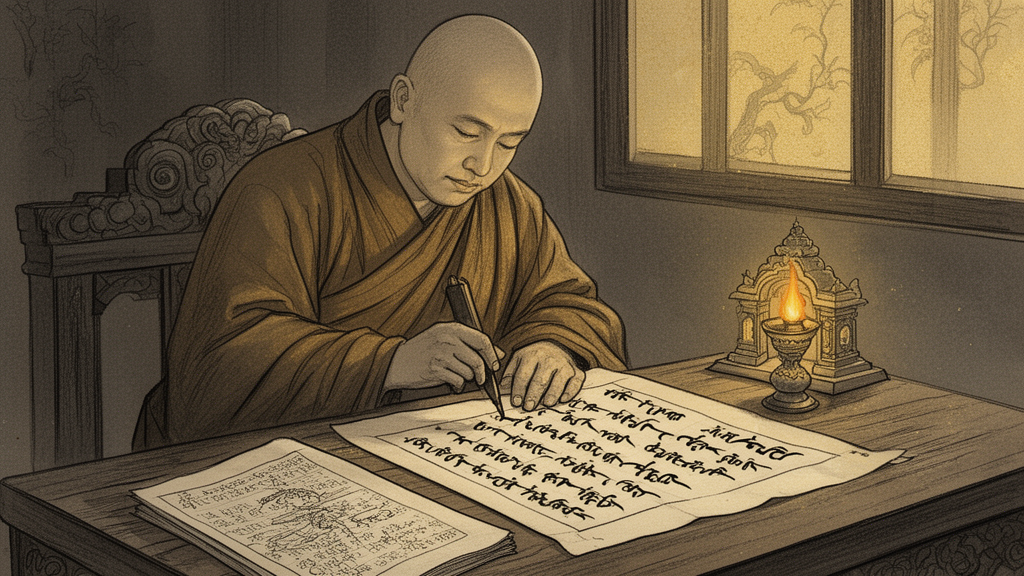
The perfection of wisdom is understood in Mahayana Buddhism as the highest or most complete form of wisdom, the insight that sees the empty (śūnya) nature of all phenomena. Its texts present it as the guide that allows a bodhisattva, a being committed to the awakening of all beings, to practice generosity, ethics, patience, effort, and meditation without clinging to any of them as fixed.
Two points help readers avoid confusion. First, the phrase is a translation of a technical term, so it does not carry the everyday English sense of “flawlessness.” Second, the term refers to a body of texts and a set of teachings, which Buddhist communities read, copy, chant, and study in different ways.
Key terms: prajñā and pāramitā
The Sanskrit compound Prajñāpāramitā combines two words. Prajñā is usually translated as wisdom or insight, a penetrating understanding rather than ordinary knowledge. Pāramitā is commonly translated as “perfection,” “transcendent virtue,” or “going to the far shore.” The word derives from pāram, meaning “the other shore,” and the sense is of reaching a state beyond ordinary limits.
Readers will see several forms of the same name. The Wikipedia article on the topic lists English renderings such as “Perfection of Transcendent Wisdom,” and gives Chinese, Japanese, Tibetan, and other forms, including Chinese bōrě bōluómìduō and Tibetan shes rab kyi pha rol tu chin pa. Those variants all refer to the same concept, though translators choose different English words. Consistent use of “perfection of wisdom” or “Prajñāpāramitā” helps keep the discussion clear.
The English word “perfection” itself has broader meanings. The Cambridge Dictionary defines it as “the state of being complete and correct in every way.” That everyday definition is useful background, but it does not capture the technical Buddhist meaning, which concerns the completeness of wisdom in relation to emptiness and liberation rather than moral or aesthetic flawlessness.
Origins within Buddhism and the Mahayana context
The perfection of wisdom belongs to the Mahayana, or “Great Vehicle,” stream of Buddhism. The Wikipedia overview describes Prajñāpāramitā as a principle in Buddhism and the texts associated with it, and its history section traces the teaching through early texts, larger sutras, esoteric texts, and later developments in Central Asia, China, and Tibet. Scholars usually describe a long period of composition and transmission rather than a single author or date, and the article should be read as a summary of that research rather than as a final chronology.
In Buddhist tradition, these texts are presented as teachings of the Buddha. Historians, however, generally treat their composition as a later development within Indian Buddhism, with versions appearing and expanding over centuries. Devotional belief, traditional attribution, and historical scholarship therefore answer different questions. A Buddhist reader may approach the sutras as the words of the Buddha; a historian asks when and where particular texts took shape and how they were transmitted.
For HindusGod.com readers, this context matters. The perfection of wisdom is part of a Buddhist framework, and it should not be read as a Hindu scripture or as a Hindu deity’s teaching. Comparisons with Hindu concepts can be helpful, but they must be made with care, as explained later in this article.
The major texts
The Prajñāpāramitā literature is a family of texts rather than one book. Its members vary in length, style, and emphasis. The Wikipedia article organizes the material into sections on the main Prajñāpāramitā sutras, a catalogue of Prajñāpāramitā texts in the Chinese Buddhist canon, the Tibetan Kangyur, and commentaries. The Taishō Tripiṭaka numbering used in the Chinese canon places the Prajñāpāramitā group in a block of translations of Indian texts, listed in the range 220 to 261 in the article’s canon overview.
Larger and shorter versions
Among the most studied texts are the longer sutras, which expand on the teaching at great length, and shorter sutras that distill it. The Wikipedia article’s table of contents identifies sections on Xuanzang’s Prajñāpāramitā library and on the Prajñāpāramitā texts preserved in the Tibetan canon, indicating that different translator traditions produced different collections. Readers who want the full set should consult a scholarly catalogue or a translation series rather than relying on a single short summary.
Well-known titles readers may encounter
Several titles are often named in introductions to the subject. These include the Heart Sutra, a very short text commonly chanted in East Asian Buddhism; the Diamond Sutra, a shorter work in the same family; and the large Perfection of Wisdom in 8,000 Lines, which is one of the more widely studied longer versions. HindusGod.com has related draft pages on some of these titles, listed in the “Related reading” section below. Those pages are internal drafts and should be checked before a reader is directed to them as live content.
When comparing editions, note the translator, the language of the base text, and whether the translation is from Sanskrit, Chinese, or Tibetan. Differences between versions are normal and often reflect translation choices as much as doctrinal emphasis.
Core teachings: bodhisattvas, emptiness, and negation
The Wikipedia article’s themes section lists several core topics: the bodhisattva and Prajñāpāramitā, other bodhisattva qualities, tathātā (suchness), negation and emptiness, and māyā (illusion). These themes give a useful map for beginners.
The bodhisattva and the perfection of wisdom
In the Prajñāpāramitā texts, the bodhisattva practices a series of perfections, which are commonly listed as generosity, ethics, patience, vigor, meditative concentration, and wisdom. Wisdom is presented as the element that gives direction to the others. Without insight into emptiness, the other practices may still be good, but they can become attached to a self or to rewards. This is a standard way of reading the relationship among the perfections in Mahayana commentary, though commentators differ in how they explain it.
Emptiness and negation
Emptiness (śūnyatā) is the central concept. In these texts, emptiness does not mean nothingness. It means that phenomena lack an independent, fixed essence and arise in dependence on causes and conditions. The texts often use a method of negation, saying that a thing is “not” what it appears to be, in order to loosen the grip of conceptual fixation. Readers new to the material often find these passages puzzling, and it helps to read them alongside a commentary or a teacher from a Buddhist tradition.
Māyā and illusion
The Wikipedia themes section also lists māyā, which in this context refers to illusion or magical appearance. The image of phenomena as illusory is used to show that things seem solid but do not exist in the fixed way ordinary perception assumes. The term has different connotations in Hindu thought, where māyā is often discussed in relation to Brahman and the appearance of the world. Direct comparison can mislead, so the Buddhist sense should be explained on its own terms first.
Tathātā and suchness
Tathātā, usually translated “suchness” or “thusness,” refers to things as they actually are, beyond conceptual labels. In the perfection of wisdom, seeing suchness is part of the wisdom that is perfected. Translators render this term in different ways, and readers should check how a given translation handles it.
Symbols and iconography
Buddhist art uses several recognizable symbols for the perfection of wisdom. The Wikipedia article identifies two common images. The first is the female personification, Prajñāpāramitā Devi, described as “a personification of Transcendent Wisdom.” The second is the bodhisattva Mañjuśrī, shown with a sword of wisdom and a sutra manuscript, which the article describes as common symbols of Prajñāpāramitā in Buddhist art.
Prajñāpāramitā Devi
In Tibetan and other Buddhist art, Prajñāpāramitā is sometimes depicted as a female figure representing the mother of the Buddhas. This personification is a devotional and artistic expression. It should not be confused with a Hindu goddess of wisdom, even though some visitors may notice visual similarities in form or in the presence of books or lotuses in certain artworks. Iconographic details vary by region and workshop, so a single image cannot be treated as a universal rule.
Mañjuśrī and the sword of wisdom
Mañjuśrī is a bodhisattva associated with wisdom in Mahayana traditions. The sword in his hand is commonly understood as a symbol that cuts through ignorance, and the sutra manuscript represents the teachings of the perfection of wisdom. These are artistic conventions, and their meaning is explained in commentarial and devotional traditions rather than in one authoritative text.
Sutra as object of devotion
The Wikipedia article includes a section titled “Sutra worship,” indicating that the texts themselves are treated as objects of reverence in some communities. Copying, reciting, enshrining, and chanting sutras are practices found in various Buddhist traditions. The article does not offer detailed instructions for these practices, so readers who want to follow them should seek guidance from a teacher or community in their own tradition.
Traditions and practice
The perfection of wisdom is not practiced in one uniform way. Buddhists in Tibet, China, Japan, Korea, Vietnam, and other regions have developed different forms of study, chant, art, and meditation around these texts. Some traditions emphasize philosophical study and debate; others emphasize chanting, copying, or meditation on the sutra’s key lines. Zen communities in East Asia are known for chanting the Heart Sutra, and calligraphy has been used as a meditative practice in connection with it. Descriptions of such practices should be taken as examples of particular traditions, not as a single standard.
Readers approaching the material as a practice should note the difference between study and devotion. Reading a translation, reviewing a commentary, or joining a study group builds understanding. Devotional forms such as chanting or copying belong to specific communities and are often guided by lineage teachers. Practices are described here for context only, and no outcome such as spiritual attainment, protection, or material benefit is guaranteed by any ritual act.
The Hindu wisdom context: what to compare and what to keep separate
HindusGod.com readers often arrive at this topic while exploring wisdom in Hinduism, so it is worth distinguishing several things. Hindu traditions have a rich vocabulary of wisdom, including jñāna (knowledge), vidyā (learning), and prajñā, a term that also appears in Hindu contexts. The Upanishads, the Bhagavad Gita, and devotional literature address wisdom in ways that differ from Mahayana Buddhist emptiness teaching, and Hindu traditions themselves differ among schools such as Advaita, Vishishtadvaita, and Dvaita Vedanta.
Draft pages on HindusGod.com that explore related wisdom topics include Wisdom of the Upanishads, which can help readers see how Hindu sources discuss knowledge of the self and ultimate reality, and Bhagavad Gita Wisdom, which covers Krishna’s counsel to Arjuna. For Hindu wisdom deities, the draft pages God of Wisdom in Hinduism and Goddess of Wisdom Hindu are relevant. Readers should not assume that a Hindu wisdom figure has the same role as Prajñāpāramitā Devi or Mañjuśrī, because the traditions and their symbols belong to different religious frameworks.
Where the comparison can help
Comparison can help readers see shared human questions: how knowledge relates to liberation, how the self is understood, and how study and practice relate. The comparison should be made as a comparison, not as a claim that the traditions teach the same thing. Hindu and Buddhist philosophers have long debated the nature of the self, and those debates are part of scholarly study.
Where the comparison can mislead
Two common errors should be avoided. The first is treating the perfection of wisdom as a Hindu teaching. The second is assuming that all Buddhist and Hindu wisdom concepts share one meaning. Terms such as prajñā, jñāna, and māyā carry different senses across traditions and texts, and each should be read in its own context.
Why the term is often misunderstood
Several misunderstandings appear repeatedly. The first is equating “perfection” with moral or spiritual perfectionism. In the Prajñāpāramitā texts, perfection refers to a completed or transcendent state of wisdom, and the path is not presented as a demand for flawlessness in a person’s conduct or achievements. The second is reading emptiness as a denial that anything exists. The texts teach that phenomena lack fixed independent nature, which is a different claim. The third is assuming the sutras have a single authoritative English version. Translations differ, and some are based on Chinese or Tibetan texts rather than Sanskrit originals.
A useful habit is to ask three questions when reading any passage: what the text says, how a tradition reads it, and what modern scholars say about its history. Keeping these separate prevents confusion.
How to begin reading
- Start with an introduction. Read a general overview of Mahayana Buddhism and the Prajñāpāramitā literature before the sutras themselves.
- Choose a translation and note its base language. Check whether it is translated from Sanskrit, Chinese, or Tibetan, and whether the translator provides notes.
- Read a short text first. Many readers begin with the Heart Sutra because of its length, then move to longer works.
- Use commentaries. Commentaries from Buddhist teachers or scholars help explain difficult passages, especially negations.
- Keep devotion and study distinct. If you practice chanting or copying within a community, follow that community’s guidance and note which teachings are scripture, which are commentary, and which are local custom.
Related reading on HindusGod.com
The following internal drafts are relevant to the topic. They are WordPress drafts and may not be public until the owner publishes them, so readers may not be able to open them yet:
- Perfection of Wisdom Sutra, which covers the sutra in more detail.
- Perfection of Wisdom in 8000 Lines, which discusses one of the longer versions.
- The Large Sutra on Perfect Wisdom, which addresses the larger Prajñāpāramitā texts.
- Wisdom Sutra, a related draft on wisdom teachings in sutra literature.
- Wisdom of the Lotus Sutra, which places wisdom themes within another Mahayana sutra.
- Wisdom of the Ancient Sages Mundaka Upanishad, a Hindu comparison point on Upanishadic knowledge.
Each of these pages should be reviewed for accuracy before any link is made live. Because they are drafts, this article does not assume their content is final.
Frequently asked questions
Is the perfection of wisdom a Hindu concept?
No. It is a central concept in Mahayana Buddhism, and its texts are Buddhist sutras. Hindu traditions have their own wisdom teachings, which are often discussed in the Upanishads, the Bhagavad Gita, and later philosophical schools. Comparisons between them can be useful when they are presented as comparisons.
Does the perfection of wisdom mean that nothing exists?
Not in the sense of simple nonexistence. The texts teach that phenomena lack independent, fixed nature and arise through causes and conditions. Interpretations differ among Buddhist schools, so readers should consult several sources.
Which text should a beginner read first?
Many readers begin with the short Heart Sutra, which is widely studied and chanted, and then move to a commentary. The best choice depends on the reader’s tradition, language, and goals.
Summary
The perfection of wisdom, or Prajñāpāramitā, is a Mahayana Buddhist principle and a family of sutras that teaches the empty nature of phenomena and the wisdom that guides the bodhisattva path. Its key themes include emptiness, negation, māyā, suchness, and the relation between wisdom and the other perfections. Its symbols, such as Prajñāpāramitā Devi and Mañjuśrī’s sword and sutra, are part of Buddhist art and devotion. Readers should keep Buddhist texts distinct from Hindu scriptures and read translations and commentaries with attention to their sources.
Sources and further reading
- Prajñāpāramitā (Perfection of Wisdom), Wikipedia: used for the definition of the Buddhist concept, its Mahayana context, the Prajñāpāramitā Devi and Mañjuśrī symbols, the Taishō canon range, and the list of core themes. Wikipedia is a secondary reference; consult the scholarly sources it cites before relying on details.
- Perfection, Cambridge Dictionary: used only for the everyday English meaning of “perfection,” to distinguish it from the Buddhist technical term.
- Perfection, Wikipedia: used for the note that the English word derives from Latin perficere, “to finish,” and for background on the general concept.
Further reading should include a scholarly translation of a Prajñāpāramitā sutra and a commentary by a recognized Buddhist scholar or teacher. Owner verification of specific editions is recommended before publication.