The Paramahamsa Upanishad is a short Sanskrit text that describes the ideal paramahamsa, a liberated renunciate who has moved beyond ritual, social identity and outward symbols. It is classified among the Sannyasa Upanishads, and it is presented as a dialogue in which the god Brahma answers the sage Narada’s question about the path and duties of the Paramahamsa yogis. This post explains what the text says, how it is structured, how traditions have read it, and where the evidence is uncertain.
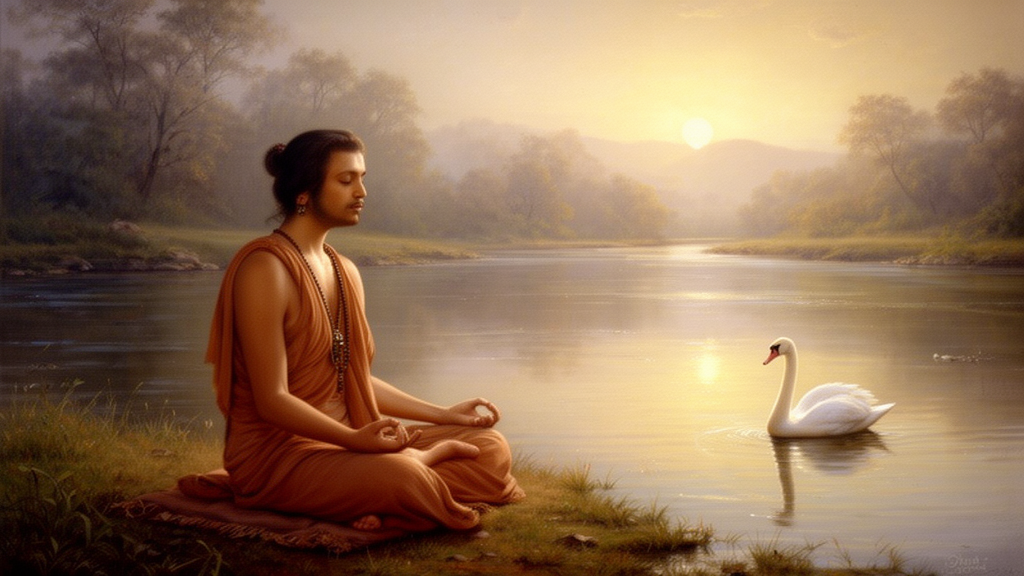
The Sanskrit title appears as परमहंस उपनिषद in the Wikipedia article on the text, and English spellings vary. You may also see Paramahansa Upanishad or Paramahaṃsa Upanishad. This article uses Paramahamsa Upanishad throughout.
Quick answer: what is the Paramahamsa Upanishad?
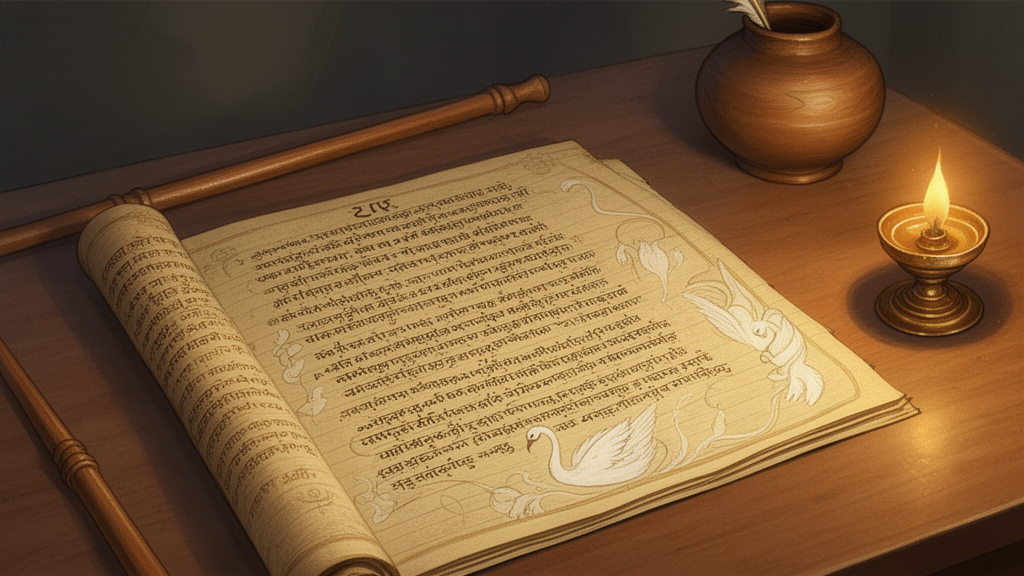
It is one of the 108 Upanishads in the widely cited canon and one of the Sannyasa Upanishads, a group concerned with monastic renunciation and liberation. Its central teaching is that the true paramahamsa abides in Brahman, the ultimate reality, and has gone beyond attachment, ritual obligation and the sense of a separate body-identity. The text states that such a person regards the body as a corpse and recognises the Self as calm, immutable and of the nature of knowledge and bliss.
The text also distinguishes genuine renunciation from merely external renunciation. A wooden staff, the sacred thread and the topknot are not, on their own, marks of the paramahamsa. Inner knowledge is what the text treats as decisive.
The meaning of the name
Paramahamsa: the supreme swan
The word paramahamsa combines parama, meaning supreme, with hamsa, meaning swan. In the Paramahamsa Upanishad, the swan is a symbol. Wikipedia’s summary of the text notes that the hamsa is used to highlight the supremacy of the paramahamsa yogi, and that the swan metaphorically represents the ability to separate milk from water. In the same way, the realised renunciate is pictured as one who can discern the real from the unreal.
The Vyasa Mahabharata summary of the text similarly describes paramahamsa as meaning the “illumined one” and links the image to the swan’s separation of milk from water. Both summaries treat this as the text’s symbolic reading, not as a literal claim about birds.
A title for a renunciate, not only a bird image
The Sanskrit term is used in the text as a title for a specific kind of renunciate. The Vedanta Spiritual Library translation renders the opening question as a question about “the path of the Paramahamsa Yogis, and what are their duties,” showing that the subject is a way of life, not an image alone.
Where the text sits in the Upanishadic literature
Sannyasa and renunciation
Most sources classify the Paramahamsa Upanishad as a Sannyasa Upanishad. Wikipedia states that it is “classified as one of the Sannyasa Upanishads,” and the Vyasa Mahabharata summary and the Sacred Texts of Hinduism listing place it in the same group. The Sannyasa Upanishads deal with the stages and conduct of the sannyasi, the person who has formally renounced worldly life. Within that group, the Paramahamsa Upanishad is notable for describing the highest type of renunciate rather than offering a set of external rules.
This classification matters for reading the text. It is not a general guide to household worship or temple ritual. It is a teaching for those who have taken or are considering full renunciation, and it contains strong statements about giving up ritual that many Hindu households do not follow in the same way.
Which Veda is it attached to? Sources disagree
The sources do not agree on the Veda to which the text is attached. Wikipedia says it is one of the 31 Upanishads attached to the Atharvaveda, and the Vyasa Mahabharata summary repeats this. The Grokipedia article, however, describes it as belonging to the Shukla Yajurveda, and the Vedanta Spiritual Library places its translation in its Shukla Yajur Veda Upanishads section. Readers should treat the Veda attribution as a point where secondary sources differ, and should check a scholarly edition or a reputable translation if the attachment matters for their study.
The disagreement does not change the main content of the text. It does show why a careful reader should separate the text itself from the reference works that describe it.
Dating and composition: what is known and unknown
The date of the Paramahamsa Upanishad is not firmly established. Wikipedia states that the century in which it was composed is not known, but that its references in other texts, whose dating is better established, suggest it is ancient. According to the same article, the text appears to have been composed before the Asrama Upanishad, which is dated to the 3rd century CE. The German scholar Sprockhoff, as Wikipedia reports, assigns it to the last few centuries of the 1st millennium BCE.
Some secondary summaries go further. The Vyasa Mahabharata summary says the text was likely composed in the centuries before the common era. The Editorial Note in the Sanatan Hindu Dharma page describes it as a later Sannyasa Upanishad. These statements are not the same, and none of them is a precise date. A fair summary is that scholars and reference works place the text in the broad period of late Vedic-era literature, with its exact date uncertain.
Structure and the Brahma-Narada dialogue
The Paramahamsa Upanishad is presented as a discourse between Brahma, the Creator, and the sage Narada. Narada asks what the path of the Paramahamsa yogis is and what their duties are. Brahma answers in a sequence of short sections. Wikipedia describes the teaching as presented in four hymns, and Grokipedia describes four brief sections in verse form. The Wikipedia infobox lists one chapter and four verses, so counts vary by source and edition. Readers should cite the edition they use rather than a single numerical summary.
The opening and closing of the text emphasise the infinite. The Vedanta Spiritual Library translation begins with the words that Brahman is infinite, the universe is infinite, and the infinite proceeds from the infinite, after which the infinite remains as Brahman alone. This invocation frames the rest of the teaching: the renunciate’s liberation is understood through the nature of the infinite Self, not through any finite object or ritual.
Key teachings of the text
The paramahamsa is rare
Brahma says that the path of the Paramahamsas is accessible only with great difficulty, and that there are few exponents of it. In the Vedanta Spiritual Library translation, the text says that it is enough if there be one such person. Wikipedia and the Vyasa summary both say the text presents such yogis as a rarity. The point is not that the path is closed to others, but that the standard described is very high.
Renunciation of family, ritual and symbols
The text lists what the renunciate gives up. According to the translation at the Vedanta Spiritual Library, he renounces sons, friends, wife and relations, and sets aside the shikha or topknot, the holy thread, the study of the Vedas and all works. The Vyasa Mahabharata summary says the same yogi renounces the sacred thread, all rituals and recitations, and the topknot hair tuft. The text then says he may use a kaupina (loincloth), a staff and just enough clothing for the bare maintenance of the body, and for the good of all.
The text then goes beyond this stage. In the translation at the Vedanta Spiritual Library, it says that this is not final, and it goes on to describe what the final stage is. The same translation states that the Paramahamsa carries neither staff, nor hair-tuft, nor holy thread, nor any covering.
Inner knowledge as the true marks
The most distinctive teaching is that inner knowledge replaces outer markers. The translation states that the knowledge of the Self is his shikha and his holy thread. It further says that realising the unity of the Jivatman, the individual self, with the Paramatman, the supreme Self, removes the distinction between them, and that this unification is his sandhya ceremony. Sandhya is normally the twilight prayer, so the text is redefining a ritual in terms of realisation. The Grokipedia summary states the same idea in a general way, saying that knowledge serves as the inner equivalent of traditional rites.
This is a teaching about the meaning of rites, not a general instruction to abandon them. Traditions that accept the Paramahamsa Upanishad often treat this as a teaching for renunciates who have already reached a stage where the outer forms no longer hold the same role.
The staff of knowledge and the wooden staff
The text contrasts two kinds of renunciate. In the translation at the Vedanta Spiritual Library, the one who relinquishes all desires and rests in the One without a second, and who holds the staff of knowledge, is called the true Ekadandi. The one who carries only a wooden staff, pursues sense-objects and lacks Jnana, goes to the hells known as the Maharauravas. The Grokipedia article summarises this as a warning against superficial asceticism, in which external symbols without inner wisdom lead to downfall.
This is one of the clearest examples of the text’s moral and spiritual emphasis. The wooden staff is not praised or condemned in itself. What the text condemns is the gap between outward appearance and inner life.
Equanimity and freedom from opposites
The text describes the Paramahamsa as one who feels neither cold nor heat, neither happiness nor misery, and neither honour nor contempt. The Vyasa summary says he is affected neither by cold nor heat, neither by pleasure nor pain, neither by respect nor disrespect. These are described as qualities of a mind that has moved beyond the pairs of opposites. They are not presented as a set of behaviour rules that a householder can copy.
The text also lists inner states to be abandoned, including slander, pride, jealousy, deceit, arrogance, desire, hate, lust, anger, greed, delusion and egotism. The Vedanta Spiritual Library translation presents this as the renunciate giving up the whole range of mental afflictions.
The body as a corpse and the claim “I am That”
The text says that the Paramahamsa regards his body as a corpse, because he has thoroughly destroyed the body-idea. In the same passage, he lives in the consciousness “I myself am He, I am That which is ever calm, immutable, undivided, of the essence of knowledge-bliss.” Grokipedia summarises the phrase as the knowledge “I am That” (so’ham). This is central to the text’s Advaita-oriented reading, in which individual self and supreme Self are not two.
Jivanmukti and videhamukti
Wikipedia reports that the text describes the monk as a Jivanmukta, a person liberated while alive, and that Videhamukta is liberation after death. These are technical terms in Vedanta-influenced literature. A jivanmukta is one who lives in the world, or in the body, with liberation already realised. Videhamukti refers to liberation at the end of embodied life. The Paramahamsa Upanishad is therefore often read as a guide to advanced seekers who have realised liberation within life, rather than only as a text about afterlife.
How traditions read the Paramahamsa Upanishad
Advaita Vedanta readings
Grokipedia and the Sanatan Hindu Dharma page both connect the text with non-dual, Advaita-oriented interpretation. The Sanatan page describes the text as reflecting a mature Advaita-oriented spirituality in which liberation is direct realisation of the deeper Self beyond body, mind, social role and conceptual limitation. Grokipedia describes its philosophical setting as rooted in Advaita Vedanta principles of non-duality. These are scholarly and traditional readings of the text, not the only possible reading.
Vaishnava attribution in Wikipedia
Wikipedia reports that, according to Ramanujacharya, the Paramahansa is one of the forms of Lord Vishnu, who imparted the Vedas to Brahma in the form of a divine swan, as described in the Vishnu-Sahasranama. This attribution belongs to a particular interpretive tradition and does not explain the whole text. It is a reminder that different sampradayas can connect the same symbol with different deities.
Renunciate communities and the question of practice
The text’s instructions are directed to renunciates. Traditions of sannyasa vary widely in their discipline, initiation, dress and daily practice. Some sannyasis follow external markers that the Paramahamsa Upanishad calls secondary, while others emphasise the inner teaching. Because of this variation, a reader should not assume that a particular ascetic lifestyle is required by the text, nor that any one community’s practice is the text’s universal meaning. Describing a monastic rule as tradition-specific is more accurate than presenting it as a universal Hindu norm.
Common misunderstandings
It is not a manual for ordinary worship
The text is not a guide to daily puja, household rites or temple worship. Its statements about renouncing rituals and recitations apply to the renunciate stage described in the text. Readers looking for puja instructions should consult texts and practices that address householders and devotional worship. For a broader overview of the Upanishadic corpus and its categories, see Meaning of Upanishad (URL to confirm, target draft).
It does not say that outward symbols are worthless
The text’s warning concerns the gap between outward symbol and inner knowledge. It does not say that all symbols are meaningless for everyone at all times. The translation at the Vedanta Spiritual Library places the strongest criticism on the person who holds a wooden staff while lacking knowledge, not on the staff as such.
It does not describe a formula for guaranteed spiritual results
The text describes a state of realisation and a standard of conduct. It does not provide a method that guarantees liberation, nor a promise of material benefit. Readers should treat its teachings as an account of renunciate ideals and as a subject for study, reflection and guidance from qualified teachers in their tradition.
Reading the text: editions and translations
Readers encounter the Paramahamsa Upanishad in several forms. The Vedanta Spiritual Library publishes a translation by Swami Madhavananda, published by the Advaita Ashram, Kolkata. The Vyasa Mahabharata website provides an online version with a summary and link to a text. The Sacred Texts of Hinduism site at texts.wara.in offers the text within a listing of the Upanishads. Each source may present a different translation, numbering and introduction, so when you quote or study the text, identify the edition and translator you are using.
Some reference articles, including Grokipedia, are secondary and are sometimes generated or edited through summary tools. They can help orient a reader, but they should not replace the text itself or scholarly editions.
Related Upanishad pages on HindusGod.com
If you are exploring the Paramahamsa Upanishad as part of a wider study of the Upanishads, these HindusGod.com pages may help. The links below point to WordPress target drafts. They are not yet confirmed as public pages, so the owner should verify each link before publication.
- 108 Upanishad (URL to confirm, target draft) gives context on the canonical list of 108 Upanishads.
- 10 Upanishad (URL to confirm, target draft) covers the principal Upanishads often studied first.
- Advaita Upanishad (URL to confirm, target draft) explains the non-dual philosophy that frames many readings of this text.
- Avadhuta Upanishad (URL to confirm, target draft) covers another renunciate-oriented text in the Sannyasa group.
- Atmabodha Upanishad (URL to confirm, target draft) discusses knowledge of the Self, a theme shared with the Paramahamsa Upanishad.
- Ashtavakra Upanishad (URL to confirm, target draft) presents a non-dual teaching on liberation through knowledge.
- Atharvashikha Upanishad (URL to confirm, target draft) connects to the Atharvaveda attribution discussed above.
- Atharva Upanishad (URL to confirm, target draft) covers another text associated with the Atharvaveda.
- Adhyatma Upanishad (URL to confirm, target draft) explores inner, self-centred teaching.
- Aranyaka Upanishad (URL to confirm, target draft) explains the forest-text category that sits near the Upanishads in the Vedic corpus.
Frequently asked questions
Who is the Paramahamsa in the text?
The Paramahamsa is a liberated renunciate described in the dialogue between Brahma and Narada. The text presents him as rare, as one who rests in Brahman, has given up worldly attachment and ritual limitation, and regards the body as a corpse. Wikipedia and the Vyasa summary both describe this figure as a jivanmukta, a person liberated while alive.
Does the Paramahamsa Upanishad say to abandon all rituals?
The text describes renunciation of rituals, recitations and the sacred thread for the Paramahamsa stage, and it reinterprets the sandhya as realisation of the unity of the individual and supreme Self. This is a teaching for advanced renunciates in the text’s framework. It is not a universal instruction for every Hindu, and renunciate communities differ in how they apply it.
Which Veda is the Paramahamsa Upanishad linked to?
Sources disagree. Wikipedia and the Vyasa Mahabharata summary say it is attached to the Atharvaveda, while Grokipedia and the Vedanta Spiritual Library place it within the Shukla Yajurveda. Consult a scholarly edition if the Veda attribution matters for your study.
Summary and takeaway
The Paramahamsa Upanishad is a Sannyasa text that describes the highest type of renunciate in the form of a dialogue between Brahma and Narada. Its distinctive contribution is the idea that inner knowledge of the Self is the true mark of the renunciate, and that outward symbols without realisation are not enough. Its date and Veda attachment are not settled in every source, so readers should cite editions carefully and distinguish the text, traditional readings and modern scholarship.
For a respectful reading, start with a translation from a named edition, note the speaker and listener, and compare the text’s statements with reliable commentary. Treat its teachings as renunciate ideals within Vedanta and Sannyasa traditions, not as a formula for guaranteed results.
Sources and further reading
- Paramahamsa Upanishad, Wikipedia: general overview, Sannyasa classification, Atharvaveda attribution, dating references, Brahma-Narada frame, and Jivanmukta and Videhamukta terms.
- Paramahamsa Upanishad, Vedanta Spiritual Library: translation by Swami Madhavananda, published by Advaita Ashram, Kolkata; source for the opening invocation, the renunciate’s practices, the staff of knowledge passage and the sandhya teaching.
- Paramahamsa Upanishad, Vyasa Mahabharata: summary of the Brahma-Narada discourse, the meaning of hamsa, and the characteristics of the Paramahamsa.
- Paramahamsa Upanishad, Sacred Texts of Hinduism: listing of the text within the Sannyasa Upanishads.
- Paramahamsa Upanishad, Grokipedia: secondary summary; used only for points that it states and that other sources do not contradict, such as the Shukla Yajurveda attribution, which it differs on. Treat as a secondary source.