The oldest holy book is not settled by a single answer. It depends on what counts as a holy book, which religion you ask about, and how old a text must be before it is counted. For Hinduism, the Rigveda is the text most often named as the oldest, and the Wikipedia article on religious texts describes it as the oldest religious text in any Indo-European language, with a manuscript caption dating it to 1500–1000 BCE. Other ancient writings from Egypt, Mesopotamia, and elsewhere also appear on lists of the oldest surviving texts, so the answer changes with the definition used.
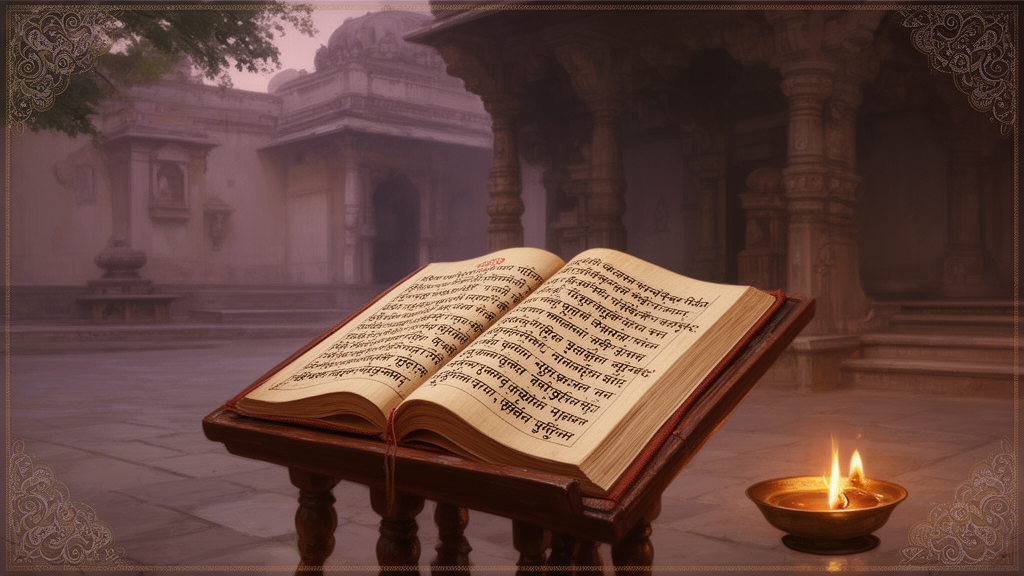
This guide explains the Rigveda’s place in Hindu tradition, the difference between a text’s age and its status as scripture, and why different sources give different rankings. It also covers the wider Hindu scriptural collection and offers a practical way to read ancient texts respectfully.
Short answer: the Rigveda is the usual answer for Hinduism
For readers who want a direct answer about Hinduism, the Rigveda is the most common response. It is one of the four Vedas and is a collection of hymns. Hindu tradition regards the Vedas as shruti, a Sanskrit term usually translated as “that which is heard,” meaning revealed knowledge rather than human authorship. That is a belief held within the tradition. Historians and philologists study the same texts as ancient compositions, and their conclusions about dating and composition are different from the tradition’s claims about origin.
If you are asking which holy book is oldest in the world as a whole, the answer is different. Some older texts are not holy books in the same sense used by Hindus, Christians, Jews, or Muslims. Others are holy in their own traditions but survive only in fragments. The sections below separate these categories so the answer stays accurate.
What counts as a “holy book”?
The term “holy book” is a modern English phrase, and it does not map neatly onto every religious tradition. The Wikipedia article on religious texts describes these works as texts that various religions consider to be of central importance to their tradition. Such texts often contain a compilation or discussion of beliefs, ritual practices, moral commandments and laws, ethical conduct, spiritual aspirations, and guidance for community life. Within each religion, they are revered as authoritative sources of guidance and, in many cases, as divine revelation.
That definition has three parts that matter for the question of age:
- Religious status: A text must be treated as authoritative by a religious community. An ancient inscription with no continuing religious role is an ancient document, not necessarily a holy book.
- Form: A text may be oral, carved, painted, written on a scroll, or printed. Many Hindu scriptures were transmitted orally for long periods before they were written down.
- Survival: A text that is old but has only fragments left may be older than a complete work, yet it is harder to describe as a single “book.”
The Archaeologist, in a list of the most ancient surviving books, makes a similar point: the question of the oldest surviving book is complex because it depends on how a book is defined and what significance is given to it. A reader should keep those definitions in mind before comparing rankings.
The Rigveda: the oldest text in the Hindu tradition
The Rigveda is a collection of Vedic hymns in Sanskrit. It is central to Hindu worship and to the study of the Vedic period. Hindu communities do not all use the Vedas in the same way. Some families chant Vedic mantras in daily or ritual life, while others engage with the Vedas mainly through philosophy, study, or regional customs. The Vedas are one foundation of the wider Hindu tradition, but they are not the only sacred literature, and Hinduism includes many regional, devotional, and philosophical traditions that treat other texts as central.
What the dating evidence says
The Wikipedia article on religious texts includes a caption for a Rigveda manuscript in Devanagari script, described as a scripture of Hinduism and dated 1500–1000 BCE. The same article states that it is the oldest religious text in any Indo-European language. Readers should treat both points carefully. The caption dates a manuscript-style depiction of the text, and scholars generally date the composition of the Rigveda’s hymns with a range and wide uncertainty. Specific dates in popular writing often sound more precise than the evidence allows.
The point that matters most for readers is that the Rigveda is widely regarded as among the earliest surviving religious compositions in the Indo-European family, and that its age is a matter of scholarly estimate, not exact record-keeping. Phrases such as “the oldest holy book on earth” simplify a much more careful historical picture.
How the text was preserved
Hindu tradition describes the Vedas as passed down through memorization and recitation, with strict methods to protect pronunciation and sound. Many scholars also accept that oral transmission was central for a long period before the texts were written down. This is a widely discussed area of academic study, and specialists differ on the details. A reader who wants a more precise account should consult an academic history of Vedic literature rather than a popular list. This page does not give a specific date for the first writing of the Rigveda, because the sources available for this article do not support one.
Other ancient texts often compared with the Rigveda
Lists of the oldest religious or written works usually include texts from Mesopotamia, Egypt, and other regions. Their inclusion depends on the definition of “religious” and “book.” The examples below come from the research sources used for this article, and each is described only as far as those sources support.
- Kesh Temple Hymn: A Sumerian work often described as one of the oldest surviving pieces of literature. A popular list dates it to about 2600 BC and says it was found in Sumer. The hymn is linked to the worship of Sumerian gods, but it is not a holy book in the same continuing sense as the Vedas.
- Pyramid Texts: Ancient Egyptian funerary spells carved in the Old Kingdom. They were meant for the pharaoh and focused on the protection of the body and the afterlife. They are religious texts in the sense of ritual writing, though they were not a scripture used by a later community in the way Hindus use the Vedas.
- Coffin Texts: A later Egyptian funerary collection that spread the afterlife spells to a wider group of people. Popular sources note that their spells were often shortened on coffin interiors.
- Madrid Codex: A pre-Columbian Maya manuscript held in Madrid. Experts debate its exact creation date, which illustrates how dating of ancient manuscripts often remains uncertain.
- Codex Vaticanus: A Greek Bible manuscript from around the early 4th century, kept in the Vatican Library. It is often cited among the oldest surviving Bible manuscripts, though it is not complete.
- Garima Gospels: Illustrated Christian manuscripts kept at a monastery in Ethiopia. A 2016 report summarized carbon dating that gives a date range of 330–650, and it also notes that the age of the texts has been debated. This is a news-source summary and should be checked against the original scientific publication before publication.
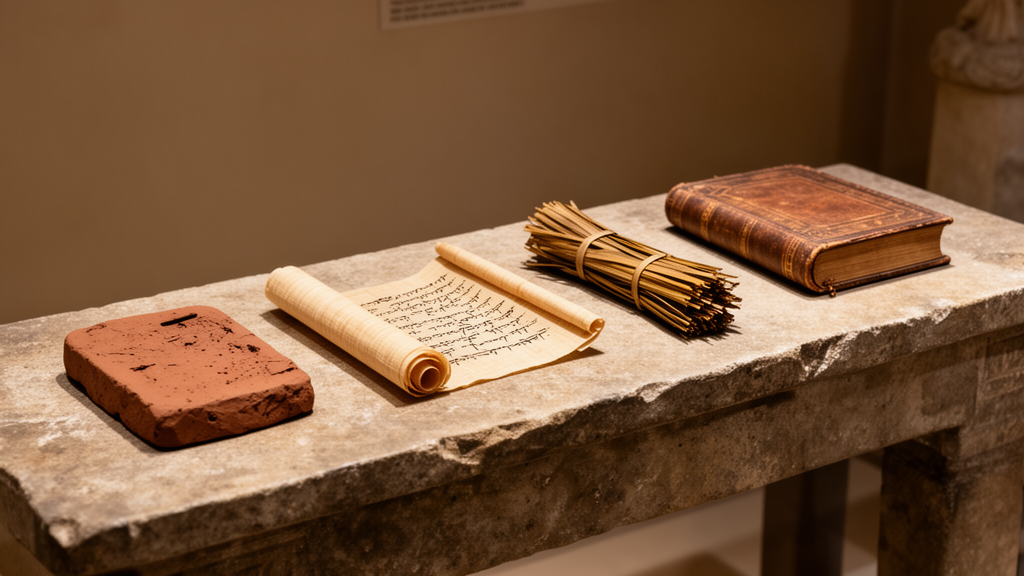
These examples show that “oldest” can refer to many things: the oldest surviving literary text, the oldest manuscript of a particular scripture, the oldest funerary spell collection, or the oldest complete copy of a Bible. Hindu tradition would most often answer the question with the Vedas, but the wider historical record includes older or differently defined works.
Why the rankings disagree
Readers often find conflicting answers because the lists are built on different assumptions. The main reasons are:
- Definition: One list counts only religious scriptures still in use. Another counts any surviving written work.
- Dating method: Some dates come from inscriptions, some from carbon dating, and some from style or context. Each method has its own range of uncertainty.
- Oral versus written: A text transmitted orally for centuries may be very old in content but young in its earliest surviving written form.
- Completeness: A fragment of a very old text may be included in one list and excluded from another that requires a complete work.
- Popular simplification: General lists often present rough estimates as exact years.
The honest answer, then, is to name the category first. For Hinduism, the Rigveda is the standard answer. For ancient written literature as a whole, the answer depends on the list’s criteria.
The wider Hindu scriptural collection
Hindu scripture is not limited to the Vedas. Traditions commonly distinguish between shruti, understood as revealed texts such as the Vedas, and smriti, understood as remembered texts such as epics, law books, and later writings. This is a traditional classification and is used differently across Hindu schools and communities.
Readers searching for a “holy book” in Hinduism often find other texts that are important in daily life. Two common examples are the Upanishads, which are philosophical texts usually attached to the Vedas, and the Bhagavad Gita, which forms part of the epic Mahabharata and is widely read for its teachings on duty, devotion, and knowledge. The Gita is revered by many Hindus, and many readers also know it through different translations and commentaries. HindusGod.com has several posts on the Gita and related topics that readers may find useful:
- For a general overview of the Gita, see Gita Holy Book, which covers the text as a devotional and philosophical resource.
- For a related spelling and background note, see Geeta Holy Book.
- For the wider question of what scripture means in Hindu life, see Holy Book Meaning.
These pages are target drafts in WordPress and may not be public yet. The owner should confirm that each link is live before publication.
How Hindu tradition and historians approach the same text
Many confusions about the “oldest holy book” come from mixing belief with history. Hindu tradition may hold that the Vedas are eternal or revealed, and that belief is central to how many people relate to them. A historian studies the same texts through language, manuscript evidence, comparative linguistics, archaeology, and context. Neither approach needs to erase the other, but a careful article should label each claim as belief, textual evidence, tradition, or scholarly interpretation.
For example, saying “the Rigveda is shruti” describes a traditional classification. Saying “the Rigveda is among the earliest surviving Indo-European religious texts” is a historical and linguistic claim. Saying “the Rigveda was composed in exactly 1500 BCE” would be false precision. Clear labels help readers avoid these errors.
Other religions’ holy books in the same comparison
Readers who ask about the oldest holy book often compare the Vedas with the Bible, the Quran, the Avesta, and other scriptures. Each tradition has its own canon, history, and way of preserving the text. Comparing them directly can mislead if the reader assumes that all traditions define scripture the same way.
- The Avesta is the sacred collection of Zoroastrianism, and readers can explore it through Avesta Holy Book.
- Buddhist scriptures are discussed in Buddhist Holy Book, which can help readers see how Buddhist canons differ from Hindu ones.
- Confucian and Daoist writings are covered in Confucianism Holy Book and Daoism Holy Book, though some traditions treat these works more as philosophy or ethics than as scripture in a narrow sense.
- The Bahá’í writings are discussed in Bahai Holy Book.
The Wikipedia list of religious texts groups traditions by region and period, including Hinduism among Indian religions and separate entries for many other faiths. That structure is helpful for orientation, but a list does not establish which text is oldest. Readers should check each tradition’s own sources and scholarly accounts.
Reading ancient scriptures respectfully
If you are new to the Vedas or other ancient texts, a few practical habits can help:
- Start with a reliable translation and note the translator. Translations of the Vedas vary in style and interpretation. Compare more than one where possible.
- Separate the text from commentary. Medieval and modern commentaries explain the text in light of later traditions. They are valuable, but they are not the same as the original hymns.
- Learn some Sanskrit terms in context. Words such as shruti, smriti, and mantra have technical meanings that shift across schools and periods.
- Ask which community you are learning from. A temple tradition, a household custom, a philosophical school, and an academic reading can each emphasize different things.
- Keep devotion and history distinct. You can respect a scripture as sacred while also acknowledging that historians date and study it differently.
These habits matter because ancient texts are living traditions for many people, not only museum objects. Respectful reading includes accuracy about what a text says, humility about what is unknown, and attention to the communities that preserve it.
FAQs
Is the Rigveda the oldest holy book in the world?
The Rigveda is the most common answer for the oldest holy book in Hinduism, and the Wikipedia article on religious texts describes it as the oldest religious text in any Indo-European language. It is not necessarily the oldest religious or written text in the world. Other lists include older or differently defined works, and the answer depends on how “holy book” and “oldest” are defined.
Why do some lists name a different oldest book?
Different lists use different criteria. Some count only living scriptures, some count any surviving text, and some count complete works. Dating methods also vary, and some ancient manuscripts have uncertain dates. Always check the definition and date method behind a ranking.
Are the Vedas and the Bhagavad Gita the same kind of text?
No. The Vedas are classed in Hindu tradition as shruti, revealed texts. The Bhagavad Gita is part of the epic Mahabharata and is widely read as a devotional and philosophical text. Traditions classify and use them differently, and communities vary in how they treat both.
Key takeaway
For Hinduism, the Rigveda is the usual answer to the question of the oldest holy book. For the wider world, the answer depends on the definition of a holy book and the evidence used to date it. The most accurate approach is to name the tradition, separate belief from historical evidence, and read ancient texts with attention to translation, commentary, and community practice.
Sources and Further Reading
- Religious text – Wikipedia: Used for the general definition of religious texts, the description of the Rigveda as the oldest religious text in any Indo-European language, and the manuscript caption dating it to 1500–1000 BCE. Treat the caption as an estimate.
- List of religious texts – Wikipedia: Used for the overview of religious texts across traditions and the placement of Hinduism among Indian religions. This is a dynamic list and does not establish which text is oldest.
- 10 Oldest Religious Texts in The World – Oldest.org: Used only for popular descriptions of the Kesh Temple Hymn, Pyramid Texts, and Coffin Texts. Its dates and claims should be checked against academic sources before final publication.
- 10 Most Ancient Surviving Books in Human History – The Archaeologist: Used for the point that the question of the oldest surviving book depends on definition, and for the note that the Madrid Codex’s creation date is debated.
- 10 Oldest Bibles of All Time – Oldest.org: Used for the description of Codex Vaticanus as an early Greek Bible manuscript that is not a complete copy.
- Ethiopian Bible is the oldest and complete bible on earth – Orthodox Christian Laity: Used for a 2016 report on the Garima Gospels and their carbon-dated range of 330–650. This is a secondary news summary and should be checked against the original research before publication.