The term vyas sutra is not a single fixed title in the sources reviewed for this article. Readers most often mean one of two things: the Brahma Sutras, also called the Vedanta Sutra, which are attributed to Badarayana and identified in many traditions with the sage Vyasa; or the Yoga Sutras of Patanjali, which appear in some editions together with a commentary attributed to Vyasa. This post explains both, separates what the texts say from what tradition claims about authorship, and points to sources you can check.
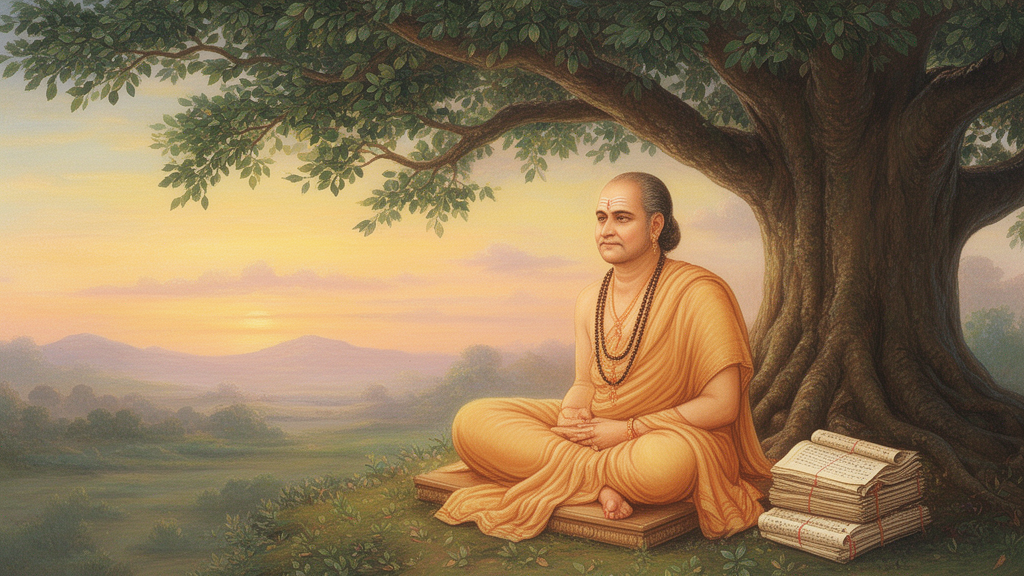
In short: if you are looking for a text called a Vyasa sutra in the Vedanta tradition, the best-documented answer is the Brahma Sutras. If you are looking at a Yoga text with Vyasa’s name attached, the relevant work is the Yoga Sutra together with Vyasa’s bhashya (commentary).
What the term vyas sutra usually refers to

The word sutra means a thread or aphoristic line, and Sanskrit sutra literature is built from very compressed statements meant to be explained by a teacher or commentary. Because of this, a title such as “Vyas Sutra” can point to different works depending on the reader’s background.
- Brahma Sutras (Vedanta Sutra): a foundational text of the Vedanta school of Hindu philosophy. Wikipedia’s entry notes that it is also known as the Shariraka Sutra and the Bhikshu-sutra.
- Yoga Sutra with Vyasa’s commentary: the Yoga Sutras of Patanjali, with the early commentary known as the Yogabhashya, which the English translation summarized by Wisdom Library calls the Sankhya Pravachana.
Search results may also use the phrase loosely. Because the sources reviewed here do not establish a single standard title called “Vyas Sutra”, this article does not treat the phrase as a formal scriptural name.
Who was Vyasa?
Vyasa, also called Vedavyasa or Maharishi Vyasa, is one of the most revered sages in the Hindu tradition. Wikipedia’s article on Vyasa describes him as an ancient Indian sage and lists several works traditionally attributed to him, including the Vedas (as their divider or arranger), the Mahabharata, the Puranas, and the Brahma Sutras. It also notes that Guru Purnima is associated with honouring him.
These attributions belong primarily to tradition and devotion. They are important for understanding how the texts are read in many communities, but they are not the same thing as modern historical proof of who wrote each work. Scholars generally treat the question of single or multiple authorship as an open academic discussion. This article therefore uses phrases such as “traditionally attributed to” when discussing Vyasa.
Belief, tradition, and scholarship
Three kinds of claims appear in discussions of Vyasa:
- Scriptural or traditional claims: texts and commentators within Hindu traditions attribute particular works to Vyasa or to Badarayana, whom some identify with Vyasa.
- Devotional claims: Vyasa is honoured as a teacher and a source of sacred knowledge, and his name is invoked in ritual and reverence.
- Academic claims: historians and philologists study manuscripts, language, and textual layers to estimate when texts were composed and how they were compiled.
Keeping these categories distinct prevents a common confusion. A reader can respect the attribution to Vyasa within a tradition while also recognizing that a scholarly date for a text may be later than the traditional date of its sage-author.
The Brahma Sutras: an overview
The Brahma Sutras are among the three texts that form the Prasthana Traya, described by Shlokam as the triple foundation of Vedanta, alongside the Upanishads and the Bhagavad Gita. Shlokam’s introduction states that the text is attributed to the sage Badarayana, who is identified with Vyasa, and that its surviving form is dated to approximately 400–450 CE, while its core material may go back to 200 BCE or earlier. These dates are presented as estimates in the source, and readers should treat them as scholarly approximations rather than fixed facts.
The text is usually described as containing 555 aphorisms arranged into four adhyayas (chapters), sixteen padas (sections), and 223 adhikaranas (topics). Shlokam notes that the sutras are so terse that they are often only two or three words long and are intelligible mainly through commentary. This is a key point for readers: the Brahma Sutras are not a narrative scripture like the Ramayana. They are a compact map of arguments that depends heavily on teachers and commentaries.
The opening line
The first sutra, as transliterated and explained by Shlokam, is athatho brahma jijnasa, rendered as “now, therefore, the inquiry into Brahman.” The source reads it as setting the frame: the text is addressed to those who have completed preliminary study and are ready for systematic Vedantic inquiry. This interpretation belongs to the commentarial reading presented by Shlokam, not to a universal consensus of all schools.
Structure and themes of the Brahma Sutras
Shlokam summarizes the four chapters in a way that helps newcomers see the text’s architecture. The following overview follows that source’s description.
Adhyaya 1: Samanvaya (harmony)
The first chapter argues that the Upanishads, despite differences in language and imagery, consistently point to Brahman as their primary subject. Shlokam says the first four sutras, known as the Catuhsutri, identify Brahman as the object of inquiry, define Brahman as the source of the world, establish the Vedas as the valid means of knowing Brahman, and affirm that the Upanishads teach this consistently.
Adhyaya 2: Avirodha (non-contradiction)
The second chapter is largely defensive. It aims to show that Vedanta does not contradict itself and that objections from rival schools fail. Shlokam says it engages Samkhya, Yoga, Vaisheshika, and Nyaya, as well as Buddhist schools. This chapter is more polemical in style, so readers who are new to philosophy may find it the hardest section without a commentary.
Adhyaya 3: The means to spiritual knowledge
The third chapter, as summarized on Wikipedia’s Brahma Sutras page, deals with the means to spiritual knowledge, including the nature of liberating knowledge and upasana, meaning worship or meditation. The same heading is used in the contents of that article, which makes it a useful reference point for readers who want to map the text section by section.
Adhyaya 4: The benefits of spiritual knowledge
The fourth chapter, according to Wikipedia’s contents outline, addresses the benefits of spiritual knowledge. Scholarly and devotional readings differ on how this chapter should be understood in detail, so readers should consult a translation with commentary rather than relying on a short summary.
Commentaries: why one sutra can have many readings
One of the most important features of the Brahma Sutras is that they have been interpreted by several major schools, sometimes in opposite ways. Shlokam names Shankaracharya’s Advaita bhashya (8th century CE) as the most important commentary and lists others by Ramanuja (Vishishtadvaita), Madhva (Dvaita), Nimbarka, and Vallabha. Wikipedia’s article also includes sections on commentaries, exegesis, and translations.
This does not mean that every Hindu reads the Brahma Sutras in the same way. Advaita, Vishishtadvaita, Dvaita, and other Vedanta schools differ on important questions, including the relation between Brahman, the individual self, and the world. For this reason, when you read a claim about the Brahma Sutras, ask which commentary or school is being described.
A practical example
Consider the opening inquiry into Brahman. A reader who studies Shankara’s Advaita framework will usually see Brahman as non-dual reality. A reader following Ramanuja’s Vishishtadvaita framework will understand Brahman as qualified by a differentiated world and selves. Both readers begin from the same sutra, but the explanations differ. A good study method is to read a sutra in translation first, then compare two commentaries to see where their interpretations diverge.
The Yoga Sutra and Vyasa’s commentary
Readers who encounter “Vyasa sutra” in a yoga context usually meet the Yoga Sutras of Patanjali. Wisdom Library’s translation, by Rama Prasada, describes the work as a collection of aphorisms dealing with samadhi (meditative absorption), sadhana (yoga practice), vibhuti (powers or siddhis), kaivalya (isolation), and moksha (liberation). Its summary lists Vyasa’s commentary as the Sankhya Pravachana or Yogabhashya, dated in that source to the seventh century, and notes a gloss by Vachaspati Mishra called the Tattvavaisaradi, dated to the ninth century.
The Internet Archive also hosts a 1917 edition from the Bombay Sanskrit and Prakrit Series with the title Patanjal Yoga Sutra with Bhashya of Vyasa and Commentary of Vachaspati Mishra, edited by Rajaram Shastri Bodas. Editions differ in arrangement, annotation, and language, so compare the edition you use with the sources above.
What the commentary adds
A bhashya explains a sutra line by line. In the Yoga context, Vyasa’s commentary is a major reason the sutras are studied as a philosophical and practical system rather than as a set of isolated statements. Readers should note that the commentary is not the same as the aphorisms themselves. When a modern writer says “the Yoga Sutra teaches X,” a careful reader should ask whether X is in the sutra text, in Vyasa’s commentary, or in later explanation.
Where to start reading
Because these texts are dense, a structured approach helps:
- Choose the text you mean. Decide whether your interest is Vedanta (Brahma Sutras) or Yoga (Yoga Sutras with Vyasa’s bhashya).
- Use a translation with notes. Prefer a translation that identifies the commentary it follows and explains technical terms.
- Read one adhyaya or book at a time. Do not try to master the full text in a single reading.
- Compare two commentaries. For the Brahma Sutras, compare Shankara with Ramanuja or Madhva. For the Yoga Sutras, compare Vyasa with Vachaspati Mishra’s gloss.
- Check claims against the text. When a secondary article describes a teaching, look for the relevant sutra and commentary.
Tradition, regional practice, and interpretation
Hindu traditions are diverse. Vedanta schools, Yoga traditions, and devotional communities may all honour Vyasa while reading texts differently. Some communities give the Brahma Sutras central place in their philosophical education. Others approach the Vyasa name primarily through devotion, Guru Purnima observances, or the Mahabharata and Puranas. Regional schools, monastic lineages (sampradayas), and family traditions also shape how texts are taught.
For this reason, avoid describing any single reading as the only Hindu view. A respectful description says, for example, “In the Advaita tradition associated with Shankara, the first sutra is read as…” rather than “Hindus believe…”
Why authorship matters, and why it may not settle every question
The traditional attribution of the Brahma Sutras to Badarayana and its identification with Vyasa matters to many readers. It connects the text to a sage whose name is honoured across the tradition. However, a scholarly reader will also ask how a compact aphoristic text was formed, edited, and transmitted over centuries. The sources reviewed here present a range of dates and a range of attributions, which is itself a reason to read with care.
A balanced approach holds two things together: the text is treated as sacred or authoritative within its tradition, and its historical development is studied with academic methods. Neither approach needs to cancel the other, but they answer different questions.
Practical examples for study
- Example 1: Identifying a term. If you see “Brahman” in a Brahma Sutras discussion, check whether the author means the non-dual reality of Advaita or a qualified Brahman in Vishishtadvaita.
- Example 2: Reading a Yoga term. When samadhi appears in Patanjal’s sutras, the Yoga Sutra summary identifies it as meditative absorption, a term that is also discussed differently in other traditions.
- Example 3: Checking an edition. If a book quotes Vyasa’s commentary on Yoga Sutra 1.1, check whether the edition clearly labels the commentary as separate from the sutra.
Related reading on HindusGod.com
The following HindusGod.com articles are currently in draft status in the WordPress database and may not be public. Their links below should be treated as target destinations to confirm before publication. They are included only where they address a related topic: the Bhakti Sutra for devotional aphorisms, the Dhyana Sutra for meditation-related sutra literature, the Devi Sutra for another Hindu sutra topic, and the Meaning Sutra for general sutra vocabulary. Bhakti Sutra discusses devotional aphorisms. Dhyana Sutra covers meditation-related teachings. Devi Sutra is relevant to readers exploring other Hindu sutra texts. Meaning Sutra may help readers who are new to the word sutra. Status: URL to confirm before publication.
The Avatamsaka Sutra (draft link) is a Mahayana Buddhist text. It is not part of the Vyasa attribution and is listed here only as a reminder that the word sutra is used across Indian traditions. Status: URL to confirm before publication.
Frequently asked questions
Is there a text officially called the Vyas Sutra?
The sources reviewed do not establish a single standard title called “Vyas Sutra.” The phrase most often points readers toward the Brahma Sutras or the Yoga Sutras with Vyasa’s commentary.
Did Vyasa personally write the Brahma Sutras?
The text is attributed to Badarayana, who is identified with Vyasa in many traditions. Whether a single author composed it is a matter of tradition and scholarly discussion. Present this as attribution rather than settled historical fact.
Do I need to read the commentaries?
For the Brahma Sutras, yes, in practice. Shlokam notes that the sutras are intelligible mainly through commentary. A translation that includes a commentary or introduction is strongly recommended.
Summary and next step
The phrase vyas sutra most often leads to two bodies of literature: the Brahma Sutras of the Vedanta tradition, traditionally linked to Vyasa and attributed to Badarayana, and the Yoga Sutras of Patanjali with Vyasa’s bhashya. The Brahma Sutras are organized into four chapters and rely heavily on commentaries such as Shankara’s Advaita bhashya. The Yoga Sutras cover samadhi, practice, powers, isolation, and liberation, and are commonly studied with Vyasa’s and Vachaspati Mishra’s commentaries.
Your next step is to identify which text you need, choose a translation with commentary, and compare at least two interpretations before drawing conclusions. Keep the tradition, the text, and the scholarly evidence distinct as you read.
Sources and further reading
- Vyasa, Wikipedia: overview of Vyasa’s traditional attributions, including the Brahma Sutras, and his honours in Hindu tradition.
- Brahma Sutras, Wikipedia: description of the text as a foundational Vedanta work, its alternative names, and its chapter outline.
- Brahma Sutras: Translation, Word Meaning and Commentary, Shlokam: introduction on attribution to Badarayana, the Prasthana Traya context, aphorism and section counts, and major commentaries.
- Yoga-sutras (with Vyasa and Vachaspati Mishra), Wisdom Library: summary of the Yoga Sutras, Vyasa’s bhashya, and Vachaspati Mishra’s gloss in an English translation.
- Patanjal Yoga Sutra with Bhashya of Vyasa and Commentary of Vachaspati Mishra, Internet Archive: a 1917 Bombay Sanskrit and Prakrit Series edition by Rajaram Shastri Bodas.