The term Vishwakarma Shastra is used loosely for Sanskrit treatises on architecture, building, craft, and image-making that are traditionally attributed to Vishvakarma, the divine architect of the Hindu gods. The best-documented text in this group is the Vishvakarma Vastushastra, a work on architecture and planning. Related craft and iconography texts are grouped under the broader Shilpashastra tradition. This article explains what the name usually refers to, what the surviving texts contain, and where the evidence is devotional, textual, or scholarly.
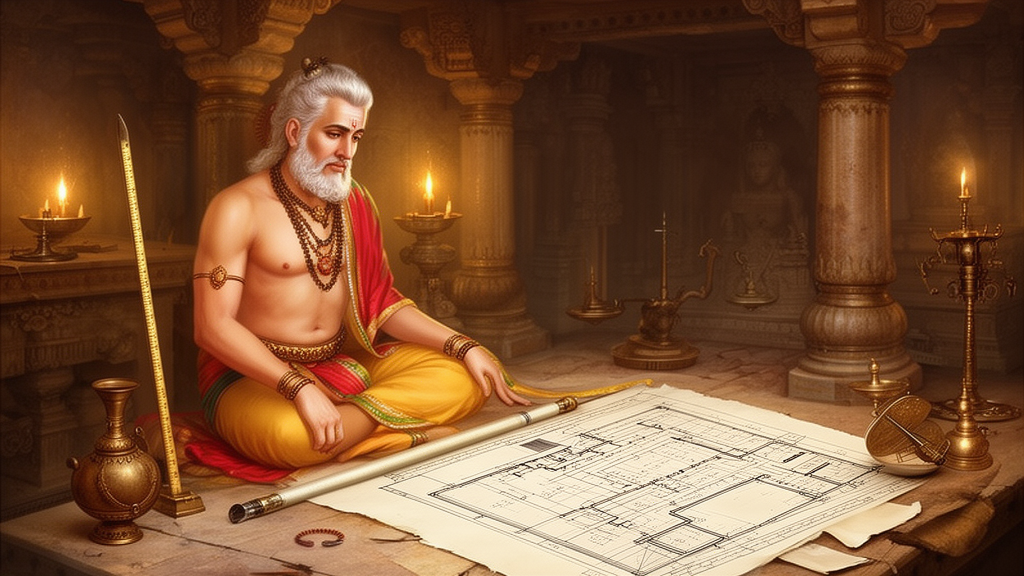
Direct answer: what is the Vishwakarma Shastra?
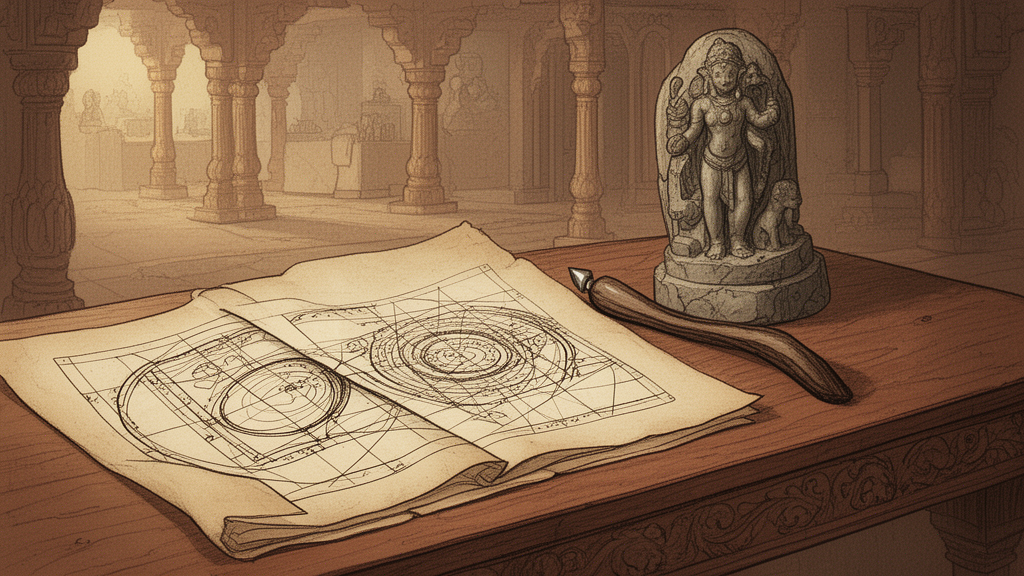
In most usage, Vishwakarma Shastra means a body of Sanskrit instruction attributed to Vishvakarma on building design, town and village planning, measurements, temples, and sometimes the making of images. It is not a single universal scripture with one fixed text. Readers may encounter several editions, commentaries, and regional versions under related titles, so the exact contents depend on which text is meant.
Three points help readers avoid confusion:
- Attribution is traditional. The texts are ascribed to Vishvakarma. That ascription is part of Hindu tradition and devotional belief; it is not the same as a verified authorship record.
- The texts are mainly practical. The Vastushastra material is largely about architecture and planning, with a smaller share on iconography and ritual. A review of one printed edition, summarized in a Hindu Blog article, says that most of its 87 chapters address architectural topics.
- Vastu is not the same as all of Vishwakarma tradition. Popular modern Vastu advice often goes beyond what the classical texts say. The sections below separate the textual content from later interpretation.
Who is Vishvakarma?
The Wikipedia article on Vishvakarma describes him as the “Architect of the Devas” and lists his mantra as Om Viśwakarmane Namaḥ. It also lists traditional symbols including a scale, a kamandalu (water pot), a book, a hammer, and a chisel, and gives the goose as his mount and the elephant as an associated animal. These details are iconographic conventions recorded in a general reference work, not an independent historical proof of the god’s life. Readers who want the devotional side should treat these as traditional attributes.
Wikipedia’s genealogy listing names Prabhasa as father and Yogasiddha or Angirasi as mother, with Ghritachi as consort. Hindu traditions and retellings differ on these relationships, so treat the family details as one recorded version rather than a single universal account.
Devotional role and craft communities
In many communities, Vishvakarma is honored as the patron of craftspeople, builders, artisans, and engineers. That devotional role is a living practice and belongs to tradition and community life. The Wikipedia article includes a section titled “Vishvakarma Puja,” which points readers to observances connected with the deity. Specific dates, rituals, and regional customs vary, and this article does not set a festival date. Readers should check a current local calendar or community source for the date and method that applies to them.
The main texts associated with Vishwakarma
The Wikipedia article organizes Vishvakarma’s literary appearances into the Vedas, the epics and Puranas, and the Shilpashastra. That structure is useful, but it is a summary. The most concrete text-level evidence available for this article comes from the Vastushastra works, the Shilpa tradition, and printed editions that catalogue them.
Vishvakarma Vastushastra
A Hindu Blog article on the “Vastushastram of Vishwakarma” describes it as a Sanskrit work on architecture ascribed to Vishwakarma. It notes a commentary named Pramanabodhini by Anant Krishna Bhattar Kavi in the edition it discusses. The same article lists topics covered by its introduction, including auspicious time, site selection, measurements, planning villages and cities, the design of the vastumandala (a grid-based diagram used in site planning), house construction, forts, temples, tanks, cowsheds, roads, and the forms of images.
The same review says its table of contents has 87 chapters, most of them on architectural subjects and a few on iconography and rituals. It describes chapters on measurements, with the smallest unit called pramana and the largest called yojana. It also describes building types such as judicial courts, treasuries, libraries, dining halls, stables, schools, theaters, and granaries. The article is a secondary description of one edition. Readers who need exact chapter numbers should consult the text itself.
Archive collections also list editions. The Internet Archive holds an item titled Viswakarma Vastusastram from 1958, credited to Sastri Sri K. Vasudeva, and a separate Internet Archive record for a Devanagari and transliterated edition titled Visvakarma Vastusastram. These catalogue records confirm that editions exist and show their titles and publication details. They do not by themselves verify the translation or commentary inside each file.
Shilpashastra and craft instruction
The Wikipedia article includes a “Shilpashastra” heading under Vishvakarma’s literature and legends. Shilpashastra is a broader category of texts on crafts, art, sculpture, and building. Vishvakarma is associated with this tradition, but the category includes many works from different periods and regions. Treat any claim that a single work is “the” Shilpashastra as an oversimplification.
What the classical building rules cover
Vastu texts give instructions about how land, rooms, and structures should be arranged. These rules belong to a textual and craft tradition. They are not the same as modern building codes, and they do not guarantee any outcome.
Plot shape and soil testing
A translated PDF of a text titled Vishwakarma Prakash, uploaded to Scribd, gives examples of plot shapes described as auspicious or inauspicious. It lists square, elephant, lion, and bull shapes with associated benefits such as food grain, wealth, progeny, and cattle. The same translated material describes a test pit that is refilled with excavated soil, with the quality judged by whether soil fills the pit completely. The translation shown on that upload is user-provided and has not been independently verified against a critical edition, so treat the wording as indicative only.
Read in context, these are classical categories of site evaluation. They reflect the premises of the text. They are not tested engineering standards, and they should not be applied as a substitute for structural, soil, or legal advice.
Directions and room placement
The same Scribd translation gives directional rules for placing a temple, bathroom, kitchen, storeroom, study room, and bedroom within a house. Directions are described using traditional terms such as north-east (Ishaan) and south-east (Aagneya). The text assigns functions to zones within a home. Some of these arrangements are still followed in parts of India and in diaspora communities, but practice varies widely by region, family, and builder. Many households and architects follow only some of these rules, or none.
A cultureandheritage.org blog post on Vishwakarma Vastu Shastra presents the tradition as a way to harmonize buildings with natural elements and says it aims at prosperity and well-being. That blog is a popular interpretation rather than a primary text, and its claims about health, wealth, and prosperity should be read as devotional and cultural belief, not as a measurable result of building design. This article does not endorse those claims.
The five elements
Many Vastu presentations describe the five elements (pancha bhuta) of earth, water, fire, air, and space. The cultureandheritage.org article connects them with directions and room use. The classical texts’ use of the five elements varies by work, and modern Vastu teaching often adds material not found in the older Sanskrit sources. Readers should separate the elemental framework from later practitioner advice.
Shastra, Vastu, and Shilpa: why the words matter
The Sanskrit word shastra means a teaching, treatise, or systematic body of knowledge. It can apply to scripture, law, science, or craft. A shastra on architecture therefore is a technical text, while a religious scripture is a different category. The two can overlap in Hindu practice, but they are not interchangeable.
Vastu refers to a dwelling, site, or the way a space is arranged. Vastushastra is the study of this subject as a treatise. Shilpa refers to craft, art, or making, and Shilpashastra covers works on craft and image-making. Because the names overlap, one edition may be titled Vastushastra while another is listed under Shilpashastra, and a commentator may add material on rites or iconography.
Readers who see the name “Vishwakarma” in different contexts should check which text is meant. Commercial guides and websites often merge Vastu practice, astrology, and personal advice under the same heading. Those practices are not necessarily found in the classical texts.
Related shastra topics on HindusGod.com
Readers exploring Vishwakarma Shastra may also want to read about other texts that use the word shastra in their titles. Each of these is a separate subject and should be checked for its own sources. The following posts are currently WordPress drafts, so they may not be public yet:
- Agama Shastra covers temple and ritual texts that are relevant to the wider question of how sacred architecture and worship are ordered.
- Akshar Shastra explores letters and sound-based knowledge, which can help readers distinguish a craft treatise from a text on sacred syllables.
- Bhakti Shastra explains devotional writings, which is useful for comparing devotional belief with technical instruction.
- Brahman Shastra discusses the concept of Brahman, a reminder that many shastras concern metaphysical teaching rather than craft.
- Ganapati Shastra is relevant for readers interested in Ganesha-centered ritual and iconography.
- Durga Shastra offers context on another devotional and iconographic tradition that appears in temple and image-making literature.
- Dharma Dharma Shastra addresses the wider idea of dharma as an organizing principle for conduct and society.
- Geeta Shastra and Gita Shastra both point readers to discussions of the Bhagavad Gita; the two drafts may overlap and should be reviewed for duplication before publication.
- Bhagwat Shastra points to Bhagavata-related teaching for readers comparing Purana-based devotional literature with craft treatises.
These links are included for context only. Before publication, the owner should confirm that each destination is accurate, public if desired, and not duplicated by another post.
How to study Vishwakarma Shastra responsibly
A careful reader can approach these texts in four steps. First, identify the exact title, edition, and language. Second, look for a translator, commentator, or publisher. Third, check whether the passage is a classical instruction, a later commentary, or a modern interpretation. Fourth, ask whether the claim is about craft, belief, ritual, or outcome.
Use editions and translations with care
Printed editions may contain introductions, commentaries, and tables of contents that reflect the editor’s decisions. The Hindu Blog review describes an edition that includes an English introduction and bilingual tables of contents. Such an edition is useful for orientation, but it is not identical to every manuscript tradition. Where translations are uploaded by users or shared informally, verify them against an edition with a known translator.
Separate tradition from modern advice
Modern Vastu consultants often present precise rules as if they come directly from classical texts. Readers should check whether a particular rule is attested in the text, in a named commentary, or only in later practice. Where the source cannot be checked, the claim should be treated as unverified.
Frequently asked questions
Is Vishwakarma Shastra one book?
No. The phrase usually refers to a group of texts attributed to Vishvakarma. The best-known example discussed here is the Vishvakarma Vastushastra, but other works and editions carry related titles.
Does Vishwakarma Shastra only cover houses?
No. The Hindu Blog review of one Vastushastram edition describes chapters on villages, cities, forts, temples, tanks, roads, public buildings, and iconography, as well as houses.
Are the directional rules the same in every region?
No. Practice differs by region, family, builder, and community. The text’s rules should be presented as one tradition’s instructions, not as a universal requirement.
Will following these rules bring wealth or good health?
The classical texts describe their rules within a framework of prosperity and well-being, but this article cannot verify that building arrangements produce material results. Any such outcome belongs to devotional or cultural belief.
Summary
Vishwakarma Shastra is best understood as a family of Sanskrit texts and traditions attributed to Vishvakarma, the divine architect. Its best-documented strand is the Vastushastra literature on architecture, planning, measurements, and craft. Editions and translations differ, and many popular Vastu claims go beyond the classical sources. Readers who want to explore further should start with a named edition, compare it with a commentary, and keep devotion, textual instruction, and modern interpretation separate.
Sources and further reading
- Vishvakarma, Wikipedia: used for the description of Vishvakarma as architect of the Devas, the mantra, traditional symbols, mount, family listing, and the article’s section structure on literature, Shilpashastra, and Vishvakarma Puja. Wikipedia is a secondary reference and should be checked against primary sources before final publication.
- Vastushastram of Vishwakarma, Hindu Blog: used for the description of the Vastushastram edition, its commentary by Anant Krishna Bhattar Kavi, the 87-chapter count, topic list, and measurement terms. This is a secondary review of one edition.
- Viswakarma Vastusastram (1958), Internet Archive: used to confirm the existence and title of a 1958 edition credited to Sastri Sri K. Vasudeva. The catalogue record does not verify translation or commentary.
- Visvakarma Vastusastram, Internet Archive: used to confirm the title of a separate catalogued edition. The page was inspected as a catalogue record.
- Exploring the Wisdom of Vishwakarma Vastu Shastra, The Cultural Heritage of India: used for the popular description of the tradition, its attribution, and its claims about harmony, prosperity, and the five elements. This is a popular blog interpretation and not a primary text.
- Vishwakarma Prakash: Vastu Shastra, Scribd: used cautiously for the plot-shape examples, test-pit description, and directional room rules shown in a user-uploaded translation. The translation has not been independently verified and should be checked against a critical edition before publication.