The Vimalakirti Nirdesa Sutra is a Mahayana Buddhist scripture in which a lay householder named Vimalakirti teaches advanced monks and bodhisattvas about non-duality and emptiness (śūnyatā). Its best-known episode is a silent response that many readers treat as the text’s final teaching. This guide explains what the sutra says, how it is structured, how its major themes are understood in different traditions, and how to read it responsibly. It is a Buddhist scripture, not a Hindu one, but it comes from the same Indian cultural world and is still valued by readers of many backgrounds.
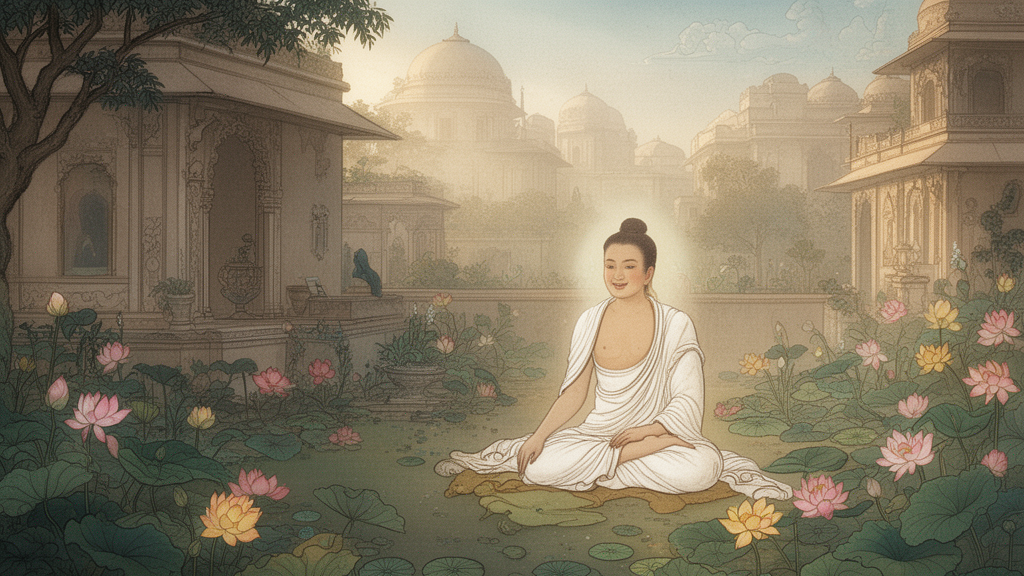
What the Vimalakirti Nirdesa Sutra Is
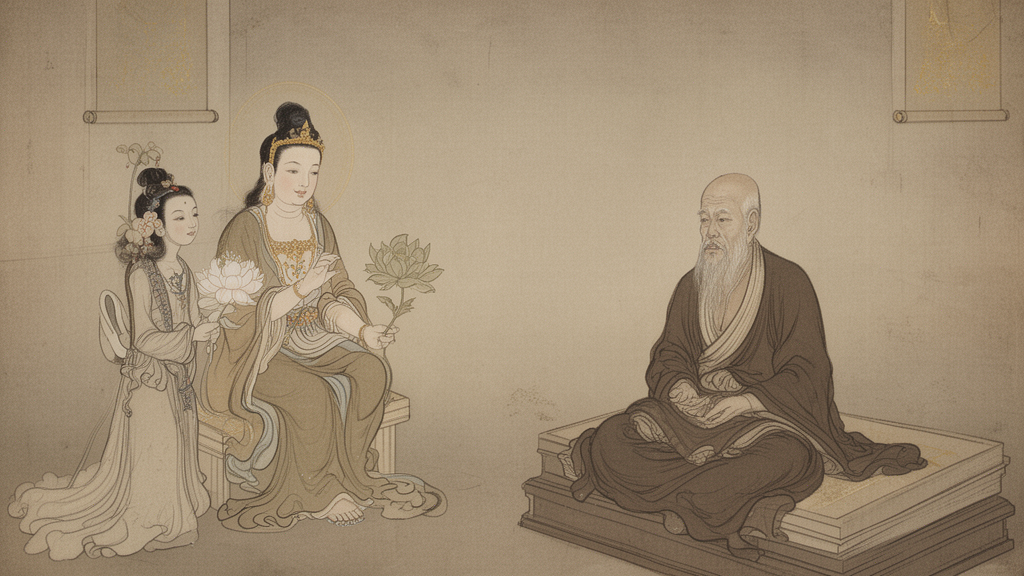
The title is usually given in Sanskrit as Vimalakīrtinirdeśa Sūtra. Scholars and translators also write it as Vimalakirti Nirdesa Sutra, Vimalakirtinirdesa Sutra, or simply Vimalakirti Sutra. The name Vimalakirti is commonly rendered as “Undefiled Reputation,” according to the summary on the Wisdom Library page. The word nirdeśa is generally understood as “exposition” or “teaching,” so the title can be read as “the teaching of Vimalakirti.” These spelling variants all refer to the same text, but library catalogs, translations, and websites use them inconsistently, so readers may see more than one form.
Wikipedia describes the work as a sutra in Mahayana Buddhism and includes it among the major Mahayana sutras. It also shows a Chinese painting from the Dunhuang Caves of the Tang dynasty depicting Vimalakirti debating the bodhisattva Mañjuśrī, which shows how the text was visualized in East Asian Buddhist art.[1]
Where This Text Fits in Religious Traditions
Readers who come to HindusGod.com from a Hindu background should keep one distinction clear. The Vimalakirti Nirdesa Sutra belongs to the Buddhist tradition. It does not form part of the Vedic, Upanishadic, Puranic, or Agamic literature used in Hindu worship and theology. Its characters are Buddhist figures, including the Buddha, the disciples Śāriputra, and bodhisattvas such as Mañjuśrī, and its doctrinal vocabulary comes from Buddhist philosophy.
The text still matters for comparative study of Indian religion. It shows how Buddhist writers of the Mahayana movement reflected on the relation between worldly life and liberation, and how they used paradox and dialogue to make those ideas concrete. Readers interested in how the word sutra is used across traditions may also find it helpful to compare Buddhist texts with Hindu works bearing the same term, such as the Ashvalayana Sutra, a ritual manual, and the Bhakti Sutra, a text on devotion. The word has different meanings in each context, and treating them as one category would be misleading.
Setting and Structure
The sutra is set in Vaiśālī, an ancient city in the Indian subcontinent, in the garden of Amrapali. The opening, in the English translation by Robert A. F. Thurman published in 1976 by Pennsylvania State University Press, describes a large assembly that includes thousands of monks and tens of thousands of bodhisattvas.[4] This framing is traditional. Its numbers are symbolic descriptions of the gathering, not historical census figures, and readers should not treat them as factual claims about an actual event.
The Wisdom Library index divides the text into an introduction, twelve chapters, and an epilogue. The chapter titles are useful for navigation:
- Chapter 1: Purification of the Buddha-Field
- Chapter 2: Inconceivable Skill in Liberative Technique
- Chapter 3: The Disciples’ Reluctance to Visit Vimalakirti
- Chapter 4: The Reluctance of the Bodhisattvas
- Chapter 5: The Consolation of the Invalid
- Chapter 6: The Inconceivable Liberation
- Chapter 7: The Goddess
- Chapter 8: The Family of the Tathágatas
- Chapter 9: The Dharma-Door of Non-duality
- Chapter 10: The Feast Brought by the Emanated Incarnation
- Chapter 11: Lesson of the Destructible and the Indestructible
- Chapter 12: Vision of the Universe Abhirati and the Tathágata Aksobhya
The Wisdom Library lists the translation at about 37,346 words, which gives a sense of the text’s length.[3] Because chapter titles and word counts depend on the translation and edition, readers comparing sources should check which edition they are using.
The Narrative: Illness, Visits, and Dialogue
The most widely retold storyline is the one summarized in secondary sources. According to the Grokipedia summary of Thurman’s translation, Vimalakirti, a wealthy householder in Vaiśālī, appears to fall ill as a teaching device that draws attention to impermanence and the selfless nature of the body. The Buddha asks his disciples and bodhisattvas to visit and inquire about his health. Several decline, recalling earlier discussions in which Vimalakirti’s non-dual insights left them unable to answer. Mañjuśrī agrees to go, and a large assembly follows him to Vimalakirti’s home for extended dialogue.[2]
This account is consistent with the chapter titles listed on Wisdom Library, which name the disciples’ reluctance, the bodhisattvas’ reluctance, and the consolation of the invalid.[3] Readers should still consult the full translation for exact wording, because summaries compress and sometimes reorder episodes.
The Illness as Teaching
In the sutra, illness is not presented as a misfortune to be explained away. The text uses Vimalakirti’s sickness to open a discussion of the body. The opening teaching in the Berlin Buddhist Society PDF, which was listed in the research set but not fully inspected, begins with the four main elements and describes the body as impermanent and unreliable. Readers can use that passage to see the teaching in context, while noting that the cited PDF was not fully reviewed for this post.[5] The point of the episode is philosophical instruction, not a claim that illness has a specific spiritual cause or that devotional practice guarantees healing.
The Goddess Episode
One of the most discussed scenes, according to the Grokipedia summary, involves a goddess who transforms the elder Śāriputra to illustrate the absence of fixed gender distinctions.[2] The scene is often cited in discussions of gender in Buddhist literature. Because it is a summary of a secondary source, readers should check the chapter 7 text in a full English translation before quoting or teaching it. Interpretations of this scene vary. Some readers see it as a challenge to conventional categories of gender, while others focus on its role in illustrating non-duality and the limits of conceptual thinking.
Major Themes
The sutra is best known for its treatment of non-duality. The Wisdom Library summary states that the text teaches, among other subjects, the meaning of non-duality, and that Vimalakirti expounds the doctrine of śūnyatā, or emptiness, to arhats and bodhisattvas.[3] The sutra does not simply deny that things exist. It argues that fixed categories such as pure and impure, self and other, or worldly and sacred do not hold up under close analysis.
Emptiness and Non-Duality
Emptiness in Mahayana thought means that phenomena lack independent, unchanging essence. The Wisdom Library summary says the sutra presents this doctrine through Vimalakirti’s teaching to both monks and bodhisattvas.[3] The Grokipedia summary adds that the text uses the emptiness of dualities such as purity and impurity to show that awakening is not limited to monastic life.[2] Both summaries point to the same central idea: liberation is not found by rejecting the world but by seeing through conceptual divisions.
Skillful Means
Chapter 2 is titled “Inconceivable Skill in Liberative Technique,” and the phrase “skillful means” (upāya) is important throughout the text.[3] In Mahayana Buddhism, skillful means refers to methods suited to a listener’s capacity. The sutra presents Vimalakirti’s illness, his dialogues, and his miraculous displays as examples of such methods. Readers should not treat every episode as a literal event. The narrative is a teaching structure, and different traditions interpret its miracles differently.
The Layperson’s Path
One reason the sutra remains popular among lay readers is its treatment of the householder. Vimalakirti is wealthy, active in city life, and still described as a teacher superior to many monks. The Grokipedia summary says the text emphasizes that full awakening is accessible to laypeople and critiques rigid attachment to monastic or conceptual attainments.[2] This theme is significant for lay Buddhists, but it is interpreted in different ways. Monastic traditions may read the text as a challenge to narrow views of spiritual achievement, while lay practitioners often treat it as an affirmation of ordinary life as a field for practice.
The Power of Silence
The sutra is also known for its ending. The Wisdom Library summary states that the teaching culminates in a wordless teaching of silence.[3] The Grokipedia summary describes Vimalakirti’s silence as the ultimate expression of non-duality.[2] Readers who study Buddhist philosophy often connect this silence to the idea that words cannot fully capture the nature of reality. Readers who are new to the text should note that silence here is a doctrinal and literary climax, not a rule for personal meditation or ritual conduct.
Commentary, Art, and Influence in East Asia
The text has a long history of commentary and visual representation in East Asia. Wikipedia includes sections on East Asian commentaries and on the sutra’s influence in the region, indicating that the text was studied and discussed extensively across Chinese, Korean, and Japanese Buddhism.[1] The Dunhuang painting mentioned earlier shows that the debate between Vimalakirti and Mañjuśrī was visualized in the Tang period.[1]
The Grokipedia summary states that the sutra has been popular for about two millennia among Mahayana Buddhists in India, Central Asia, China, Japan, and Tibet.[2] That broad claim is plausible but is supported only by a secondary summary, so this post treats it as a general description rather than a precise historical finding. For detailed histories of translation and commentary, readers should consult academic sources on Buddhist textual history.
Translations and Reading Notes
Robert A. F. Thurman’s translation, published in 1976, is the English version most often cited in the sources reviewed for this article.[2][4] The Kenyon College page reproduces the opening of that translation, which is copyrighted, so this post does not quote it at length.[4] The Grokipedia summary says Thurman’s translation is based primarily on the Tibetan version and is noted for clarity.[2] That detail should be verified against the translator’s introduction before being repeated as a fact about the translation method.
The Wisdom Library states that the full text in English is publicly accessible online, and it also recommends buying a current edition for the latest版本 of the translation.[3] Readers should compare the online text with a published edition, because online transcriptions may differ in formatting, chapter divisions, and annotations.
- Check the translator, edition, and year before citing a passage.
- Compare chapter numbers across editions, since web pages and printed books may divide sections differently.
- Use commentaries to separate the sutra’s own words from later interpretation.
- Be cautious with online summaries, including AI-generated encyclopedia entries, and verify key claims against the translated text.
How to Read the Sutra
A useful way to approach the text is to read it in stages rather than trying to master its philosophy in one sitting. The steps below are a study method, not a ritual prescription, and they do not imply any specific spiritual result.
- Read the chapter list first to see how the narrative moves from the opening assembly to the illness, the visits, and the final silence.
- Read Chapter 2 with the theme of skillful means in mind, noting how the text links teaching to the listener’s needs.
- Read the dialogues in Chapters 3 through 7 slowly, identifying which concept each character challenges, such as attachment, status, or conventional categories.
- Read the non-duality chapter and compare it with the summary sections of a commentary or academic introduction.
- Finish with the closing scenes and consider how the sutra ends without a conventional doctrinal conclusion.
Readers who want to place the sutra within the wider Mahayana corpus can also compare it with other texts. The Avatamsaka Sutra offers a very different vision of cosmic interpenetration, while the Dasabhumika Sutra focuses on the stages of the bodhisattva path. The Akasagarbha Sutra and the Avalokiteshvara Sutra introduce other bodhisattvas who appear in Mahayana devotion and teaching. The Amida Sutra belongs to the Pure Land tradition, which has different emphases from the Vimalakirti text. Comparing these texts helps readers see that Mahayana scripture is diverse rather than uniform.
For a general introduction to the figure and the text, the Vimalakirti and Vimalakirti Sutra drafts may later provide background, and the Vimalakirti Nirdesa draft may cover the title in more detail. These are WordPress drafts and may not yet be public, so their links should be checked before publication.
Why the Text Matters for Readers of Indian Religion
For HindusGod.com readers, the sutra is most useful as a window into the Indian religious environment in which Buddhist, Hindu, and Jain thinkers often engaged the same questions about renunciation, householder life, liberation, and the nature of the self. The text does not describe Hindu deities or Hindu worship, and it should not be presented as part of Hindu scripture. Its value lies in showing how one Buddhist tradition reflected on those shared questions.
Readers from Hindu families sometimes encounter Buddhist texts through shared temples, cultural festivals, or regional histories. In such settings, it is respectful to acknowledge that Buddhists, Hindus, and other communities have different scriptures, authorities, and practices, even where they share vocabulary or geography.
Frequently Asked Questions
Is the Vimalakirti Nirdesa Sutra a Hindu text?
No. It is a Mahayana Buddhist sutra. Hindu readers may study it for comparative and historical reasons, but it is not part of the Hindu scriptural canon.[1][3]
Who is Vimalakirti?
Vimalakirti is the lay bodhisattva at the center of the sutra. The Wisdom Library summary describes his name as “Undefiled Reputation” and identifies him as a layman who teaches emptiness to arhats and bodhisattvas.[3]
Which translation should I read?
Robert A. F. Thurman’s 1976 translation is widely cited in the sources reviewed here.[2][4] Readers should choose a current published edition for citation and check the translator’s notes, because online versions may vary.
What is the main teaching?
The main teaching is non-duality, expressed through the doctrine of emptiness and the idea that awakening is not limited to monastic life.[2][3] The text ends with Vimalakirti’s silence, which many interpreters read as the highest expression of non-duality.
Summary
The Vimalakirti Nirdesa Sutra is a central Mahayana Buddhist text that combines narrative, dialogue, and paradox to teach non-duality and emptiness. It centers a lay householder rather than a monk, uses Vimalakirti’s illness as a teaching occasion, and closes with silence. For readers of Hindu and Indian religious traditions, it is best read as a Buddhist text that illuminates shared Indian questions about the self, the world, and liberation. Readers who want to go further should consult a current English edition, compare the translation with commentaries, and verify the details of each episode against the translated chapters.
Sources and Further Reading
- Vimalakirti Sutra, Wikipedia: used for the sutra’s classification as Mahayana, the Dunhuang painting, and the existence of sections on themes, East Asian commentaries, and influence. Article content was partially inspected.
- Vimalakirti Nirdesa Sutra, Wisdom Library: used for the name meaning, the summary of non-duality and emptiness, the chapter list, the word count, and the note on the silent teaching.
- Vimalakirti Nirdesa Sutra, Kenyon College: used to identify the 1976 Thurman translation and the opening setting in Vaiśālī. The copyrighted translation is not quoted at length.
- The Holy Teaching of Vimalakirti, Grokipedia: secondary, AI-generated summary used for the narrative outline, the goddess episode, and the Tibetan-basis claim. Its claims should be checked against the translation before reuse.
- Vimalakirti Nirdesa Sutra PDF, Buddhistische Gesellschaft Berlin: listed in the research set; the page was not fully inspected, so it is not relied on for specific claims in this post.