The Vastusutra Upanishad (Sanskrit: वास्तुसूत्रोपनिषत्) is a Sanskrit text that presents itself as an Atharvavediya work and deals mainly with sculpture, architecture and image-making rather than with the philosophical discussions found in many better-known Upanishads. Its opening line identifies it as belonging to the Atharvaveda, and its sutras describe how a sculptor moves from an idea to a finished form through lines, grids, measurements and meditation. Traditional Hindu sources connect it with shilpa (craft) and murti shastra (the science of images), and the text is dedicated to Vishwakarma, the divine architect.

This article explains what the text covers, how it is organized, which ideas recur in it, and how readers can approach editions and commentaries. It separates what the text says from later interpretation, and it notes where sources disagree or where the evidence is limited.
What the Vastusutra Upanishad is
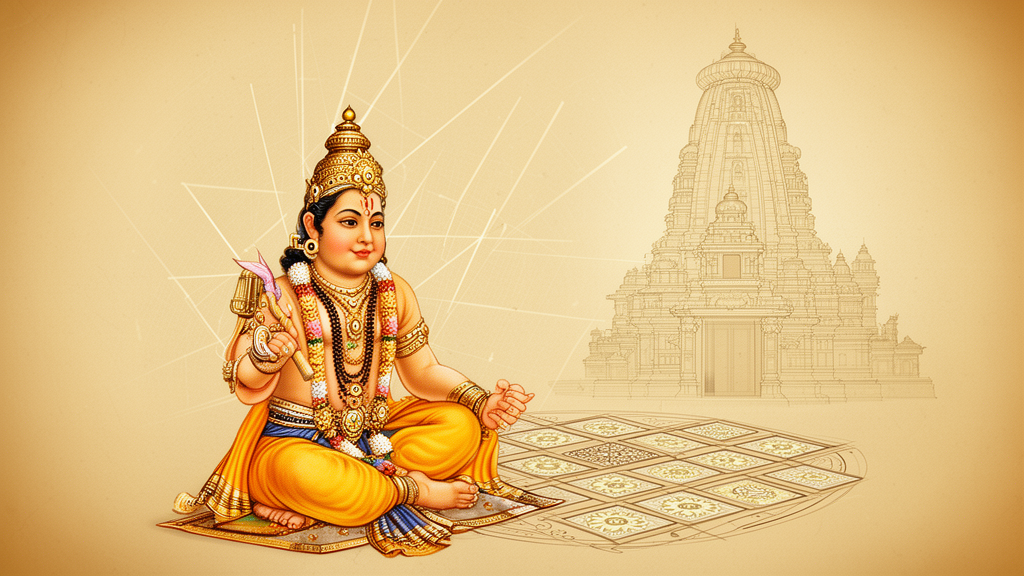
Despite its name, the Vastusutra Upanishad is not a dialogue about the self, Brahman or liberation in the way that texts such as the Isha or Mandukya Upanishads are. The Sanskrit text opens with the phrase atha atharvavediya vastusutropanishat, identifying it as a Vastusutra Upanishad of the Atharvaveda, and it is organized as a set of numbered sutras, or aphorisms, grouped into six chapters (prapathakas). The text is available as a Devanagari document on the Sanskrit Documents website, where its sutras are numbered within each chapter.
The Hindu Blog overview describes the work as a text on architecture and sculpture that was shaped to bring out the philosophy of these arts, especially iconography. It also notes that the text is written in Sanskrit, follows the style of Upanishadic writing, and is dedicated to Vishwakarma. That overview is a secondary source, so its statements about the text’s themes should be checked against the Sanskrit or a scholarly translation.
The term vastu in the title is broader than the modern English word “architecture.” In this text, the focus is on how a form is made and measured. Readers who associate Vastu Shastra with house orientation or site planning should note that this text is primarily concerned with the making of images and forms.
Authorship and date: what sources say and where they disagree
The Vastusutra Upanishad has no widely accepted historical author that can be confirmed from the sources reviewed for this article. The text itself presents its teaching in traditional form, and the sources reviewed do not establish a single author or a secure composition date.
Dating is a point of disagreement. One presentation found in the research describes the Vastusutra Upanishad as a classical text on creating symbolic form and gives a date of the 2nd century AD. That is a single secondary claim, and it should be treated as a proposed date rather than settled history. Other scholarship on the wider Vastu literature may use different dates, so readers should consult academic sources before citing any precise century.
This uncertainty matters. The text claims to be part of the Atharvaveda, which is a devotional and ritual tradition in the Vedic corpus, but the content is largely technical instruction on carving and proportion. Traditional attribution, textual context and historical dating are three separate questions, and this article keeps them apart.
How the text is structured
The Sanskrit edition on Sanskrit Documents divides the work into six prapathakas. The Hindu Blog overview gives the chapter titles as Sat-Shilpavicharah, Khilapanjarrajnana Sailabhedanam, Angaprayogah, Rupa Bhavana Bodhah, Sambandhaprabodhanam, and a sixth chapter whose title is not reproduced in the sources. Readers should verify chapter titles against a full Sanskrit edition, since the sources reviewed do not provide a complete, independently checked list.
Chapter 1: six arts and six kinds of stone
The first chapter introduces the basic categories. The Sanskrit text opens with a sutra stating that the lord of the site, vastospati, is to be known, and it moves to the idea that forms arise through the use of six limbs of craft (shilpa-anga). The Hindu Blog overview describes this chapter as covering six categories of the art of Vastu and six types of stone, with reference to how stone affects the colour of the finished image.
Chapter 2: preparing the stone and drawing the lines
The second chapter describes practical steps: setting the stone, polishing it, and drawing a line diagram on its surface before carving. It explains how circles and diagonals are used to lay out the limbs of an image. Sutra 2.1 in the Sanskrit edition refers to the stone being struck or prepared as a first action, and the sources describe the preparation as a sequence rather than a single step.
Chapter 3: carving and tools
The third chapter deals with the act of carving and with the tools used. Sutras in this section refer to the handling of implements and the mental focus that the work requires. The sources reviewed describe the chapter in general terms, so readers who need technical detail should consult a full translation or commentary.
Chapter 4: proportion and the grid
The fourth chapter concentrates on the arrangement of the limbs of an image and on iconometry, the measurement of proportions. The translation of the text available on Scribd renders a key statement as: “The form appears within the grid of sixteen compartments, this is best for making the images.” Because that rendering is from a presentation, not a critical edition, it should be treated as an illustrative translation.
Chapter 5: the interior of the form
The fifth chapter is described as dealing with the interior of the form. The Scribd rendering gives a sutra often cited as 5.20: “An Image should be envisaged to express a specified meaning.” The sources do not provide enough verified detail on the fifth chapter to explain its content beyond that general theme.
Chapter 6: integration and the philosophy of shilpa
The final chapter, according to the Hindu Blog overview, integrates the composition and discusses the philosophy of shilpa. The overview also says the text covers composition, ornamentation, gestures, weapons, the postures of vehicles, secondary divinities and devotees. The text closes with a sutra that describes the exposition of Vastu as being for the purpose of conferring knowledge.
Key ideas in the text
From the formless to the form
A recurring theme is that an idea must be made visible through a form. The Scribd presentation summarizes the text as a method for “giving Form to Formless,” moving from an invisible idea to a visible image. In its rendering, the text says that a form-message can be conveyed through a mantra in word or sound form, a mandala as a geometric diagram, or a murti as an icon or image.
This idea is more abstract than a set of carving instructions. It treats the image as a vehicle for meaning. For readers, the important point is that the text ties artistic method to the expression of a specified meaning, rather than to decoration alone.
Lines, elements and direction
The Scribd translation records a passage describing three types of lines: vertical lines associated with fire, horizontal lines with water, and diagonal lines with wind. It then states that upright forms arise on the fire line, fluid and longing forms on the horizontal line, and energetic forms on the diagonal line. The corresponding sutras appear in the second chapter of the Sanskrit edition, where the lines are described as urdhva, parshva and tiryag. Readers should note that this is a symbolic and technical scheme described in the text, not a modern physical theory.
Grid and proportion
The text repeatedly stresses the grid. In the Scribd rendering, “for making images, a grid is most important,” and the parts of an image should be imagined within it. The grid of sixteen compartments is presented as best for image-making in that translation. A grid of this type helps the artist keep proportions consistent across the figure.
Mind, intention and image
The Scribd presentation quotes an early sutra, 1.7, as saying that when worship is done without bodily images, the mind becomes particularly vitiated by indiscriminate imagination. It adds that the intention to worship (sankalpa) is the cause of the imagination (vikalpa) of the particular form in which a deity is worshipped. The Sanskrit sutra 1.7 in the Sanskrit Documents edition contains the words shariramurtirahite manah avesya, which correspond to the idea of the mind being directed toward an imageless act. The Sanskrit wording should be compared with a full translation before it is quoted in a formal study.
This section is important for understanding the text’s view of image-making. It does not treat the image as merely decorative. It presents the mind’s intention as part of how a form takes shape.
Feeling and character in the form
The Scribd rendering says that “the character of the form is the main aspect,” and that the lines should be arranged according to the character of the image. It also says that feeling must be infused into the form. These are translated phrases from the text and should be read as the translator’s rendering of Sanskrit concepts such as bhava (inner feeling or character) and rupa (form).
Dedication to Vishwakarma
The text is dedicated to Vishwakarma, who in Hindu tradition is regarded as the divine architect and craftsman. The Hindu Blog overview describes him as associated with all kinds of works and as the divine architect of the universe. This is a traditional and devotional attribution. The Vastusutra Upanishad does not, in the sources reviewed, present a narrative of Vishwakarma’s life in detail, so readers should not assume a specific myth from the text itself.
For craftspeople and devotees, this dedication links the technical rules of image-making to a sacred source. That relationship is part of the tradition’s self-understanding, while the scholarly question is how the text was used in practice.
Relationship to murti shastra and iconography
The text is often discussed in relation to murti shastra, the body of knowledge on images. Iconography is concerned with the identifying features of a deity, such as hand positions, attributes and vehicles. Iconometry concerns the measurement of proportions. The Vastusutra Upanishad addresses both, especially in chapters on the grid, the limbs and the meaning of the form.
Readers should be cautious about treating a single technical text as the final authority on all Hindu images. Image traditions vary by region, school and workshop. Temple sculpture in one part of India may follow different conventions from those of another, and the Vastusutra Upanishad is one textual witness among others.
How the text differs from devotional belief
It helps to separate three things. First, the text says what it says, which is a set of instructions and principles for making images. Second, traditional Hindu communities may believe that a properly made image is a sacred presence and that the right craft is a form of worship. Third, scholars study the text as a historical document whose date, transmission and influence can be examined.
These categories should not be mixed. A devotional reading may treat the text as revealed or sacred. A historical reading asks when it was written and how it was used. This article reports the text’s claims and the scholarly context, and it does not assert that any ritual result follows from following its instructions.
Editions, translations and commentaries
Sanskrit editions
The Sanskrit Documents website provides a Devanagari text of the Vastusutra Upanishad, along with PDF, Tamil, Telugu, Kannada and Gujarati versions in the same listing. Its file information states that the text was proofread by Mohan Chettoor, that a commentary is available in a separate file, and that the latest update was August 8, 2022. Because online Sanskrit texts can contain transcription errors, readers who need a formal edition should compare the file with a printed critical or scholarly edition.
Translations and digital copies
A translation titled Vastusutra Upanishad: The Essence of Form in Sacred Art is listed by Vedic Books under the name of Alice Boner. The listing is a bookseller’s page and does not itself verify the translation’s contents or quality, but it identifies a published English-language work on the subject. An Internet Archive entry titled Sthapatya Ved Vastusutra Upanishad also exists as a digital copy. Users should check the copyright status and terms of any digital copy before relying on it.
Secondary sources named in overviews
The Hindu Blog overview cites several works on Vastu and Hindu architecture, including Vibhuti Chakrabarti’s Indian Architectural Theory: Contemporary Uses of Vastu Vidya (1998), D. N. Shukla’s Vastu Shastra: Hindu Science of Architecture (1993), Gayatri Devi Vasudev’s Vastu: Astrology and Architecture (2001), and an entry in The Encyclopedia of Hinduism, volume XI. These titles are mentioned by a secondary source and have not been independently checked for this article’s claims. Readers who want scholarly discussion should consult these works or university library catalogues to confirm the details.
Practical examples: reading a sutra in context
Consider sutra 1.7, which the Scribd rendering presents as a statement about worship without bodily images. The Sanskrit clause in the Sanskrit Documents edition, shariramurtirahite manah avesya, can be read as “when the mind is fixed on a formless or imageless object.” The translation then links this to the mind’s imagining a form. Read in context, the sutra raises a practical question for image-makers: how a form can be shaped so that the mind is directed toward a specific meaning rather than to vague imagination.
A second example is the grid. The Scribd rendering presents the grid of sixteen compartments as the best basis for making images. A sculptor following that principle would divide the stone or design surface into a defined structure, place the main axes, and then arrange the limbs in proportion. This is a method described in the text, and modern sculptors may use grids for similar reasons, but the text does not provide modern measurements.
What the text does not establish
Several claims are often made about the Vastusutra Upanishad that the sources reviewed do not support. The sources do not establish a precise date of composition, a secure author, or a complete list of ritual outcomes. They also do not show that following the text guarantees a spiritual result. Readers should treat claims about special powers, protection or success in the making of images as devotional beliefs rather than findings of the text.
It is also important not to present the Vastusutra Upanishad as the only Hindu text on image-making. Other works and regional practices address similar questions, and communities may have their own norms for consecrating and worshipping images.
Frequently asked questions
Is the Vastusutra Upanishad a philosophical Upanishad?
Its title and Atharvavedic attribution place it in the Upanishad genre, but its main content is technical and concerns carving, proportion and image-making. Some sources describe it as philosophical in its discussion of shilpa, but the emphasis is on craft and iconography rather than on the metaphysical inquiries found in many Upanishads.
Who is the text dedicated to?
According to the Hindu Blog overview, the text is dedicated to Vishwakarma, the divine architect in Hindu tradition. This is a traditional attribution and is reported by a secondary source.
Is the text the same as Vastu Shastra?
The two are related but not identical. Vastu Shastra is commonly associated with building design, site planning and orientation, while the Vastusutra Upanishad is primarily concerned with the making of sculpted forms and images. Some overviews discuss them together, and readers should check each text’s scope before drawing conclusions.
Which translation should I read first?
For a first reading, a scholarly translation with an introduction and notes is more useful than an unannotated online rendering. Check whether the translator provides Sanskrit text, sutra numbering and a commentary. The Vedic Books listing is a bookseller’s page, so verify the edition details with the publisher or a library.
Does the text give fixed dimensions for every image?
The sources reviewed describe grids, proportions and the use of a sixteen-compartment grid, but they do not provide a universal table of measurements that applies to all deities. Iconographic details also vary by tradition and workshop.
Summary and next steps
The Vastusutra Upanishad is a Sanskrit sutra text associated with the Atharvaveda and devoted to sculpture, architecture and image-making. Its six chapters cover the arts of craft, stone preparation, carving tools, proportion, the interior of the form and the philosophy of shilpa. Its recurring ideas include the movement from formless to form, the role of lines and grids, and the importance of mind and intention in image-making.
For readers who want to go further, begin with the Sanskrit edition on Sanskrit Documents, compare it with a full translation, and consult academic works on Vastu and iconography. For related reading on the Upanishadic genre, see Meaning of Upanishad and Atharva Upanishad.
Related reading on HindusGod.com
Readers interested in how the term Upanishad is used across texts may find these target pages useful, although they are currently drafts and may not be public yet: 10 Upanishad, 108 Upanishad, Aitareya Upanishad, Atharvashikha Upanishad and 1st Upanishad. Each of these covers a different Upanishad or a general question about the genre, so they are linked for comparison rather than as a source for claims made in this article.
Sources and further reading
- Vastusutra Upanishad, Devanagari text, Sanskrit Documents: source for the Sanskrit text, chapter divisions and sutra numbering.
- Vastusutra Upanishad PDF file information, Sanskrit Documents: source for proofreading information, commentary note and update date.
- Vastusutra Upanishad in Hinduism, Hindu Blog: secondary overview of chapter themes, dedication to Vishwakarma and cited secondary works.
- Vastusutra Upnishad PDF, Scribd: presentation with an English rendering of selected sutras; treat as an unverified translation.
- Sthapatya Ved Vastusutra Upanishad, Internet Archive: digital copy listing; check the copyright and access terms before use.
- Vastusutra Upanishad: The Essence of Form in Sacred Art, Vedic Books: bookseller listing for an English-language work attributed to Alice Boner.