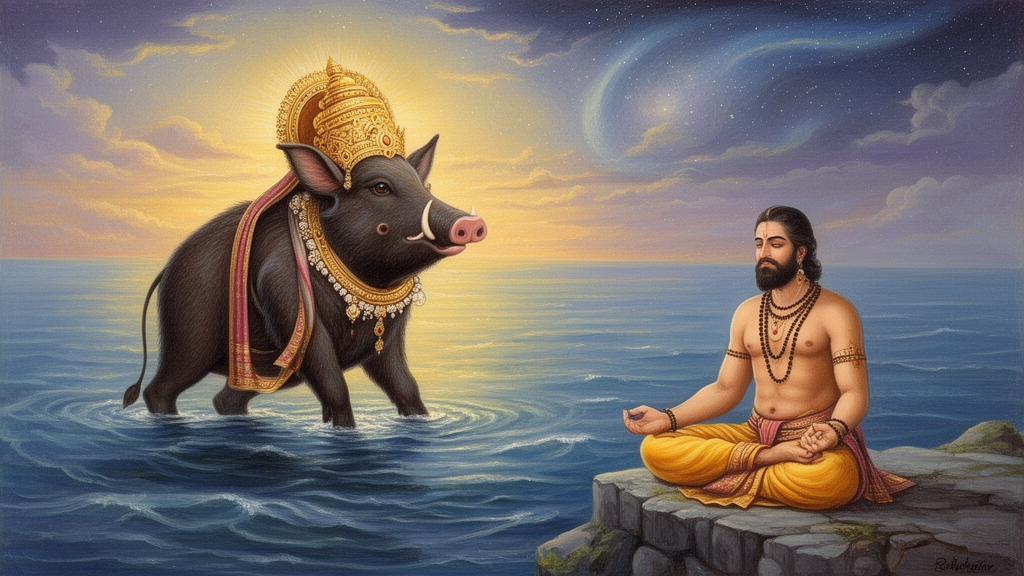
The Varaha Upanishad is a minor Sanskrit Upanishad presented as a dialogue between Vishnu in his boar avatar, Varaha, and the sage Ribhu. It is usually classed as a Yoga Upanishad and is associated with the Krishna Yajurveda. Its main concerns are the tattvas (principles of existence), the relationship between the individual self (Atman) and Brahman, the stages of learning, the marks of a liberated living person (jivanmukta), and yoga as a means of liberation. This guide explains what the text says, how it is dated and classified, where its teachings come from, and which parts are devotional belief, textual content, or modern interpretation.
The short answer
The Varaha Upanishad is a late, relatively short philosophical text of Hinduism. Wikipedia gives its composition as c. 13th to 16th century CE and notes that it has five chapters and 247 verses, and that it is listed among the Krishna Yajurveda Upanishads and among the Yoga Upanishads [1]. Its first chapter contains the best-known teaching: the sage Ribhu asks Lord Varaha for the knowledge of Brahman rather than worldly boons, and the Lord then lists ninety-six tattvas (principles), while noting that some disputants count twenty-four or thirty-six [3][4]. The text also teaches that knowledge of Brahman, devotion to Varaha, and inner detachment lead to liberation, and the final chapter treats yoga and its methods [1].
If you are new to the text, read it as a late Upanishadic dialogue that combines Vedanta-style discussion of Self and Brahman with Vaishnava devotion to Vishnu as Varaha and with yoga practice. It is not a single, universally used scripture in daily worship in the way that the Bhagavad Gita or the Ramayana often are, and its teachings should be described as those of this text rather than as the common teaching of all Hindus.
What the Varaha Upanishad is
Title and meaning
The title is Sanskrit Varaha (वराह), which means “boar.” Wikipedia gives the meaning of the title as “boar” and identifies the text as a minor Upanishad [1]. The title refers to the boar incarnation of Vishnu, who in Hindu tradition rescues the earth goddess from the cosmic waters. Wikipedia notes a sculpture at the Durga temple in Aihole that depicts Vishnu as Varaha rescuing Bhudevi, the earth [1]. That image belongs to the wider iconographic tradition of Varaha. It is not a direct illustration of the Upanishad’s teachings.
Date and attribution
Dating a text like this is uncertain. Wikipedia gives c. 13th to 16th century CE [1], while the Grokipedia summary gives the 13th century CE [2]. The difference is a reason to treat any single date with caution. Upanishads were transmitted and revised over long periods, and manuscript dates do not always match the date of composition. Wikipedia lists “Ribhu and Vishnu” as the traditional authors in its infobox [1]. Within the text, Ribhu is the sage who receives the teaching. Readers should not take that traditional attribution as evidence of a specific historical author.
Classification
The text is classified in two ways that readers should keep separate. It is listed among the Krishna Yajurveda Upanishads, and it is also grouped among the Yoga Upanishads [1]. Its philosophical content is often described under Vedanta and Vaishnavism. Wikipedia lists Vaishnavism and Yoga as its philosophical categories [1]. The Grokipedia summary places the text within Advaita Vedanta teachings [2]. These are classifications by later scholars and publishers, so they describe how the text is read, not how its earliest audiences necessarily understood it.
Structure of the text
The Varaha Upanishad has five chapters [1][2]. Based on the Sanskrit edition at Sanskrit Documents, the first chapter closes with the phrase indicating the end of the first chapter, and it contains seventeen numbered verses in that edition [4]. The Narayanasvami Aiyar translation, first published in 1914 in the collection Thirty Minor Upanishads, presents the same opening and first chapter in English prose [5][6]. Verse numbering differs among editions and translations, so readers should always check the edition they are using.
The chapters can be understood as movements in a teaching. The first chapter sets out the tattvas and the basic relation between the seeker and the Lord. Later chapters move toward the nature of Brahman, the qualifications for knowledge, the stages of learning, the marks of a liberated person, and yoga. Grokipedia summarizes the second chapter as describing the qualifications for Brahma-vidya, the knowledge of Brahman, including the performance of one’s caste duties, austerity, service to a guru, and the development of dispassion (vairagya) [2]. That summary is secondary, so readers who want to check the exact list should consult the Sanskrit or a translation of Chapter II.
Chapter one: the ninety-six tattvas
Why the text begins with a count of principles
The first chapter is often the most memorable part of the Varaha Upanishad because it lists principles in detail. Tattva (तत्त्व) can be translated as “principle,” “reality,” or “that-ness.” In Hindu philosophy the word is used for basic categories of existence. The text opens by saying that some disputants count twenty-four tattvas, some thirty-six, and others ninety-six [3][4]. The Lord then says he will relate them in order [3][4].
This opening matters because it shows that the number of tattvas was itself debated in the sources the author knew. The text does not say the disagreement is unimportant. It then gives its own enumeration, which ends at ninety-six [3][4].
How the list is built
The Lord’s list begins with the familiar categories. According to the translation, the organs of sense are five, such as the ear, skin, and eye [3]. The organs of action are five, such as the mouth, hand, and leg [3]. Five vital airs (prana) are listed, followed by five subtle objects of the senses [3]. The inner instruments are four: mind (manas), intellect (buddhi), mind-stuff or memory-field (chitta), and ego-sense (ahankara) [3]. Together these give twenty-four tattvas, which the text says are known to those who know Brahman [3].
The list then expands. It adds five gross elements (earth, water, fire, air, and space), three bodies (gross, subtle, and causal), and three states of consciousness (waking, dreaming, and dreamless sleep) [3]. Adding the individual self, or jiva, produces thirty-six tattvas in the count given by the text [3]. The text then extends the list to ninety-six by including further categories such as the three gunas (sattva, rajas, and tamas), the three karmas (prarabdha, sanchita, and agami), the presiding deities of directions and functions, and deities such as Indra and Rudra [2][3].
How readers should interpret the list
The list should be read as part of a philosophical method. It is a systematic way of showing how the many experiences and faculties of a person are classified, and how they differ from the Self. The text does not present the ninety-six tattvas as a set of rituals or as a magical formula. It also does not say that counting them alone brings liberation. The verse that follows the list says that those who worship Varaha with devotion, and who are other than the aggregate of these principles, are liberated while living [3][4]. Readers should therefore separate the descriptive content of the list from the devotional and soteriological claim attached to it.
Brahmavidya: knowledge of Brahman and the Self
The request for knowledge
In the opening dialogue, Ribhu refuses the usual boons that a seeker might ask for. He says that the Vedas, the Shastras, the Itihasas, the sciences, and even Brahma and the other devas speak of liberation as following from knowledge of the Lord’s nature [3][4]. He therefore asks to be taught the science of Brahman that describes that nature [3]. The request defines the text’s main aim: liberation is understood as knowledge, not as the granting of a worldly wish.
Advaita themes
Wikipedia summarizes the text’s central message as the non-dual nature of existence and the oneness of Self, Brahman, and Vishnu [1]. Grokipedia describes the later chapters as developing Advaita principles, including Brahman as the non-dual reality of consciousness, being, and bliss, beyond the world produced by maya [2]. Both summaries point to Advaitic language. However, Wikipedia’s summary and Grokipedia’s summary are secondary, so the exact wording of the Upanishad should be checked against the translation or Sanskrit text.
Readers should also note that Advaita is one of several Vedanta interpretations. Dvaita, Vishishtadvaita, and other schools read Upanishadic statements about Brahman differently. The Varaha Upanishad is a text with Advaitic and Vaishnava elements, so a reader should not assume that its teaching matches every Vedantic school.
Devotion and knowledge
The text combines knowledge with devotion. In Chapter I, the Lord says that those who worship him in the form of a boar with devotion attain freedom from ignorance and become liberated while living [3][4]. Grokipedia summarizes the claim that knowledge of the tattvas and devotion to Varaha dispel ignorance and its effects, and that this knowledge leads to liberation regardless of external practices, caste, or appearance, with examples such as yogis with matted hair or ascetics with shaven heads [2]. The Sanskrit verse in Chapter I includes the words for matted hair, shaven head, and topknot, but the exact interpretation of the sentence should be checked in a reliable translation [4].
For a devotee, this teaching can be a source of meaning because it says that liberation is not limited to a single outward form of life. For a scholar, it is a claim within a text, not an observable historical fact. It should be presented as the text’s own position.
The seven stages of knowledge and the jivanmukta
Stages of learning
Wikipedia lists the “seven stages of knowledge” as one of the text’s main subjects [1]. It is one of the topics that the dialogue develops after the account of the tattvas. The summary does not provide the full stage-by-stage list in the supplied material, so this guide does not reproduce one. Readers who want the stages should read the relevant section of the Sanskrit text or a reliable translation and compare it with the commentary they are using.
Who is a jivanmukta?
The jivanmukta (जीवन्मुक्त) is a person who is liberated while still living in the body. Wikipedia describes the text’s account of the jivanmukta as including an inner state that is not affected by happiness or by suffering inflicted from outside [1]. The same summary says the jivanmukta does not shrink from the world out of fear, and the world does not shrink from him with fear, and that his inner calm and contentment are free from anger, fear, and joy toward others [1]. This is a description of an inner state. It is not a claim that such a person is publicly recognized or can be identified by behavior.
Wikipedia also says the text distinguishes four types of jivanmuktas [1]. The supplied material does not give the full four-part classification, so this article does not list them. A useful next step is to consult the translation of the relevant section directly.
Why this matters for daily practice
The jivanmukta teaching is philosophical and aspirational. It describes a goal of inner freedom that Hindu texts frame in many ways. For readers, it can help clarify why the Upanishad treats ethical qualities and inner detachment as parts of spiritual life. It should not be treated as a promise that practice will produce a particular experience or status.
Yoga in the final chapter
Wikipedia notes that the last chapter of the Varaha Upanishad is dedicated to yoga, its goals, and its methods [1]. The text is one of the Yoga Upanishads, so yoga is part of its purpose, not an afterthought [1]. The supplied sources do not provide a complete verse-by-verse treatment of this chapter, so the descriptions below are limited to what the summaries state.
Yamas in the summary
Wikipedia lists ten yamas, or restraints and virtues, as essential to liberation in the text’s account: nonviolence, truthfulness (satya), non-stealing (asteya), celibacy (brahmacharya), compassion, rectitude, forbearance (kshama), non-hypocrisy, moderation in eating (mitahara), and purity (shaucha) [1]. The same summary frames these as qualities required for the liberation of the soul [1]. Readers should note that yama and niyama are terms used across Indian philosophical and yogic literature, and their lists differ among texts. The Varaha Upanishad’s list should be read in its own context.
Asanas and kundalini
Wikipedia’s contents list includes sections on yogasanas and kundalini within the Varaha Upanishad article [1]. Grokipedia includes sections on asanas and physical disciplines, and on kundalini awakening [2]. Those secondary summaries show that these topics are discussed in the commentary-style overviews, but the supplied material does not contain a verified translation of the relevant verses. For that reason, this guide does not describe specific postures, breath techniques, or kundalini procedures. Readers who practice yoga should not treat a general article as a practice manual, and should consult qualified teachers and the primary text for any physical practice.
Yoga as a path, not a shortcut
The text’s own framing links yoga to self-liberation [1]. It does not offer a guaranteed material benefit. Health, wealth, or other outcomes that are sometimes attributed to yoga practice are not supported by the sources used here, and should not be assumed from this text.
Reading the Varaha Upanishad: translations and editions
Sanskrit text
The Sanskrit text is available in digital form at Sanskrit Documents, which presents the opening invocation, Chapter I, and the subsequent chapters in Devanagari [4]. Working with the Sanskrit is valuable for checking technical terms, but a beginner should use it with a glossary or with a translation.
K. Narayanasvami Aiyar’s 1914 translation
The Vedanta Shastras Library presents a translation attributed to K. Narayanasvami Aiyar [3]. The Theosophical Library presents a translation by K. Narayanaswami Aiyer from the 1914 collection Thirty Minor Upanishads [5]. Wisdom Library presents the same collection and describes it as an English translation of thirty minor Upanishads [6]. Because these are older translations, their English and their notes reflect the period in which they were produced. A reader should compare them with a modern translation where precision matters.
Why translations differ
Translators make choices about how to render terms such as tattva, Brahman, Atman, jiva, and yoga. The Sanskrit term may carry more than one sense, and the translation may choose one. For example, tattva can be rendered as “principle,” “category,” or “reality,” depending on context. When an English word is used for a Sanskrit term, readers should remember that it is an interpretation.
Belief, text, tradition, and scholarship
It helps to separate four kinds of statement when reading about this Upanishad.
- Text: What the Varaha Upanishad says, as found in its Sanskrit or in a translation. The list of ninety-six tattvas, the boon request, and the statement about devotion to Varaha are textual statements [3][4].
- Tradition: What Hindu communities hold about the text’s authority, its use in study or devotion, and its place in Vaishnava or Vedanta practice. The supplied sources do not document specific community practices involving this text, so this guide does not describe any.
- Scholarship: Dating, classification, and comparison with other texts. Wikipedia’s date range and classification statements are examples of scholarly or encyclopedic summaries [1].
- Modern interpretation: Explanations that link the text to contemporary questions. The Grokipedia summary includes a section on modern interpretations, but its contents are not verified here as scholarship [2].
Secondary summaries are useful for orientation, but they can differ in details. The Grokipedia summary gives the Muktika-canon numbering of the text as 98th among 108 Upanishads, but this numbering was not verified in the supplied primary sources and should be checked in a reference on the Muktika canon before it is repeated [2].
Why the Varaha Upanishad matters for readers
The Varaha Upanishad is useful for readers who want to see how a later Upanishad joins Vedanta reflection, Vaishnava devotion, and yoga. Its opening dialogue is accessible because it frames the teaching as a request by a sage for a clear account of Brahman. Its list of tattvas shows how Indian philosophy classified human experience and cosmic principles. Its final chapter links those ideas to inner discipline.
The text also shows the range within Hinduism. A reader who knows the Bhagavad Gita or the Puranas may find that the Varaha Upanishad uses different vocabulary and emphases. That difference is useful. It shows that Hindu traditions did not present one uniform account of liberation. For a broader guide to what the term Upanishad means and how these texts are arranged, see Meaning of Upanishad.
Connections to other Upanishads
The Varaha Upanishad belongs to a large group of texts called Upanishads, and readers often find it helpful to compare categories. The Upanishadic corpus is commonly discussed in terms of canons and classifications. For example, the Muktika canon of 108 Upanishads is a classification that is often discussed in reference works, and readers can explore it through 108 Upanishad. For a broader introduction to how the numbers of Upanishads are discussed, see 10 Upanishad.
Several other Upanishads share the Vedanta or yoga themes that appear in the Varaha Upanishad. Readers who want to compare Advaita-oriented texts can begin with Advaita Upanishad, while Adhyatma Upanishad addresses the inner, self-focused themes that appear in many late texts. For a text focused on Self-knowledge, see Atmabodha Upanishad.
For readers interested in the Yoga Upanishads and the role of the Atman in yogic discourse, Atharvashikha Upanishad and Avadhuta Upanishad are related reading. Readers who want to see how Upanishads relate to the Aranyakas can compare Aranyaka Upanishad. Those interested in a different philosophical dialogue style may also look at Ashtavakra Upanishad, and for another text in the Krishna Yajurveda and Vedanta reading tradition, see Aitareya Upanishad.
These internal links point to draft articles on the HindusGod.com site. They may not be public yet, so the owner should confirm their status before publication.
Frequently asked questions
Is the Varaha Upanishad the same as the Varaha Purana?
No. The Varaha Upanishad is a minor Upanishad in Sanskrit, classified among Krishna Yajurveda Upanishads and Yoga Upanishads [1]. The Varaha Purana is a different text. The supplied sources for this article do not describe the Varaha Purana, so this guide does not compare its content.
Does the text say that Vishnu and Shiva are the same?
The supplied sources describe a theme of syncretism in the text. Grokipedia says the text includes an identity of Vishnu and Shiva and an integration of Shaiva and Vaishnava elements [2]. Wikipedia’s summary names oneness among Self, Brahman, and Vishnu [1]. Because the supplied sources do not quote the relevant verses in full, readers should read the section directly before drawing conclusions.
Do I need to practice yoga to understand this text?
No. Understanding the text does not require physical practice. The Upanishad treats yoga as part of its teaching, and it discusses ethical qualities such as nonviolence and truthfulness [1]. A reader interested in physical yoga should consult a qualified teacher. This article does not provide practice instructions.
Closing takeaway
The Varaha Upanishad is a late Sanskrit text that brings together a dialogue on Brahman, a detailed account of tattvas, teachings on jivanmukti, and a final chapter on yoga. Its central request is for knowledge of Brahman rather than worldly gain, and its teaching ties liberation to knowledge, devotion, and inner discipline [1][3][4]. The best way to study it is to read a reliable translation alongside the Sanskrit, keep the text distinct from later commentary, and treat devotional and philosophical claims as the text’s own statements rather than as universal Hindu doctrine.
Sources and further reading
- Varaha Upanishad, Wikipedia: used for the title meaning, date range, classification, chapter and verse counts, main themes, the ten yamas, and the jivanmukta summary.
- Varaha Upanishad, Grokipedia: a secondary summary used for the account of Chapter I, the Advaita framing, and section headings. Treat its claims as secondary and check them against primary sources.
- Varaha Upanishad, Vedanta Shastras Library: an English translation attributed to K. Narayanasvami Aiyar, used for the opening dialogue and the list of tattvas.
- Varaha Upanishad, Sanskrit Documents: Sanskrit text in Devanagari, used to check the opening verses and the chapter structure.
- Varaha Upanishad, The Theosophical Library: a 1914 English translation by K. Narayanaswami Aiyer from Thirty Minor Upanishads, used for comparison of the opening chapter.
- Varaha Upanishad of Krishna-Yajurveda, Chapter I, Wisdom Library: a digital presentation of the 1914 translation collection, used to confirm the chapter opening and the collection’s description.