The Vajra Cutter Sutra is a Mahayana Buddhist sutra, also widely known as the Diamond Sutra or Diamond Cutter Sutra. It is a discourse on emptiness, presented as the teaching of the Buddha, and it is one of the best-known texts in the Buddhist tradition. This post explains what the sutra is, where it comes from, how its name is used, what it teaches as a Buddhist text, and how different communities approach it. Because readers searching for this title sometimes come from a Hindu background, the post also explains how this Buddhist scripture differs from Hindu scriptures.
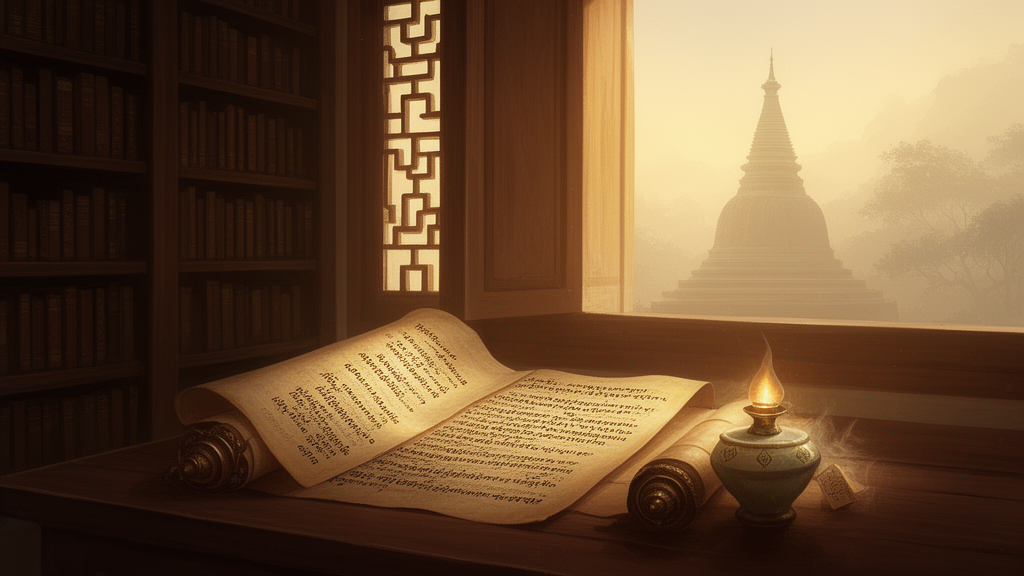
Quick answer: what is the Vajra Cutter Sutra?
The Vajra Cutter Sutra is a Buddhist sutra in the Mahayana tradition. It is known in English as the Diamond Sutra, the Diamond Cutter Sutra, or the Vajra Cutter Sutra. According to the English Wikipedia entry, the text is written in Sanskrit, its author is unknown, and it is dated to the 2nd through 5th centuries CE. The teaching centers on emptiness, which Lama Yeshe Wisdom Archive describes as “Wisdom Gone Beyond.” Buddhist communities read it as a text about seeing through fixed notions of self and phenomena. It is not a Hindu scripture, and it is not a text about the Hindu deity or weapon named vajra.
The names of the sutra
The text appears under several names, and readers may encounter more than one form. The most common English forms are “Diamond Sutra” and “Vajra Cutter Sutra.” The Lama Yeshe Wisdom Archive uses “Diamond Cutter Sutra” as its main title and gives “Diamond Sutra” and “Vajra Cutter Sutra” as alternatives. The FPMT, a Mahayana organization in the Lama Tsongkhapa tradition, publishes material under the title “Vajra Cutter Sutra.”
The word vajra is a Sanskrit term, and it is commonly translated as “diamond” or “thunderbolt” in Buddhist contexts. In Buddhism, the vajra is often associated with an indestructible quality. The English word “diamond” in the common title reflects this sense of hardness and clarity. The Tibetan title recorded in one archived edition, rDo rje gcod pa, uses the Tibetan word for vajra together with a term meaning “cutting,” which is why “Vajra Cutter” is a faithful English rendering of that title.
Readers may also see the Sanskrit title written as Vajracchedikā. The fetched sources in this review did not independently confirm the full Sanskrit title, so readers who need the exact Sanskrit form should check a scholarly edition before citing it.
Why the title uses the image of a cutter
The title’s imagery of a vajra that cuts is usually read by commentators as a metaphor for cutting through mistaken views. This is a traditional interpretation, not a claim that the sutra’s text uses a particular sentence to say this. Readers who want to study the metaphor in detail should consult a translation with commentary, such as the editions and teaching materials listed in the sources below.
A Mahayana Buddhist text, not a Hindu scripture
The Vajra Cutter Sutra belongs to Mahayana Buddhism, the branch of Buddhism that developed the bodhisattva ideal and a large body of sutras, many of them connected with the Prajñāpāramitā, or “Perfection of Wisdom,” literature. The English Wikipedia entry on the Diamond Sutra lists it under Mahayana Buddhism and places it among the Mahayana sutras. The same page presents Prajñāpāramitā as a central topic in Buddhist literature, and it links the text to a range of Mahayana schools.
For Hindu readers, this distinction matters. Hindu scriptures such as the Vedas, the Upanishads, the Bhagavad Gita, and the Puranas belong to a different textual and religious tradition. Buddhism shares a common cultural background with Hinduism in South Asia, and both traditions use Sanskrit, but the Vajra Cutter Sutra is a Buddhist text. It teaches a Buddhist view of emptiness and does not describe Hindu deities, Vedic rituals, or Hindu cosmology. Keeping these traditions separate helps readers understand what the sutra says and what it does not say.
Historical background and the Dunhuang print
The date and authorship of the sutra are uncertain. The English Wikipedia entry gives its period as the 2nd through 5th centuries CE and lists its author as unknown. Dating a Buddhist text from this period involves scholarly judgment, and different sources may give different ranges. Readers should treat these dates as approximate and as scholarly estimates, not as firmly established facts.
The text is much better documented in later history. The Wikipedia entry describes a Chinese Diamond Sūtra printed in the ninth year of the Xiantong era of the Tang dynasty, corresponding to 868 CE. It is described there as the oldest known dated printed book in the world, and the page credits the British Library as the holding institution for this object. The Wikipedia article also has a section on the Dunhuang block print, which connects the sutra to the manuscript discoveries around the Dunhuang caves. This is a specific historical object with a known date, and it is one of the most important reasons the sutra is studied as a book history subject as well as a religious text.
What the print shows and what it does not show
The 868 print shows that a Buddhist text was reproduced in printed form in China at that date, and that the printed copy survives. It does not show that the sutra was first composed in 868, and it does not prove the sutra’s date of composition. The earlier dating of the text rests on textual and scholarly analysis rather than on this printed object alone.
The main teaching: emptiness and “wisdom gone beyond”
The Lama Yeshe Wisdom Archive describes the Diamond Cutter Sutra as a discourse on the Buddhist concept of emptiness, or “Wisdom Gone Beyond.” Emptiness, in this sense, does not mean nothingness. In Mahayana Buddhism, emptiness refers to the idea that phenomena do not exist in a fixed, independent way. Teachers in different traditions explain this idea in different ways, and some of the differences are important.
Many readers approach the sutra as a challenge to fixed ideas. The text is often read as a way of loosening attachment to concepts, including concepts about the self, about the Buddha, and about the teaching itself. This reading is a common interpretation across several Mahayana communities, but it is not a single official doctrine stated in one line of the text. Readers who want to examine specific passages should work with a translation and a commentary, and should note which parts come from the sutra and which come from the commentator.
Scripture, commentary, and modern explanation
It helps to separate three layers when reading about the sutra. The first is the sutra itself, the words attributed to the Buddha in the text. The second is commentary, written by Buddhist teachers over centuries, which explains the sutra’s meaning. The third is modern explanation, often given in teaching centers, books, and online materials. A modern teacher may use examples from daily life to explain emptiness, and those examples are helpful for understanding, but they are not identical to the sutra’s wording.
Recitation and devotional practice
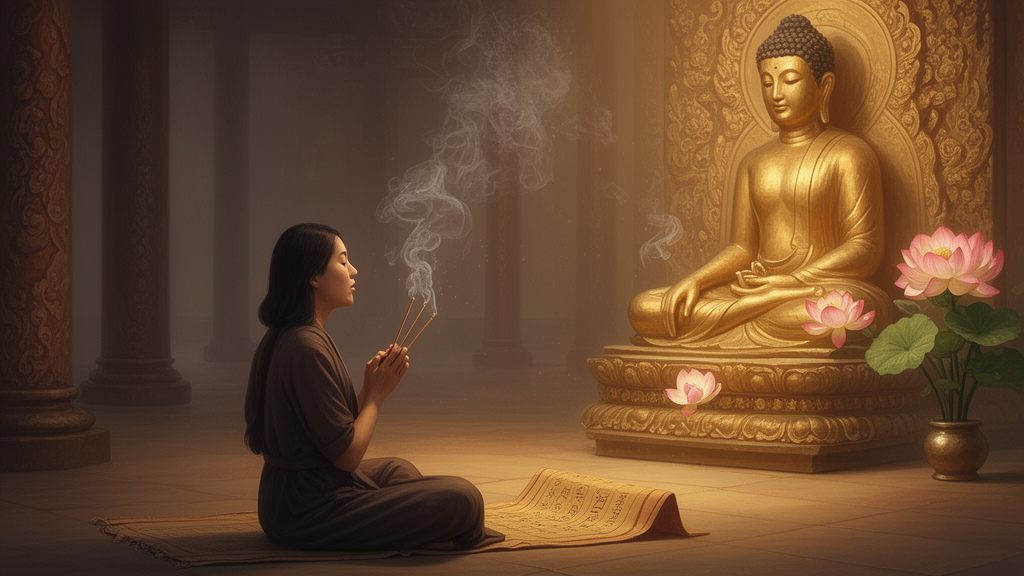
In many Buddhist communities, the Vajra Cutter Sutra is recited, studied, copied, and taught. Recitation is a devotional and meditative practice, and its form depends on the community. Some groups recite the text in a monastery or temple, some in a home shrine, and some as part of a study group. The Lama Yeshe Wisdom Archive links to teachings by Lama Zopa Rinpoche on the benefits of reciting this sutra, and to a special dedication written by Rinpoche. These materials are teachings within the FPMT lineage, and they describe benefits from the point of view of that tradition.
It is important to be precise about what a source says. A teacher’s description of the benefits of recitation is a devotional teaching. It is not a scientific finding, and it is not a guaranteed result. A Buddhist text can be a meaningful practice for a reader without being a promise of protection, wealth, health, or any particular outcome. Readers should approach recitation as a religious practice with its own meaning, not as a technical method with a fixed result.
Practical steps that vary by tradition
- Choose a reliable translation from a recognized Buddhist publisher, teaching center, or scholarly edition.
- Read the sutra with a commentary or teacher from the tradition you are studying, because interpretations differ.
- If you recite the text, follow the instructions of your teacher or community, since opening verses, pacing, and dedications vary.
- Keep study and devotion distinct. Reading the text for understanding is different from reciting it as a devotional act.
These steps are general guidance, not a fixed ritual. Specific recitation practices belong to particular communities, and readers should follow the guidance of a qualified teacher in the tradition they practice.
Editions, translations, and the question of which version to read
The sutra exists in many editions and translations. The FPMT resource page presents the Vajra Cutter Sutra as a resource and links to translations in several languages. The Lama Yeshe Wisdom Archive states that the FPMT website carries the latest translations in many languages. An archived PDF from the Internet Archive describes a small edition republished by FPMT, and it also refers to a Lanchou edition of the Vajra Cutter and its commentary, titled in Tibetan as rDo rje gcod pa dang de’i ‘grel ba bzhugs so, which includes the sutra with the commentary of Cone Grag-spa.
Differences among translations can matter. A translation made for a Tibetan Buddhist audience may use different technical terms from one made for Chinese or Zen readers. A translation may also include notes, introductions, or commentary that shape the reader’s understanding. For that reason, the best approach is to compare two or three reputable editions and to read introductions carefully. The English Wikipedia entry notes that a full text is available on English Wikisource, but readers should check the edition and translation information there before relying on it.
Differences across Buddhist traditions
The Diamond Sutra has been important in several Buddhist traditions, including Chinese Buddhism and Tibetan Buddhism, and it is often discussed in relation to Chan (Zen) practice. The Wikipedia entry lists many traditions and schools that appear in Mahayana Buddhism, but it does not establish a single universal role for the text across all of them. Readers should therefore avoid saying that every Buddhist community uses the sutra in the same way.
How the text is connected to other HindusGod.com topics
Readers interested in this sutra may also be interested in other Buddhist sutras and in Hindu texts on devotion. The following pages on HindusGod.com may help readers compare related topics. Each link goes to a target draft that may not yet be public, so readers may see a non-public page until the owner publishes it.
- For a shorter overview of the same title, see Vajra Sutra.
- For the alternative title used in many English sources, see Diamond Cutter Sutra.
- For another Mahayana sutra with a focus on devotion to a bodhisattva, see Amida Sutra Meaning.
- For a related Mahayana text on the Buddha’s teaching of the Amida Buddha, see Amida Sutra.
- For a Mahayana sutra associated with the bodhisattva Avalokiteshvara, see Avalokiteshvara Sutra.
- For a large Mahayana sutra with a broad cosmological scope, see Avatamsaka Sutra.
- For a text on the stages of the bodhisattva path, see Dasabhumika Sutra.
- For a Buddhist text on dharani recitation, see Dharani Sutra.
- For a Hindu devotional text with a different tradition and purpose, see Bhakti Sutra.
- For a text on the bodhisattva ideal and its moral training, see Brahmajala Sutra.
The Bhakti Sutra link is included to help readers distinguish Hindu devotional literature from Buddhist sutras. The two traditions use similar Sanskrit vocabulary in places, but their texts, deities, and practices differ.
Common misunderstandings
The sutra is not a ritual formula for guaranteed results
Some popular accounts describe reciting the sutra as a way to gain protection, success, or material benefit. Teachers in the traditions discussed here typically describe such benefits in devotional terms, and they do not present them as guaranteed outcomes. A reader who approaches the text for understanding and reflection will get more from it than one who looks for a fixed result.
The sutra does not belong to one school
Because the text has circulated across Asia in many languages and editions, it is studied by different communities with different emphases. A Chan reader, a Tibetan Buddhist reader, and a scholar may each read the same text in ways that reflect their traditions. Presenting one interpretation as the only correct reading would not match the range of sources.
The name does not refer to a Hindu weapon story
The Sanskrit word vajra appears in both Buddhist and Hindu literature, and its meanings vary by context. In the Vajra Cutter Sutra, the word is part of a Buddhist title, and the sutra’s teaching is Buddhist. Readers who encounter the word in Hindu mythology should not assume that the Buddhist sutra follows that story.
Frequently asked questions
Is the Vajra Cutter Sutra the same as the Diamond Sutra?
Yes, in common usage. The Diamond Sutra, the Diamond Cutter Sutra, and the Vajra Cutter Sutra are names for the same Mahayana Buddhist text, though editions and translations may use different titles. Readers should check the title page of the edition they are using.
Is the Vajra Cutter Sutra a Hindu text?
No. It is a Buddhist sutra in the Mahayana tradition. Hindu and Buddhist traditions share some Sanskrit vocabulary and a common South Asian background, but this sutra is part of Buddhist scripture.
When was the sutra written?
The exact date of composition is uncertain. The English Wikipedia entry gives a scholarly estimate of the 2nd through 5th centuries CE, and it describes an 868 CE Chinese print as a dated printed object. The print is a later historical witness, not the date of composition.
Can a non-Buddhist read the sutra?
Yes, many readers study Buddhist texts for historical, literary, or philosophical reasons. Readers who wish to understand the text in its tradition should use translations with introductions and should distinguish between the sutra, its commentaries, and modern explanations.
Closing takeaway
The Vajra Cutter Sutra is a Mahayana Buddhist text on emptiness, also known as the Diamond Sutra. Its name, date, and translations have a documented history, and it is studied in several Buddhist traditions. For a reader in the Hindu tradition or a general reader, the most useful approach is to learn the Buddhist context, compare reliable translations, and separate the sutra’s words from commentary and devotional teaching. A careful reading of the text and its commentaries will give a clearer understanding than any single summary.
Sources and further reading
- Diamond Sutra, Wikipedia: supports the classification as a Mahayana Buddhist sutra, the Sanskrit language, the unknown author, the 2nd–5th century CE dating estimate, the 868 CE Dunhuang print, and the existence of an English Wikisource full text. Readers should check the cited scholarly sources on that page for further detail.
- Diamond Cutter Sutra, Lama Yeshe Wisdom Archive: supports the description of the sutra as a discourse on emptiness, the alternative titles, the reference to FPMT translations, and the existence of teachings by Lama Zopa Rinpoche on the sutra’s benefits.
- Vajra Cutter Sutra Resource Page, FPMT: supports the use of the title “Vajra Cutter Sutra” in FPMT resources and the description of FPMT as a Mahayana organization in the Lama Tsongkhapa tradition. The page was checked for the organizational description and title; the resource listings should be rechecked before publication.
- Vajra Cutter Sutra PDF, Internet Archive: supports the description of an FPMT small edition and the Lanchou edition with the commentary of Cone Grag-spa, including the Tibetan title. This was not fully inspected, so the listing should be verified before citing details beyond the title information.