The Upanishads are ancient Sanskrit texts that record philosophical conversations about the self, ultimate reality, and liberation. They form the concluding portion of the Vedas and are often called Vedanta, meaning “end of the Vedas.” If you are new to them, the most useful place to start is with the core ideas of Brahman (ultimate reality) and Atman (the self), the way the texts are organized, and the fact that different traditions count and interpret them differently. This guide explains those basics in plain language, separates what the texts are said to teach from what scholars and traditions say about them, and suggests a simple way to begin reading.
What Are the Upanishads?
The Upanishads are a collection of Hindu philosophical texts. One yoga-focused introduction describes them as providing philosophical and spiritual insight into large questions about life, and notes that they form part of a much larger body of works called the Vedas (Yogajala, ‘Understanding The Upanishads’). A more general guide describes them as the theoretical foundation of Hinduism, containing discussions between teachers and students about the nature of reality, consciousness, and the self (Hinduvigyan, ‘Upanishads Guide for Beginners’).
In short, the Upanishads are not a single book with one author or one story. They are a group of texts, usually presented as dialogues, in which teachers answer students’ questions about what exists, what the self is, and how a person can be free from suffering. Their philosophical style is a major reason they are studied separately from the Vedic hymns and rituals.
The Meaning of the Name
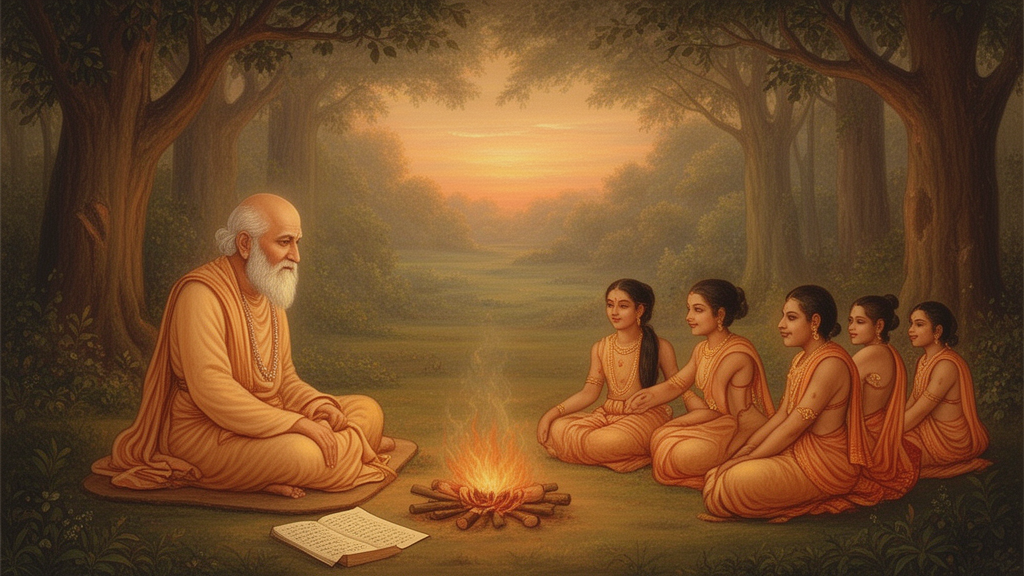
The word Upanishad is usually broken into three parts: upa (near), ni (down), and shad (to sit). Together they are commonly rendered as “sitting down near,” which is often understood as sitting at a teacher’s feet. A yoga-focused article gives this same breakdown and explains that the knowledge was not meant for everyone and was shared orally from guru to committed student (Yogajala). Another guide presents the word as “sitting near the teacher” and describes the texts as conversations rather than lectures (VedaLingo, ‘Upanishads for Beginners’).
This etymology is useful for beginners because it explains the tone of the texts. Many passages read like a student asking a question and a teacher gradually leading toward an answer. Some Upanishads are conversations between a father and a son, or between a teacher and a student, and the questions they raise are still familiar: Who am I? What happens after death? Why does anything exist?
Where the Upanishads Fit in the Vedas
The Vedas are traditionally divided into parts. A detailed guide presents the structure as follows: the Samhita portion contains mantras, prayers, and hymns to deities; the Brahmana portion contains ritual procedures and explanations; the Aranyaka portion contains symbolic interpretations of rituals; and the Upanishads focus on inner meaning and knowledge (Divine Aarti, ‘Upanishads: Complete Guide to Vedantic Wisdom’). The same source explains that the Upanishads are called Vedanta because they come at the end of each Veda.
This placement matters. Earlier Vedic material is largely concerned with hymns and ritual. The Upanishads shift the focus toward knowledge (Sanskrit jnana) and liberation (moksha). A beginner’s guide makes this distinction directly, contrasting the Vedas’ focus on rituals and hymns with the Upanishads’ focus on philosophical investigation into reality and consciousness (Hinduvigyan).
It is worth noting that these categories are a scholarly and traditional framework for reading the texts. Real Vedic literature is not always neatly separated, and not every reader or community organizes the material in the same way.
Who Were the Upanishads Written For?
According to the sources reviewed for this article, the Upanishads were not presented as a public religion manual. One yoga site states that the knowledge was not intended for everyone and that there was some secrecy around sharing it (Yogajala). A devotional guide describes them as revelations meant to be contemplated, meditated upon, and lived (Divine Aarti).
These descriptions reflect a view often associated with oral teaching: a student received guidance personally, over time, from a qualified teacher. Readers today usually meet the texts in print or online, which is a different experience. That difference is one reason many beginners feel lost. A translation can be read in an afternoon, but its meaning often depends on a commentary, a teacher, or a tradition of interpretation.
The Core Ideas Beginners Should Know
Although the Upanishads cover many topics, most introductions focus on a small set of concepts. Two are central in nearly every guide: Brahman and Atman. Two more, maya and moksha, appear frequently in popular summaries. Each is explained below as it is presented in the cited sources. For the strongest study, check these ideas against a scripture translation and a reputable commentary.
Brahman: Ultimate Reality
The Upanishads use the term Brahman for ultimate reality. A popular guide describes Brahman not as a god in the sky but as the ground of all existence, and notes that everything that exists is described as a manifestation of Brahman (VedaLingo). The same source offers an etymology: the word is said to come from the Sanskrit root bṛh, meaning “to expand” or “to grow.” Scholars may discuss the derivation differently, so treat this as one presented explanation rather than a settled conclusion.
A practical warning is needed here. Brahman is not the same word as Brahma, the creator deity in some Hindu mythologies. A pronunciation guide in one popular article makes the distinction explicitly, noting that Brahman refers to ultimate reality and not to the god Brahma (Divine Aarti). Beginners often confuse the two, so keep them separate when reading.
Atman: The Self
Atman is usually translated as the self or soul. The VedaLingo guide describes Atman as the true self, distinguished from the body, personality, and even the mind, and reports the Upanishadic idea that something within a person was never born and will not die (VedaLingo). Another guide frames the central inquiry as the relationship between the individual soul (Atman) and universal consciousness (Brahman) (Hinduvigyan).
The relationship between Atman and Brahman is one of the most debated topics in Vedanta. Some schools emphasize their identity, others a relationship that is not identical, and others a distinction that remains even in liberation. A beginner does not need to settle this debate immediately, but should know that “the self is ultimate reality” is one interpretation among several, not the only reading of every passage.
Maya and Moksha
Maya is commonly described as illusion or a cosmic power that makes the world appear as separate and multiple. Moksha means liberation, often described as freedom from the cycle of rebirth and from ignorance about one’s true nature. Two sources list these terms among the key concepts of the Upanishads: one describes Maya as illusion or cosmic power and Moksha as liberation (Divine Aarti), and another names Maya as illusory perception and Moksha as liberation while presenting them as core concepts for beginners (Hinduvigyan).
These terms have long and varied histories in Indian philosophy. Their meaning changes between texts and schools, and popular summaries sometimes flatten those differences. When you encounter them, ask which text, translator, or school is being described.
How Many Upanishads Are There?
This is one of the most common beginner questions, and the answer depends on the source. Sources reviewed here do not agree on the numbers, so the disagreement itself is useful to understand.
- Several sources state that tradition counts 108 Upanishads. One article says tradition recognizes 108 as authentic, listed in the Muktika Upanishad (Divine Aarti).
- The same article says there are over 200 Upanishads in total and that 13 are considered principal (Mukhya) Upanishads, because the teacher Adi Shankaracharya wrote commentaries on them (Divine Aarti).
- A different article says scholars focus on 10 to 13 principal Upanishads, and that Shankara wrote commentaries on 10 of them (VedaLingo).
- A third guide says the Upanishads are 108 principal texts (Hinduvigyan). This conflicts with the other sources’ distinction between a total list of 108 and a smaller principal set, so treat it with caution.
For a beginner, the safest summary is this: the total number traditionally given is 108 in a Muktika list cited by some sources, while many scholars and commentators focus on a smaller principal group, most often described as 10 to 13 texts. Exact counts can vary by list, edition, and tradition. Check the edition you buy for its table of contents.
The Ten Principal Upanishads at a Glance
The list below follows one popular introduction, which names ten principal Upanishads, each with a Veda and a core question (VedaLingo). Other sources present a list of thirteen, so use this as a starting map, not a final catalogue.
- Isha (Yajurveda): how one lives in the world without attachment.
- Kena (Samaveda): by whose power the mind thinks.
- Katha (Yajurveda): what happens after death, and what the Self is.
- Prashna (Atharvaveda): the origins of life and breath.
- Mundaka (Atharvaveda): the difference between higher and lower knowledge.
- Mandukya (Atharvaveda): the meaning of Om and the four states of consciousness.
- Taittiriya (Yajurveda): the five sheaths (koshas) of the self.
- Aitareya (Rigveda): how the universe is described as arising from consciousness.
- Chandogya (Samaveda): the true nature of the self, including the phrase tat tvam asi.
- Brihadaranyaka (Yajurveda): the nature of Brahman and the Self, including the phrase neti, neti.
Notice that the summaries are short. Each Upanishad is much richer than a one-line question. Use the list to choose where to begin, then read a full translation and a commentary.
A Reading Example: The Opening Question of the Kena Upanishad
The Kena Upanishad is a useful first example because its opening is famous and its questions are direct. One blog written for students of the texts describes the Kena as one of the smaller Upanishads, notes that its name comes from its first word, Kena (“by whom”), and describes its opening as a student asking what enables the mind, the breath, speech, and the senses to function (Upanishads for Dummies, blog). This is a personal blog reading, not a scripture edition, so verify the wording against a published translation before quoting it.
The same blog describes a teaching in the Kena that the answer is consciousness, which people often look for outside themselves. It offers a simple illustration: a group of ten friends who count only nine because each forgets to count himself (Upanishads for Dummies, blog). The story is a teaching aid in that blog, not a passage of the Upanishad itself. This distinction matters. When a modern analogy is used to explain a scripture, it should be labeled as commentary or illustration.
A practical way to read the Kena is to take one question at a time. Ask what the text is asking, what answer it suggests, and what the translator or commentator says. Write down any term you do not understand, such as prana (life breath) or manas (mind), and look it up in a dictionary or commentary.
A Second Example: Neti, Neti and Tat Tvam Asi
Two short phrases appear often in popular introductions. The first is neti, neti, which is commonly translated as “not this, not this.” One source associates it with the Brihadaranyaka Upanishad, which it presents as asking what Brahman is and who the self is (VedaLingo). The phrase is often read as a method of negation: each attempt to name ultimate reality is set aside because it is incomplete.
The second is tat tvam asi, commonly translated as “you are that.” VedaLingo associates it with the Chandogya Upanishad and the question of the true nature of the self (VedaLingo). It is one of the most quoted phrases in Vedanta, but popular quotations often lose context. The phrase appears within a dialogue, and its meaning depends on the surrounding passage and the commentary tradition.
A careful reader should avoid turning either phrase into a slogan. Both are best understood in their literary setting. Read the paragraph before and after the phrase, and check how several translators render it.
How Dates and Origins Are Described
Dating the Upanishads is difficult, and popular sources give different answers. One guide places their composition roughly between 800 and 200 BCE and notes that oral tradition is much older (Divine Aarti). Another says they were composed around 800 BCE, in a storytelling frame set in a forest (VedaLingo). A third states that they were composed over 2,500 years ago (Hinduvigyan). These figures are not identical, and some popular summaries present them with more certainty than the evidence supports.
What can be said with reasonable care is that the Upanishads belong to the Vedic period of Indian religious literature, and that the texts were transmitted orally for a long time before they were written down. The exact dates of individual Upanishads, and the exact order in which they were composed, remain matters for scholarly discussion. A reader who wants a historical timeline should consult academic introductions and university-published translations rather than relying on general blogs.
The same caution applies to claims about the Buddha and Mahavira. One guide says the Upanishads pre-date them (Divine Aarti). This is a commonly stated view, but it still needs to be checked in academic sources before it is presented as settled history.
Scripture, Tradition, and Scholarship
Readers often ask whether the Upanishads are “true” or “authoritative.” The answer depends on the perspective being used. It helps to separate four kinds of statements:
- What the text says: the words of the Upanishad in a particular translation, such as a dialogue about Brahman or Atman.
- Traditional belief: the view of a community or school that the Upanishads are revealed knowledge. One guide describes them as Shruti, meaning divinely revealed knowledge rather than human composition, in the traditional view (Divine Aarti).
- Interpretation: how a commentator, teacher, or school understands the text. Adi Shankaracharya’s commentaries are one major example.
- Scholarship: historical, linguistic, and comparative study of when, how, and by whom the texts were composed and transmitted.
A devotee may treat the Upanishads as revelation, while a historian may study their language and transmission. Both approaches can be respectful. The mistake is to treat one as if it proves the other.
The Upanishads and Yoga
Many modern readers first encounter the Upanishads through yoga. One yoga-focused article says that the Upanishads are part of the wider background of yoga philosophy, although its excerpt available for this review does not provide a full account of that relationship (Yogajala). A yoga-practice site also describes pranayama as breathing exercises with a philosophical vocabulary, but that page is about practice and does not establish the Upanishads’ teachings on yoga (Yoga Basics).
The safest way to understand the connection is this: the Upanishads are a philosophical source for several later Indian traditions, including Vedanta, and yoga practice in its many forms draws on a wide range of texts and teachers. Not every yoga practice is rooted in the Upanishads, and not every Upanishad teaches a physical practice. If you are curious about yoga as a practice, read the Upanishads for their philosophy and consult a qualified teacher for technique.
How to Start Reading the Upanishads
The following steps are a practical study suggestion, not a traditional requirement. Many communities and teachers recommend different starting points.
- Begin with a short principal Upanishad. The Isha and Kena are often suggested as brief starting texts in popular guides, although lists vary.
- Choose a reputable translation. Look for an edition that gives the Sanskrit transliteration, a clear translation, and a note on the translator’s method.
- Read a commentary. A commentary helps explain difficult terms and shows how different schools have read the same passage.
- Keep a glossary. Write down terms such as Brahman, Atman, maya, and moksha, and note how the translation renders them.
- Read slowly and return often. Many passages are short but dense. Reread a passage before moving to the next.
- Discuss with a teacher or study group. If you can, study with someone who knows the tradition and can explain the context.
If you want an online starting point, the Internet Sacred Text Archive is mentioned by one guide as housing many translations (Hinduvigyan). Check the current site and each edition’s translator and date before relying on it, because online editions vary in accuracy and copyright status.
Explore More on HindusGod.com
The following pages are related HindusGod.com drafts. They may not be public yet, so confirm their status before relying on these links. If you are reading this on the live site, these links point to the destinations listed below.
- Upanishads overview on HindusGod.com for a broad introduction to the texts and their place in Hindu thought.
- 13 Upanishads on HindusGod.com for a closer look at the principal list that many sources describe.
- 112 Upanishads on HindusGod.com for a discussion of how counts of the texts differ.
- 12 Upanishads on HindusGod.com for another view of how the principal texts are counted.
- About Upanishads in English on HindusGod.com for guidance on English-language study.
- Essence of the Upanishads on HindusGod.com for a summary of the central teachings.
- Aurobindo Upanishads on HindusGod.com for a modern commentary tradition.
- Free Upanishads on HindusGod.com for guidance on accessible reading copies.
Only these eight internal links were used because the remaining verified target drafts on the supplied list did not match this post’s topic closely enough to add value.
Frequently Asked Questions
Do I need to know Sanskrit to read the Upanishads?
No, but knowing a few key terms helps. Many readers use an English translation with a glossary. Sanskrit terms such as Brahman, Atman, and moksha are explained in most introductions, and a good translation will explain how it renders them.
Are the Upanishads the same as the Bhagavad Gita?
No. The Bhagavad Gita is often discussed alongside the Upanishads, but it is a separate text. One guide describes the Upanishads as purely philosophical investigations compared with epics such as the Ramayana and Mahabharata (Hinduvigyan). Scholars and traditions discuss the relationship between these texts in more detail, so check an academic source for that comparison.
Which Upanishad should I read first?
There is no single required starting point. Popular guides often suggest short texts such as the Isha or Kena. Choose one that fits your interest, then read a reliable translation and commentary.
Do all Hindus read the Upanishads?
No. Hindu practice and study vary widely by region, family, community, and tradition. The Upanishads are central to Vedanta and to many philosophical discussions, but they are not the only sacred texts used in Hindu life.
Closing Takeaway
The Upanishads are best approached as a set of philosophical dialogues rather than a single doctrine. They explain themselves through conversation, metaphor, and short aphorisms, and they have been read in many ways across time. For beginners, the most useful steps are to learn the meaning of the name, understand where the texts sit in the Vedas, keep the key terms straight, and check each claim against a translation and commentary. Start small, read slowly, and keep notes on what the text says, what a tradition believes, and what scholars have discovered.
Sources and Further Reading
- Yogajala, ‘Understanding The Upanishads: A Beginner’s Guide’. Used for the etymology of the name and the oral, guru-to-student transmission described in the article.
- Hinduvigyan, ‘Upanishads Guide for Beginners’. Used for the description of the Upanishads as philosophical dialogues, the comparison with the Vedas and epics, and the key concepts listed for beginners. Some of its numerical claims conflict with other sources.
- Divine Aarti, ‘Upanishads: Complete Guide to Vedantic Wisdom’. Used for the Vedic structure table, the count of 108 and 13 principal texts, the Shruti description, and the pronunciation note distinguishing Brahman from Brahma.
- VedaLingo, ‘Upanishads for Beginners: Ancient Wisdom Explained’. Used for the ten-principal-Upanishad list, the Brahman and Atman summaries, and the neti neti and tat tvam asi examples.
- Upanishads for Dummies, blog. Used only for a reading of the Kena Upanishad’s opening question and an illustrative analogy. Treat it as a personal commentary, not as a scripture edition.
- Yoga Basics, ‘The Upanishads: History, Teachings, and Best Quotes’. Reviewed, but the inspected excerpt did not provide Upanishad content, so it is not cited for any claim about the texts.
Readers should consult a published scripture translation and an academic introduction before quoting or relying on any of the claims above.