If you searched for an upanishad mp3, you most likely want an audio recording of one of the Upanishads, a spoken lecture explaining one, or an audiobook that reads the text aloud. The short answer is this: some established Vedanta and Hindu study organizations publish downloadable audio lectures on the Upanishads, and some third-party sites host audiobook files whose authors, narrators, translations, and rights you should check before downloading. This guide explains what to look for, gives examples from verified sources, and suggests how to listen with understanding rather than treating an audio file as a substitute for study.
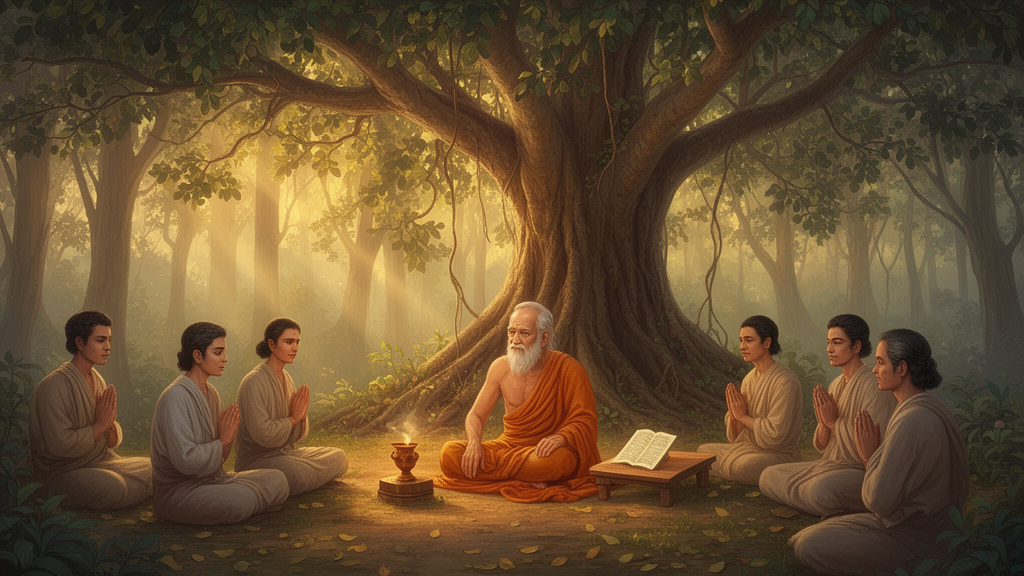
What an “Upanishad MP3” Usually Means

The word Upanishad refers to a body of philosophical and spiritual texts that form part of the Vedic literature. Traditional Hindu usage often describes the Upanishads as the concluding portions of the Vedas, which is one reason they are sometimes called Vedanta, a term that can mean the end or culmination of the Vedas as well as the philosophical school that developed from these texts. Readers should note that this etymology and the classification are traditional explanations, not disputed facts that a single source settles for everyone.
Because the Upanishads are long and written in Sanskrit, many people prefer listening to lectures or audiobooks. An audio file can be useful in three different ways:
- A lecture by a teacher who explains the text, often in a specific tradition of interpretation.
- An audiobook that reads a translation or retelling aloud.
- A chanted recitation of the Sanskrit text, which belongs to a different devotional and oral practice from a lecture.
These three forms serve different needs. A lecture explains meaning. A translation audiobook gives access to the text in another language. A recitation preserves the sound of the Sanskrit. Before you download a file, identify which of these you are getting, because the title alone often does not make this clear.
Direct Answer: Where to Find Legitimate Upanishad Audio
For reliable and clearly licensed audio, start with the organizations that publish their own lecture series and state their terms. The steps below are a practical method you can use with any site.
- Start with an organization that names the speaker, date, and text. A good listing identifies the teacher, the Upanishad covered, and when the talk was recorded.
- Read the download terms on the page. Some organizations say files can be downloaded at no charge, while others invite donations or sell certain classes.
- Check whether a file is a lecture, a translation, or a recitation. Match the format to what you want to learn.
- Look for the author, narrator, and translator. Audiobook files often credit the person who wrote the text and the person who reads it. Missing credits are a reason to be cautious.
- Respect copyright notices. A page may state that content is protected. Do not re-upload or redistribute files unless the rights holder allows it.
- Pair the audio with a text. A verified translation or commentary helps you check the speaker’s claims against the scripture itself.
The first two examples below are the strongest starting points because their pages were checked for this article and state their download arrangements directly.
Example 1: Mundaka Upanishad Lectures from Vedanta Press
Vedanta Press and Catalog, which describes itself as a DBA of the Vedanta Society of Southern California and as a 501(c)(3) non-profit, publishes an MP3 series on the Mundaka Upanishad. The product page describes the Upanishads as the foundational texts of Vedanta and calls the Mundaka Upanishad one of the most important of them. The page says the Mundaka Upanishad reveals the nature of spiritual knowledge and speaks of the spiritual glory within each person and how to realize it in daily life. That description is the publisher’s own framing of the text, so readers should treat it as an introduction to the lecture series rather than as a neutral summary of the Upanishad.
According to the page, the series consists of 12 classes delivered by Swami Prabhavananda in the mid-fifties. The page lists Class 1 through Class 12, each linked as an audio file. The publisher states that the classes can be downloaded at no charge, that donations help cover costs, and that some other classes are fee-based. The same wording appears on a second Vedanta Press listing for the Mundaka series, which suggests the publisher’s arrangement is consistent across its catalog pages.
How to Use the Mundaka Series
Because this is a 12-class lecture series, it works best as a sequence rather than a single download. A practical approach is:
- Listen to Class 1 to understand the speaker’s introduction and general approach.
- Keep a written translation of the Mundaka Upanishad beside you, so you can locate the passages being discussed.
- Note the terms the speaker uses, such as knowledge, self, and realization, and look up how a translation renders them.
- Record questions for a teacher or study group rather than treating every explanation as final.
The Mundaka Upanishad is also associated with the Atharvaveda in traditional classifications. Our guide to the Atharva Upanishad explains that Atharvaveda connection in more detail, but readers should note that the Atharva Upanishad is a different text from the Mundaka.
Example 2: Swami Krishnananda’s Audio Series on the Upanishads
The website of Swami Krishnananda has separate pages for audio lessons on the Upanishads and for the Chhandogya Upanishad. These pages organize recordings by chapter, and the Chhandogya page labels each section with a text download option, which shows that the site pairs many of its recordings with written material.
The Chhandogya Upanishad page lists chapters and sections, including Chapter 1 on the Vaishvanara Vidya and Chapter 2 on Uddalaka’s teaching about the oneness of the self, followed by a Chapter 3 on Sanatkumara’s instruction on Bhuma-Vidya. Each entry is listed with a sequence number and a link labeled Text Download. This chapter-based structure is useful because you can follow a text section by section.
The Lessons on the Upanishads page lists chapters that cover general introduction, preparation for Upanishadic study, and individual Upanishads such as the Isavasya, Kena, Taittiriya, Mandukya, Aitareya, Katha, Brihadaranyaka, and Chhandogya. The listing we reviewed was cut off partway through the chapter list, so readers should open the page directly to see the complete set of lessons.
The same site’s menu also includes entries such as Commentary on the Mundaka Upanishad, The Essence of the Aitareya and Taittiriya Upanishads, and The Brihadaranyaka Upanishad. These are listed as site sections, but the review for this article did not confirm the audio format or availability of each one. Check the individual page before assuming an audio file exists.
Why Chapter Order Matters
Many Upanishad lectures build on earlier passages. In the Chhandogya listing, the first chapter is followed by teaching on the self and then by instruction on a specific vidya, or form of knowledge. Listening in order helps you see how a teacher connects one idea to the next. Jumping to a famous section without context may leave you with a fragment of a teaching rather than its argument.
Example 3: Third-Party Audiobook Listings and How to Check Them
Not every upanishad mp3 result comes from a teaching organization. Some file-hosting pages and archive listings collect audiobooks, and these can be useful, but they require more checking. During research for this article, a public directory page under an Upanishads audiobook folder listed a file titled as an introduction to the 108 Upanishads, with the author and narrator named in the file title and a file size of 342.6 MB. The page showed a folder for The Thirteen Principal Upanishads as well. The listing did not show the translation, publisher, or permission for redistribution in the content we inspected, so the file’s rights status is unverified.
A separate Internet Archive item with a title suggesting a translation of the Upanishads was also reviewed. The text captured during inspection was mostly site navigation, so its contents, narrator, translation details, and license could not be verified from that capture. Treat such listings as leads to check, not as confirmed sources.
A Checklist for Third-Party Files
- Is the author or translator named? A named translator lets you compare the text with other translations.
- Is the publisher clear? A publisher’s imprint or institutional page is a stronger signal than an anonymous upload.
- Is the license stated? Look for a clear statement of rights rather than assuming a file is free to share.
- Does the file match the title? Check whether the audio covers the full text, a summary, or a single chapter.
- Is there a text companion? A reading edition makes it easier to verify the audio.
If you cannot identify the rights holder or license, consider a library, an official publisher, or a teaching center instead. Downloading unauthorized copies of protected recordings can harm the people who produced them, including teachers, narrators, and small publishers.
What the Upanishads Are, Before You Press Play
An audio lecture is an interpretation of a text, and the text itself is a separate object of study. Keeping the two apart helps you read any teacher more critically. The Upanishads are usually discussed as philosophical and meditative texts in prose and verse, many of them prepared for study in teacher-student settings. They explore questions about the self, the ultimate reality, knowledge, and liberation, though different Upanishads emphasize these themes differently.
Scholars, teachers, and traditions often distinguish among several layers:
- The text, meaning the Sanskrit or a translation of what the Upanishad says.
- Traditional commentary, such as the explanations written by later teachers within a particular school.
- Modern lectures and interpretations, which may explain the text for contemporary listeners.
- Devotional or community practice, which can use the Upanishads in prayer, study, or chanting.
An audio file may mix these layers. When a speaker says what a passage means, ask whether the speaker is quoting the text, explaining a traditional commentary, or offering a personal interpretation. The Vedanta Press description, for example, frames the Mundaka Upanishad through a particular Vedanta vocabulary, which is a useful lens but still an interpretive lens.
Traditions and Interpretations Differ
Hindu traditions do not all read the Upanishads in the same way. Some schools of Vedanta read them as central to understanding the nature of reality and the self, while other Hindu groups emphasize ritual, devotion to a personal deity, or regional practices. A lecture from one tradition may use terms that another tradition would explain differently. This is not a flaw in the audio; it is a reason to identify the speaker’s tradition.
When comparing lectures, notice whether the speaker presents one view as the only possible reading. Good teachers often mention alternative interpretations, but audio files do not always make this clear. If two teachers seem to disagree, compare the passage in a translation and see whether the difference comes from translation choice, commentary tradition, or the speaker’s own emphasis.
Several Upanishad pages on HindusGod.com cover this variety of traditions and texts. Our overview of the meaning of Upanishad explains the word and its scope, while our page on the Advaita Upanishad discusses one term and its association with nondualist interpretation. Readers interested in a different orientation can explore the Ashtavakra Upanishad or the Adhyatma Upanishad, each of which needs its own source-based treatment.
How Many Upanishads Are There?
The number of Upanishads depends on the source. The Thirteen Principal Upanishads is a common phrase in popular and academic usage, and a folder title on one audiobook directory used the same phrase. Traditional lists also include a larger number, and the file listing we reviewed refers to 108 Upanishads in a title. These counts describe different collections and should not be treated as interchangeable.
For a listener, the practical point is this: check which list an audio series or book covers. A recording called The 108 Upanishads may introduce many texts briefly, while a series on the Mundaka or Chhandogya goes deeply into one. Our 108 Upanishad page and our 10 Upanishad page can help you compare how different collections are described, once those pages are published and checked.
A Beginner’s Listening Path
If you are new to the Upanishads, a single long series can feel overwhelming. The following sequence is a practical approach rather than a traditional curriculum:
- Begin with an overview. Listen to an introductory lecture or read a short guide to what the Upanishads are and how they relate to the Vedas.
- Choose one Upanishad. The Mundaka and Chhandogya series discussed above are useful because each is organized by class or chapter.
- Get a translation. Use a reading edition that names its translator, so you can check words and passages.
- Listen in order. Follow the chapter or class sequence to see how the argument develops.
- Take notes. Write down terms you do not understand, such as Brahman, atman, or moksha, and look up how the speaker and translator define them.
- Compare one passage. When a lecture explains a passage, read the same passage in another translation and note differences.
This method works whether you use a free lecture, a donation-supported class, or a library audiobook. It also helps protect against a common problem with audio learning, which is hearing a confident explanation without seeing the text it explains.
Sanskrit Terms in Context
Audio lectures often use Sanskrit words without stopping to define them. Four terms appear frequently in Upanishad discussions, though their meanings can vary by translator and tradition:
- Upanishad is the name of the text genre and of individual works. Its traditional sense is often linked to sitting near a teacher, though this etymology is one traditional explanation and should be presented as such.
- Vedanta refers both to the Upanishadic texts and to the later philosophical schools that interpret them.
- Brahman is commonly rendered as ultimate reality, but translators differ in how they explain it.
- Atman is commonly rendered as the self, and interpretations of its relation to Brahman differ across schools.
When a lecture uses these terms, pause and ask how the speaker defines them. A reliable teacher will usually explain the term in the context of the passage rather than merely assuming the listener knows it.
Practical Tips for Using Upanishad Audio
- Use headphones in a quiet place if you want to follow a lecture closely, especially on longer series.
- Keep the text open on a device or in print so you can follow references to section or class numbers.
- Store files carefully. Name them by series, class number, and speaker so you can find them later.
- Respect donation requests. When an organization says it accepts donations to cover costs, consider supporting it if you use its recordings regularly.
- Do not treat audio as a substitute for discussion. A study group, teacher, or local community can help you question and understand difficult passages.
Frequently Asked Questions
Are Upanishad MP3 lectures free?
Some are. The Vedanta Press listing for the Mundaka Upanishad lectures states that the classes can be downloaded at no charge, and it invites donations and mentions fee-based classes in its catalog. Other sites may use different terms, so check each page before downloading.
Is an audiobook of the Upanishads the same as the original text?
No. An audiobook is usually a translation, a retelling, or a reading of a translation. If you want to study the Sanskrit, look for a reading edition that includes the original text, transliteration, or a clearly identified translation.
Should I trust every audio explanation?
Not automatically. Identify the speaker’s tradition, compare explanations with a translation, and note whether the speaker is quoting the text, explaining a commentary, or giving a personal view.
Can listening to Upanishad audio replace reading or teaching?
Audio can support study, but it is most useful alongside a text and, where possible, guidance from a teacher or study group. Upanishadic study has traditionally been discussed in teacher-student contexts, and many modern readers still benefit from discussion.
Summary and Next Step
An upanishad mp3 can be a valuable way to study the Upanishads when the source is clear. Look for named speakers, stated download terms, chapter or class structure, and a companion text. The Vedanta Press Mundaka Upanishad series and the Swami Krishnananda audio lessons on the Upanishads and Chhandogya Upanishad illustrate what a well-organized listing can look like. Third-party audiobook files may be useful too, but their translation, narrator, and rights should be verified before use.
Your next step is to choose one Upanishad, find a verified translation, and listen to the first class or chapter with the text open. Then compare the explanation with the passage itself and with another reading. This method builds understanding and keeps the audio tied to the tradition and the text it explains.
Sources and Further Reading
- Vedanta Press and Catalog, MP3 Mundaka Upanishad Lectures: used for the description of the Mundaka series, the 12-class structure, the speaker and recording period as stated, and the download and donation terms.
- Vedanta Press and Catalog, Subject Listing for MP3 Mundaka Upanishad Lectures: used as a second listing showing the same series description and terms.
- Swami Krishnananda, The Chhandogya Upanishad Audios: used for the chapter structure and text-download labels on the Chhandogya audio page.
- Swami Krishnananda, Lessons on the Upanishads Audios: used for the chapter list of the Lessons on the Upanishads series. The listing was truncated in the review.
- SpiritMaji Files, Audio Books/Upanishads directory: used only to show that a file listing exists under this folder. Rights, narrator, and translation were not verified.
- Internet Archive, The Upanishads, Pure Vedic Spirituality (translation As It Is Audiobook): listed as an item to verify. The captured page content was mainly site navigation, so its contents and license were not confirmed.