The Upanishads are the concluding portions of the Vedas, and they are the basis of the tradition called Vedanta. For students, they offer a set of philosophical dialogues about the self, ultimate reality, and freedom from ignorance. This guide explains what the Upanishads are, which texts a beginner can approach first, the main ideas students meet, and how to study them responsibly. It also marks where a claim comes from a specific text, a commentary, a translation, or modern scholarship.
Quick answer: what an Upanishad is for a student

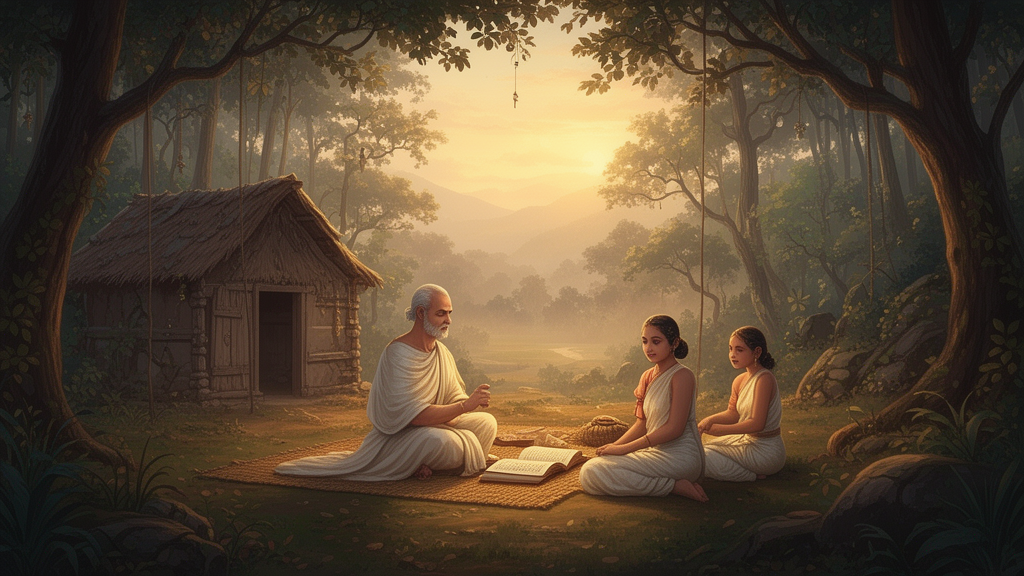
An Upanishad is a short prose or verse text that explores questions such as who I am, what the Self (Atman) is, and what ultimate reality (Brahman) is. The word is commonly explained as “sitting near” a teacher, and the texts are presented as teacher-student dialogues. The Vedapath Upanishads collection describes them as the concluding portions of the Vedas, known as Vedanta, meaning “the end of the Vedas.”
For a first reading, a student can start with a principal (Mukhya) Upanishad, read a summary alongside a translation, and focus on one theme at a time. Students who want a short, guided entry can use a selection of passages edited for young readers, as discussed below.
What the Upanishads are and where they sit in the Vedas
Scripture within the Vedic tradition
The Upanishads are generally treated within Hinduism as part of the Veda, and many Hindu traditions regard them as śruti, revealed scripture. That status is a belief held within the tradition, not a finding a reader can verify by historical evidence alone. The Upanishads themselves are texts, and their origins, dates, and compilation are discussed by historians and Indologists in ways that differ from traditional accounts. Students should keep the textual, devotional, and scholarly questions separate.
Why the phrase “end of the Vedas” matters
The Vedapath page explains that the Upanishads form the closing portion of Vedic literature and are called Vedanta. This is more than a label. Many Vedic ritual texts focus on sacrifice and its procedures. The Upanishads often reinterpret ritual symbols as pointers to inner knowledge. The Vedanta Students summary of the Upanishads, Part 1 describes ritual imagery as something to be read for its inner meaning, a reading that is central to many Upanishadic passages but is presented by that summary as its own study approach rather than as the only reading.
Principal and later texts
The Vedapath collection notes that the Mukhya (principal) Upanishads were recognized by Adi Shankaracharya, and it also lists later groups, including Yoga, Shaiva, Sannyasa, and Shakta and Vaishnava Upanishads. The same source presents the total as 60 texts. The traditional count is different: the Vedanta Students summary refers to 108 traditional Upanishads, while noting that its own study set covers 23 major and minor texts. Students will meet different numbers in different editions, and no single count should be treated as the only correct one.
Why students read the Upanishads
A useful way to see what the Upanishads offer students is to look at a selection made with young readers in mind. The Vedanta Society of Northern California describes Upanishads for Students, edited by Swami Atmashraddhananda and published by SRK Math, Chennai, as a small selection of important Upanishadic passages made especially for young people. According to that page, the book provides original Devanagari script, transliteration, English translation, and comparable passages from Swami Vivekananda’s works.
The Vedanta Press catalog entry for the same book, Upanishads For Students, adds detail about its structure. It describes two short introductory chapters on the relevance of the Upanishads for students and on some facts about them, followed by ten chapters on aspects of spiritual life. Its examples include “The Magic of Sincere Seeking,” “Taming the Mind,” and “Unity in Diversity.” It states that each verse is followed by a commentary by Swami Vivekananda taken from The Complete Works, and that the book is intended for teenagers and young adults.
This structure shows an important distinction. The verses are the Upanishadic text as presented in the edition. The commentary is by Swami Vivekananda, a modern teacher whose interpretation is one lens within the Vedanta tradition. A student who quotes the book should say which part is scripture and which is commentary.
Strength, discipline, and purpose
The catalog describes the book as organized around strength of mind, living a great life, and enriching relationships. These are the editors’ selected themes, not a universal summary of the Upanishads. Students who read the whole Upanishadic corpus will find more difficult metaphysical arguments, ritual symbolism, and discussions that are not aimed at young readers. The selection is a practical starting point, not a complete introduction.
Which Upanishads should a beginner read first?
No single order is fixed across all traditions, but the sources suggest a sensible approach. The Vedanta Students study page presents a broad survey of 23 texts and suggests that a reader begin with an overview before moving to individual texts. Its general method is to skim the summaries first, then choose one Upanishad each week for focused reading.
Principal texts with clear summaries
The Vedanta Students list of Upanishads includes the Aitareya, Chandogya, Kena (also spelled Keno), Isha (also called Ishavasya), Brihadaranyaka, Katha, Taittiriya (also spelled Taittriya), Prasna (also spelled Prasno), Mundaka (also spelled Mundak), Mandukya, and Svetasvatara Upanishads, among others. These spelling variations are common, and students should choose one transliteration system for notes and search.
The Vedanta Students summary describes the Chandogya and Brihadaranyaka as among the oldest and most profound metaphysical dialogues in the set. It also describes Katha, Taittiriya, and Mundaka as practical guides. Readers should note that these are study-guide descriptions, not academic classifications, but they give a useful orientation.
Shorter texts for focused practice
The Vedapath collection includes shorter texts that can be read in one sitting. For example, it describes the Adhwayataraka Upanishad as a terse synthesis of yogic discipline and Vedantic liberation, associated with the Atharvaveda and counted among the Yoga Upanishads, with 19 verses. It describes the Adhyatma Upanishad as a concise Vedantic treatise with 70 verses, focused on inward self-knowledge. A student can use these brief texts to practice reading a complete argument before taking on longer works.
Once a student has the basic vocabulary, this site’s draft guides can help as companion reading. These are not yet confirmed as public pages. Readers can explore the meaning of Upanishad, the 108 Upanishad overview, and the Adhyatma Upanishad guide when those pages are live. The owner should confirm that these destinations are published before the post goes live.
The core ideas students meet
Atman and Brahman
Two terms appear across the Upanishads. Atman usually means the Self, the innermost reality of a person. Brahman usually means ultimate reality. The Vedapath summary describes the Upanishads as exploring the nature of the Self, ultimate reality, the relation between the individual and the cosmos, and the path to liberation, moksha. The Vedanta Students summary states that a common theme is the identity of individual consciousness with ultimate reality.
This identity is an interpretive position, central to the Advaita Vedanta reading associated with Adi Shankaracharya and his commentaries. Other Vedanta schools and other Hindu traditions read the relation between individual self and ultimate reality differently. Students should therefore say “in the Advaita reading” or “in many Vedantic interpretations” when discussing non-dual identity. A complete account of Hindu philosophy requires attention to several schools, not only one.
Liberation and the removal of ignorance
Many Upanishadic summaries describe liberation as freedom from ignorance and from the cycle of rebirth. The Vedanta Students summary describes moksha as the realization of the Self. The Vedapath entry for the Adhyatma Upanishad describes bondage as arising from superimposition, a mistaken identification of the self with body, senses, and mind, and liberation as knowledge that removes that ignorance. These are presented as the text’s argument as summarized by those sources. Students should read the original passages with a translation before accepting a summary.
Mahavakyas, or “great sayings”
Students often meet short statements called mahavakyas, or great sayings. The Vedanta Students summary lists mahavakyas among practical tools and gives the example prajnanam brahma, translated there as “Brahman is perfect knowledge.” The summary associates this statement with the Aitareya Upanishad. Readers should look for the verse in a reliable edition, since summaries can differ on translation and placement. Translators often render such statements differently, and a student should compare two or three versions.
Inner meaning of ritual
A recurring teaching in Upanishadic summaries is that ritual images can be read as pointers to inner states. The Vedanta Students summary asks readers to treat ritual symbolism as a guide to consciousness. The Vedapath entry for the Adhyatma Upanishad describes a reinterpretation of sacrifice as an inner offering of ego, desire, and doership. This is a major theme, but it does not mean that Hindu communities have abandoned temple worship, festival rites, or household practice. Many traditions hold both ritual and inner knowledge as meaningful, and students should avoid presenting the inner reading as the only valid one.
Study, discipline, and teacher
The Upanishads are presented as dialogues shaped by teaching. The Vedapath entry for the Adhyatma Upanishad describes a progression of hearing, reflection, and contemplation: śravaṇa, manana, and nididhyasana. This pattern shows why the Upanishads were studied in the company of teachers and why a student benefits from guidance. Reading alone is possible, but a teacher helps clarify technical terms and differing interpretations.
A practical study plan from the sources
The Vedanta Students study approach offers a clear method for beginners. It is one suggested method, not the only one used in Hindu education, but it is simple to follow.
- First pass: Skim the summaries of several Upanishads to see the overall map.
- Daily routine: Spend about 20 to 40 minutes on reading, reflection, and note-taking. The source suggests 5 to 10 minutes of reading, 10 to 20 minutes of meditation on one verse or practice, and 5 to 10 minutes of journaling.
- Weekly focus: Choose one Upanishad, read it carefully, and write one or two insights.
- Verse memory: Memorize a short key statement, such as a mahavakya, and reflect on it briefly each day.
- Compare translations: Read the same passage in two or more editions and note where the wording differs.
The booklet discussed above suggests a similar pattern: read the original script, transliteration, and translation together, then read the commentary. Students who use this method should keep their notes divided into text, commentary, and personal reflection.
Traditions, translations, and scholarship
Different traditions read the texts differently
The Upanishads are shared by many Hindu traditions, but interpretations differ. Advaita Vedanta, Vishishtadvaita, Dvaita, and other schools read key terms in different ways. Bhakti traditions may emphasize devotion to a personal deity, while some Yoga-oriented or Shakta texts describe practices and goals in ways that differ from the principal Upanishads. Students should identify the tradition behind a commentary before treating it as a general statement.
Translation is interpretation
An English translation of a Sanskrit Upanishad always involves choices. Terms such as Atman, Brahman, moksha, and mahavakya are often left in transliterated form because no single English word carries the full meaning. Students should read the translator’s introduction, check the glossary if one is available, and note where a translation gives an interpretive paraphrase. The Vedanta Press catalog’s description of verses in Devanagari, transliteration, and English translation is useful because it shows the original alongside the rendering.
Historical study and devotional reading
Devotional and historical approaches can both be valid, but they answer different questions. A devotional reader may ask how a text guides prayer, meditation, or daily conduct. A historian may ask when and where a text took its present form, how manuscripts differ, and how the text was received in different periods. The Vedapath and Vedanta Students pages describe the Upanishads from within the tradition, and they should be read with that in mind. Students who need historical dates should consult academic editions and specialist works rather than relying on general websites.
Counting the texts
Students often ask how many Upanishads exist. The answer depends on the source. The Vedapath page lists 60 texts. The Vedanta Students summary refers to 108 traditional Upanishads, and its study set covers 23. Editions and collections may also group texts differently. A student writing a report should name the collection being used and avoid presenting one count as universal.
Common misunderstandings
- “The Upanishads reject all ritual.” The sources describe a reinterpretation of ritual as inner meaning. They do not describe the abandonment of all practice in every community.
- “Every Hindu follows the Upanishads in the same way.” Many Hindus draw on the Upanishads, but practice and belief vary by region, family, sect, and devotional path.
- “A short summary is the same as the text.” Summaries help orientation, but students should check the passage itself and a reliable translation.
- “The Upanishads are only for scholars.” Selected editions are prepared for young readers, but the full corpus can be demanding and is best approached gradually.
Frequently asked questions
Are the Upanishads the same as the Vedas?
No. The Upanishads are generally presented as the concluding portion of the Vedas, known as Vedanta, while many earlier Vedic texts focus more on hymns, rituals, and sacrifice. The Vedapath source describes the Upanishads as the culmination of Vedic thought.
Which Upanishad should a student read first?
A student can begin with a shorter text or a student-oriented selection, then move to longer principal texts. The Upanishads for Students booklet is one option because it includes verses, transliteration, translation, and commentary. Students who prefer a survey can start with the Vedanta Students overview.
Do I need Sanskrit to read the Upanishads?
No, but Sanskrit terms are easier to understand when the translator explains them. Learning core terms such as Atman, Brahman, moksha, and mahavakya helps a student read translations more accurately.
Why do different books show different spellings?
Sanskrit names are transliterated in different systems. Kena and Keno, Prasna and Prasno, and Mundaka and Mundak all appear in study sources. Students should choose one spelling for their notes and recognize the variants when searching.
Takeaway for students
The Upanishads invite students to ask careful questions about the Self, reality, ritual, and freedom. A good way to begin is to read one short text slowly, compare translations, identify the commentary, and write down a single insight. Students should keep scripture, tradition, commentary, and modern interpretation distinct. That habit makes the study more accurate and more personal.
Sources and Further Reading
- Vedapath, Upanishads in English: used for the description of the Upanishads as the concluding portion of the Vedas, the list of 60 texts and categories, the attribution of the principal Upanishads to recognition by Adi Shankaracharya, and summaries of the Adhwayataraka and Adhyatma Upanishads.
- Vedanta Students, Upanishad: used for the list of Upanishad titles and study materials in the Vedanta Students collection.
- Vedanta Students, Summary of 108 Upanishads Part 1: used for the description of the study set, common themes, the mahavakya example, the suggested study routine, and the statement about traditional 108 Upanishads.
- Vedanta Society of Northern California, Upanishads for Students: used for the description of the student selection, its editor, publisher, script and translation features, and inclusion of Vivekananda passages.
- Vedanta Press and Catalog, Upanishads For Students: used for the book’s structure, chapter themes, commentary format, and intended readership.
Internal references for later review (draft targets; URL to confirm publication status): Meaning of Upanishad, 10 Upanishad, 108 Upanishad, Adhyatma Upanishad, Advaita Upanishad, Aitareya Upanishad, Atmabodha Upanishad, Ashtavakra Upanishad.